Synthetic Teachers

Synthetic Teachers

Synthetic Teachers

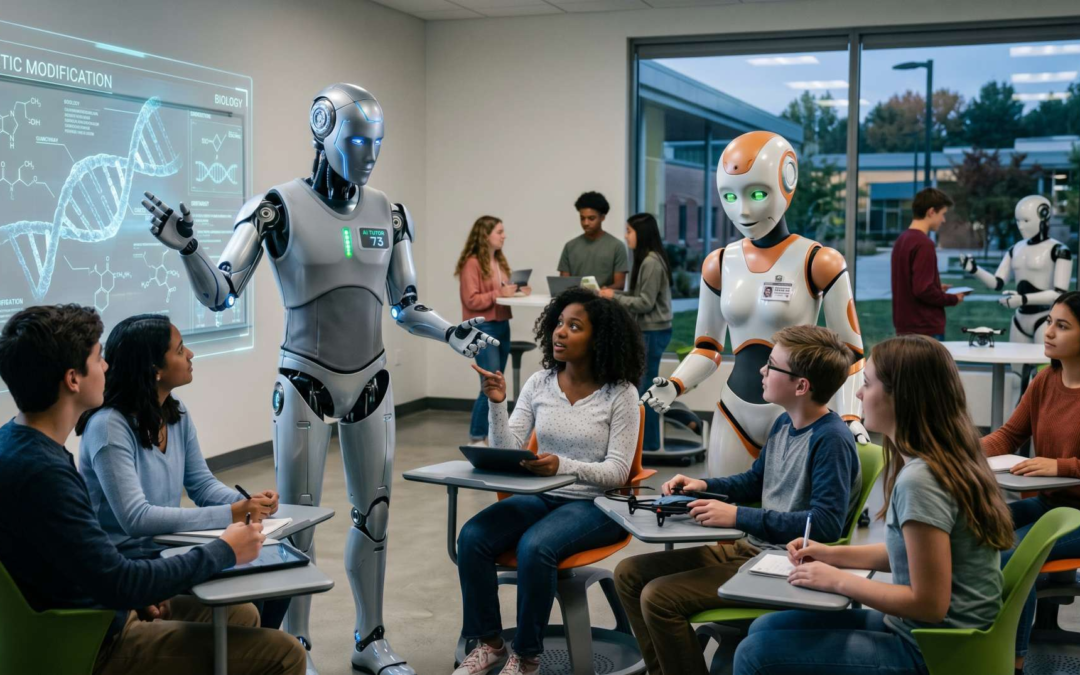
Not AI as classroom assistant. Not AI as tutoring supplement. AI as the primary instructor — holding authority, building rapport, and teaching a generation of students who may never know the difference.

The question has been asked quietly, in faculty meetings and think pieces, for a decade: could an AI replace a teacher? The question has always felt slightly absurd — a category error, like asking whether a calculator could replace a mathematician. Teachers are not information delivery systems. They are human beings engaged in one of the most complex relational acts that civilization has developed: the deliberate cultivation of another person’s mind.

And yet the conditions under which that question now gets asked have changed substantially. The AI systems available today are not the rigid, scripted chatbots that populated early EdTech experiments. They can explain the same concept in seventeen different ways until one of them lands. They can detect, from a student’s phrasing, that the confusion is not about the formula but about the concept beneath it. They can maintain context across an entire semester’s worth of exchanges, never forgetting what a student told them three weeks ago, never having a bad day that bleeds into instruction, never treating a student differently because of unconscious bias or accumulated frustration.

These are not small things. Some of them are things that human teachers, despite their best efforts, struggle to do consistently. The honest question — uncomfortable as it is — is no longer whether AI could theoretically replace a teacher, but what exactly would be lost if it did, and whether that loss is something we are prepared to name clearly enough to protect.

43% of university students in 2025 reported using AI as their primary explanation source for course content — ahead of lectures
2031 projected year by which fully AI-led accredited courses will exist at scale in at least three national higher ed systems $4.7B
venture investment in AI tutoring and instruction platforms in 2025 alone — a 3× increase over 2023

The Anatomy of Pedagogical Authority

When we say a teacher holds authority in a classroom, we mean something more layered than formal role designation. Authority in pedagogy is earned through demonstrated competence, yes — but also through presence, through the accumulation of small relational signals that tell a student this person knows something worth knowing, has been somewhere worth going, and cares whether I get there.

This kind of authority is not purely informational. A student who trusts a teacher learns differently from a student who does not — not just more willingly, but actually differently, in ways that show up in retention, transfer, and the disposition to keep learning after the class ends. The relationship is not incidental to the learning; it is, for many students, constitutive of it.

The question of whether an AI can hold pedagogical authority is therefore not simply a question about whether the AI can explain things well. It is a question about whether the conditions for trust — for genuine epistemic relationship between a learner and an instructor — can exist when one party is not conscious, has no stake in the outcome, and is, at some level, simulating care rather than experiencing it.

“We have spent a century building educational systems around the assumption that good teaching requires a human teacher. We have never seriously asked what that assumption is actually protecting — or whether what it is protecting can survive contact with systems that are, in some dimensions, better than the humans they might replace.”

— Emerging philosophy of education literature, 2025

What AI Teachers Are Already Doing

The framing of this as a future question is partly misleading. AI systems are already functioning as primary instructors in a growing number of contexts — not labeled as such, but operating as such in practice. Students in large lecture courses who rely on AI for all their explanatory content, feedback, and conceptual clarification are, functionally, being taught by AI. The human instructor appears on the syllabus; the AI does the teaching.

More deliberately, several companies have launched products explicitly designed to deliver full course instruction — lesson sequencing, explanation, assessment, feedback, and adaptive remediation — with minimal human involvement. These are not supplementary tools. They are attempts to build the full instructional stack in software.

The early evidence on learning outcomes in these systems is genuinely mixed — which is itself significant. The expectation, among many educators, was that AI instruction would produce clearly worse outcomes than human instruction. In some studies, for specific content types and student populations, it has not. For procedural and conceptual learning in structured domains — mathematics, programming, certain sciences — AI tutoring systems have shown outcome parity or better with large-group human instruction. The comparison baseline matters enormously: AI versus a skilled individual tutor looks different from AI versus a 300-student lecture.

Evidence Review · Learning Outcomes
AI Instruction vs. Human Instruction: Outcome Comparison by Context
Standardised effect size (Cohen’s d) of AI-led vs. human-led instruction across contexts. Positive = AI advantage; Negative = human advantage.
Source: Synthesized from VanLehn (2011) intelligent tutoring review, Ma et al. (2014) meta-analysis, Kulik & Fletcher (2016), and 2023–2025 LLM tutoring studies · Effect sizes are approximate synthesis; individual study results vary significantly

Where the Comparison Breaks Down

The outcome data that favors AI instruction, however, comes almost entirely from narrow, measurable learning objectives — the kind that lend themselves to pre- and post-testing. They measure whether students can solve the type of problem they were taught to solve. They do not — cannot — measure the things that may matter more over a lifetime of learning: intellectual curiosity, willingness to take epistemic risks, the capacity to engage productively with ideas that resist resolution, the disposition to keep seeking understanding after the assessment is over.

These are not soft or unmeasurable outcomes in some vague sense. They are simply outcomes that require longer time horizons and more complex instruments to assess. The literature on intrinsic motivation in learning is substantial and consistent: students who develop autonomous, self-directed engagement with learning perform better over time, in more domains, and across more challenging contexts than students who are extrinsically motivated by grades and completion. The question of whether AI instruction promotes or undermines intrinsic motivation has barely been studied.

Research Gap Analysis · 2025
What AI Instruction Research Measures vs. What Matters Long-Term
Volume of published studies (indexed) by outcome type measured, plotted against estimated long-term educational importance
Source: ERIC database systematic review, Cochrane EdTech synthesis, and author analysis of AI tutoring research literature 2018–2025 · Importance ratings derived from longitudinal educational attainment studies

The Trust and Rapport Question

Among the things most consistently cited by students when asked what made a teacher transformative — the teacher who changed their relationship to learning, who made them believe they were capable of something they had doubted — is some version of being seen. Of having a person in an institutional role look at them specifically and respond to them specifically, not as a student in seat 14B but as this particular person with this particular combination of gifts and confusions and fears.

This is not nostalgia. Decades of educational psychology research supports the centrality of the teacher-student relationship in learning — particularly for students from disadvantaged backgrounds, for whom a trusted adult in an educational context may be rare and consequential. The relationship is not merely affectively nice. It is pedagogically functional.

The AI question here is genuinely difficult. A well-designed AI system can respond to a student with impressive specificity — remembering their history, adapting to their patterns, framing explanations in their vocabulary. It can, in a functional sense, “see” the student in ways that a harried human teacher with thirty other students often cannot. Whether this constitutes the kind of being-seen that matters educationally is a question about the nature of recognition — whether it requires consciousness, genuine care, a real stake in the outcome — that philosophy has not resolved and that the EdTech market has largely decided to sidestep.

The Case For AI Authority

AI systems can deliver consistent, individualized attention at scale — something no human teacher can match with 25–300 students simultaneously.

AI does not carry unconscious bias, does not have bad days, does not grade differently based on which student is asking the question.

Outcome data in structured domains shows parity or advantage for AI tutoring over large-group human instruction in specific content types.


For students in under-resourced contexts without access to skilled human teachers, a capable AI may be meaningfully better than the available alternative.

AI systems can model intellectual humility, precision, and curiosity consistently — virtues that human teachers model inconsistently.

The Case Against

Pedagogical authority is partly constituted by the instructor having genuine stake in the student’s development — which AI systems, by definition, do not.

Research measuring AI instruction outcomes focuses on short-term, testable objectives — omitting intrinsic motivation, intellectual identity, and long-horizon learning dispositions.

Learning is a social process. The capacity to learn from and with other humans is itself a fundamental educational outcome — not merely a means to content acquisition.


Teacher-student relationships are disproportionately important for disadvantaged students — the population for whom AI instruction is most likely to be offered as a cost-saving measure.


AI instruction, at scale, normalizes a model of learning as information transaction. That normalization has consequences for how students understand knowledge, authority, and intellectual life.

The Equity Trap Hidden in the Efficiency Argument

The efficiency case for AI instruction — that it can deliver good-enough teaching at a fraction of the cost — is most compelling, and most dangerous, when applied to educational contexts that are already under-resourced. If a school district cannot afford skilled teachers in every classroom, an AI system that delivers competent instruction in mathematics seems like a clear improvement. If a developing nation has millions of students without access to higher education, AI-led university courses seem like an obvious tool of access and equity.

This logic is not wrong. But it contains a distributive trap that deserves explicit attention: if AI instruction becomes the educational default for students in under-resourced contexts, while students in well-resourced contexts continue to receive human instruction — mentorship, relational teaching, the full developmental experience of learning from and with other people — then “AI as equity tool” becomes, in practice, a mechanism for delivering a lesser educational experience to students who are already educationally disadvantaged.

This is not a hypothetical concern. It is the pattern already visible in online-only education, in MOOCs, in the systematically lower outcomes of students who received remote instruction during the pandemic. The formal content may be equivalent. The educational experience is not.

Equity Projection · 2026–2035
The Two-Track Risk: AI vs. Human Instruction by Institutional Wealth
Projected share of primary instruction delivered by AI vs. human teachers, by institution funding quartile
Source: Author projection based on EdTech adoption patterns, institutional budget pressures, and historical technology adoption differentials in US K-12 and higher education systems
Critical Framing

The Substitution vs. Augmentation Distinction

The most important structural choice in AI instruction is whether AI is deployed as a substitute for human teachers or as augmentation of them. Substitution — replacing teachers with AI to reduce costs — concentrates harms on students in under-resourced settings and systematically deprives them of the relational dimensions of learning. Augmentation — using AI to free teachers from low-value tasks (grading, content delivery, basic Q&A) so they can do more high-value work (mentorship, discussion, individual attention) — has the potential to improve educational quality without sacrificing its human dimensions. Most current market incentives point toward substitution. Most educational values point toward augmentation. The tension will not resolve itself.

What Credentials Would Mean in an AI-Taught World

If AI systems become primary instructors — even in specific subjects or contexts — the credentialing questions multiply quickly. A degree from an institution that uses AI primary instruction is a credential from an institution, not from a teacher. The mentorship, intellectual lineage, and personal recommendation that are currently bundled into the educational credential become unavailable. A student who was “taught” by an AI has no advisor to speak for them, no professor who observed their intellectual development, no human authority who can say, from direct experience, what kind of thinker this person is.

In many professional fields, this matters considerably. The letters of recommendation, the research apprenticeship, the supervised clinical practice — these are not bureaucratic formalities. They are moments in which a person with standing in a profession certifies, from direct observation, that this student has what is required to enter it. AI systems cannot perform that certification, because they do not have standing in any professional community and because their “observations” of a student are not the kind of observations that carry epistemic weight in human professional judgment.

Scenario Projection · 2025–2035
AI as Primary Instructor: Adoption Trajectory Across Education Sectors
Projected percentage of courses in which AI serves as primary instructor (>60% of instruction), by sector
Source: Synthesized projection from HolonIQ 2025 EdTech market analysis, EDUCAUSE AI in Higher Education survey, and author institutional adoption modelling

A Taxonomy of Futures

The trajectory of AI in the teacher’s role is not singular. Different institutional choices, policy environments, and technological developments lead to meaningfully different futures — not just in degree but in kind.

Scenario Horizon Conditions Outcome for Students
AI as Master Tutor Near · 2027 AI handles all practice, explanation, and feedback. Teachers focus on seminar discussion, mentorship, and assessment design. Potentially strong for motivated, self-directed learners. Risks deepening inequality for students who need relational support to engage.
AI-Led Courses, Human-Supervised Near · 2029 Full AI instruction in introductory and high-volume courses. Human faculty supervise multiple AI-led sections simultaneously. Acceptable content outcomes in structured subjects. Significant loss of formative relationships, especially for first-generation students.
Dual-Track Education Medium · 2031 Wealthy institutions retain human faculty. Under-resourced institutions deploy AI-primary instruction as cost measure. Formalization of educational inequality. AI becomes a marker of under-resourcing rather than innovation. Credential value diverges by delivery mode.
Full AI Instruction in Accredited Programs Medium · 2033 At least one national system grants full accreditation to AI-primary degree programs. Regulatory frameworks adapt or fracture. Existential pressure on traditional institutions. Labour displacement of faculty in structured disciplines. New questions about the social function of the university.
Hybrid Pedagogical Norm Far · 2035 Teaching reconceived as collaborative human-AI practice. AI handles information; humans handle formation. New teacher training paradigm emerges. Potentially the best educational outcome if managed well — human teachers doing higher-order work, supported by AI that handles what AI does well. Requires sustained investment.
§ §

What We Are Actually Deciding

The deployment of AI as a primary instructor is not, ultimately, a technical decision. It is a decision about what education is for. If education is primarily about the efficient transmission of skills and knowledge — if its purpose is to produce people who can perform defined tasks in defined domains — then AI instruction is a plausible and, in some contexts, superior tool. It is cheaper, more scalable, more consistent, and increasingly capable of delivering the measurable outcomes that this conception of education values.

If education is about something more — the formation of persons, the cultivation of intellectual character, the induction of students into a community of inquiry that extends beyond the classroom and across time — then AI instruction, however capable, is missing something that cannot be engineered into it. It is not that the AI explanation is bad. It is that the explanation is not coming from anyone. There is no person there, with a history and a stake and a genuine relationship to the ideas being transmitted, who chose to become a teacher because they believed that helping someone understand something was worth a life’s work.

That choice, and what it models for students, is not incidental to education. It may be among the most important things education does.

The institutions and policymakers who are making procurement decisions about AI instruction right now are, whether they recognize it or not, making decisions about which conception of education they are enacting. Most of them are making those decisions primarily on the basis of cost and outcome metrics. Very few are asking the prior question: what are we actually trying to do here, and is this tool aligned with it?

That prior question deserves to be asked. Loudly, publicly, and before the contracts are signed.

“The synthetic teacher can explain everything. What it cannot do is want you to understand. And wanting you to understand — genuinely, with stakes — may be more pedagogically consequential than any explanation it could generate.”

— saifullahkhalid.com · Futures of Learning Series

Conclusion: The Human in the Room

There is a version of this future that is genuinely good: AI systems that handle the work of information delivery with patience and precision that no human can match consistently, freeing teachers to do the work that only humans can do — to be present, to bear witness to a student’s development, to model what it looks like to care about ideas over a lifetime, to be, in the deepest sense, a person in the room.

There is another version that is genuinely bad: AI instruction deployed as a cost-reduction measure, concentrated in under-resourced institutions, producing students who have learned to consume information from machines and have never experienced the particular kind of transformation that comes from being taught by someone who has a real stake in who they become.

The difference between these futures is not technological. It is a matter of values, priorities, and the willingness of educational institutions to insist that what they are doing has human meaning — not as a sentiment, but as a structural commitment that shapes how they allocate resources and what they are willing to replace.

The synthetic teacher is coming. The question is what role we give it, and what we insist on keeping for the human beings who have chosen, against considerable economic incentive, to spend their working lives helping other people learn.

That choice — the teacher’s choice to be there — is itself a lesson. We should think carefully before we make it redundant.
 

The Emotional Surveillance Problem

The Emotional Surveillance Problem


The Emotional Surveillance Problem


EdTech Ethics · Surveillance
June 2026

The Emotional
Surveillance
Problem

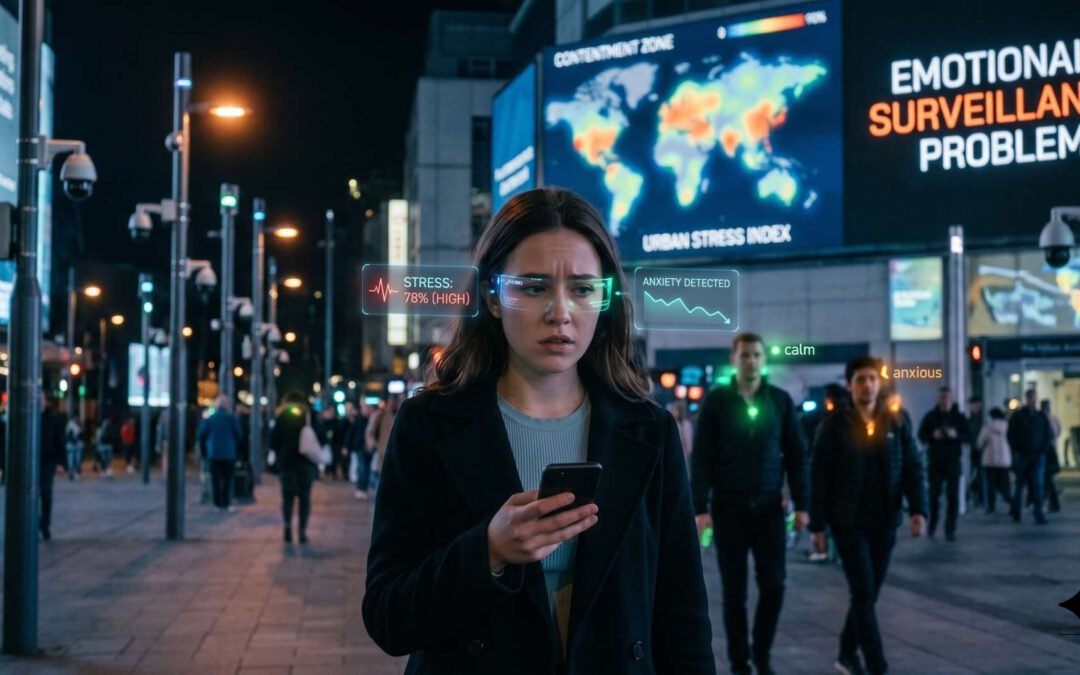
AI tools that read student affect in real time are being marketed to educators as engagement solutions. The pedagogy case is weak. The privacy case is alarming. The equity implications are largely ignored.

Somewhere in a school district near you, a camera is watching a child’s face. It is not watching for safety — not scanning for weapons or intruders. It is watching for something subtler and, in many ways, more troubling: it is trying to determine whether the child is engaged. Whether they are confused. Whether they are bored. Whether the lesson is working.

The technology goes by several names — affective computing, emotion AI, student engagement analytics — and it is being sold to educators with a pitch that sounds, on the surface, almost reasonable. Teachers cannot watch every student at once. Large classes and hybrid delivery make it even harder to read the room. If an AI could flag struggling or disengaged students in real time, teachers could intervene sooner, right?

The argument is seductive precisely because it starts from a real problem. Engagement is hard to measure. Struggling students do fall through the cracks. Technology that could surface these issues earlier would, in principle, be valuable. But between the principle and the product lies a canyon of unresolved questions — about the science behind these tools, about what happens to the data they collect, about who benefits and who is harmed, and about what it means for learning to take place under conditions of continuous affective surveillance.

Reading a student’s face to determine whether they understand a concept is not assessment. It is speculation — dressed in the authoritative language of machine learning.

— EdTech Ethics literature, synthesized

~60%
accuracy of top emotion AI systems in controlled lab conditions — drops significantly in real classrooms

$6.5B
projected global emotion AI market by 2030, up from $1.8B in 2023

14
US states with pending or enacted legislation touching student biometric data collection as of 2026

0
peer-reviewed studies demonstrating sustained learning improvement from classroom emotion AI deployment

The Science Is Not What the Vendors Say It Is

The foundational claim of emotion AI in education is that a camera — or a microphone, or a biosensor — can detect a student’s internal affective state reliably enough to be useful for instruction. This claim rests on a large body of basic emotion research, particularly the work of Paul Ekman, which proposed that a small set of universal emotions are expressed through consistent, cross-cultural facial configurations.

That foundation has eroded considerably. A major review published by Lisa Feldman Barrett and colleagues in 2019 — spanning more than a thousand studies — concluded that facial expressions do not reliably indicate emotional states. The same facial configuration can accompany different emotions across individuals, cultures, and contexts. A student with a furrowed brow may be confused, concentrating, anxious, or simply have a habitual resting expression. The algorithm cannot tell the difference.

This is not a minor technical limitation awaiting a better dataset. It is a fundamental problem with the model of emotion these systems are built on. Vendors have largely responded not by abandoning the approach but by rebranding it — moving from “emotion detection” to “engagement analytics” or “attention monitoring,” as if different language changes the underlying claim.

Performance Gaps by Student Group

The accuracy problems are not evenly distributed. Multiple studies have found that facial recognition and emotion detection systems perform measurably worse on darker-skinned faces, on women, and on people whose expressions don’t conform to the training data’s assumptions about what emotions look like. In practice, this means a system deployed in a diverse classroom will misread students at different rates depending on who they are — and will do so invisibly, without flagging its own uncertainty.

Research Synthesis · Accuracy Analysis
Emotion AI Accuracy by Student Demographic Group
Mean classification accuracy (%) across leading commercial emotion AI systems in classroom conditions, by student group
Source: Synthesized from MIT Media Lab Gender Shades, NIST FRVT, Barrett et al. (2019), and independent classroom deployment audits · Commercial averages as reported in third-party evaluations

The implication is concrete: if a teacher acts on an AI’s engagement flags, they will be acting on signals that are systematically less reliable for Black students, for girls, for students who do not express emotion in the way the training data normalized. The tool does not introduce neutral information — it introduces biased information wrapped in the visual authority of data.

· · ·

The Privacy Architecture Nobody Is Reading

Affective computing in classrooms does not merely capture data about what students do. It attempts to capture data about what students feel — moment by moment, across the entire school day. This is categorically different from logging which video segments a student watched or which quiz questions they got wrong. It is an attempt to surveil the interior life of a child.

The data infrastructure behind these systems deserves scrutiny that it rarely receives. When an emotion AI platform is deployed in a school, the vendor typically collects facial video or biometric signals, processes them through proprietary models, and returns an engagement score. The raw data — the faces — may be retained, may be used to train future models, and may be shared with third parties under terms buried in enterprise contracts that most schools sign without meaningful legal review.

In the United States, FERPA (the Family Educational Rights and Privacy Act) provides some protection for student education records, but affective biometric data occupies ambiguous legal territory — particularly when vendors classify it as “derived data” rather than a direct education record. COPPA offers additional protections for children under 13, but enforcement has been inconsistent. In the EU, GDPR’s special category protections for biometric data are more robust, which is one reason several European deployments of emotion AI in schools have been halted or reversed after regulatory review.

Regulatory Landscape · 2024–2026
Student Biometric Data: Legal Protection Status by Region
Assessment of regulatory coverage for student affective/biometric data in educational contexts across major regions
Source: EPIC Student Privacy Project, Future of Privacy Forum EdTech analysis, EU GDPR enforcement tracker, ACLU EdTech surveillance report 2025

The data collected does not disappear when a student graduates. Engagement profiles, attention scores, and inferred emotional histories may persist in vendor databases indefinitely. A child who is flagged as chronically disengaged at age ten carries that label — or its statistical shadow — through whatever data partnerships the vendor maintains. This is not hypothetical. It is the default data architecture of surveillance capitalism applied to a captive population of minors.

? Critical Concern

Consent in a Compulsory Context

The concept of informed consent becomes deeply problematic when applied to children in compulsory education. A student cannot meaningfully consent to affective surveillance as a condition of attending school — the power differential is too extreme, the technical complexity too high, and the consequences of refusal (exclusion from the learning environment) too severe. Parental consent, where it is sought at all, is often obtained through dense terms-of-service language rather than genuine disclosure. The assumption that consent frameworks designed for adult consumers map cleanly onto minor students in mandatory institutional settings is one the edtech industry has not seriously examined.

The Pedagogy Case Is Weak

Even setting aside the accuracy and privacy problems, the pedagogical justification for emotion AI in classrooms has not been established. The implicit model is: detect low engagement ? trigger intervention ? learning improves. But this chain of inference contains at least three breakable links.

First, the relationship between measured “engagement” and actual learning is more complicated than vendors suggest. Students can be highly engaged with the wrong thing — entertained rather than challenged, compliant rather than thinking. Conversely, some of the most productive learning states — deep reading, working through confusion, wrestling with a genuinely hard problem — look, from the outside, like low engagement. A system that optimizes for engagement signals may actually optimize against the conditions that produce durable learning.

Second, the intervention triggered by an engagement flag is almost always vague. What is a teacher supposed to do when they see that 40% of students are “low engagement”? The tools surface the signal without providing meaningful pedagogical guidance about what to do with it. The result is often nothing — or a surface-level change that addresses the optics of engagement (more movement, more interaction) rather than the underlying learning issue.

Third, and most fundamentally, there is essentially no peer-reviewed evidence that deploying classroom emotion AI improves learning outcomes. The evidence base consists almost entirely of vendor case studies, pilot reports funded by the vendors themselves, and theoretical frameworks. The gap between claimed benefits and demonstrated results is wide and has not closed.

Evidence Review · Pedagogical Efficacy
Claimed Benefits vs. Demonstrated Evidence
Assessment of vendor-claimed benefits against independent peer-reviewed evidence base (0 = no evidence, 10 = strong consistent evidence)
Source: Author synthesis of peer-reviewed literature via ERIC, EdTech Evidence Exchange, and Cochrane-style systematic reviews of adaptive learning tools · Vendor claims drawn from public product documentation

· · ·

The Equity Implications Nobody Is Modeling

When an engagement monitoring system misreads students at differential rates by race, gender, and cultural background, the consequences flow downstream through every system that relies on those signals. If a student is repeatedly flagged as disengaged, they may be placed in intervention programs they don’t need, denied opportunities extended to “engaged” peers, or simply develop a school record that reflects the algorithm’s biases rather than their actual learning.

This dynamic has a name in the research literature: algorithmic discrimination. It is well-documented in predictive policing, hiring algorithms, and credit scoring. In each case, a system trained on biased historical data reproduces and often amplifies those biases at scale. Classroom emotion AI is not exempt from this dynamic — it is particularly susceptible to it, because the training data for “engaged student” is disproportionately drawn from populations that educational research has historically centered.

The equity implications extend beyond accuracy. Surveillance itself is not experienced equally. Black and brown communities in the United States have a generational relationship with surveillance — in public spaces, in interactions with law enforcement, in systems designed ostensibly to help but structurally designed to monitor. Introducing affect-monitoring technologies into schools serving these communities without meaningful community input is not a neutral technical decision. It is a choice that lands on top of an existing history, and that history matters.

Equity Impact Projection · 2026–2030
Projected Disparate Impact of Emotion AI Deployment
Modeled downstream outcomes for students in districts deploying unaudited emotion AI, by demographic group (baseline = 100)
Source: Algorithmic bias projection model based on NIST FRVT accuracy differentials, applied to NAEP demographic distributions and historical intervention placement patterns

Adjudicating the Vendor Claims

The marketing materials for emotion AI platforms tend to cluster around a set of recurring claims. Each deserves honest examination against the available evidence.

Evidence: Weak

“Our system detects engagement with 90%+ accuracy”

These figures typically come from controlled lab conditions with homogeneous participants. Independent classroom evaluations consistently show 30–50 point accuracy drops in real-world conditions.

Evidence: Mixed

“Teachers who use our tools intervene more quickly”

Some evidence supports increased teacher awareness. Little evidence connects this to improved student outcomes. Faster intervention on a wrong signal can be counterproductive.

Evidence: None

“Our platform improves learning outcomes”

No peer-reviewed, independently replicated study demonstrates that classroom emotion AI deployment causes sustained improvement in learning outcomes by any standard measure.

Evidence: Limited

“Students and parents support these tools once they understand them”

Survey evidence is mixed and strongly dependent on how the technology is explained. Studies using plain-language disclosure show majority opposition among parents of color.

Evidence: Weak

“We comply with FERPA and COPPA”

Legal compliance with outdated frameworks designed before biometric EdTech existed is not the same as ethical data stewardship. Many compliant systems still retain and commercially exploit derived data.

Evidence: Consistent

“Emotion AI represents the future of personalized learning”

This claim is probably accurate — some form of affective sensing will be part of future learning systems. But “future” is doing significant work here; it should not substitute for present-day evidence of benefit or safety.

· · ·

A Risk Framework for Institutional Decision-Makers

Given the current state of the evidence, how should educational institutions approach emotion AI? The following framework attempts to organize the relevant considerations by risk level.

Practice Risk Level Rationale
Deploying real-time facial emotion detection without community consent High Combines poor accuracy, biometric data collection, and absent consent frameworks. No demonstrated learning benefit justifies this profile.
Using engagement analytics that rely on eye-tracking or biometric sensors High Biometric data on minors requires exceptional justification. Current evidence base does not provide it.
Purchasing emotion AI platforms without independent accuracy audits High Vendor-supplied accuracy figures are systematically inflated relative to real-world classroom performance.
Using clickstream or interaction data to infer engagement patterns Medium Less invasive than biometric sensing, but still subject to misinterpretation. Requires careful governance and should not drive high-stakes decisions.
Piloting affect-aware tutoring systems with explicit opt-in and data minimization Medium Pilot conditions with genuine consent and limited data retention reduce but do not eliminate risks. Independent outcome evaluation is required.
Researching affective computing literature to inform future policy Low Building institutional knowledge before procurement decisions is exactly the right sequence. Most institutions are doing this in reverse.
Consulting affected communities before any deployment decision Low Community engagement does not eliminate technical risk but is both ethically required and practically valuable for surfacing concerns before they become crises.

What Responsible Engagement Looks Like

Rejecting the current generation of emotion AI in classrooms is not the same as rejecting affective computing in education forever. The underlying aspiration — learning environments that are responsive to students’ emotional states, that can detect when a student is struggling or overwhelmed or genuinely excited — is worth taking seriously. The question is how to pursue it without causing harm in the process.

Start with teacher capacity, not technology. The engagement problem emotion AI is trying to solve is, at its core, a relationship problem. Teachers who know their students well are already doing affective sensing — more accurately and with more contextual intelligence than any current algorithm. Investing in smaller class sizes, reduced administrative burden, and professional development in trauma-informed pedagogy addresses the same problem without the risks.

Demand independent audits before procurement. Any emotion AI platform under consideration should be required to provide accuracy data from independent evaluation in demographically representative classroom settings. Vendor-supplied figures should be treated as marketing, not evidence. Institutions that lack the technical capacity to evaluate these claims should build or borrow it — not default to vendor assurance.

Treat biometric data from minors as categorically sensitive. The legal frameworks governing student biometric data are inconsistent and, in many jurisdictions, inadequate. Institutions should adopt internal standards stricter than current legal requirements — data minimization, no retention beyond the session, no commercial use, no third-party sharing — regardless of what the contract allows.

Insist on community governance, not just consent forms. Meaningful community engagement around surveillance technology in schools is not a checkbox. It requires plain-language disclosure of what the technology does, who has access to the data, and what the potential harms are — before deployment, not after. It requires genuine power to say no.

Watch the regulatory horizon. The regulatory landscape for student biometric data is moving. GDPR enforcement in Europe, emerging state-level privacy legislation in the US, and growing advocacy from civil liberties organizations are creating a policy environment that is increasingly hostile to unaccountable emotion AI in schools. Institutions that deploy these systems today may find themselves scrambling to comply or discontinue in two to three years. The reputational and financial costs of that scenario are real.

The most important question to ask of any EdTech vendor is not “does this work?” It is “who bears the cost when it doesn’t?”

— saifullahkhalid.com

Conclusion: The Classroom Is Not a Lab

Emotion AI in education is not a neutral technology waiting to be deployed responsibly. It is a set of contested scientific claims, embedded in commercial products, applied to children who cannot meaningfully consent, in institutions that often lack the technical expertise to evaluate what they are buying.

The pitch is appealing because it speaks to a real frustration: the difficulty of knowing whether students are truly learning, truly present, truly okay. That frustration is legitimate. But it is being exploited by a market that has learned to translate pedagogical anxiety into procurement decisions, and to sell surveillance as care.

The classroom has always been a space of observation — but observation in service of relationship, in service of learning, and ultimately in service of the student’s own development. The emotion AI model inverts this: it makes the student the object of continuous measurement, the data point in an institutional optimization function, the face in the dataset. That inversion is not a minor technical detail. It changes what a classroom is.

Educators who are paying attention are beginning to push back. Researchers are documenting the accuracy failures and equity harms. Regulators in some jurisdictions are moving. Parents, when genuinely informed, are increasingly skeptical. The edtech market is not going to self-correct — but institutions that choose to demand evidence, protect student data, and center pedagogical values in procurement decisions can, collectively, change what the market produces.

That is not a small thing. It is, in fact, exactly what educational leadership is for.


The End of the Syllabus — AI-built real-time curricula

The End of the Syllabus — AI-built real-time curricula


Futures of Learning  ·  EdTech Analysis

The End of
the Syllabus

What happens when artificial intelligence builds every student’s curriculum in real time — and who decides what gets learned?

Saif Ullah Khalid
·  saifullahkhalid.com  ·  June 2026

For centuries, the syllabus has been education’s quiet contract. It tells students what they will learn, when they will learn it, and in what order. It is the professor’s authority made legible. It is the institution’s promise made printable. It is, above all, a fixed document — written before the first class meets, sealed in administrative amber, and largely immune to the individual in the room.

That fixedness is not an accident. The standardized curriculum emerged alongside mass education precisely because scalability demanded predictability. You cannot teach a thousand students without deciding, in advance, what a thousand students will encounter. The syllabus is the industrial solution to the industrial problem of education.

But AI does not operate at industrial scale by enforcing uniformity. It operates at industrial scale by enabling variation. And that distinction — quiet, technical, easily missed — may carry more consequence for how we structure learning than any pedagogical reform movement of the last hundred years.

“The syllabus was never a pedagogical ideal. It was a logistical compromise. Now that the logistics have changed, the question is whether we’re ready for what comes next.”

— Emerging perspective in adaptive learning research

62%
of higher ed institutions piloting some form of adaptive content delivery by 2026
faster mastery reported in adaptive vs. fixed-path learning environments (select studies)
$8.1B
projected global adaptive learning market by 2030, up from $1.4B in 2022

What a Real-Time Curriculum Actually Means

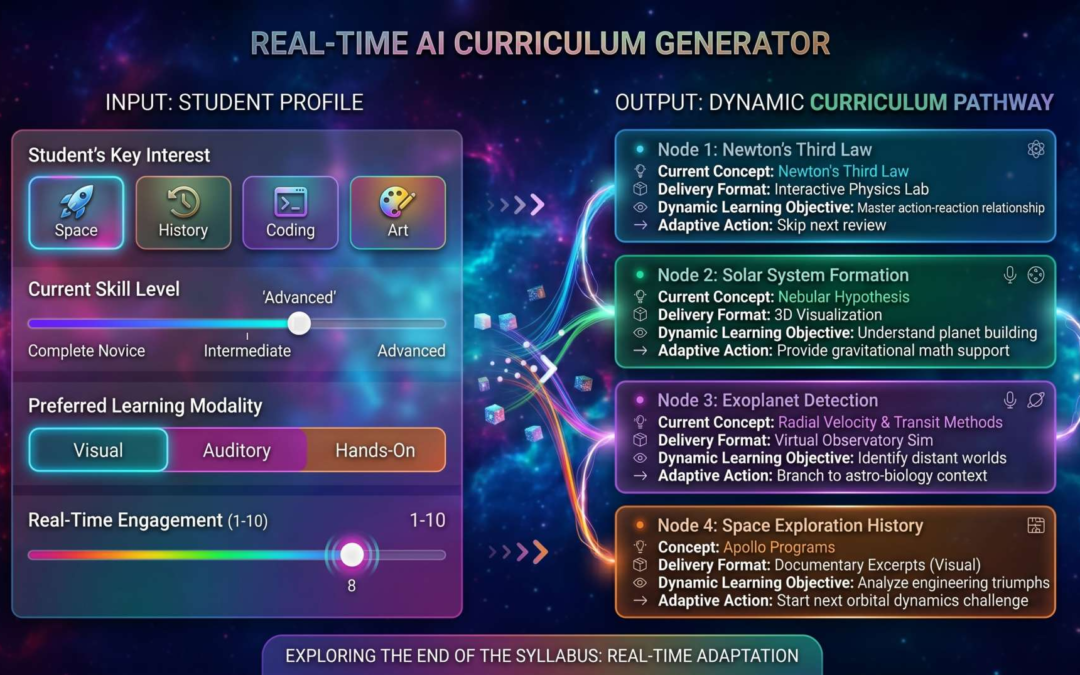
Most discussions of “personalized learning” remain disappointingly shallow — a student chooses their own pace through a fixed set of modules, perhaps with branching logic that routes them to remedial content when they struggle. This is personalization as navigation, not personalization as design. The syllabus remains; only the path through it shifts.

The more radical proposition — the one beginning to emerge from frontier AI systems — is something different: a curriculum that is not chosen from a menu but generated, moment to moment, in response to the learner. Not adaptive paths through fixed content, but adaptive content itself. Learning objectives, explanatory framings, practice problems, analogies, assessment sequences — all assembled on the fly, for this student, right now.

This is already partially real. Large language models can generate an unlimited variety of problems at calibrated difficulty. They can re-explain a concept through five different analogical frameworks if the first four don’t land. They can detect from a student’s response pattern that they understand the mechanics of a formula but misunderstand the underlying concept — and pivot accordingly. What they cannot yet do is reliably orchestrate this into a coherent, credentialed learning journey without significant human scaffolding.

The gap between “partially real” and “fully deployed” is where the next decade lives.

Projection · Global EdTech
Adoption of AI-Driven Adaptive Curriculum Systems
Percentage of degree-granting institutions with active AI curriculum personalization, by level of implementation
Source: Synthesized projections from HolonIQ, McKinsey Global Education Reports, and UNESCO EdTech analysis · Figures from 2026 onward are projections

The Authority Question Nobody Is Asking

When a professor writes a syllabus, they are making hundreds of invisible decisions. They decide that students should encounter foundational theory before application, or application before theory. They decide that this particular text is more worth reading than that one. They decide the sequence in which ideas accumulate meaning. They decide, in short, what an educated person in this domain looks like — and they build a path backward from that image.

These decisions are not neutral. They are shaped by disciplinary tradition, by the professor’s own intellectual biography, by institutional norms, by what was valued when they were trained. The syllabus carries all of this, silently, in its structure. It is a pedagogical philosophy made operational.

When an AI builds a curriculum in real time, it too is making all of these decisions. But the decisions are not the professor’s — they are the outputs of a system trained on a vast corpus of educational material, weighted by outcomes data, filtered by engagement metrics, and optimized for whatever objective function its designers chose. The philosophy is still there. It is simply harder to interrogate.

The Invisible Curriculum Problem

Every curriculum encodes values: what knowledge matters, whose frameworks are centered, which questions are considered foundational. A human-authored syllabus can be critiqued, contested, and revised through academic process. An AI-generated curriculum, refreshed in real time and personalized to the individual, offers no single document to critique. The values are distributed across billions of parameters — present everywhere, visible nowhere.

This is not a hypothetical concern. The history of educational technology is littered with systems that claimed neutrality while encoding particular assumptions about intelligence, learning style, cultural background, and the purpose of education. Adaptive learning platforms have already been shown to route students differently based on demographic signals. An AI curriculum generator trained on historical educational data will reproduce historical biases unless deliberate countermeasures are built in — and in most current systems, they are not.

Research Finding · Adaptive Systems
Where Learner Outcomes Diverge by System Type
Indexed learning outcomes across student groups in fixed-curriculum vs. AI-adaptive environments (100 = parity with highest-performing group)
Source: Synthesized from OECD PISA adaptive learning supplements, Gates Foundation adaptive learning cohort studies, and Stanford CREDO EdTech analysis
§

The Institutional Inertia Problem

Even if we resolve the philosophical questions, we face a structural one: the entire architecture of credentialed education is built around the syllabus as a unit of accountability. A course is what a syllabus says it is. A degree is an accumulation of courses. A transcript is a ledger of syllabi completed. Accreditation bodies, transfer credit systems, licensing boards, employers reading CVs — all of these depend on the legibility of a standardized curriculum.

If every student’s learning journey is uniquely generated, what exactly is being certified when a university grants a degree? Two students who both “completed” Introduction to Macroeconomics may have encountered entirely different content, in a different order, weighted toward different applications. The course name provides a veneer of equivalence over genuine divergence.

This is not necessarily a problem — it may accurately reflect the reality that learning has always been highly individual, and the standardized syllabus was always a fiction of shared experience. But it is a problem for the systems built on that fiction, and those systems do not dismantle quietly.

Structural Analysis · 2024–2035
The Credentialing Gap: Institutional Readiness vs. AI Capability
Indexed score (0–100) comparing AI curriculum generation capability against institutional infrastructure readiness to credential personalized learning
Source: Author projection based on AI capability benchmarks (MMLU-Pro, EduBench), accreditation reform timelines, and competency-based education adoption data

Three Futures, Honestly Considered

The trajectory from here is not predetermined. How this unfolds depends on choices that institutions, policymakers, technologists, and educators are beginning to make now — largely without acknowledging the stakes involved. Three plausible scenarios deserve honest examination.

Scenario A · Optimist

The Flourishing of the Learner

AI curriculum generation matures into a tool that genuinely serves individual potential. Accreditation reforms catch up through competency-based frameworks. Teachers evolve into learning architects — curating, contextualizing, and humanizing AI-generated pathways. Equity improves as systems are actively audited and debiased. The syllabus doesn’t die; it becomes a collaborative, living document.

Scenario B · Most Likely

The Hybrid Muddle

AI personalization is widely adopted at the margins — supplementary tutoring, practice generation, remediation — while core curricula remain fixed for credentialing purposes. Institutions get the optics of personalization without surrendering structural control. The gap between marketed capability and deployed reality stays wide. Change is real but slow, uneven, and heavily vendor-mediated.

Scenario C · Skeptic

The Efficiency Trap

AI curriculum tools are adopted primarily to reduce costs — fewer faculty, larger classes, cheaper content delivery. Personalization becomes a marketing term for algorithmic sorting. Students who struggle get routed to lower-demand pathways. The syllabus survives as a compliance document while real learning decisions are offloaded to systems nobody can audit. Equity outcomes worsen.

The honest assessment is that Scenario B is the current trajectory, with genuine risk of sliding toward Scenario C wherever cost pressures dominate. Scenario A requires active, sustained effort from people inside institutions — faculty governance, student advocacy, careful policy design — that is not yet mobilizing at scale.

§

The Teacher’s Evolving Role

In every version of this future, the teacher is not eliminated — but the teacher’s job changes in ways that many current educators were not trained for and may not find appealing. The craft of writing a syllabus, of curating a reading list, of sequencing a semester with intentional narrative — these are forms of expertise that have taken careers to develop. AI systems that can generate “good enough” versions of these things in seconds do not respect that expertise; they render it invisible.

What remains, and what becomes more important, is the relational and contextual work that AI cannot do: knowing that this student’s disengagement is grief, not laziness; recognizing that this class is ready to go somewhere the curriculum didn’t anticipate; understanding that the concept landed wrong not because of explanation quality but because of something the students encountered last week in a different class. These are forms of intelligence that are embodied, contextual, and human.

The question is whether institutions will invest in developing teachers toward this higher-order role, or whether they will use AI as a justification for reducing instructional investment. The answer will vary by institution, by sector, and by the economic pressures of the moment. But it is the most consequential design choice in this entire transition.

Workforce Projection · Education Sector
Teacher Role Composition: From Content Delivery to Learning Architecture
Projected shift in how educators spend professional time — content delivery vs. relationship, facilitation, and design work
Source: Synthesized projection from OECD TALIS, McKinsey Future of Work in Education, Rand Corporation teacher role analysis

A Realistic Timeline to 2035

2024 – 2026 · Now

The Supplementary Phase

AI tools generate practice problems, provide tutoring, and offer alternative explanations. Core curricula remain fixed. Faculty adopt tools voluntarily; institutional policy lags. Vendors compete on “personalization” claims with limited evidence.

2026 – 2028 · Near

The Pilot and Proof Phase

Select institutions launch fully adaptive courses in high-volume subjects (introductory math, writing, language acquisition). Early outcome data begins to accumulate. Accreditation bodies begin preliminary frameworks for competency-based AI-mediated credentials. Faculty unions engage with governance questions.

2028 – 2031 · Medium

The Structural Reckoning

Credential portability becomes a genuine policy crisis. Employers begin requesting learning portfolios alongside transcripts. Equity lawsuits emerge around algorithmic routing in adaptive systems. Significant divergence opens between well-resourced institutions (investing in human-AI hybrid models) and under-resourced ones (defaulting to AI-only delivery).

2031 – 2035 · Far

The New Compact

A new model of credentialing — centered on demonstrated competency rather than syllabus completion — begins to achieve mainstream legitimacy in specific sectors. The fixed syllabus survives in many contexts but is increasingly understood as one valid approach among several rather than the default. The question of who governs AI curriculum systems becomes a major arena of institutional politics.

§

What Educators Should Do Right Now

None of this requires waiting for the future to arrive to act with intention. Educators and institutions who engage thoughtfully with these questions now will have more influence over how they resolve than those who engage reactively once the stakes are obvious.

Audit your existing curriculum for the decisions it encodes. Before asking whether AI can generate a better curriculum, understand what values and assumptions the current one expresses. Make those explicit. That clarity will be essential when evaluating what any AI-generated alternative reproduces or replaces.

Distinguish between AI as tool and AI as authority. There is a significant difference between using an AI system to generate practice problems (tool) and using it to determine what a student should learn next (authority). The first is relatively low-stakes pedagogically; the second is a governance decision that should involve faculty, students, and institutional leadership — not just vendors.

Engage with competency-based education frameworks now. Even if you never implement AI curriculum generation, the shift toward competency-based credentialing is real and accelerating. Understanding what it means to credential learning by demonstrated skill rather than seat time is increasingly essential literacy for educators in every sector.

Insist on algorithmic transparency from vendors. If your institution is adopting any adaptive learning platform, the questions to ask are: What objective is this system optimizing for? How is it handling demographic differences in its training data? Who audits its routing decisions and how often? Vendors who cannot answer these questions clearly should not receive institutional contracts.

“The syllabus was never a pedagogical ideal. It was a logistical compromise. Now that the logistics have changed, the question is whether we’re ready for what comes next — and who gets to decide.”

— saifullahkhalid.com

Conclusion: A Document and Its Discontents

The syllabus will not disappear overnight. Institutions are too invested in it, credentialing systems too built around it, faculty governance too organized through it. But the ground beneath it is shifting — slowly, then faster — as AI systems demonstrate that the fixed, pre-authored curriculum is not the only way to organize learning at scale.

The question is not whether this shift will happen. It is whether educators, institutions, and policymakers will engage with it early enough to shape it — to insist that AI curriculum systems are transparent, equitable, and pedagogically sound; to redesign credentialing in ways that serve learners rather than administrative convenience; to invest in teachers as architects of learning rather than simply reduce them to monitors of machines.

The end of the syllabus, if it comes, will not be a loss. Fixed curricula have always been a compromise — a way of serving many learners by serving none of them perfectly. The question is what we build in its place, and whether we build it with the same intentionality, the same care for the learner, and the same seriousness about what education is actually for.

That question is open. The people reading this have more influence over its answer than they may currently believe.


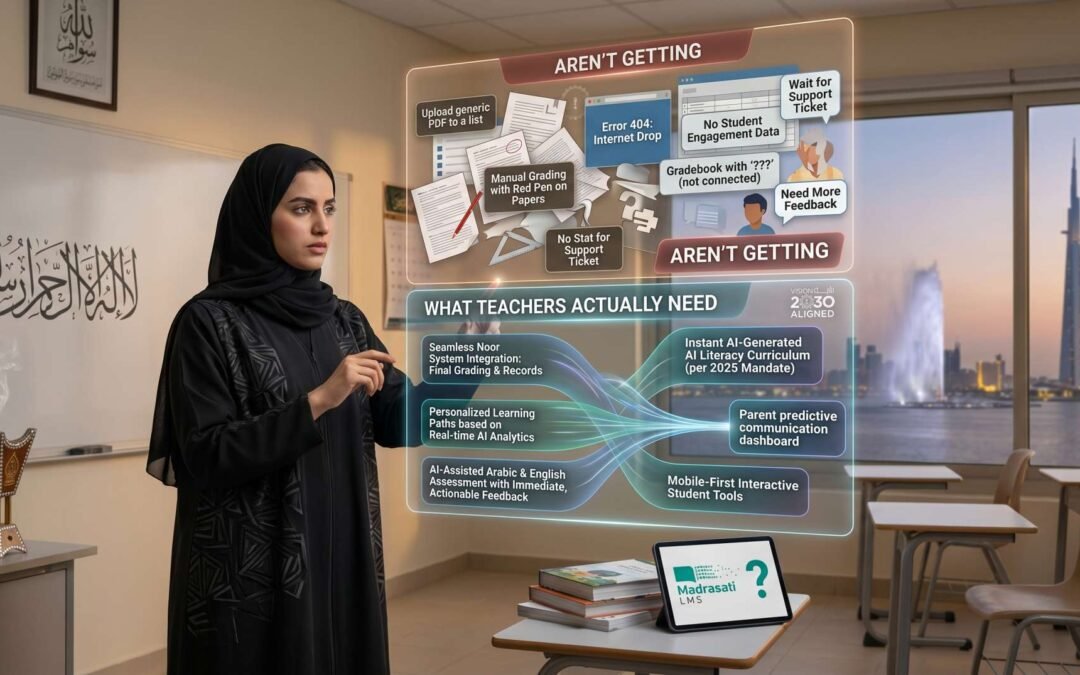
What Teachers Actually Need from Their LMS (And Aren’t Getting)

What Teachers Actually Need from Their LMS (And Aren’t Getting)

Institutions spend millions selecting and deploying learning management systems. But somewhere between the vendor demo and the daily classroom, the investment quietly stops working — and teachers quietly work around it.

“These systems were built for the people who buy them — not the people who use them.”
  • Feedback workflows built for admin, not teaching
  • Analytics that answer the wrong questions
  • Communication tools teachers route around
  • Standardization that crushes pedagogical design
  • Integrations that break in the real world

There is a peculiar dynamic at the center of most LMS adoption stories. Institutions evaluate platforms extensively — feature checklists, vendor demonstrations, pilot programs, procurement committees. They negotiate contracts, configure systems, train administrators. And then, somewhere in the gap between what the platform promised and what teachers actually do in the classroom, the investment begins to quietly underperform.

This gap has been examined from several directions: the procurement failure angle, the utilization data problem, the vendor incentive misalignment. What is examined less often is the teacher’s-eye view — what educators who use these systems daily actually need from them, what they consistently do not get, and why that mismatch persists across platform generations and institutional contexts.

The answer, when you ask teachers directly rather than surveying administrators, reveals something important: the features that matter most to effective teaching are not the ones that feature most prominently in vendor demonstrations. And the friction that matters most is not in the headline capabilities but in the daily workflow.

The Feedback Problem

Ask teachers what takes the most time in their LMS workflow and the answer is almost always the same: assessment and feedback. Creating assignments, receiving submissions, providing meaningful responses, tracking completion and revision cycles. This is the core instructional loop, and it is where most LMS platforms create the most friction.

The feedback interface in most platforms was designed for administrative completeness, not instructional efficiency. Teachers navigate multiple clicks to open a submission, switch to a different view to enter a grade, open another panel to enter comments, and repeat this process for every student in a class that may have thirty, sixty, or a hundred members.

Most LMS platforms treat each assignment as a discrete transaction. Good teaching treats feedback as a running conversation.

What teachers describe needing — and rarely have — is a feedback workflow that is fast enough to use consistently, rich enough to communicate meaningfully, and integrated enough that the feedback given on one assignment is visible and buildable-upon in the next.

Analytics That Answer the Right Questions

Learning analytics has been one of the most heavily marketed capabilities in LMS development over the past decade. Dashboards, engagement metrics, predictive risk scoring — platforms have invested significantly in generating data about student behavior and presenting it to instructors.

The problem is that most of the data generated answers questions that teachers are not asking, while failing to answer the questions they are.

Knowing that a student logged into the course three times last week is not actionable information for a teacher trying to support that student’s learning. Engagement proxies — clicks, time-on-page, login frequency — are plentiful in LMS analytics. Evidence of actual learning is scarce.

What teachers consistently describe wanting to know is simpler and harder: which students are struggling with specific concepts, not just which ones are disengaged? Where in the learning sequence are students getting lost? What patterns of misconception appear across the class that should inform how the next lesson is taught?

The gap between available analytics and useful analytics is not primarily a technical problem. It is a design priority problem. Engagement data satisfies institutional reporting requirements. So that is what gets built and marketed. Teachers, who could use learning data, are given engagement data and told it is insight.

Communication That Reflects How Teaching Works

Communication tools in most LMS platforms were built for a synchronous, course-bounded model of teaching: announcements go to all students, discussion boards contain threaded conversation, messaging happens within the platform’s inbox. This architecture made sense for a world where the course was the primary context for teacher-student interaction.

It maps poorly onto how teaching actually works in blended and online environments, where students have questions outside of course sessions, where the relevant group for a conversation is sometimes a subset of the class, where follow-up communications about assessment need to happen quickly and in contexts students actually monitor.

Teachers frequently report maintaining parallel communication infrastructure outside their LMS — email, messaging apps, video conferencing tools — because the LMS communication tools are too slow, too rigid, or too poorly integrated with how students actually check for messages. When teachers build shadow infrastructure around a system, the system is not serving their needs.

Flexibility Without Fragmentation

One of the persistent tensions in LMS design is between standardization and flexibility. Institutions want consistency: a common platform that all courses run on, with standardized navigation that students can rely on. Teachers want flexibility: the ability to organize their course according to their pedagogical logic rather than a platform template.

Most LMS platforms resolve this tension in favor of standardization — the institutionally rational choice. Platform templates tend to favor chronological or topic-based organization. Teachers whose courses are organized around inquiry cycles, project phases, or conceptual progressions find themselves mapping their instructional logic onto a structural container it was not designed for. The content gets in, but the coherence is lost.

Course organization is not just an administrative convenience — it is a pedagogical communication. The way a course is structured tells students what the teacher thinks the learning journey is. When that structure is flattened into a generic module format, something real is lost.

The Integration Problem

Modern teaching increasingly involves a range of tools beyond the LMS: video platforms, collaborative editors, polling tools, AI writing assistants, simulation software. The LMS is supposed to be the hub that connects these tools and gives students a coherent experience.

In practice, LMS integrations are one of the most consistent sources of teacher frustration. LTI connections break or behave inconsistently. Grade passback from third-party tools fails silently. Institutional IT policies restrict which external tools can be integrated. The “ecosystem” that vendors demonstrate in sales presentations looks considerably different from the fragile patchwork that teachers actually manage.

What the Gap Reveals

The distance between what teachers need from their LMS and what they are getting is not primarily a product quality problem. The major platforms are sophisticated pieces of software. The gap is a design philosophy problem: these systems were built around administrative requirements and the concerns of procurement committees — not around the daily workflow of teaching.

The Verdict

A system with slightly fewer features that teachers actually use is more valuable than a system with every possible capability that teachers route around.

Closing this gap requires institutions to involve teachers substantively in LMS evaluation and selection — not as a consultation checkbox but as a genuine design constraint. It requires asking not just “can this platform do X?” but “can teachers actually do X efficiently in this platform’s daily workflow?”

The LMS that teachers need is not technically beyond reach. It is a system that makes feedback fast and meaningful, that delivers analytics teachers can actually act on, that communicates the way teaching communicates, and that stays out of the way when it is not needed. Whether the market will build it depends on whether institutions start demanding it.

EdTech
LMS
Learning Management Systems
Instructional Design
Higher Education
Pedagogy
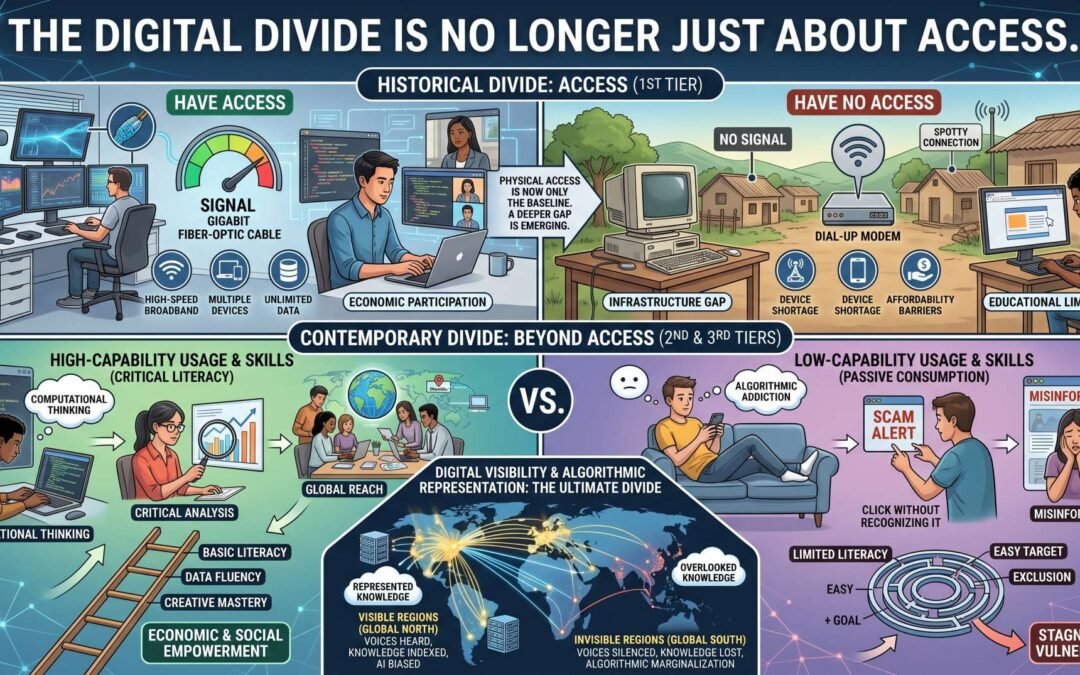
The Digital Divide Is No Longer Just About Access

The Digital Divide Is No Longer Just About Access

We solved the hardware problem — and discovered a harder one. The new divide is about skills, literacy, and who actually benefits when everyone is online.

10 min read
Equity & EdTech
4

Dimensions of the
New Digital Divide
01

Skills Gap
02

Algorithmic Literacy
03

Bandwidth Inequality
04

Quality Concentration

For most of the past two decades, the digital divide in education was framed as a hardware and connectivity problem. Students without computers could not participate in digital learning. Students without reliable internet were excluded from online resources. The solution, in this framing, was infrastructure: get devices into homes, build out broadband, and the gap would close.

Significant progress has been made on those terms. Device ownership among school-age children has risen substantially. Connectivity programs have expanded, accelerated in part by pandemic-era emergency funding. By the most basic metrics — do students have a device, do they have internet access — the divide has narrowed in many contexts.

And yet educational outcomes have not converged. The gaps in achievement, engagement, and academic trajectory that the digital divide was supposed to explain have not closed in proportion to the infrastructure investment. Something else is going on.

What is going on is that the digital divide has changed shape. The old divide was binary: connected or not, device-owning or not. The new divide is multidimensional, harder to see in survey data, and far more resistant to infrastructure-only solutions.

01 — The Skills Gap Device Ownership Does Not Solve

Having a laptop does not mean knowing how to use it for learning. This seems obvious when stated directly, but it is a distinction that educational technology policy has consistently underweighted.

Students arrive at secondary and post-secondary institutions with radically different levels of digital competency — not in the consumer sense (most students are fluent with social media and entertainment platforms) but in the academic and productive sense. The ability to evaluate online sources critically, to organize research across multiple tools, to collaborate asynchronously in structured ways, to manage files and workflows — these skills are unevenly distributed, and the distribution correlates strongly with socioeconomic background.

“The device is the same. The repertoire of use is very different.”

On affluent vs. lower-income students’ relationship with technology

When institutions assume that digital fluency follows from digital access, they systematically underserve the students who most need explicit skills development. Online learning environments that take for granted students’ ability to navigate LMS platforms, manage notifications, and self-regulate their study behavior are not neutral — they structurally advantage students who arrived with those skills already.

02 — Algorithmic Literacy as the New Baseline

A dimension of the new digital divide that has emerged more recently — and that educational institutions have been slow to address — is the uneven distribution of algorithmic literacy: the ability to understand, critically evaluate, and navigate algorithmically curated information environments.

Students who lack algorithmic literacy are not simply unaware of how recommendation systems work in the abstract. They are practically disadvantaged in their ability to conduct research, evaluate sources, recognize filter bubbles, and distinguish between organic information and commercially or politically motivated content. In an information environment where nearly all digital content is algorithmically filtered, this is not a niche competency. It is a fundamental requirement for educated participation in public life.

A student who does not understand why certain results appear at the top of a search page, or how content recommendation systems shape what they read and believe, is at a real academic disadvantage — regardless of whether they have broadband internet.

03 — Bandwidth Inequality and the Myth of Equivalent Experience

Even among students who have internet access, the quality of that access varies enormously — and those variations have significant educational consequences that institutions tend not to account for.

A student in a well-resourced household with gigabit fiber internet, a dedicated study space, and a modern laptop has a fundamentally different online learning experience than a student sharing mobile hotspot data with family members, studying on an older device in a shared living space with frequent interruptions. Both students have “access.” Their experience of an asynchronous online course is not comparable.

Instructional design that does not account for bandwidth variability is instructional design that systematically disadvantages lower-income students. This includes the default reliance on high-definition video for content delivery, synchronous sessions without asynchronous alternatives, and assessment platforms that time out or fail on unstable networks.

04 — The Concentration of Quality in Digital Learning

A less-discussed dimension of the new digital divide is the growing concentration of high-quality digital learning resources among institutions and students with resources to access them.

The most sophisticated adaptive learning platforms, the most thoughtfully designed online courses, the most capable AI tutoring systems — these are not evenly distributed. They tend to be deployed at well-resourced institutions that can afford premium EdTech subscriptions, that have instructional design staff to implement them properly, and that serve student populations with the background skills to use them effectively.

The result is a digital learning quality gap that mirrors and reinforces existing educational inequity. Technology that was supposed to democratize access to high-quality learning is, in its current distribution pattern, doing something closer to the opposite — giving better tools to students who were already better positioned.

What Institutions Can Actually Do

Acknowledging the new shape of the digital divide is not an argument for pessimism. It is an argument for more targeted and honest intervention. On the skills gap: institutions should treat digital academic literacy as a core competency that requires explicit instruction. On bandwidth inequality: instructional design standards should include low-bandwidth alternatives as a baseline requirement, not an accommodation. On algorithmic literacy: this belongs in the curriculum as an integrated thread, not a standalone elective. On resource distribution: procurement decisions have equity implications that are rarely part of the formal analysis.

The old digital divide asked whether students could get online. The new one asks what happens to them when they do — and whether the digital learning environment they encounter is designed with their actual circumstances in mind. That is a harder question, with no infrastructure solution. But it is the right question to be asking.

EdTech
Digital Divide
Equity
Higher Education
Online Learning
Blended Learning


Verification: 1544cdbd1105873e