
|
Getting your Trinity Audio player ready...
|
The debate about AI in education often sounds like this: Should we allow it? Is it cheating? What about academic integrity?
Meanwhile, somewhere between Reykjavík and Singapore, that debate has already been replaced by a different question: How do we do this well?
Around the world, a growing number of countries aren’t waiting for the perfect policy framework or the perfect AI tool. They’re running pilots, building curricula, training teachers, and learning in real time — while the rest of the world watches and debates.
This article is a tour of five of those countries. What they’re doing, why it matters, and — most importantly — what lessons any educator, parent, or student can take away, regardless of where they are in the world.
1. Iceland — The World’s First National AI Teacher Pilot
? Focus: Teacher support | ? Tools: Claude (Anthropic) + Gemini (Google) | ? Pilot: Oct 2025 – Apr 2026
When Anthropic and Iceland’s Ministry of Education and Children announced their partnership in November 2025, headlines called it “one of the world’s first comprehensive national AI education pilots.” And while the scale was modest — around 300 teachers across the country — the intent was anything but.
The Icelandic pilot, run through the Educational and School Services Centre (MMS) in collaboration with the Icelandic Teachers’ Union, gave participating teachers access to both Claude and Gemini for a six-month period. The goal wasn’t to hand students AI tools. It was to give teachers back their time.
Icelandic Minister of Education Guðmundur Ingi Kristinsson framed it clearly: “Artificial intelligence is here to stay. It is developing at a tremendous pace, and it is important to harness its power while at the same time preventing harm.”
What teachers could do with it:
- Generate and adapt lesson plans for different learner levels
- Analyze complex texts and mathematical problems
- Create differentiated materials for students with special needs
- Reduce administrative workload — the single biggest time drain teachers report
Critically, the pilot was structured around teacher voice. Participants completed regular surveys, attended optional workshops, and fed directly into national policy decisions about whether — and how — AI should be formally adopted in Icelandic education.
? The Lesson: Starting with teachers — not students — is a powerful approach. When educators understand and trust AI tools, they’re better equipped to guide how students engage with them. Teacher buy-in isn’t a nice-to-have; it’s the foundation.
2. Singapore — The Smart Nation Classroom
? Focus: Personalized learning + teacher AI literacy | ? Tools: National AI platform (AICET) | ? Target: AI-ready by 2030
Singapore doesn’t do things halfway. Its national “Smart Nation” strategy — with the explicit goal of positioning the country as a world leader in AI by 2030 — includes education as a central pillar, not an afterthought.
The research center AICET, hosted by AI Singapore and funded by the Smart Nation and Digital Government Office, works directly with the Ministry of Education to launch projects aimed at improving the national education system. By 2026, AI training for teachers is being offered at every level — from those just entering the profession to experienced educators seeking to upskill.
What makes Singapore’s approach distinctive is its focus on personalization at scale. The system being developed includes:
- An AI-enabled companion that provides each student with customized feedback and motivation
- Automated grading systems that free teachers from repetitive marking
- Machine learning tools that identify how individual students respond to different classroom materials and activities
- AI modules integrated into primary school computer science curricula
Singapore also runs the Student Learning Space (SLS) — a national digital platform where AI tools help students access personalized content aligned to their current level. For students with special needs, the system adapts to provide accessible, scaffolded learning experiences.
The underlying philosophy: every child deserves a learning experience designed for them, not for an average student who doesn’t actually exist. AI makes that possible at national scale.
? The Lesson: AI’s biggest educational promise isn’t making content delivery faster — it’s making learning genuinely personal. Singapore is betting that adaptive, individualized education will produce better outcomes than any one-size-fits-all curriculum ever could.
3. UAE — AI as a Formal School Subject, From Kindergarten to Grade 12
? Focus: National AI curriculum + classroom tool adoption | ? Tools: ChatGPT, Gemini, Claude, Alef Platform | ? Live: 2025–2026 academic year
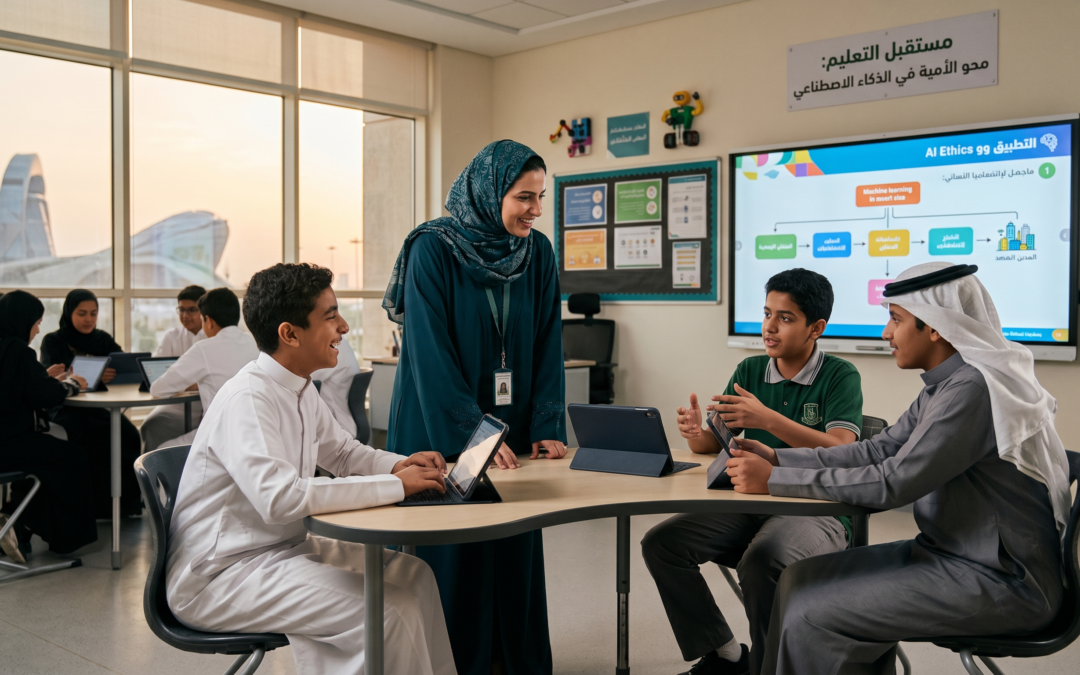
The UAE made a bold move in 2025: it became one of the first countries in the world to introduce AI as a formal school subject for every student from kindergarten through Grade 12, integrated into the national curriculum starting in the 2025–2026 academic year.
UAE Minister of Education Sarah Al Amiri announced the curriculum covering seven key domains: fundamental AI concepts, data and algorithms, software literacy, ethical awareness, real-world applications, innovation and project design, and policies and community engagement. Over 1,000 specially trained teachers are delivering the subject, supported by a dedicated quality monitoring committee.
But the UAE’s AI integration goes beyond a single subject. Private schools across the country are now allowing students to use generative AI tools — including ChatGPT, Gemini, Claude, and others — for assignments and homework, provided they verify and cite sources appropriately. At Dubai Schools Al Khawaneej, Principal Jamie Efford described their approach:
“We take a deliberate and education-first approach to artificial intelligence in the classroom. Our focus is not simply on access to tools, but on developing AI literacy, critical thinking and responsible use.”
The UAE’s Alef Education platform — an AI-powered adaptive learning system — already serves 1.4 million students across five countries, making it one of the largest AI-in-education deployments in the world.
? The Lesson: Making AI a subject — not just a tool — changes everything. Students don’t just learn with AI; they learn about AI: how it works, its ethical dimensions, its limitations. That’s the difference between a generation that uses AI and a generation that understands it.
4. South Korea — AI-Smart Textbooks and Personalized Homework
? Focus: Adaptive learning + AI textbooks | ? Tools: National AI curriculum platform, KERIS | ? Status: Rolled out to one-third of schools
South Korea has moved faster than almost any other country in converting classroom ambition into operational reality. Within the span of roughly a year, it went from AI pilot programs to deploying AI-enhanced smart textbooks in a third of its schools — a rollout speed that’s remarkable by any standard.
The Korean Ministry of Education’s KERIS (Korea Education and Research Information Service) unit has been designing and piloting extensive teacher development programs around AI. A key feature: the Ministry’s Future of Education Center runs model classrooms where educators and policymakers from around the world can visit and experience what AI-integrated learning looks like in practice.
South Korea’s approach is highly focused on adaptive homework and assignments. AI systems analyze each student’s educational level, learning tendencies, and behavioral patterns to dynamically adjust what they’re assigned — so a student struggling with fractions gets more foundational practice, while a student who’s mastered the concept is pushed ahead. No two students receive exactly the same homework.
The longer-term vision is even more ambitious: every child in South Korea will eventually have access to a personalized AI tutor and a connected online learning platform — allowing teachers to focus on higher-order skills like collaboration, critical thinking, and creativity, while AI handles the repetitive reinforcement work.
? The Lesson: Adaptive homework — work that adjusts to the individual learner in real time — is one of the most concrete, immediate wins AI offers in education. South Korea is proving it’s not science fiction. It’s policy.
5. Finland — AI With Ethics at the Center
? Focus: Equity, ethics, and teacher-centered AI | ? Tools: AI in Learning research platform, free national courses | ? Status: Ongoing national commitment
If Singapore represents AI-in-education as national infrastructure, Finland represents it as national philosophy.
Finland — long regarded as one of the world’s gold standards in education — has approached AI not with the urgency of rapid deployment, but with the deliberateness of a country that takes pedagogy seriously. Its national commitment includes offering free online AI coursework to all citizens — not just students, not just teachers, but anyone — in a bold move toward universal AI literacy.
The AI in Learning project, a collaboration between international researchers and companies, is producing scholarly work on the ethical use of AI in education and developing an intelligent digital system that assesses student wellness — feeding insights back to both students and educators. The goal is not just smarter learning, but healthier learning.
Finland’s approach offers a counterpoint to the speed-first models of Singapore and South Korea. Finnish educators are asking harder questions: What are the risks of cognitive offloading? How do we ensure AI serves equity rather than widening gaps? What does responsible AI deployment look like for a teacher-centered system that values professional autonomy?
Finland also runs one of the most respected international courses on AI in education through the European School Education Platform — bringing educators from across Europe to Helsinki to see firsthand how Finnish schools are thinking through AI integration. The course isn’t about getting the most out of AI tools. It’s about getting AI integration right.
? The Lesson: Speed isn’t always the goal. Finland is proving that thoughtful, ethics-first AI integration — that prioritizes teachers, equity, and student wellbeing — may ultimately produce more sustainable and beneficial outcomes than rapid deployment for its own sake.
?? Side-by-Side: What Each Country Prioritizes
? What Does This Mean for the Rest of the World?
The countries featured here aren’t outliers or exceptions. They’re early data points in a trend that’s accelerating globally. By early 2026, over half of U.S. states have schools reporting AI use in classrooms. Estonia launched its “AI Leap” program for 20,000 teenagers. Greece partnered with OpenAI to bring ChatGPT to secondary schools. China’s Squirrel AI adaptive tutoring system now reaches 24 million learners.
The pattern is consistent: countries that treat AI as infrastructure — rather than a disruption to be managed — are moving faster and learning more.
For educators reading this from any country: you don’t need a national mandate to start. You need one class, one use case, and one week of honest experimentation. The schools leading in 2030 are being built by teachers who started thinking about this in 2026.
For students: you are entering a world where AI fluency is becoming as foundational as digital literacy was in the 2000s. The question isn’t whether you’ll use these tools — it’s whether you’ll understand them well enough to use them wisely.
For policymakers: the global evidence is accumulating. The countries sitting out this transition won’t avoid the disruption — they’ll just arrive at it less prepared.
? 5 Lessons Any School Can Apply Today
- Start with teachers, not students. Build AI confidence in educators first — it creates better student outcomes downstream. (Iceland’s model)
- Teach AI as a subject, not just a tool. Students who understand how AI works use it more responsibly and effectively. (UAE’s model)
- Use AI to personalize, not standardize. Adaptive learning that meets each student where they are is the real prize. (Singapore + South Korea)
- Ethics can’t be an afterthought. Questions about equity, bias, and cognitive development need to be part of every AI integration plan. (Finland’s model)
- Pilot, measure, then scale. Every country on this list started small and learned before committing nationally. Evidence-first isn’t slow — it’s smart.
Written by
Saifullah Khalid
Covering AI, education, and the future of learning at saifullahkhalid.com
? Know an educator who’s still on the fence about AI? Share this with them — the world isn’t waiting.