
|
Getting your Trinity Audio player ready...
|
Here’s an uncomfortable truth about how most of us were taught to study: it doesn’t work.
Highlight the textbook. Re-read your notes. Stare at flashcards the night before the exam. Make a summary. Read the summary. Repeat until your brain feels full.
Decades of cognitive science research have shown that these techniques — the ones most students use, the ones most teachers implicitly endorse — are among the least effective ways to actually learn something and retain it long-term.
We’ve known this for years. The problem was never the research. The problem was that the better methods — spaced repetition, active recall, interleaving, elaborative interrogation — were harder to do alone. They required structure, consistency, and ideally, someone to quiz you and push back when you got something wrong.
Most students don’t have that. Until now.
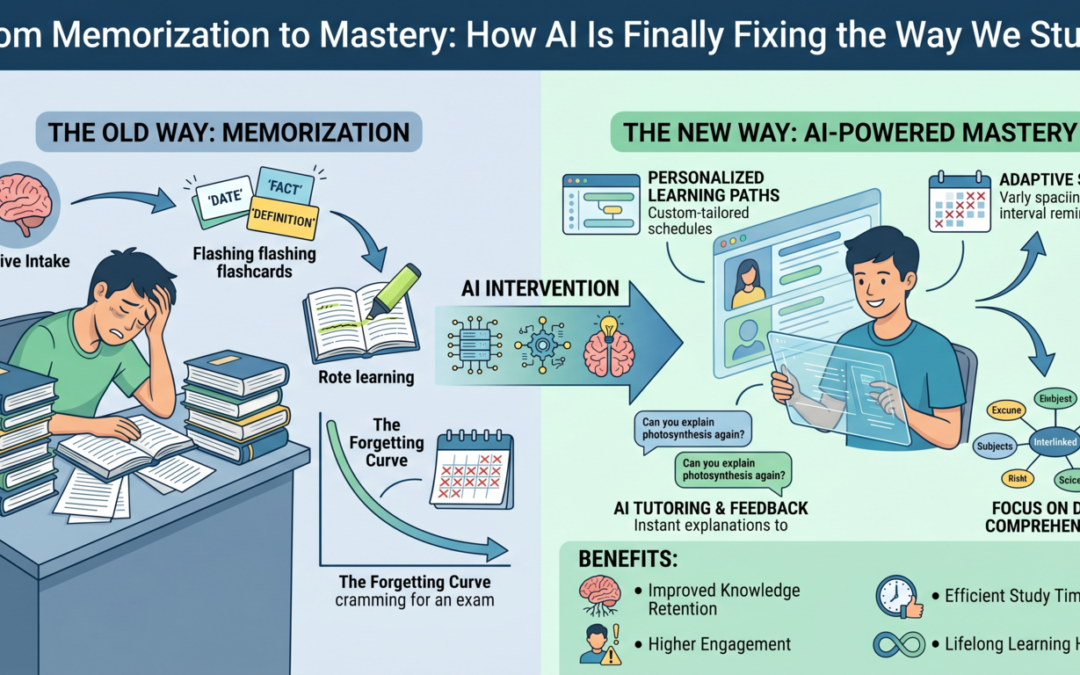
AI is changing the equation. Not by replacing teachers or making studying “easier” in a shallow sense — but by making the right kind of hard effortlessly accessible to any student, anywhere, at any time.
This is the story of how that’s happening.
? First: Why Our Traditional Study Methods Fail
To understand why AI matters here, you need to understand the science of how memory actually works.
The brain doesn’t store information the way a hard drive does. You can’t just “save” something by reading it repeatedly. Memory is reconstructive — every time you retrieve a memory, you strengthen the neural pathway that leads to it. The act of retrieval is the learning.
This is why two of the most well-researched study techniques — active recall and spaced repetition — are so powerful:
- Active recall means testing yourself on material rather than passively reviewing it. Closing the book and trying to remember — even imperfectly — strengthens memory far more than re-reading.
- Spaced repetition means reviewing material at increasing intervals over time. Instead of cramming everything in one session, you revisit information just as you’re about to forget it — which is precisely when retrieval strengthens the memory most.
Studies going back to the early 20th century, and confirmed repeatedly since, show that students using these methods retain information significantly longer and with less total study time than students who use passive review methods.
So why doesn’t everyone study this way?
Because it’s hard to do alone. Active recall means you need someone — or something — to generate questions. Spaced repetition means you need a system that tracks what you know, what you don’t, and when to review each thing. For decades, the tools available (physical flashcard boxes, basic apps like early Anki) worked but required enormous self-discipline to use consistently.
AI removes that barrier entirely.
? How AI Is Implementing Learning Science at Scale
Modern AI tools are doing something remarkable: they’re taking what cognitive scientists have known for decades and making it the default experience for students. Here’s how:
1. AI-Generated Active Recall — On Demand
Instead of re-reading your notes, you can now paste any study material into an AI and ask: “Quiz me on this. Don’t give me multiple choice — ask me open-ended questions and tell me when I’m wrong.”
The AI becomes a tireless examiner. It can generate dozens of questions from a single chapter, vary the difficulty, ask follow-up questions when you give a shallow answer, and explain why you got something wrong — not just tell you the right answer.
This is active recall at scale, available at 2am before an exam, with no study partner required.
2. Adaptive Spaced Repetition
Tools like Anki have offered spaced repetition for years — but they required the student to create every flashcard manually, which most people didn’t sustain. AI changes this in two ways:
- Automatic card generation: Upload your notes, get a complete flashcard deck in seconds. No manual entry.
- Adaptive scheduling: AI systems that track your responses can identify which concepts you’re weakest on and prioritize them — rather than treating all material equally.
3. Socratic Questioning — The Most Underrated Study Method
One of the most powerful learning techniques is elaborative interrogation: asking why something is true, not just what is true. This forces the brain to connect new information to existing knowledge — which is what creates deep understanding rather than surface-level recall.
AI tutors can do this naturally. Instead of just answering your question, a well-prompted AI will ask: “Before I explain, what do you think might be happening here?” or “That’s right — but can you explain why?”
Khan Academy’s Khanmigo is explicitly designed around this Socratic model. Rather than giving students answers, it guides them toward figuring out answers themselves — which is dramatically more effective for long-term retention.
4. Interleaving — The Uncomfortable Method That Works
Most students study one topic completely before moving to the next (called “blocking”). Research consistently shows that mixing topics — called interleaving — produces better long-term retention, even though it feels harder and less productive in the moment.
AI can create interleaved study sessions automatically: mixing questions from Chapter 3, Chapter 7, and last week’s material in a single session, forcing the brain to constantly retrieve and differentiate between concepts — which is exactly how exam conditions work.
?? The AI Study Stack: Tools That Actually Work
Here are the specific tools leading this shift, and how to use them effectively:
? A Real Study Session: What This Looks Like in Practice
Let’s make this concrete. Here’s what a science-backed AI study session looks like for a university student preparing for a biology exam:
Example Prompt to Claude
“I have a biology exam on cellular respiration in 3 days. Here are my notes: [paste notes]. Please do the following: First, identify the 5 concepts I most likely need to understand deeply. Then quiz me on them one at a time using open-ended questions. After each answer I give, tell me what I got right, what I missed, and ask a follow-up that pushes me deeper. Don’t give me the answer until I’ve tried at least twice.”
This single prompt creates a study session that incorporates active recall, elaborative interrogation, immediate feedback, and Socratic follow-up — all the high-impact techniques at once.
After 30 minutes of this kind of session, students report understanding the material in a way that hours of passive review never achieved. The reason is simple: the brain was working, not coasting.
?? The Risks: When AI Study Tools Go Wrong
This wouldn’t be an honest article without addressing the shadow side. AI study tools can actually harm learning when used incorrectly.
The Shortcut Trap
Asking AI to summarize a chapter for you and then reading the summary is still passive learning. It feels efficient — you covered the material in 3 minutes instead of 30 — but you haven’t done the retrieval work that creates memory. The summary is the AI’s understanding, not yours.
Over-Reliance Without Verification
AI tools can be wrong, especially on technical or niche topics. Students who accept AI explanations without cross-referencing authoritative sources risk learning incorrect information confidently — which is worse than not knowing at all.
The Fluency Illusion
When an AI explains something clearly and you think “I understand that,” you may be experiencing the fluency illusion — mistaking the ease of reading a good explanation for actual knowledge. The test is always: can you explain it back without looking? If not, you don’t know it yet.
The rule of thumb: AI should be the thing that tests you, not just the thing that tells you. Use it to generate questions more than answers.
? What This Means for Students, Teachers & Institutions
For Students
You now have access to a personalized tutor available 24/7 that can adapt to your pace, your weaknesses, and your schedule. The students who figure out how to use this well will have a significant advantage — not because AI does their work, but because they’ll develop genuine mastery faster than ever before.
For Teachers
The role of a teacher is shifting from information-deliverer to learning architect. If AI can handle explanations, practice problems, and basic feedback — teachers are freed to focus on what AI can’t do: building relationships, developing critical thinking, facilitating discussion, and inspiring students to care about learning at all.
For Institutions
Schools and universities that ban AI rather than teach students to use it wisely are preparing students for a world that no longer exists. The institutions leading the future are the ones designing curricula that treat AI as a tool to be mastered — like a calculator, like the internet — not a threat to be feared.
The Bottom Line
We have spent generations teaching students what to think about without adequately teaching them how to think — or how to learn. Traditional study methods optimized for the appearance of effort: filled notebooks, highlighted pages, long library sessions.
AI is finally making the science of learning accessible to everyone. Spaced repetition, active recall, Socratic questioning, interleaving — these aren’t new ideas. They’re just now, for the first time, available without friction.
The students who will thrive in the next decade won’t be the ones who memorized the most. They’ll be the ones who learned how to learn — and used every tool available to do it better.
AI is the most powerful learning tool ever put in a student’s hands. The question isn’t whether to use it. The question is whether you’ll use it wisely.
? Quick-Start: 5 AI Study Habits to Build This Week
- After reading any topic, ask Claude: “Quiz me on what I just read — open-ended questions only.”
- Paste your lecture notes into NotebookLM and ask: “What are the 5 things I most need to understand deeply here?”
- Use ChatGPT or Claude in Socratic mode: “Don’t give me the answer — guide me to it.”
- Generate a spaced repetition deck from your notes using AI — then actually review it daily.
- End every study session by asking AI: “Give me 3 questions I should be able to answer after this session. Test me.”
Written by
Saifullah Khalid
Writing about the future of education, AI, and human potential at saifullahkhalid.com
? Know a student who still highlights and re-reads? Share this with them — it might change how they study forever.