
|
Getting your Trinity Audio player ready...
|
The LMS Trap: Why Institutions Spend Millions on Learning Platforms and Get Mediocre Results
Every few years, a university or school district announces a major investment in a new learning management system. There are demos, committee approvals, migration timelines, and professional development sessions. Administrators speak about transformation. Teachers are trained. Students are onboarded.
And then, quietly, almost nothing changes.
The LMS becomes a place to upload files. Grades get posted. Announcements go out. The course catalog moves online. But the actual experience of learning — the thing the institution spent hundreds of thousands of dollars to improve — remains largely the same, or gets worse.
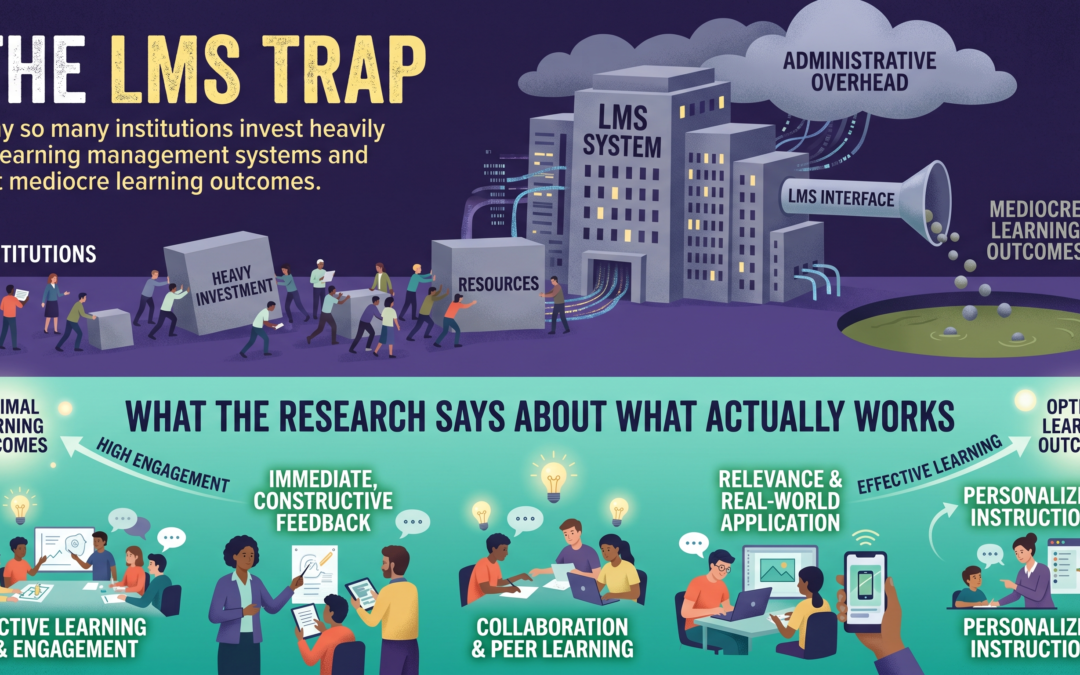
This is the LMS trap: a pattern in which institutions invest heavily in learning management systems and receive mediocre outcomes in return. It is widespread, well-documented, and poorly understood — even by the institutions caught in it.
The Numbers Behind the Problem
The LMS market is one of the fastest-growing segments in educational technology. Global revenues exceeded $23 billion in 2024, with projections pointing to $70 billion or more by the end of the decade. These are not niche figures — they represent the accumulated purchasing decisions of thousands of institutions across higher education, corporate training, and K–12 schooling.
Higher education leads adoption, with approximately 85% of universities and colleges globally using some form of LMS. Corporate training follows at around 70%, and K–12 adoption sits near 48% — a figure that accelerated significantly during the COVID-19 pandemic.
Yet adoption tells us nothing about effectiveness. And this is precisely where the picture gets complicated. Across sector after sector, research finds the same pattern: widespread deployment of LMS platforms paired with underwhelming learning outcomes, low feature utilization, and persistent teacher frustration.
The Feature Utilization Gap
Modern LMS platforms are remarkable in their ambition. Platforms like Canvas, Moodle, Blackboard, and D2L Brightspace offer dozens of tools: adaptive learning paths, sophisticated analytics dashboards, peer collaboration spaces, video integration, competency tracking, gamification layers, and rubric-based assessment engines.
Most of these features go unused.
Research consistently finds that institutions actively use between 20% and 30% of their LMS’s available functionality. Content delivery — uploading slides, PDFs, and recorded lectures — is near-universal. Basic assessments like quizzes and assignment submission are moderately used. But the features designed to improve learning outcomes — adaptive content, learning analytics, collaborative tools — are barely touched.
The analytics gap is particularly revealing. Nearly every major LMS includes dashboards that can identify at-risk students, flag engagement drops, and surface early warning signals. These tools exist precisely because the data is there — every login, click, submission, and forum post is logged. Yet studies find that fewer than one in four instructors regularly consult these dashboards, and fewer still use them to adjust instruction in real time.
“Most faculty use the LMS the same way they used email — as a delivery mechanism. The pedagogical transformation vendors promise is not happening at scale.” — EDUCAUSE Review, 2023
Why the Trap Closes Around Institutions
The LMS trap is not primarily a technology problem. The platforms themselves are often technically sophisticated and genuinely capable. The trap is a procurement and implementation problem — a mismatch between what institutions buy and why they buy it.
Procurement is driven by compliance and administration, not learning.
Most LMS selection processes are committee-driven, with representation from IT, compliance, finance, and academic administration. Pedagogy is often underrepresented, and the faculty who will actually use the system frequently have little influence over the final decision.
This produces purchasing criteria weighted toward administrative efficiency — grade book integration, SIS compatibility, FERPA compliance, uptime guarantees — rather than pedagogical capability. The result is a system selected for the wrong reasons, then handed to educators without the support needed to use it well.
Implementation ends where learning begins.
The typical LMS implementation follows a predictable arc: technical setup, data migration, a round of training sessions, a go-live date. After that, support thins out. The institution has “deployed” the system and considers the job done.
But the actual challenge — changing how teachers design and deliver learning — is not a technical event. It is a slow, ongoing professional development process. That process almost never gets the sustained investment it requires. What institutions call implementation is really just installation.
The path of least resistance points away from transformation.
Teachers are busy. Adding a sophisticated new tool to an already demanding workload requires time and incentive. Without both, faculty default to using the LMS the way they used whatever came before: as a document repository and gradebook. The system is technically present, pedagogically absent.
This is not a failure of motivation. It is a rational response to institutional structures that do not reward pedagogical innovation, do not protect time for experimentation, and do not provide ongoing support for faculty learning.
What the Research Says Actually Works
The contrast between tool-first and pedagogy-first approaches is stark when measured against actual learning outcomes. When researchers compare institutions that invested primarily in LMS capability with those that prioritized instructional design, faculty development, and blended approaches, the outcomes tell a clear story.
Knowledge retention is 20+ percentage points higher in pedagogy-first environments. Student engagement — measured through participation rates, voluntary activity, and self-reported motivation — is sharply higher. Completion rates improve. And skill transfer, the hardest outcome to achieve and the one most employers actually care about, shows the widest gap of all.
These differences are not marginal. They are the difference between a system that works and one that looks like it should.
What pedagogy-first looks like in practice:
Pedagogy-first institutions share several characteristics that distinguish them from their tool-first counterparts. They invest in instructional design staff who work alongside faculty as partners, not just technical support. They treat LMS adoption as an ongoing professional development challenge, not a one-time training event. They give faculty protected time to redesign courses, experiment with tools, and reflect on what works.
Critically, they also resist the pressure to use every feature a platform offers. The best-performing courses tend to use a small number of tools very well — not the full feature set used superficially.
The Vendor Relationship Problem
There is a structural asymmetry in the LMS market that makes this problem harder to solve. Vendors profit from initial sales and annual contracts, not from learning outcomes. Their incentives are aligned with feature development, market expansion, and contract renewal — not with whether students in Amman or Atlanta actually learned something.
This produces a market where platforms compete on feature count, integration breadth, and UI modernity rather than on evidence of learning impact. Institutions buy the shiniest platform, not the most effective one. And because measuring learning outcomes is genuinely difficult — more difficult than counting features — institutions often cannot tell the difference until years of mediocre results force the question.
The honest answer is that no LMS vendor can fully deliver on the transformation they imply in their sales material. The transformation has to come from within the institution, from the humans who design and deliver learning. The platform is infrastructure, not intervention.
A More Honest Framework for LMS Investment
Institutions that want to escape the LMS trap need to reframe how they think about the investment entirely. The platform budget is not the education budget. Licensing fees are the smallest part of what it actually costs to change how learning happens.
A more honest accounting would treat the LMS as infrastructure — like classroom furniture or network connectivity — and invest the bulk of the education budget in the things that research shows actually move outcomes: instructional design capacity, faculty professional development, learning analytics literacy, and evidence-based course design.
This is a harder sell internally. “We need more instructional designers” is less compelling in a budget meeting than “We’re migrating to a platform with AI-powered adaptive learning.” But it is what the evidence supports.
The Question Worth Asking Before the Next Contract
Most institutions will renew their LMS contracts. The switching costs are high, the migration is painful, and the new platform usually promises the same things the old one did. That is fine. The platform is not the problem.
The question worth asking before the next renewal is not “which LMS should we buy?” It is “what would it take to actually use what we already have well?” And then: “are we willing to invest in that?”
Because the data is clear. The tools are capable. What is missing is not technology. It is the sustained, patient, unfashionable work of helping educators become better designers of learning — with or without a new platform.
That work does not generate press releases. But it is the only thing that has ever actually worked.