
|
Getting your Trinity Audio player ready...
|
Futures of Learning · Issue 04
Memory
Augmentation
as a Learning Tool
Spatial computing, AR overlays, and ambient AI are beginning to blur the line between remembering and looking up. What does this do to how we define — and develop — mastery?
There is a moment in every student’s learning journey — usually unnoticed, unremarkable, and yet genuinely consequential — when something that required effort to recall becomes automatic. When the formula no longer needs to be looked up. When the grammatical rule no longer needs to be consciously applied. When the historical sequence clicks into place without prompting. Educators call this internalization. Psychologists call it automaticity. In the language of cognitive science, it is the point at which knowledge moves from working memory into long-term memory, freeing up mental bandwidth for higher-order thinking.
For as long as formal education has existed, the cultivation of this internalization has been one of its central purposes. You memorize the multiplication tables not because they are inaccessible otherwise, but because having them readily available in memory changes what you can do with mathematics — changes the speed of calculation, the recognition of patterns, the intuition about numerical relationships. The goal is not mere retrieval. The goal is a mind transformed by what it has thoroughly absorbed.
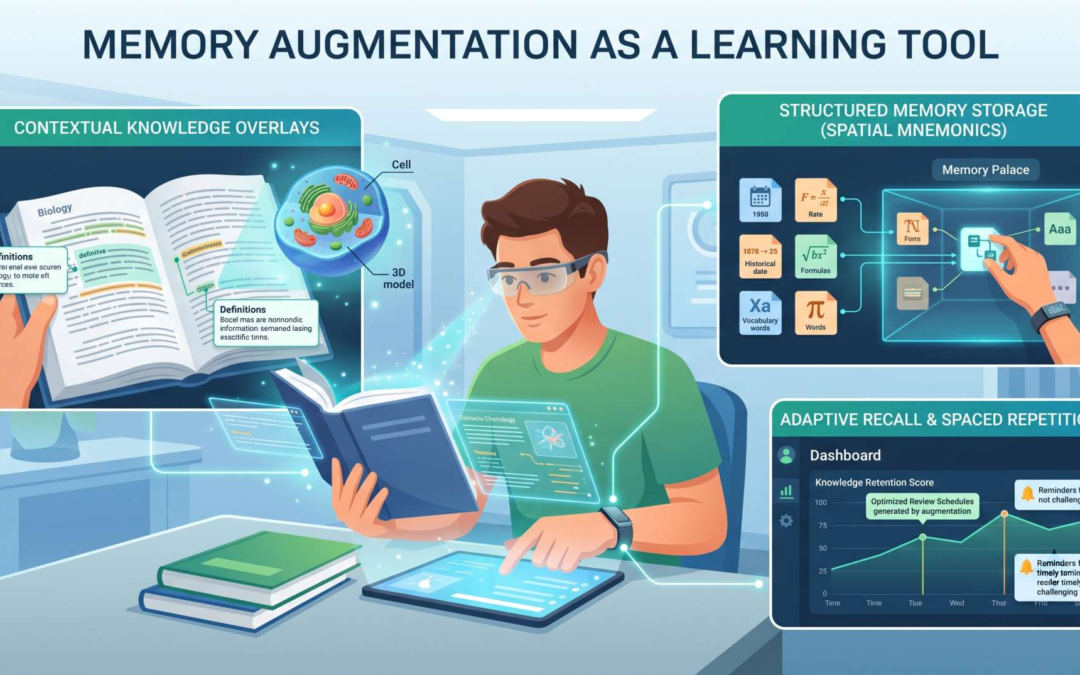
Now, for the first time in educational history, technology is arriving that could render some forms of internalization optional — not by making them easier, but by making them unnecessary. Wearable devices with ambient AI can provide answers before the question is fully formed. Augmented reality overlays can annotate the visual world with contextual information in real time. Spatial computing environments can surface relevant knowledge precisely when and where a learner needs it, without the learner having to hold it themselves.
This is not a distant possibility. It is a present condition, arriving incrementally, mostly without institutional frameworks to guide it. And it raises a question that education has genuinely never had to answer before: if a person never needs to remember something, does learning it still matter?
What Memory Actually Does in Learning
The case for memorization has been poorly made for decades — mostly by tradition, sometimes by rote, rarely by genuine engagement with the cognitive science underlying it. When defenders of memorization make their case, they tend to reach for nostalgia or discipline rather than the actual mechanisms by which internalized knowledge changes cognition. This has made them easy to caricature, and has allowed a shallow “look it up” counterargument to dominate EdTech discourse without serious examination.
The cognitive case for internalized knowledge is, in fact, quite strong — and considerably more nuanced than either side of this debate typically acknowledges.
Working memory — the mental space in which active cognition occurs — is severely limited. A person can hold roughly four chunks of information in working memory at one time. Everything that has to be looked up, retrieved, or consciously reconstructed during a cognitive task is occupying one of those slots. Everything that has been internalized — that is genuinely automatic — does not occupy working memory at all. It is available as background infrastructure.
This means that the more deeply a person has internalized the foundational knowledge of a domain, the more of their working memory is free for higher-order operations: analysis, synthesis, creative connection, the recognition of patterns that span large bodies of information. The doctor who has internalized pharmacology is not just faster at drug recall — she is a different kind of thinker when facing a complex case than the doctor who must look up each drug interaction. The chess grandmaster does not simply know more openings than the novice; the internalization of thousands of positions has created a qualitatively different perceptual system.
The question is not whether augmented memory changes what a learner can do. It clearly does. The question is whether it changes what a learner becomes — and whether those two things are still the same goal.
— Emerging cognitive science of augmented cognition, 2025
The Augmentation Landscape Right Now
Memory augmentation in educational contexts is not one technology but several overlapping ones, arriving at different speeds and with different implications. Understanding what is already deployed versus what is emerging matters for institutional responses.
Smartphone lookup
The baseline augmentation that every student already has. Normalized to the point where its cognitive effects are rarely studied as augmentation at all. First-generation data on how constant smartphone access changes what students bother to learn is beginning to accumulate.
Ambient AI assistants
Earpiece and wearable AI that can answer questions in real time, whispered into the user’s ear. Already used widely by students in informal learning contexts. The instructional and assessment implications remain almost entirely unaddressed by institutions.
Consumer AR glasses
Persistent AR overlays that annotate the visual world — identifying objects, surfacing relevant information, providing contextual memory augmentation as a constant background layer. Will enter classrooms whether or not institutions are ready for them.
Spatial learning environments
Immersive spatial computing platforms that embed educational content in three-dimensional space, creating environmental memory scaffolds — buildings where rooms contain knowledge, physical manipulation that encodes abstract concepts, shared spatial memory with other learners.
Redefining Mastery in an Augmented World
If the external availability of knowledge changes what it means to know something, then the definition of mastery that education has been built around requires renegotiation. This is not a new problem — every major information technology has forced it. The printing press made extensive personal memorization of texts less essential. Writing itself, as Plato famously worried, weakened the memory of those who relied on it. Each shift produced genuine losses and genuine gains, and the educational systems that navigated them well were those that thought carefully about what the new technology actually changed — rather than either resisting it wholesale or adopting it without examination.
The current moment calls for the same careful thinking, but with greater urgency: the speed of deployment is faster, the scope of the technology broader, and the institutional frameworks for response thinner than in any previous information technology transition.
Three distinct conceptions of mastery are now in tension, and being honest about the tension matters for what institutions decide to do.
The Extended Mind Problem
The philosophical groundwork for thinking about memory augmentation as something other than cheating was laid in 1998 by Andy Clark and David Chalmers in their paper “The Extended Mind.” Their argument was, and remains, controversial: that cognition is not confined to the skull. If an external resource — a notebook, a calculator, an AI assistant — reliably performs a cognitive function and is available whenever needed, it is reasonable, they argued, to treat it as part of the cognitive system of the person using it.
On this view, a student using AR glasses to access pharmacological information during a clinical rotation is not cheating any more than a surgeon using a reference guide is cheating. The cognitive system — student plus tool — is what matters. What the student needs to contribute is not the storage of facts but the judgment about which facts to surface, what to do with them, and how to integrate them with the embodied knowledge that cannot be externalized.
This is a serious philosophical position, not a rationalization for intellectual laziness. But it has limits that its enthusiastic adopters in EdTech often gloss over. The extended mind is only as effective as the interface between the human and the external component. And that interface — the judgment about what to look up, when to trust the answer, how to integrate it with what is already known — requires exactly the kind of internalized domain knowledge that augmentation is being offered as a substitute for.
In other words: effective use of memory augmentation tools requires a level of domain knowledge sufficient to evaluate and contextualize what the tools return. The student who has internalized no pharmacology cannot effectively use an AR pharmacology assistant — she cannot evaluate whether the suggestion is appropriate for this patient, in this context, with this history. The tool is only as good as the knowledge surrounding it.
The Bootstrapping Problem
There is a profound circularity at the heart of the memory augmentation argument: to use an external memory tool effectively, you need enough internalized knowledge to evaluate its outputs. But if you already have that internalized knowledge, the case for the tool is weaker. The implication is that augmentation tools are most valuable to experts — who need them least — and least valuable to novices — who are most likely to be offered them as a substitute for building the foundational knowledge that would make the tools useful. This is not a reason to reject augmentation tools entirely. It is a reason to be very careful about at what stage of learning they are introduced, and what kind of internalization they replace versus what they supplement.
What AR Environments Actually Do to Spatial and Embodied Learning
Not all memory augmentation is cognitively equivalent, and the distinction matters for educational design. AI-delivered text answers and AR spatial overlays work through different cognitive channels and have different implications for learning.
The case for spatial and embodied augmentation — AR environments that embed learning in three-dimensional space, that attach information to physical locations and objects — is actually considerably stronger than the case for text-based AI recall, because it works with rather than against the grain of how human memory naturally operates.
Human memory is profoundly spatial. The method of loci — the ancient mnemonic technique of mentally placing information along a familiar spatial route — works because human spatial memory is particularly robust and long-lasting. AR environments that use physical space as an organizational scaffold for knowledge may actually enhance internalization rather than replacing it: the information is attached to a place, a gesture, a physical interaction, in ways that create richer encoding than text alone.
Early research on spatial learning in AR environments supports this. Students who learn anatomy in AR by manipulating three-dimensional models — interacting with them physically, building spatial relationships between structures — show better retention and better transfer to novel problems than students who learn from two-dimensional representations. The AR is not bypassing memory; it is enriching the encoding that makes memory deeper.
The Assessment Crisis This Creates
Every memory augmentation technology that enters the classroom creates an immediate assessment problem, and the accumulation of these technologies without corresponding assessment reform is producing a slow-motion crisis that most institutions are managing through prohibition rather than redesign.
The prohibition approach — banning devices during assessments, using AI detection tools, requiring in-person exams — is understandable as a short-term response but is not a sustainable long-term strategy. The technologies will become smaller, more embedded, and harder to detect. Enforcement will become a game of escalation that institutions are systematically losing. More importantly, assessments that test performance under conditions of deliberate cognitive impoverishment — no tools, no references, no augmentation — are increasingly testing an experience of knowing that students will never encounter in their professional lives.
The more productive response, which some pioneering institutions are beginning to develop, is to redesign assessments around the cognitive capabilities that augmentation cannot replicate: judgment, synthesis, contextual application, evaluation of conflicting information, the generation of genuinely novel approaches to problems that resist lookup. These are the assessments that remain valid in an augmented world — and they happen to be assessments of the higher-order capabilities that education has always claimed to value, even when its assessments were actually testing recall.
A Framework for Institutional Decision-Making
The decisions institutions face around memory augmentation are not primarily technical. They are decisions about what they believe learning is for, what they believe mastery means, and what kind of minds they are trying to help students develop. The following framework attempts to organize those decisions around dimensions that matter.
| Dimension | Key Question | Current Approach | Recommended Direction |
|---|---|---|---|
| Foundational knowledge | What must students internalize before augmentation tools are introduced? | Undefined — decisions left to individual faculty | Explicit domain-level frameworks for minimum internalization thresholds before augmented practice begins |
| Assessment design | What does valid assessment look like when recall is freely available? | Reactive — prohibition-first, redesign later | Proactive redesign toward judgment, synthesis, and transfer assessments that remain valid under augmentation |
| Tool introduction timing | At what stage of learning should augmentation tools be available? | Undecided — default is full availability immediately | Research-informed staged introduction: internalization first, augmentation as scaffold for higher-order application |
| Equity of access | Do students have equal access to augmentation tools, and do disparities create new educational inequality? | Emerging concern — rarely addressed in policy | Active monitoring of access gaps; institutional provision of tools where disparities emerge |
| Professional preparation | Does the augmented learning experience prepare students for augmented professional practice? | Partial — strong in professional programs, weak in foundational courses | Explicit curriculum mapping of augmentation tool competencies alongside domain knowledge |
| Cognitive development | Are there aspects of cognitive development that require non-augmented practice to develop? | Under-researched — policy decisions outpacing evidence | Sustained investment in longitudinal research; cautious defaults pending better evidence |
The Decade Ahead: A Realistic Timeline
Now
The Ambient AI Phase
Earpiece and wearable AI becomes common among students. Institutions respond primarily through honor code updates and detection technology. First systematic studies of how ambient AI access changes what students retain from courses begin to produce data. Assessment integrity becomes a major institutional concern.
Near
Consumer AR Enters Classrooms
Sub-$400 AR glasses reach consumer mainstream. Early adopter students bring them to class. Prohibition becomes difficult to enforce at scale. Some progressive institutions begin piloting AR-integrated curricula in professional programs (medicine, engineering, law). Assessment redesign initiatives launch at leading institutions.
Medium
The Mastery Redefinition Period
Significant divergence opens between institutions that have redesigned their curricula around augmented cognition and those still operating on prohibition. First generation of students who learned primarily in augmented environments enters professional practice. Early evidence on whether augmented learning produces different professional capabilities begins to emerge.
Far
Spatial Computing Becomes an Educational Medium
Spatial computing platforms mature into genuine educational infrastructure in leading institutions. Research on embodied AR learning produces clearer design principles. New cognitive-augmentation literacies emerge as explicit educational objectives. The definition of what an educated person knows — vs. can do with tools — is genuinely renegotiated across multiple disciplines.
What Educators Should Protect
The response to memory augmentation is not to pretend it is not happening, and not to embrace it uncritically as liberation from the drudgery of memorization. It is to think carefully about what internalized knowledge actually does — what cognitive capacities it enables, what kinds of thinking it makes possible — and to protect those capacities explicitly in curriculum design, even as the tools for bypassing them proliferate.
Protect the foundations, not the facts. The most important thing to internalize in any domain is not the individual facts but the conceptual structure that makes the facts meaningful — the framework within which new information can be placed and evaluated. A medical student who has internalized a deep model of physiological systems can use an AR drug reference effectively. A student who has only memorized drug names and doses cannot. Curriculum design should identify and protect the structural knowledge that makes augmentation tools usable, even as it relaxes requirements around peripheral factual recall.
Redesign assessment proactively, not reactively. The institutions that are ahead of this curve are not the ones with the best AI detection tools. They are the ones that have redesigned their assessments to test the capabilities that remain valid under augmentation — judgment, integration, transfer, creativity, the ability to evaluate conflicting information and reach a defensible conclusion. These assessments are harder to design and harder to grade. They are also more honest measures of what education is actually producing.
Study the cognitive effects before scaling the tools. The research on how sustained use of ambient AI and AR memory augmentation affects cognitive development — particularly in students who are still building foundational knowledge — is thin. Institutions that are deploying these tools at scale without longitudinal outcome tracking are running an educational experiment on their students without controls or consent. The precautionary principle applies: default to staged, researched introduction rather than full availability from day one.
Take spatial augmentation seriously as an opportunity. Not all augmentation is cognitively equivalent. The evidence for spatial, embodied AR learning environments is considerably more positive than the evidence for text-based AI recall. Institutions that invest in developing genuinely immersive spatial learning experiences — particularly in domains where three-dimensional spatial reasoning matters — may find that augmentation actually deepens internalization rather than replacing it.
The question was never whether students should be allowed to look things up. The question is what kind of mind you need to look things up well — and whether we are still building it.
— saifullahkhalid.com · Futures of Learning Series
Conclusion: The Mind in the Tool
Every major educational technology — writing, printing, calculation — has changed what it is necessary to hold in memory. Each time, educators have worried that something essential was being lost, and each time, something genuinely was lost — alongside something genuinely gained. The history is not comforting in the simple sense that it reassures us everything will be fine. It is comforting in the more honest sense that it shows us that these transitions are navigable, that the losses and gains are real and distinguishable, and that the institutions that navigate them well are those that think carefully about what they are trading.
Memory augmentation is the most significant of these transitions yet — not because it changes what is externally available, but because it changes what is available internally, in real time, in the middle of thinking. It is augmentation not of storage but of cognition in progress. That is a qualitatively different kind of change, and it deserves a qualitatively more careful response than either prohibition or celebration.
The question is not whether students will learn differently in an augmented world. They will. The question is whether we help them build the internal cognitive architecture that makes that augmentation genuinely powerful — rather than handing them tools before they have the knowledge to use them well, and calling it education.
The mind in the tool is only as good as the mind behind it. That has always been true. It has never mattered more.