|
Getting your Trinity Audio player ready...
|
Prepared as an analytical framework, incorporating the KTrade FY27 Budget Initial Impression (12-Jun-26) and current market data. This is research-style analysis, not personalized investment advice — verify live valuations before acting.
- Macroeconomic Backdrop
Market context: The KSE-100 closed at 169,703 on June 11, 2026, roughly 11% below the all-time high of ~191,033 reached in January 2026. The pullback is geopolitically driven: Israeli strikes on Iran and escalating Middle East tensions triggered heavy selling, with the index shedding over 1,500 points in a single session in early June. This correction has restored valuation comfort heading into FY27.
GDP growth: The FY27 budget targets 4.0% real GDP growth (vs. 4.2% targeted in FY26), supported by LSM recovery (+6.1% in FY26), services expansion and export momentum. The SBP itself projected FY26 growth in the 3.75–4.75% range, with momentum strengthening into FY27. The 4.0% target is credible.
Interest rates: The easing cycle has paused. The SBP raised the policy rate by 100bps to 11.5% on April 27, 2026 — the first hike since June 2023 — citing volatile oil prices from Middle East tensions clouding the inflation outlook. For the June 15 MPC, market expectations are evenly split between a hold and another hike. Base case: rates peak at 11.5–12.0% in H1 FY27, then resume easing toward 9.5–10.5% by June 2027 if oil normalizes. This rate path is the single most important variable for the equity strategy below.
Inflation: FY26 averaged ~7%; the budget assumes 8.2% for FY27 due to delayed oil pass-through. Topline Research projects FY27 average inflation in the 8–8.5% range. Real rates remain positive (~3%), giving SBP room to cut once the supply shock fades.
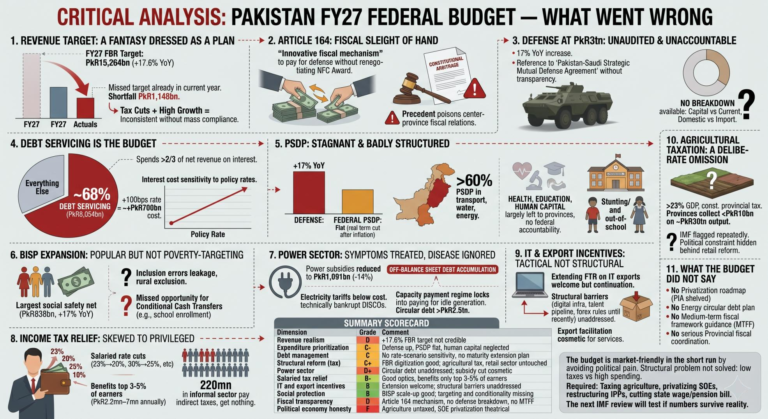
IMF and fiscal: The EFF remains on track — reviews are progressing, the current account was broadly balanced, and private sector credit growth recovered to 15%. The FY27 budget is IMF-consistent: 2.0% primary surplus, fiscal deficit narrowing to 3.6% of GDP (from 7.8% in FY23), and tax-to-GDP rising to 10.6%. The FBR target of PkR15.26tn (+17.6% YoY) is ambitious and is the main fiscal slippage risk — mid-year mini-budgets remain possible if collection lags.
Currency: PKR is unusually stable — trading near 279/USD, with Topline projecting PKR/USD in the 283–286 range by December 2026. SBP FX reserves were expected to surpass $18bn by June 2026 and rise further in FY27, nearing 3-month import cover. Assume 3–4% annual depreciation in the base case; the bear-case trigger is sustained Brent above $95–100.
Flows: Domestic liquidity dominates (~90%+ of volumes — mutual funds, insurance, banks rotating out of fixed income as rates fall). Foreign participation remains marginal; any MSCI-related or post-conflict foreign re-entry is upside optionality, not a base-case assumption.
Key geopolitical risk: The Iran–US/Israel conflict is the defining FY27 risk — it simultaneously raises oil (import bill, inflation, rates) and suppresses sentiment. Conversely, the Pakistan–Saudi Strategic Mutual Defense Agreement and GCC investment flows are structural positives.
- Sector Outlook
| Sector | Stance | Core Logic |
| Banks | Neutral-to-Positive | High rates extend NIM strength near-term; rate cuts later in FY27 compress margins but boost credit growth and book-value re-rating. Super tax on banks unchanged in budget. Prefer high-CASA, high-ROE names. |
| E&P | Neutral (oil hedge) | Elevated oil prices lift earnings and act as a portfolio hedge against the main macro risk. Circular debt resolution progress is the structural catalyst. Budget neutral. |
| OMCs | Neutral | Volume recovery with GDP; PkR80/litre FED on solvents eliminates fuel adulteration arbitrage — positive for compliant players (PSO, APL). Margin revisions are the catalyst. |
| Cement | Positive | Direct budget winner: property WHT halved (purchase 2.5%?1.25%, sale 5.5%?2.75%), PkR1tn PSDP with 60%+ in transport/water/energy infrastructure. Pricing discipline intact; coal costs the main risk. |
| Fertilizer | Neutral (defensive income) | Stable demand, strong pricing power, high dividend yields. Sector-specific super tax retained. Gas pricing is the perennial risk. Core defensive allocation. |
| Technology / IT | Positive | 0.25% FTR on IT exports extended to June 2029 — multi-year policy certainty. PKR stability slightly dampens the translation tailwind, but dollar revenue growth and margin expansion continue. |
| Telecom | Neutral-to-Negative | ARPU pressure, heavy capex, taxation burden. Limited investable depth on PSX. Avoid as a dedicated allocation. |
| Power | Neutral (yield play) | Subsidies trimmed (-14% YoY) signals continued reform; circular debt workout is gradual. Select IPPs with resolved receivables offer double-digit dividend yields. |
| Steel | Positive | Construction WHT cuts + PSDP + housing pickup feed long-steel demand; budget explicitly flags steel positive. |
| Refineries / REITs | Positive (satellite) | Brownfield refinery upgrades policy and REIT-friendly property measures; small tactical positions only. |
- Top Picks (10 names)
Valuation references are indicative levels typical of these names; confirm current multiples before execution.
Large-cap core
- Meezan Bank (MEBL) — Thesis: highest-ROE major bank (~mid-30s%), structural Islamic banking shift, zero-cost deposit advantage means it retains NIM resilience better than peers as rates fall. Valuation: premium P/B justified by ROE spread; P/E mid-single digits. Catalysts: rate-cut resumption driving credit growth; continued deposit share gains. Risks: MDR regulation changes on Islamic deposits, super tax.
- United Bank (UBL) — Thesis: aggressive balance sheet, strong dividend payer, international operations. Valuation: dividend yield historically among the highest in large-cap banks. Catalysts: capital gains realization on bond books as rates fall. Risks: NIM compression in H2 FY27.
- Oil & Gas Development Co. (OGDC) — Thesis: cheapest large-cap energy proxy; direct beneficiary of elevated oil; circular debt resolution plan unlocking trapped cash flows and dividend capacity. Valuation: P/E ~4–5x, deep discount to reserves value. Catalysts: circular debt settlement tranches, dividend step-up, Reko Diq progress. Risks: oil collapse, receivable buildup.
- Lucky Cement (LUCK) — Thesis: lowest-cost producer, diversified (mobile assembly, chemicals, power IPP), prime beneficiary of the construction-friendly budget. Valuation: holding-company discount to sum-of-parts. Catalysts: north demand recovery from WHT cuts, PSDP execution. Risks: coal price spike, pricing indiscipline.
- Fauji Fertilizer (FFC) — Thesis: post-merger (FFBL) scale, near-monopoly urea pricing power, defensive cash machine. Valuation: dividend yield ~8–10% historically; single-digit P/E. Catalysts: urea price adjustments, food security policy support. Risks: gas tariff hikes, GIDC-style levies.
Mid-cap growth
- Systems Limited (SYS) — Thesis: Pakistan’s flagship IT exporter; FTR extension to 2029 removes the biggest policy overhang; GCC delivery expansion. Valuation: highest P/E on this list (~15–20x) but justified by 20%+ dollar revenue growth. Catalysts: large GCC contract wins, margin recovery. Risks: PKR stability compressing rupee earnings growth, attrition costs.
- Mari Energies (MARI) — Thesis: gas-weighted E&P with the best exploration track record; consistently among the top index contributors. Valuation: production growth at single-digit P/E. Catalysts: new discoveries, Shewa/Ghazij development. Risks: dry wells, gas price negotiations.
- D.G. Khan Cement (DGKC) — Thesis: undervalued cement turnaround; export optionality (south plant), portfolio value (MCB stake) not reflected in price. Valuation: trades below replacement cost per ton; P/B discount. Catalysts: demand recovery, deleveraging as rates fall. Risks: higher leverage than LUCK, coal costs.
Income / undervalued
- Hub Power (HUBC) — Thesis: transitioning from legacy IPP to energy investment company (Thar coal, EV/mobility ventures, potential E&P stake); strong dividend resumption. Valuation: double-digit dividend yield potential, low P/E. Catalysts: Thar expansions, dividend announcements. Risks: receivables, policy renegotiation of IPP contracts.
- Pakistan State Oil (PSO) — Thesis: deep asset value play — trades at a fraction of book; FED on solvents curbs smuggled/adulterated fuel, recovering volumes for the formal market leader. Valuation: P/B ~0.4–0.6x historically; normalized earnings cheap. Catalysts: circular debt resolution, OMC margin revision, refinery upgrade (PRL stake). Risks: receivables from SNGPL/power chain, inventory losses if oil falls sharply.
- Model Portfolio (FY27)
| Sector | Weight | Names | Role |
| Banks | 22% | MEBL 12, UBL 10 | Income + rate-cycle play |
| E&P | 16% | OGDC 9, MARI 7 | Oil hedge + value |
| Cement | 14% | LUCK 9, DGKC 5 | Budget-driven growth |
| Fertilizer | 12% | FFC 12 | Defensive income |
| Technology | 9% | SYS 9 | Structural growth |
| Power | 8% | HUBC 8 | High yield |
| OMC | 6% | PSO 6 | Deep value |
| Steel/Construction-linked | 5% | ISL or MUGHAL | Tactical budget play |
| Cash / T-bills | 8% | — | Dry powder at 11%+ yields |
Profile: roughly 55% defensive/income (banks, fertilizer, power, cash) vs. 45% growth/cyclical (cement, tech, E&P beta, steel). Estimated portfolio dividend yield ~6.5–7.5%, with the balance of returns from capital appreciation.
Expected FY27 total return:
| Scenario | Index assumption | Portfolio return |
| Bull | KSE-100 retests/exceeds 191k ATH (~+15–20%) | +25–32% |
| Base | Index 180–190k (~+8–12%) | +15–20% |
| Bear | Index 140–150k (-12–18%) | -5–10% (dividends cushion) |
- Market Scenarios
Bull (25% probability): Iran–US de-escalation, Brent back to $70–75, SBP cuts to ~9.5% by mid-FY27, FBR target broadly met, foreign frontier-fund inflows resume. Market re-rates from ~7x toward 8.5–9x forward P/E. Leaders: cement, tech, mid-cap cyclicals.
Base (55%): IMF program stays on track, oil $75–90, one more hike or extended hold then 100–150bps of cuts in H2 FY27, PKR drifts to ~285–292, GDP ~3.8–4.0%. Market grinds higher on earnings growth (~10–14%) without major re-rating. Balanced portfolio works.
Bear (20%): Regional conflict escalates, Brent sustains $100+, inflation breaches 11–12%, SBP forced to 13%+, PKR breaks 300, IMF review delays, political instability. Defensive rotation: banks (rate beneficiaries), E&P (oil hedge), FFC, cash. Cement/tech/steel underperform sharply.
Note the portfolio’s built-in hedge: the same shock (oil) that hurts cement and the macro lifts E&P earnings and bank NIMs — this is deliberate.
- Risk Management Framework
Position sizing: Max 12% in any single stock; max 25% per sector; minimum 8% cash. Mid-caps (DGKC, steel names) capped at 5% each due to liquidity.
Exit discipline: Trim any position that exceeds 1.5x its target weight through appreciation. Hard review trigger if a stock falls 20% from cost with no thesis-relevant news. Exit entirely on thesis break (e.g., circular debt plan abandoned ? exit OGDC/PSO; IT tax regime reversed ? exit SYS).
Hedging: Direct hedges are limited on PSX. Practical substitutes: (a) E&P overweight as the oil hedge, (b) the 8% cash sleeve earning 11%+ in T-bills/money market funds, (c) deliverable futures to reduce net exposure tactically if the index breaks key support (~160k), (d) for your situation specifically, USD-linked exposure (IT exporters) hedges PKR risk.
Monthly monitoring dashboard: SBP policy decisions and forward guidance (next: June 15); monthly CPI vs. the 8.2% budget assumption; Brent crude (>$95 sustained = de-risk cyclicals); SBP FX reserves (<$14bn = warning); monthly FBR collection vs. PkR15.26tn run-rate (shortfall >5% by Dec = mini-budget risk); current account monthly prints; IMF review calendar; mutual fund equity flows (NCCPL/MUFAP data).
Bottom line: The FY27 budget is genuinely market-friendly — salaried tax relief, super tax rationalization, construction WHT cuts, and IT incentives — and the recent geopolitical correction has reset entry valuations to ~6.5–7x forward earnings against a 10-year average of ~8x. The strategy is to be fully invested in the base case with a deliberate oil-hedged structure, leaning into cement/tech/steel on budget tailwinds while anchoring the portfolio in bank and fertilizer income until the rate-cut cycle resumes.
One caveat as always: I’m not a licensed financial advisor, and several stock-level valuation figures above are indicative ranges — pull live multiples from PSX/your broker terminal before sizing positions. Want me to build this into a tracking spreadsheet with target weights and monthly macro checkpoints?