
|
Getting your Trinity Audio player ready...
|
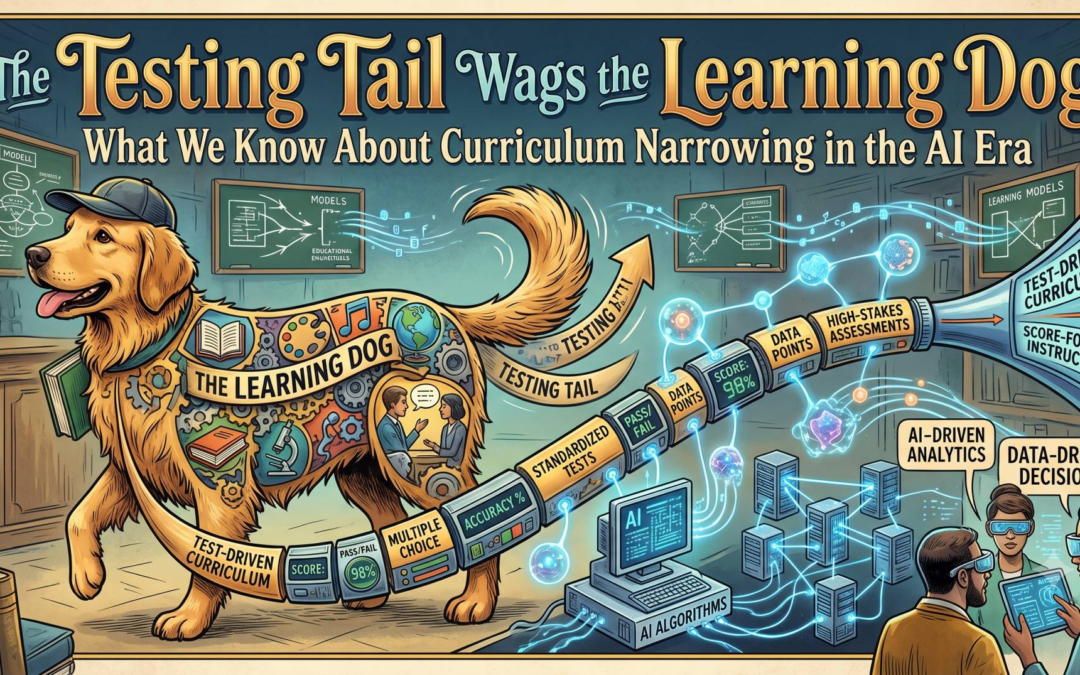
There’s a well-documented phenomenon in education: when stakes attach to test scores, curriculum narrows. Schools teach to the test. Subject areas not on the test—arts, social studies, sciences beyond what’s assessed—lose instructional time. Teachers focus on measurable skills. Deeper, messier, less-testable forms of learning get compressed.
This is old news. What’s new is the feedback loop: standardized assessment pressure now feeds directly into AI-driven content recommendation systems. And when an algorithm is trained to optimize for what gets tested, it doesn’t just recommend narrower content. It makes narrowing feel like personalization.
The result is a form of curriculum collapse that’s harder to see than the old version—because it looks like choice, and because it operates at scale, invisibly, in thousands of classrooms simultaneously.
How We Got Here
The narrowing problem predates AI by decades. High-stakes testing—NCLB accountability measures, state standardized tests, college admissions tests—created perverse incentives. Schools in under-resourced districts especially faced pressure to allocate time to tested subjects. Time spent on science lab work, historical argumentation, or artistic practice was time not spent on test prep.
The research on this is solid. Curriculum narrowing is real. It’s largest in lower-income schools and schools serving students of color. And it correlates with lower long-term outcomes, even as short-term test scores rise.
But the narrowing was at least transparent. A principal could say: “We’re spending more time on reading and math because that’s what’s tested.” A teacher could push back: “But my students need science and history too.” There was friction. There was visibility.
Now add AI-driven content recommendation. These systems—used in adaptive learning platforms, tutoring apps, and increasingly embedded in LMS environments—are trained on massive datasets of student interaction and outcomes. The systems learn: when students engage with content on this topic, and then take a test on this topic, they score higher.
So the algorithm recommends more of that content. And less of everything else.
The problem deepens when you consider what data these systems are trained on. In most cases, it’s outcomes from standardized assessments. A student’s “success” is often defined as test score improvement. So the algorithm optimizes for that. It learns to recommend content that correlates with higher test performance, and to de-prioritize everything else.
This is mathematically rational. It’s also educationally catastrophic.
The Personalization Illusion
The mechanism is subtle enough that it doesn’t feel like narrowing. It feels like personalization.
An adaptive platform sees that a student struggles with fractions. So it recommends more fraction problems. This is good—targeted practice on a weakness. But the algorithm also learns that this student’s test scores correlate most strongly with procedural fluency in fractions, not with conceptual understanding of rational numbers. So it recommends procedural practice, not conceptual exploration.
The student gets more practice problems. The student’s test scores go up. The platform is “working.” But the student hasn’t learned what fractions mean in different contexts—how they show up in recipes, in probabilities, in music. That’s deeper learning. It’s harder to measure. The algorithm doesn’t optimize for it.
Scale this across a curriculum. A student “struggles” with essay writing, so the platform recommends more templates and formulaic exercises. It doesn’t recommend reading challenging essays, because reading doesn’t directly improve writing test scores in the short term. A student shows low engagement with history, so the platform deprioritizes history content in favor of subjects with higher engagement-to-test-score correlation.
The algorithm is doing exactly what it’s designed to do: maximize measurable performance. But in doing so, it collapses the curriculum into the testable, the measurable, the short-term-scoreable.
And here’s the kicker: because this happens at the level of algorithmic recommendation, it’s nearly invisible. A teacher might not realize that the platform is systematically steering her students away from certain topics. The system presents it as “personalized learning path.” The student experiences it as “recommended for you.” Nobody sees the narrowing happening.
The Interaction Effect
The problem gets worse when you consider how AI recommendation interacts with existing assessment pressure.
In a traditional system: teacher experiences pressure to raise test scores, so teacher de-emphasizes untested subjects. At least there’s a human decision-making point. A teacher might resist. A department might push back. A principal might allocate protected time for science or arts despite testing pressure.
In an AI-mediated system: the pressure is baked into the algorithm. The recommendation engine doesn’t “de-emphasize” untested subjects. It simply doesn’t recommend them as often. Over a school year, a student might see 30% less history content, 40% less science exploration, not because anyone decided this, but because the algorithm’s training data showed that those topics don’t correlate as strongly with test score improvement.
And because the system is adaptive—it’s continuously learning from each student’s interaction—it’s continually tightening the curriculum around what’s tested. There’s no static decision point to push back against. The narrowing is dynamic, personalized, and largely invisible.
Teachers also can’t easily override it. If a platform is recommending content algorithmically, a teacher would have to manually curate every student’s learning path to ensure breadth. Most don’t have time. Most don’t even know it’s happening.
What the Data Shows
There’s limited research on this specific phenomenon—AI-driven narrowing in real classrooms—because most of these systems are relatively new and proprietary. But early evidence is concerning.
Studies of adaptive math platforms have found that while they improve performance on practice problems and immediate assessments, they don’t improve transfer to novel problems or conceptual understanding. Students get faster at the narrow skill the algorithm optimized for. They don’t get better at thinking mathematically.
Research on algorithmic recommendation in other domains (social media, e-commerce, news) consistently shows that recommendation systems narrow the range of content users encounter. They create filter bubbles. Algorithms are biased toward engagement and measurable outcomes. Breadth and serendipity are not optimizable.
There’s no reason to think educational algorithms are different.
And there’s indirect evidence from learning sciences: deeper learning—the kind that transfers, that connects across domains, that builds genuine understanding—requires exposure to multiple representations, contexts, and disciplines. It requires “productive struggle” with ideas that don’t immediately connect to testable outcomes. It requires time for exploration, question-asking, and intellectual wandering.
All of these are precisely what narrowed curricula and AI-optimized pathways eliminate.
The Equity Dimension
This matters most for students who are already underserved by assessment-driven education policy.
In high-poverty schools, curriculum narrowing has been documented for years. Limited resources mean hard choices about what gets taught. And because accountability pressure is heaviest in schools serving low-income students and students of color, those schools narrow first and narrowest.
An AI system trained on data from these schools will learn the narrowed curriculum as “optimal.” It will recommend that same narrow path to new students. It will do so at scale, in the name of personalization and efficiency.
For affluent students, there’s often a safety valve: private schools, enrichment programs, cultural capital at home that supplements school. For students in under-resourced schools relying on the platform? The algorithm is the curriculum. And the curriculum is whatever the algorithm learned to optimize for.
This is algorithmic reproduction of inequality. It’s not malicious. It’s mechanical. It’s exactly what you’d expect from a system trained to optimize for test scores in a context where test score pressure falls unevenly across schools.
What Institutions Need to Do
If you’re adopting or using adaptive learning platforms, here’s what matters:
Audit what “success” means in the platform’s training data. Ask the vendor: What outcomes did you optimize for? If the answer is “test score improvement,” push back. Insist on training data that includes longer-term outcomes, transfer, and measures of conceptual understanding—even if those are harder to quantify.
Mandate breadth floors. If a platform is recommending content algorithmically, establish non-negotiable minimums for curriculum breadth. Students should encounter history, science, arts, and social-emotional content even if the algorithm predicts lower test score gains. Pedagogy isn’t just about optimization.
Make the algorithm’s recommendations visible to teachers. If an algorithm is steering a student’s learning path, teachers need to see it. Not as a black box (“your student’s personalized learning path”), but as: “The system is recommending 60% math, 20% reading, 15% science, 5% other because these correlate with higher assessment performance.” Then teachers can decide whether that’s educationally sound.
Resist the efficiency argument. Adaptive systems often promise to “save time” by focusing students only on what they need to improve. But time spent on breadth, exploration, and deeper understanding is not wasted time. It’s the foundation of actual learning. If the platform can’t account for that, it’s not actually saving time—it’s just narrowing what you measure as time well-spent.
Build in counterbalance. If you’re using AI-driven recommendation for part of learning, use human-designed, breadth-forward curriculum for the rest. Don’t let the algorithm drive the whole learning experience. Use it as one tool among many, not as the curriculum itself.
The Bigger Picture
The narrowing problem is old. Assessment-driven incentives are old. What’s new is the scale and invisibility of algorithmic optimization.
We’ve known for thirty years that high-stakes testing narrows curriculum. Teachers have resisted it. Some schools have protected space for unmeasured learning. Some systems have pushed back against the worst accountability excesses.
An algorithm doesn’t resist. It optimizes. It operates at scale without friction. And it feels like personalization because it’s tailored to each student—even as it’s systematically narrowing what all students encounter.
The question isn’t whether to use adaptive learning systems. They’re here. The question is whether we’ll implement them in ways that respect curriculum breadth, or whether we’ll let them become just another mechanism for teaching only what we can test.
History suggests we’ll choose the latter unless we’re deliberate about choosing otherwise.