From Memorization to Mastery: How AI Is Finally Fixing the Way We Study

From Memorization to Mastery: How AI Is Finally Fixing the Way We Study

Educational Technology · May 2026

From Memorization to Mastery:
How AI Is Finally Fixing
the Way We Study

We’ve been studying wrong for decades. Highlighting, re-reading, cramming — science proved these don’t work. Now AI is making the right methods effortless.

Here’s an uncomfortable truth about how most of us were taught to study: it doesn’t work.

Highlight the textbook. Re-read your notes. Stare at flashcards the night before the exam. Make a summary. Read the summary. Repeat until your brain feels full.

Decades of cognitive science research have shown that these techniques — the ones most students use, the ones most teachers implicitly endorse — are among the least effective ways to actually learn something and retain it long-term.

We’ve known this for years. The problem was never the research. The problem was that the better methods — spaced repetition, active recall, interleaving, elaborative interrogation — were harder to do alone. They required structure, consistency, and ideally, someone to quiz you and push back when you got something wrong.

Most students don’t have that. Until now.

AI is changing the equation. Not by replacing teachers or making studying “easier” in a shallow sense — but by making the right kind of hard effortlessly accessible to any student, anywhere, at any time.

This is the story of how that’s happening.


? First: Why Our Traditional Study Methods Fail

To understand why AI matters here, you need to understand the science of how memory actually works.

The brain doesn’t store information the way a hard drive does. You can’t just “save” something by reading it repeatedly. Memory is reconstructive — every time you retrieve a memory, you strengthen the neural pathway that leads to it. The act of retrieval is the learning.

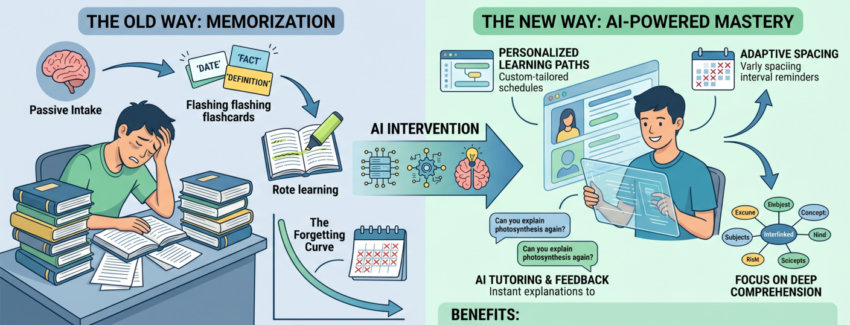
This is why two of the most well-researched study techniques — active recall and spaced repetition — are so powerful:

  • Active recall means testing yourself on material rather than passively reviewing it. Closing the book and trying to remember — even imperfectly — strengthens memory far more than re-reading.
  • Spaced repetition means reviewing material at increasing intervals over time. Instead of cramming everything in one session, you revisit information just as you’re about to forget it — which is precisely when retrieval strengthens the memory most.

Studies going back to the early 20th century, and confirmed repeatedly since, show that students using these methods retain information significantly longer and with less total study time than students who use passive review methods.

So why doesn’t everyone study this way?

Because it’s hard to do alone. Active recall means you need someone — or something — to generate questions. Spaced repetition means you need a system that tracks what you know, what you don’t, and when to review each thing. For decades, the tools available (physical flashcard boxes, basic apps like early Anki) worked but required enormous self-discipline to use consistently.

AI removes that barrier entirely.


? How AI Is Implementing Learning Science at Scale

Modern AI tools are doing something remarkable: they’re taking what cognitive scientists have known for decades and making it the default experience for students. Here’s how:

1. AI-Generated Active Recall — On Demand

Instead of re-reading your notes, you can now paste any study material into an AI and ask: “Quiz me on this. Don’t give me multiple choice — ask me open-ended questions and tell me when I’m wrong.”

The AI becomes a tireless examiner. It can generate dozens of questions from a single chapter, vary the difficulty, ask follow-up questions when you give a shallow answer, and explain why you got something wrong — not just tell you the right answer.

This is active recall at scale, available at 2am before an exam, with no study partner required.

2. Adaptive Spaced Repetition

Tools like Anki have offered spaced repetition for years — but they required the student to create every flashcard manually, which most people didn’t sustain. AI changes this in two ways:

  • Automatic card generation: Upload your notes, get a complete flashcard deck in seconds. No manual entry.
  • Adaptive scheduling: AI systems that track your responses can identify which concepts you’re weakest on and prioritize them — rather than treating all material equally.

3. Socratic Questioning — The Most Underrated Study Method

One of the most powerful learning techniques is elaborative interrogation: asking why something is true, not just what is true. This forces the brain to connect new information to existing knowledge — which is what creates deep understanding rather than surface-level recall.

AI tutors can do this naturally. Instead of just answering your question, a well-prompted AI will ask: “Before I explain, what do you think might be happening here?” or “That’s right — but can you explain why?”

Khan Academy’s Khanmigo is explicitly designed around this Socratic model. Rather than giving students answers, it guides them toward figuring out answers themselves — which is dramatically more effective for long-term retention.

4. Interleaving — The Uncomfortable Method That Works

Most students study one topic completely before moving to the next (called “blocking”). Research consistently shows that mixing topics — called interleaving — produces better long-term retention, even though it feels harder and less productive in the moment.

AI can create interleaved study sessions automatically: mixing questions from Chapter 3, Chapter 7, and last week’s material in a single session, forcing the brain to constantly retrieve and differentiate between concepts — which is exactly how exam conditions work.


?? The AI Study Stack: Tools That Actually Work

Here are the specific tools leading this shift, and how to use them effectively:

Tool Best For Learning Technique
Claude / ChatGPT Socratic Q&A, concept explanation, essay feedback Active recall, elaborative interrogation
Khanmigo Math, science tutoring without giving answers Socratic method, guided discovery
Anki + AI Automatic flashcard generation from notes/PDFs Spaced repetition, active recall
Perplexity AI Research with cited sources, concept deep-dives Elaborative interrogation, source evaluation
NotebookLM Uploading course materials and querying them Active recall from personal notes

? A Real Study Session: What This Looks Like in Practice

Let’s make this concrete. Here’s what a science-backed AI study session looks like for a university student preparing for a biology exam:

Example Prompt to Claude

“I have a biology exam on cellular respiration in 3 days. Here are my notes: [paste notes]. Please do the following: First, identify the 5 concepts I most likely need to understand deeply. Then quiz me on them one at a time using open-ended questions. After each answer I give, tell me what I got right, what I missed, and ask a follow-up that pushes me deeper. Don’t give me the answer until I’ve tried at least twice.”

This single prompt creates a study session that incorporates active recall, elaborative interrogation, immediate feedback, and Socratic follow-up — all the high-impact techniques at once.

After 30 minutes of this kind of session, students report understanding the material in a way that hours of passive review never achieved. The reason is simple: the brain was working, not coasting.


?? The Risks: When AI Study Tools Go Wrong

This wouldn’t be an honest article without addressing the shadow side. AI study tools can actually harm learning when used incorrectly.

The Shortcut Trap

Asking AI to summarize a chapter for you and then reading the summary is still passive learning. It feels efficient — you covered the material in 3 minutes instead of 30 — but you haven’t done the retrieval work that creates memory. The summary is the AI’s understanding, not yours.

Over-Reliance Without Verification

AI tools can be wrong, especially on technical or niche topics. Students who accept AI explanations without cross-referencing authoritative sources risk learning incorrect information confidently — which is worse than not knowing at all.

The Fluency Illusion

When an AI explains something clearly and you think “I understand that,” you may be experiencing the fluency illusion — mistaking the ease of reading a good explanation for actual knowledge. The test is always: can you explain it back without looking? If not, you don’t know it yet.

The rule of thumb: AI should be the thing that tests you, not just the thing that tells you. Use it to generate questions more than answers.


? What This Means for Students, Teachers & Institutions

For Students

You now have access to a personalized tutor available 24/7 that can adapt to your pace, your weaknesses, and your schedule. The students who figure out how to use this well will have a significant advantage — not because AI does their work, but because they’ll develop genuine mastery faster than ever before.

For Teachers

The role of a teacher is shifting from information-deliverer to learning architect. If AI can handle explanations, practice problems, and basic feedback — teachers are freed to focus on what AI can’t do: building relationships, developing critical thinking, facilitating discussion, and inspiring students to care about learning at all.

For Institutions

Schools and universities that ban AI rather than teach students to use it wisely are preparing students for a world that no longer exists. The institutions leading the future are the ones designing curricula that treat AI as a tool to be mastered — like a calculator, like the internet — not a threat to be feared.


The Bottom Line

We have spent generations teaching students what to think about without adequately teaching them how to think — or how to learn. Traditional study methods optimized for the appearance of effort: filled notebooks, highlighted pages, long library sessions.

AI is finally making the science of learning accessible to everyone. Spaced repetition, active recall, Socratic questioning, interleaving — these aren’t new ideas. They’re just now, for the first time, available without friction.

The students who will thrive in the next decade won’t be the ones who memorized the most. They’ll be the ones who learned how to learn — and used every tool available to do it better.

AI is the most powerful learning tool ever put in a student’s hands. The question isn’t whether to use it. The question is whether you’ll use it wisely.


? Quick-Start: 5 AI Study Habits to Build This Week

  1. After reading any topic, ask Claude: “Quiz me on what I just read — open-ended questions only.”
  2. Paste your lecture notes into NotebookLM and ask: “What are the 5 things I most need to understand deeply here?”
  3. Use ChatGPT or Claude in Socratic mode: “Don’t give me the answer — guide me to it.”
  4. Generate a spaced repetition deck from your notes using AI — then actually review it daily.
  5. End every study session by asking AI: “Give me 3 questions I should be able to answer after this session. Test me.”

Written by

Saifullah Khalid

Writing about the future of education, AI, and human potential at saifullahkhalid.com

? Know a student who still highlights and re-reads? Share this with them — it might change how they study forever.

The Classroom of Tomorrow Is Already Here

The Classroom of Tomorrow Is Already Here

Educational Technology · In-Depth

The Classroom of Tomorrow Is Already Here

How artificial intelligence, intelligent platforms, and the rise of online learning are fundamentally reshaping what it means to teach — and what it means to learn.

April 13, 2026  ·  12 min read  ·  For educators & school leaders

$404B
Global edtech market projected by 2025
60%
Of K–12 teachers now use AI tools regularly
Faster skill acquisition with adaptive learning systems
1.8B
Learners reached by online platforms globally

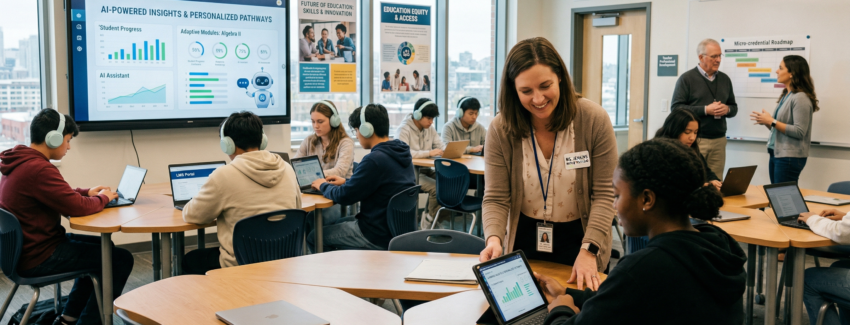
Walk into a forward-thinking school today and you might struggle to recognize it. One student is working through a personalized algebra module at her own pace, guided by an AI tutor that adjusts every question based on her last response. A teacher nearby is not lecturing — he is coaching, circulating among small groups, armed with real-time dashboards that flag which students are falling behind before they even raise their hand.

This is not a vision of 2035. It is happening right now — and for educators and administrators navigating this transformation, the challenge is no longer whether technology belongs in learning, but how to deploy it with wisdom, equity, and intention.

Part I — AI in Education: Beyond the Hype

Artificial intelligence has become the most discussed and most misunderstood force in modern education. Cut through the noise, and what emerges is a technology that is simultaneously more modest and more profound than its headlines suggest.

What AI is actually doing in classrooms

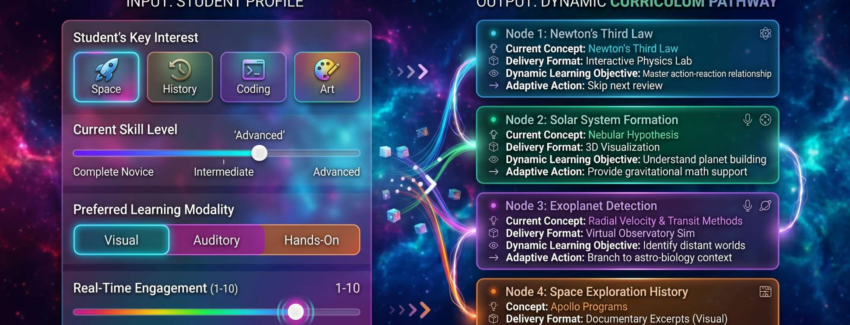
The most impactful AI applications in education are not robots replacing teachers. They are systems that do the cognitive heavy lifting that teachers were never designed to carry alone. Adaptive learning platforms like Khan Academy’s Khanmigo, Carnegie Learning, and Synthesis use machine learning to track thousands of micro-signals — response times, error patterns, topic avoidance — to build a unique learning profile for each student. The system then adjusts difficulty, pacing, and content type in real time.

For educators, this means something genuinely revolutionary: the ability to differentiate instruction at scale. A teacher managing thirty students has never, realistically, been able to personalize learning for each one. AI makes that personalization automatic, continuous, and invisible to the student — it simply feels like a curriculum that fits.

Practitioner Insight

AI-powered formative assessment tools are among the highest-leverage investments a school can make. They move feedback from summative (end-of-term) to continuous, allowing teachers to intervene weeks earlier than traditional grading would allow.

AI as a teacher’s co-pilot

Beyond student-facing applications, AI is quietly transforming teacher workflows. Lesson planning tools can generate differentiated worksheets across three reading levels in seconds. Grading assistants can provide first-pass feedback on written work, freeing teachers to focus their attention on the qualitative judgments only a human can make — the student who is technically correct but clearly confused, or the essay that ticks every box but lacks a genuine voice.

Administrative AI is also reducing the invisible workload that drives educator burnout: attendance logging, parent communication drafting, IEP documentation, and scheduling are all areas where intelligent automation is reclaiming hours per week for teachers who need them.

“The best AI tools don’t replace teacher judgment — they create the conditions for more of it.”

The equity imperative

No discussion of AI in education is complete without confronting the equity gap. The schools most likely to have sophisticated AI infrastructure are already the best-resourced. Without deliberate policy intervention — subsidized licensing, device access programs, teacher training pipelines — edtech risks being another mechanism that widens the gap between advantaged and under-served learners.

School administrators have a critical role to play here: evaluating not just what a tool can do, but who it is designed for, whose data it trains on, and whether its recommendations reflect the full diversity of students it will serve.

Part II — The EdTech Platform Landscape

The tools market has matured dramatically. Where early edtech was often a digitized worksheet — content moved online without meaningful pedagogical redesign — a new generation of platforms is built around learning science from the ground up.

Learning Management Systems grow up

LMSs like Canvas, Schoology, and Google Classroom have evolved from content repositories into rich ecosystems. Modern platforms integrate video, discussion, formative assessment, analytics, and third-party app markets in a single environment. For administrators, the critical evaluation criteria have shifted from features to interoperability: can this platform share data with your student information system? Can it integrate with the specialist tools your special education or gifted programs rely on?

Collaborative and project-based tools

A generation of tools has emerged to support the pedagogies that research consistently shows produce the deepest learning: collaboration, project-based learning, and authentic audience. Platforms like Padlet, Flipgrid, Book Creator, and Canva for Education give students the ability to create, share, and receive feedback in multimodal formats that reflect how knowledge is actually communicated in professional life.

For School Leaders

Before adopting any new platform, audit your current tool stack for overlap and complexity. Teachers managing eight different logins will use none of them well. Consolidation — even at the cost of some functionality — typically improves adoption and outcomes.

Assessment reimagined

The traditional test is under pressure from two directions simultaneously: AI tools that can answer most knowledge-recall questions, and a deeper pedagogical consensus that performance tasks, portfolios, and authentic demonstrations of competency reveal learning that multiple-choice cannot. Platforms like Seesaw, Formative, and Peergrade are building new models of evidence-based assessment that are harder to automate and more meaningful to students.

Part III — The Future of Online Learning

Online learning has undergone two distinct revolutions. The first, accelerated by the pandemic, was one of necessity — schools moved online because they had to, and the results were mixed. The second, now underway, is one of design — institutions building online and hybrid experiences that are genuinely better than what a traditional classroom offers for certain learners, certain content, and certain contexts.

Hybrid as the default

The binary of “online” versus “in-person” is dissolving. Blended learning — where students move fluidly between independent digital work and collaborative in-person experience — is becoming the dominant model in progressive schools. When designed well, blended environments allow students to spend more time on the activities that most require human presence (discussion, mentorship, lab work, performance) and less time passively receiving information that a video or interactive module can deliver equally well.

Micro-credentials and modular learning

One of the most significant structural shifts in online education is the unbundling of the traditional course. Platforms like Coursera, edX, and a growing number of employer-backed programs are offering micro-credentials — focused, verifiable certificates of specific skills — that sit alongside or instead of degree programs. For educators, this represents both an opportunity and a disruption: an opportunity to certify and communicate the specific competencies students develop, and a disruption to the assumption that the semester-long course is the natural unit of learning.

The social problem — and its solutions

Online learning’s most persistent weakness is social. Learning is fundamentally relational, and screen-mediated interaction, however convenient, rarely replicates the spontaneity, warmth, and incidental connection of shared physical space. The best online programs are addressing this not by apologizing for the limitation, but by engineering intentional social structures: cohort models, live synchronous sessions, peer accountability partnerships, and community platforms that make the social layer explicit rather than incidental.

“Online learning fails when it tries to replicate the classroom. It succeeds when it builds something the classroom never could.”

What This Means for Educators and Administrators Today

The convergence of AI, mature platforms, and redesigned online learning creates both extraordinary opportunity and genuine complexity. For educators on the ground, the mandate is to resist two failure modes: uncritical adoption — implementing technology because it is new and generates excitement — and defensive resistance — treating every innovation as a threat to the human heart of teaching.

The most effective educators in this landscape are those who have internalized a simple evaluative question: does this tool give me or my students more time and space for the things that matter most? If an AI assistant frees forty minutes a week for one-on-one conversations with struggling students, that is a trade worth making. If a new platform adds cognitive load without a corresponding pedagogical return, it is not.

For school administrators, the strategic priority is infrastructure: not just device access and broadband, but the professional development pipelines, data governance frameworks, and community trust necessary to ensure that technology serves the school’s mission rather than reshaping it by default.

The classroom of tomorrow is not a destination that arrives fully formed. It is built, iteratively and collaboratively, by educators willing to experiment, reflect, and share — equipped with better tools than any generation of teachers has had before.

Artificial Intelligence
EdTech
Online Learning
School Leadership
Adaptive Learning
Blended Learning
Education Equity
Verification: 1544cdbd1105873e