
|
Getting your Trinity Audio player ready...
|
Every school runs on a clock that has almost nothing to do with how people learn. The bell rings at 7:45 because buses need to be back for the second run. Mathematics happens in period three because the mathematics teacher has period four free for Grade 9. The year begins in September and ends in June because that is how it has always been done, and because the calendar is now load-bearing for everything from teacher contracts to exam boards to the rhythm of family life.
None of this is a secret. Educators have complained about the timetable for as long as timetables have existed. What is new is that the technologies now entering schools are, for the first time, capable of dissolving the schedule entirely. AI tutors do not have a period four. Adaptive platforms do not close for the summer. Micro-credentials can be earned on a Tuesday evening in March or a Sunday morning in August, and the credential does not care which.
The previous installments of this series looked at what happens when the syllabus goes, when the teacher becomes partly synthetic, when emotion is surveilled, when memory is augmented, and when credentials detach from courses. This one looks at something quieter and more structural: what happens when learning loses its relationship with time. And, crucially, who loses that relationship first.
What the schedule actually does
It is tempting to treat the timetable as pure friction, an administrative leftover that technology will mercifully remove. That misreads it. The schedule performs several jobs at once, and most of them are invisible until they stop working.
First, it coordinates. A school is a place where hundreds of people need to be in specific rooms at specific times with specific resources. The timetable is the shared agreement that makes this possible. Remove it and coordination does not disappear; it becomes someone’s individual problem.
Second, it paces. A course with a fixed end date forces a rate of progress. Students who would drift are pulled along. Teachers who would over-elaborate are pulled back. The pace is often wrong for any given individual, but it is a pace, and a pace is a form of care.
Third, it protects. The school day marks out time that belongs to learning and, by implication, time that does not. The bell at 3:15 is a boundary. Homework blurs that boundary, but the existence of a formal end to the school day means that “not now” is a legitimate answer.
Fourth, it signals. Being in school during school hours communicates something to families, employers, and the state. Attendance is legible. Presence is countable. Truancy is definable. A great deal of child welfare infrastructure quietly depends on the fact that children are expected to be in a known place at a known time.
Fifth, and least discussed, it provides childcare. Schools are where children are while adults work. This is not a side effect. It is one of the reasons mass schooling was politically possible in the first place, and it remains one of the reasons it is politically untouchable.
Any technology that removes the schedule has to either replace these functions or push the cost of their absence onto someone. Understanding who that someone is requires looking at the mechanism.
How the schedule dissolves
The dissolution does not arrive as a policy. Nobody announces the end of the timetable. It happens through a sequence of individually reasonable decisions, each of which makes sense on its own.
It begins with supplementation. An AI tutoring platform is introduced for students who are behind. It is available after school, on weekends, during holidays. This is unambiguously good for the students who use it. The school’s learning now happens partly outside the school’s hours.
Then comes substitution. The platform performs well. A teacher is on leave and a replacement cannot be found. Rather than a supply teacher, the class is given structured platform time with a supervising adult. Then a struggling department finds that platform-led instruction for the routine parts of the curriculum frees teachers for the difficult parts. The proportion of learning that happens on a human schedule shrinks.
Then comes decoupling. Once a meaningful share of instruction is platform-delivered, the argument for fixed periods weakens. Why should a student who has mastered the content in September wait until June to be certified? Why should a student who needs more time be failed in June rather than passed in August? Competency-based progression follows, and it is, again, a genuine improvement for many students.
Then comes the contraction of the institution. If learning is asynchronous and assessment is on demand, the school building is needed for less. Timetabled contact hours fall. The school day shortens, or becomes optional for older students, or splits into a compulsory core and an elective periphery. Space is repurposed. Staff are reallocated. The physical school becomes a hub rather than a container.
At each step the language is about flexibility, personalization, and meeting learners where they are. At each step the schedule loses a little more of its coordinating, pacing, protecting, signaling, and childcare function. And at no step is anyone asked to decide whether they wanted those functions to go.
The critical detail is that this sequence does not happen at the same speed everywhere. It happens fastest where the pressure is greatest and the alternatives are fewest.
Who loses the schedule first
Here is the counter-intuitive part. The schools most likely to keep their timetable are the ones with the most resources. The schools most likely to lose it are the ones with the least.
Consider the logic from the perspective of a well-funded independent school. It has small classes, stable staffing, expensive facilities, and parents who are paying for exactly the structured, supervised, high-contact experience the timetable provides. The platform is an enrichment. The schedule stays.
Now consider an under-resourced public school with chronic staff shortages, oversubscribed classrooms, and a budget that cannot fund a supply teacher. The platform is not an enrichment. It is the only way to cover the curriculum. Substitution is not a choice; it is the alternative to nothing. Decoupling follows, because once instruction is largely platform-led, the fixed-period structure is expensive overhead. The school day contracts because the building and staff cannot be sustained at full capacity.
The result is a two-tier system in which structured, human-paced, protected time in a physical institution becomes a premium product, and unstructured, self-paced, platform-mediated learning becomes the default for everyone else. The schedule, which was once the great equalizer of schooling (everyone in the same room at the same time, whatever their home circumstances), becomes something you have to be able to afford.
This inverts the usual equity story about Ed-tech. The concern is normally that poor students will lack access to the technology. The more plausible risk is that they will have nothing but the technology.
What the loss of the schedule costs
When the schedule goes and is not replaced, the costs land on specific people in specific ways.
They land on families. If the school day is no longer a fixed block, childcare becomes a household problem. Families with a parent at home, or with money for supervision, absorb this. Families with two working parents, or one working parent, or no parents, do not. The child is either alone with a device or not learning at all.
They land on students who need pacing. Self-paced learning is a gift to the motivated and organized. It is a trap for everyone else. The research on massive open online courses is instructive here: enormous enrollment, tiny completion, with completion skewed heavily towards learners who already had degrees. Self-direction is a skill, it is unequally distributed, and it correlates with exactly the advantages the schedule was compensating for.
They land on the boundary between learning and everything else. When the platform is always available, “always available” becomes an expectation. The student who has not logged in this weekend is now visible as a student who has not logged in this weekend. The end of the school day, which once protected time for rest, family, play, and work, no longer exists as a structural fact. It has to be defended individually, and individuals with the least power defend it worst.
They land on child protection. The teacher who notices the bruise, the hunger, the change in behavior, does so because the child is in front of them five days a week. A learner model can detect disengagement. It cannot detect a child who is being harmed at home, and it certainly cannot act. Reducing contact hours reduces the surface area through which the institution sees the child.
And they land on the institution’s own legitimacy. A school that is a hub rather than a container has to justify its existence in a way a container never did. If most learning happens elsewhere, what is the building for? The honest answer is coordination, pacing, protection, signalling, and care. But a school that has already surrendered those functions has no answer left.
What institutions should do
The point is not to defend the timetable as it exists. The timetable is often genuinely bad: too rigid, too fragmented, indifferent to individual need, and built around adult convenience. The point is to be deliberate about what replaces it, and to treat the functions of the schedule as things to be preserved on purpose rather than lost by accident.
Name the functions before touching the structure. Before any change to the school day is made in response to a platform or a competency model, leadership should write down, explicitly, what the current schedule is doing for coordination, pacing, protection, signalling, and care. Each proposed change should then state which of these functions it affects and how that function will be delivered afterwards. If the answer is “it won’t be,” that is a decision, and it should be made by governors, not by default.
Protect contact hours as a floor, not a ceiling. Competency-based progression should decide when a student is certified, not how much time they spend with adults. A student who masters the content early should gain enrichment, mentoring, or depth, not fewer hours in the building. Contact time should be treated as a guaranteed entitlement that platform efficiency cannot erode.
Make the platform run on the school’s clock. Adaptive tools can be configured to respect boundaries. Assignments can have windows. Notifications can stop at a defined hour. Dashboards can be designed so that out-of-hours inactivity is not surfaced as a deficit. Institutions should negotiate these settings at procurement and refuse platforms that cannot honour a school day.
Build pacing into self-paced systems. If students are progressing at their own rate, someone must own the rate. That means named adults responsible for checking progress at fixed intervals, minimum-velocity expectations with human follow-up when they are missed, and cohort structures that keep students moving with peers even when content is individualized. Self-paced does not mean unsupervised.
Treat any contraction of the school day as a childcare and safeguarding decision. It should be assessed as such, with the families most affected consulted first and provision made before hours are cut, not after.
Watch the gap. If the school day is shortening in some schools and not others, that is a systemic equity signal, and it belongs in front of policymakers and boards, not buried in individual school reports. The measure to track is not platform adoption but protected, supervised, human-paced hours per student per week, disaggregated by the socio-economic profile of the school.
The choice that is not being made
The schedule was never neutral. It embodied a set of decisions about whose time mattered, what learning looked like, and where children belonged. Those decisions are now being revisited, but not by anyone in particular and not on purpose. They are being revisited by procurement cycles, staffing crises, and the quiet accumulation of platform hours.
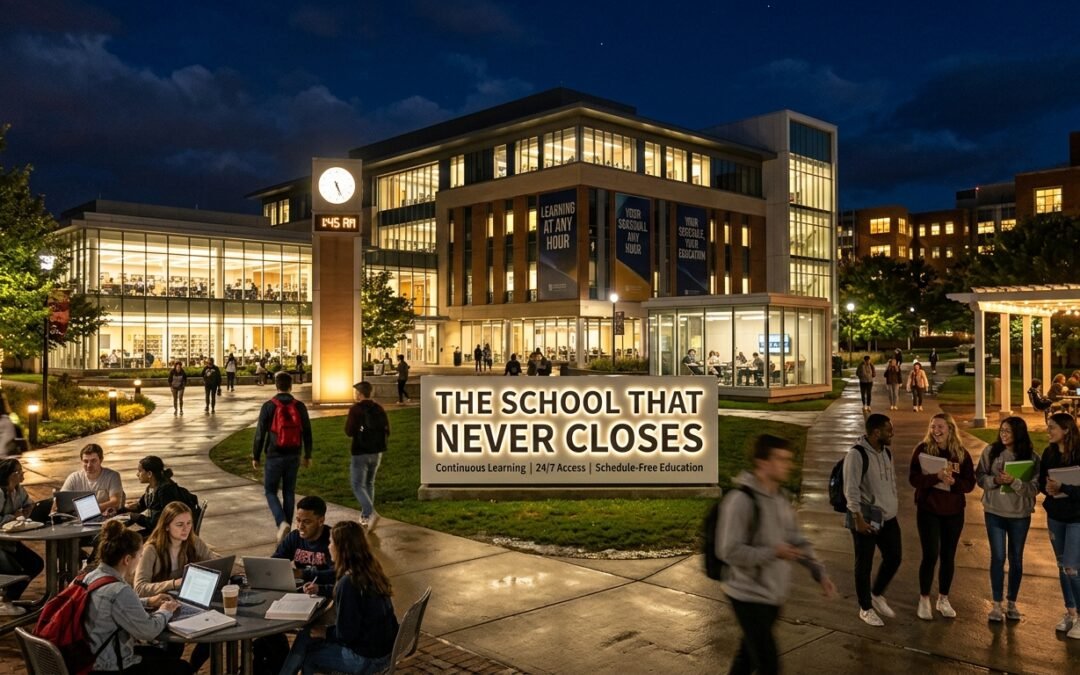
The future of learning does not have to be a school that never closes. It could be a school that closes deliberately, at a time it chooses, having decided what to keep. But that requires institutions to see the timetable not as an obstacle to be automated away but as a piece of infrastructure whose functions they are responsible for. The schools that understand this will keep their students’ time. The schools that do not will find that their students’ time has been kept by someone else.