
|
Getting your Trinity Audio player ready...
|
Ask a teacher what they did today and you will get a list that does not fit any job description. They explained photosynthesis, noticed that a quiet student had stopped eating lunch, rewrote a worksheet because the printed one had a mistake, mediated a dispute over a phone, marked twenty-eight essays, emailed a parent who was worried, adjusted tomorrow’s lesson because today’s ran long, and stayed after the bell because one student finally understood something and wanted to keep going.
That list is the job. Not the content delivery, not the marking, not the pastoral work, but all of it, held together in one person who knows the same thirty students in all of these dimensions at once. The teacher is a generalist in the oldest sense: someone whose value comes precisely from not being specialised.
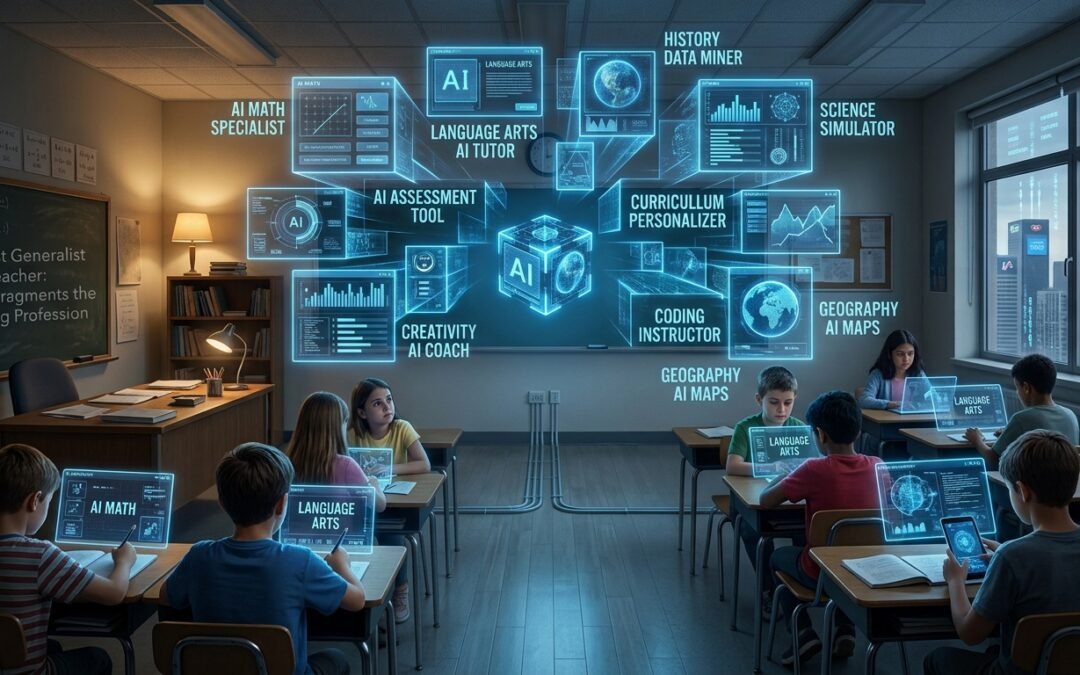
This is the role that AI is now dismantling. Not by replacing the teacher, which is the fear everyone talks about, but by pulling the role apart into components and then asking which components still need a human. The answer to that question, as it is currently being given, will produce a teaching profession that looks more professional, more specialised, and more efficient, and that is in fact hollowed out.
This article is about how that happens, why it is being sold as progress, and what school leaders can do to decide which parts of the role they are going to protect.
The generalist role and why it works
Teaching as a single, integrated role is not an accident of history. It emerged because the components of the job reinforce each other in ways that are easy to miss until they are separated.
The teacher who delivers the content is the teacher who marks the work, which means they see, in the marking, exactly which part of the explanation failed. The teacher who marks the work is the teacher who knows the student, which means they can tell the difference between a student who did not understand and a student who understood but had a bad week. The teacher who knows the student is the teacher standing at the front of the room, which means the relationship built over months makes the explanation land differently than it would from a stranger.
These are not separate tasks that happen to be done by one person. They are one task with several faces. Content knowledge without relationship is a lecture. Relationship without content is a chat. Assessment without either is a number. The generalist teacher is valuable because the integration is where the teaching actually happens.
There is also a simpler reason the role stayed integrated: it is cheap. One salary, one classroom, one adult responsible for thirty children across all dimensions. Every attempt to specialise the role has historically run into the cost of needing more adults.
AI changes that calculation, and that is where the trouble begins.
How the role fragments
The fragmentation does not arrive as a redesign of the profession. It arrives as a series of tools, each of which takes one face of the job and does it well enough.
Content delivery goes first, because it is the most legible. An AI tutor can explain photosynthesis to thirty students at thirty different levels, with infinite patience, at any hour. It does not get the explanation wrong because it is tired. It does not lose the thread because someone threw a pen. For the routine transmission of established knowledge, the tools are already good and getting better.
Assessment goes second. Automated marking of structured work is already common. Marking of extended writing is now within reach. Generated feedback is fluent, specific, and instant. A teacher who spent evenings marking now spends them reviewing what the system marked, and soon spends them on something else entirely.
Planning goes third. Lesson generation, differentiation, resource creation, curriculum sequencing: these are text-generation tasks and the tools are text generators. The teacher who used to build a lesson now selects and adjusts one.
What is left, once content, assessment, and planning are absorbed, is the human residue: the relationship, the noticing, the classroom management, the pastoral care, the judgement about when a rule should bend. And here is where the redesign happens, because once the residue is visible as a residue, it becomes possible to ask whether it, too, should be a specialist role.
So new titles appear. The learning designer, who configures the platforms and sequences the curriculum. The wellbeing coach, who handles the pastoral load. The assessment auditor, who checks that the automated marking is fair. The classroom facilitator, who supervises platform time and manages behaviour. The subject expert, retained for the difficult material the platform cannot handle, spread across many more students than before.
Each title comes with a job description, a training pathway, and, often, a lower salary than the generalist teacher it replaces. Each is defensible on its own terms. Together they are the end of the profession as it has existed.
Why this is sold as professionalization
The language around this shift is uniformly positive, and it is worth understanding why, because the positive framing is not dishonest. It is simply incomplete.
Specialisation is what professions do. Medicine specialised. Law specialised. Engineering specialised. In each case, specialisation was associated with deeper expertise, clearer standards, higher status, and better outcomes. When a school announces that it is creating a learning design team and a dedicated wellbeing function, it sounds like teaching is finally being taken as seriously as those other fields.
Workload is the other argument, and it is a real one. Teachers are exhausted. The generalist role has always been overloaded, and the load has grown as expectations have grown without any corresponding growth in time. Removing marking and planning from the teacher’s evening is a genuine relief. Telling a teacher they no longer have to be a counsellor, a data analyst, and a curriculum designer as well as an instructor is, on its face, kindness.
And there is the efficiency argument, which is rarely stated out loud but drives most of the decisions. A generalist teacher is an expensive way to deliver content that a platform can deliver. If the platform handles instruction, the school needs fewer subject specialists and can staff the residual functions with people who cost less. The specialised roles are attractive to leadership not because they are better but because they are cheaper, and the professionalisation language makes the cost saving look like an upgrade.
The problem is that teaching is not medicine. In medicine, the patient’s condition is the object of the work, and different specialists can examine it from different angles. In teaching, the relationship between the adult and the child is not an angle on the work. It is the work. Splitting it into a content specialist, a wellbeing specialist, and a supervision specialist does not give the child three experts. It gives the child three strangers, none of whom has the integrated picture that made the generalist effective.
What de-skilling looks like from the inside
De-skilling is a specific thing. It is not the loss of a job. It is the transformation of a job so that the judgement and knowledge it used to require are no longer needed, because they have been built into the tool or the process. The craftsman becomes the machine operator. The role survives; the skill does not.
Applied to teaching, it looks like this.
The facilitator supervising platform time does not need to know the subject. The platform knows the subject. The facilitator needs to keep the room quiet and escalate technical problems. Over time, the school stops hiring subject-qualified staff for that role, because subject qualification is no longer required. The facilitator’s judgement about whether a student is confused or bored or struggling at home is not exercised, because the platform is reporting engagement metrics and the facilitator’s job is to respond to those.
The assessment auditor reviewing automated marking does not need to be able to mark. They need to spot anomalies in the system’s output. Over time, the ability to look at a piece of student writing and know, from experience, what the student understood and what they were faking, atrophies, because it is not what the role does.
The learning designer sequencing platform content does not need to have taught. They need to understand the platform. Over time, the people designing what children learn are people who have never stood in front of a class, and the curriculum drifts toward what the platform makes easy rather than what children need.
The subject expert, now spread across two hundred students instead of thirty, cannot know any of them. Their expertise is real but it is delivered as a service, not a relationship, and it is reserved for the hard cases the platform escalates.
None of these people is doing a bad job. All of them are doing exactly what their role requires. The de-skilling is not in the individuals. It is in the system, which no longer requires anyone to hold the integrated judgement that the generalist held.
And the consequence lands on the children, who are now seen by many adults and known by none.
Which parts of the role to protect
Leaders cannot stop the tools from arriving, and should not try. The relief from marking and planning is real, and refusing it would be its own kind of harm. But leaders can decide, deliberately, which functions of the generalist role they are going to protect as integrated, human, and relational, and which they are willing to specialise or automate.
The following framework is a way of making that decision on purpose rather than by default.
Distinguish the transmissible from the relational. Some of what teachers do can be separated from the person doing it without loss: explaining a fixed body of content, marking against a rubric, producing differentiated worksheets. These are transmissible. Other things cannot be separated from the person: knowing which student needs pushing and which needs protecting, noticing the change in a child’s behaviour, deciding that today the lesson plan matters less than the conversation. These are relational. The transmissible can be automated or specialised with modest loss. The relational cannot be specialised without destroying it, because its value lies in the same person doing it across time and context.
Protect a minimum integrated relationship. Every student should have at least one adult who teaches them, assesses them, and knows them, in the same person, across a meaningful span of time. This is not a tutor-group arrangement where a form teacher sees them for ten minutes a day. It is a teaching relationship. The number of students that adult carries should be capped at a level that makes knowing them possible. If the platform handles content for the rest of the day, that is acceptable. If no such adult exists, the school has already fragmented the role, whether or not it has changed the job titles.
Keep subject knowledge in the room. Whoever is supervising learning should be able to teach what is being learned. This is not because the platform needs help explaining. It is because the adult’s judgement about whether learning is actually happening depends on knowing the subject. An adult who cannot tell a correct answer from a confident wrong one cannot supervise learning; they can only supervise behaviour.
Treat new roles as additions, not replacements. A wellbeing coach is a good thing to have. A learning designer is a good thing to have. They should be added to a school that retains generalist teachers, not created by carving up the generalist role. The test is simple: after the reorganisation, is there still someone who does what the generalist did? If the answer is that those functions are now distributed across four people, the profession has been fragmented, and it should be named as such in the plan.
Audit the training pipeline. If the school, or the system, is hiring facilitators without subject qualifications, learning designers without classroom experience, or assessment staff without marking experience, it is building the de-skilled profession one recruitment at a time. Hiring criteria are where the future of the role is actually decided.
Measure what the generalist did. The functions of the integrated role are invisible in most school data. Engagement, attainment, and attendance are tracked. The number of students who have an adult who knows them is not. Leaders should find a way to count it, because what is not counted is what gets specialised away.
The choice about the role
There is a version of this future that is good. It is one in which the tools take the transmissible load, teachers are freed from the evening marking and the weekend planning, and the generalist role survives with a smaller class and a lighter burden, doing the relational work that it was always best at. That version requires leaders to decide, in advance, that the integrated role is the thing to protect and the tools are the thing to fit around it.
The other version is the one that happens if no such decision is made. The tools take the transmissible load, the residue is specialised because specialisation is cheaper, the generalist is retired with a professional-sounding farewell, and the children are handed to a system that sees them from many angles and knows them from none.
The last generalist teacher will not be sacked. They will be promoted to learning designer, or moved to wellbeing, or given three hundred students and called a subject lead. The role will not end with a decision. It will end with a reorganisation that nobody called a decision. Which is exactly why the decision needs to be made now, explicitly, by the people who still have the authority to make it.