|
Getting your Trinity Audio player ready... |
For most of the history of schooling, the teacher was the main source of knowledge. Books were scarce, experts were far away and the classroom was where information was delivered. That model made sense when information was expensive. It makes much less sense when a student can find a clear explanation of almost anything on a phone in seconds.
If knowledge is free, what are teachers for? The answer is not “less than before”. It is something different and harder: the design of learning. The profession is shifting from delivering content to engineering the conditions in which students actually learn.
What teachers do that content cannot
A video explains. An AI answers. Neither of them knows the student in front of them. The work that remains distinctively human falls into six areas.
- Curation. Selecting which explanations, examples and sources are good, accurate and right for these students. Abundance makes selection more valuable, not less.
- Sequencing. Deciding what comes first, what builds on what and when to return to earlier ideas. Random access to content does not create a coherent path.
- Diagnosing misconceptions. Noticing, from a student’s answer or question, exactly where their thinking has gone wrong. A teacher who listens can see what a platform cannot.
- Feedback. Responding to specific work with specific guidance, and judging when to push and when to support.
- Building habits. Teaching students how to study, persist, check their own understanding and ask for help. These are learned, and they decide how well a student can use free content.
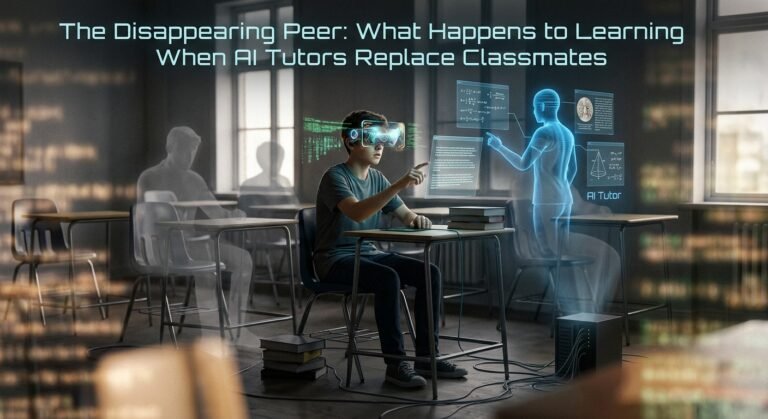
- Motivation and belonging. Creating a reason to learn and a community in which it is safe to be wrong, something I looked at in The Disappearing Peer.
The equity dimension
When content is free, the students who benefit most are the ones who can direct their own learning. That includes strong readers, students with study skills and those with adults who guide them. Others get lost in abundance, or settle for whatever the algorithm serves them.
The teacher’s design work is the main equaliser. A well-designed classroom gives every student the structure that confident self-directed learners build for themselves. Reducing the teacher’s role to content delivery, or replacing it with a platform, removes that structure from the students who need it most.
The risk: de-skilling and misplaced efficiency
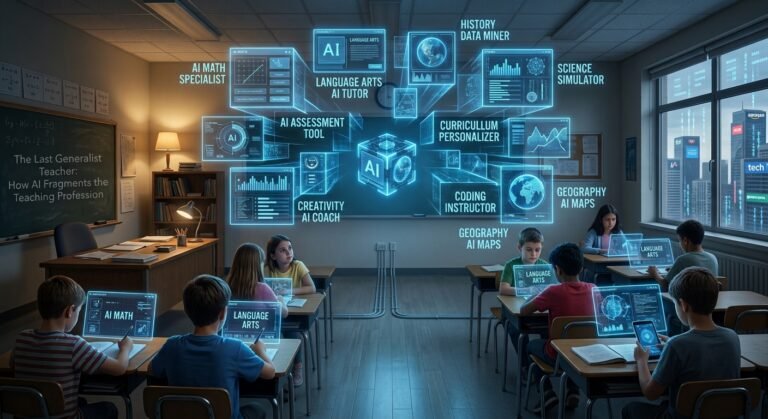
Many EdTech products promise to take over parts of this work: automated sequencing, automated feedback, automated diagnosis. Some help. But when schools adopt them mainly to cut cost or teacher time, the design work is quietly removed from teachers and given to systems nobody reviews. That is the pattern I described in The Last Generalist Teacher.
It also changes how teachers are valued. If their worth is measured by content knowledge, which is now cheap, they look replaceable. If it is measured by learning design, which is not, the profession is stronger.
What schools need to do
- Redefine the role in writing. Update job descriptions, appraisal criteria and timetables to centre on learning design, not content coverage.
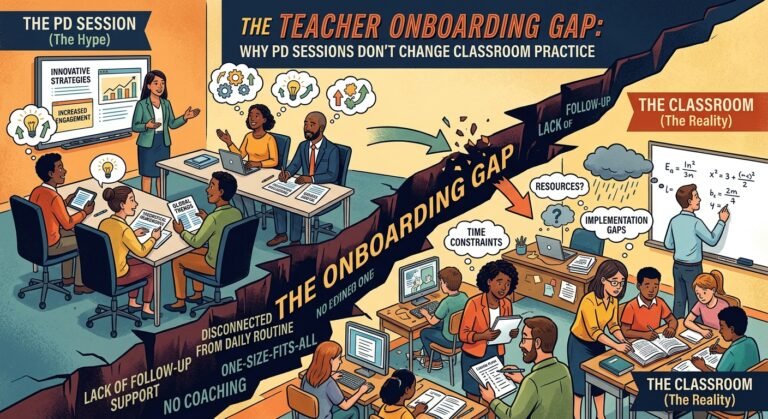
- Train for design. Offer sustained coaching on sequencing, formative assessment, feedback and misconception diagnosis, rather than another tool workshop.
- Free up time for it. If teachers are still expected to deliver every explanation live, they have no time to design. Use quality curated content for delivery where appropriate.
- Keep the teacher in the loop. Any tool that sequences, grades or diagnoses should let a teacher see, question and override what it does.
- Teach students to learn. Build explicit study-skill instruction, including retrieval practice and self-testing, into regular lessons.
- Value the relationship. Protect time for teachers to know their students, because that knowledge feeds every design decision.
- Measure what matters. Judge teaching by evidence of student learning and growth, not by volume of content delivered or tools used.
The question for your leadership team
Look at how a typical teacher in your school spends a week. How much of it is delivering information that a good video could deliver, and how much is designing, diagnosing and giving feedback? The balance tells you which model your school is actually running.
Related Reading
- Synthetic Teachers
- What Teachers Actually Need from Their LMS
- Why Teachers Are Becoming Data Analysts
- The YouTube Illusion