|
Getting your Trinity Audio player ready... |
Almost every student now has access to a free, patient explanation of nearly any topic. A well-made video can walk through a maths method, a chemistry mechanism or a history debate more clearly than many classroom lessons. AI summaries add a second layer: ask a question and receive a tidy answer in seconds.
It is tempting to conclude that knowledge is now abundant, so learning must be solved. It is not. The more fluent the explanation, the more convincing the illusion that the learner has understood. This is the YouTube illusion: watching an explanation feels like learning, but feeling is not the same as knowing.
Why fluent explanations mislead
Learning scientists have long described the illusion of fluency. When material is presented clearly, the learner finds it easy to follow and mistakes that ease for mastery. The test of learning is not whether you can follow an explanation. It is whether you can reproduce and apply it later, without help.
- Passive consumption. Watching requires little effort and produces little durable memory.
- No retrieval. Rarely does the viewer close the video and try to recall the steps from memory, which is where much of the learning happens.
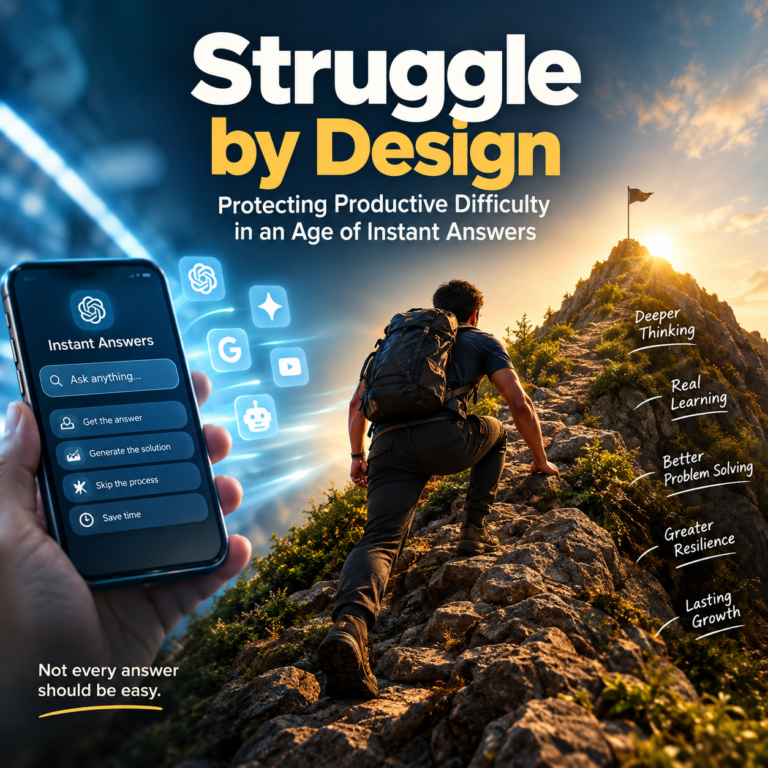
- No struggle. A good presenter removes the confusion that would force the learner to think. The confusion was doing useful work.
- Misplaced confidence. After a clear video, students rate their understanding highly, and they are often wrong until they are tested.
- Endless recommendations. Platforms encourage the next video, not the practice, so students move on before anything is consolidated.
AI summaries intensify each of these. A student can receive a ready-made answer without watching, reading or reasoning at all, a risk I explored in Is AI Making Us Smarter or Lazier?.
The equity dimension
Free video is a real gift, and many students use it brilliantly. But the benefit is uneven. Students who already know how to study will pause, take notes, test themselves and look for gaps. Students who do not will watch and move on. They also have less adult support to notice the difference.
A school that tells students to “just watch videos at home” widens that gap. It hands the hard part of learning, the practice, to the people least prepared for it. Access to content has been solved, but access to the habits that turn content into knowledge has not.
What schools can do
The aim is not to discourage video or AI. It is to design the tasks around them so that learning actually happens.
- Pair every video with a retrieval task. After watching, students close the screen and write down what they remember, then check. A short blank-page exercise does more than a second viewing.
- Ask for explanation, not summary. Have students explain the idea to a peer or teacher, in their own words, with an example the video did not use.
- Use low-stakes quizzes. Frequent, ungraded or lightly graded checks at the start of the next lesson reveal what stuck and reinforce it.
- Space it out. Return to the same material after a few days and again after a few weeks. A single viewing rarely lasts.
- Apply it. Move quickly from watching to solving a new problem, building something or critiquing a flawed example.
- Teach students the illusion. Show them how easy it is to feel confident and fail a test of recall. Experiencing it themselves is persuasive.
- Curate, do not just recommend. Point students to a small number of trusted explanations and tell them what to do with each.
- Protect in-class time for practice. If students can watch the explanation anywhere, the classroom is best used for the effortful part, with a teacher present to catch errors.
This shifts what teachers are for, which I explore in From Content Delivery to Learning Design.
A simple test for any home-learning task
Ask whether the student will have to produce something from memory by the end of it. If the only requirement is to watch, read or generate a summary, then the task measures exposure, not learning.
The question for your next curriculum meeting
Take one topic where students are told to watch a video or use an AI explanation. What would a teacher see a week later that proves the student learned it? If nothing, the task is feeding the illusion.
Related Reading
- From Memorization to Mastery
- Blended Learning Done Wrong
- The Digital Divide Is No Longer Just About Access
- Struggle by Design