|
Getting your Trinity Audio player ready... |
Governments are moving from advice to enforcement on AI in education. Sharjah has just published an ethical framework for private schools. The UAE has banned generative AI for under-13s and in formal exams. Saudi Arabia, China, Singapore and India are building AI into curricula, the EU has made AI literacy a legal duty, and Australia’s higher education regulator is moving to firmer oversight. If you lead a school or an academic community, the question is not whether rules will reach you, but whether you will be ready. This is part two of a series: see part one, the global roundup of government AI rules for education.
The good news is that these frameworks agree on far more than they differ. A school that builds a few solid habits now will be close to compliant almost anywhere.
What every regulator wants
- AI is taught as a skill, but young children don’t get unsupervised access.
- Teachers stay in charge, and AI supports them instead of replacing them.
- Exams and assessments of independent mastery stay AI-free.
- Only approved or vetted tools are used.
- Student data is protected, and personal data stays out of AI systems.
- Use is disclosed, and academic integrity rules apply.
Build your preparation around these six ideas.
Step 1: Find out what is already in use
Start with an honest inventory. List every AI tool that staff and students use, including the ones nobody approved, and the AI features hidden inside tools you already own such as your LMS, ERP, plagiarism checker, proctoring software and admissions system. For each tool, note who uses it, what data goes in, and where the vendor stores it. This list is the foundation for everything else, and the first thing an inspector or auditor will ask for.
Step 2: Build an approved-tools list
Many regulators require that classroom AI tools meet defined standards, and some ban unapproved platforms outright. Don’t wait to be told. Keep two lists, approved and not approved, and vet each tool with four questions:
- Does the vendor sell student data or train its models on it?
- Is the tool legally and practically suitable for the ages using it?
- Where is the data hosted, and who can access it?
- Can you restrict it by grade, class or user group?
Review the list every term, because tools change their terms and features constantly.
Step 3: Write a short policy people will read
A forty-page policy sits in a drawer. Aim for two to four pages covering which tools are allowed, for whom and from what grade; what must never be entered into an AI tool, such as student names, grades, health details and family information; how students and staff disclose AI use; the rules for exams and assessments; and consequences, linked to your existing academic integrity policy. If a Grade 9 student and a parent can both understand it, you’ve done it right.
Step 4: Set age rules early
The age of 13 appears again and again, in UNESCO’s guidance and in rules from the UAE and Saudi Arabia. Even if your regulator hasn’t acted yet, adopt a simple ladder now:
- Under 13: no independent use of generative AI tools; teacher-led demonstrations only.
- 13 and above: supervised use with approved tools.
- Upper grades: more independence, with disclosure and clear limits.
This is one of the cheapest rules to adopt and one of the most likely to become mandatory.
Step 5: Redesign assessment
This is the hardest step and the most important. Regulators and researchers increasingly accept that detecting AI-written work is unreliable, so don’t build your integrity system on detectors alone. Build assessments that survive AI:
- Keep core-skill checks in class, under supervision.
- Use oral defences, presentations and short viva-style questions.
- Ask for process evidence such as drafts, notes and reflections.
- Use applied, local or personal tasks that are hard to outsource.
- State clearly, task by task, whether AI is allowed, limited or banned.
Treat any detector result as a reason to talk to the student, never as proof of misconduct.
Step 6: Train teachers first
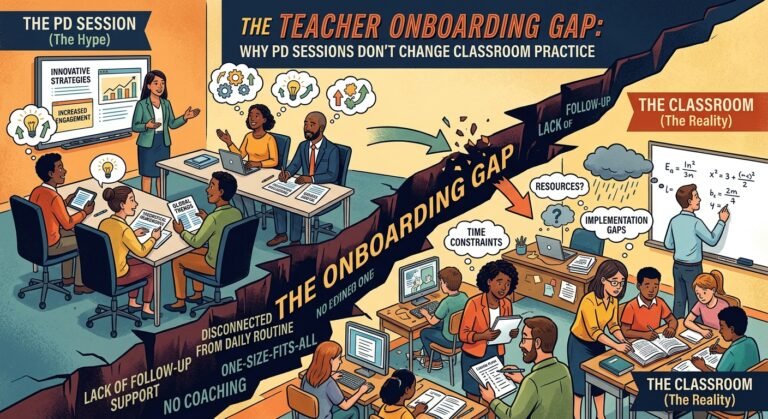
Policies fail when the people carrying them out don’t understand the tools. Run short, hands-on sessions where teachers practise real tasks: planning lessons, writing feedback, spotting hallucinations and bias, and using AI without exposing student data. Appoint an AI lead for each school or department who can answer questions and collect concerns. The EU’s requirement for staff AI literacy is a useful benchmark even outside Europe.
Step 7: Teach students to think with AI, not hide behind it
Rules matter, but literacy is the real defence. Singapore’s approach is a good model: students learn about AI, learn to use it, learn with it, and learn when using it would hurt their own learning. Cover verifying AI answers against real sources, bias and unreliable outputs, privacy and what not to share, deepfakes and misinformation, and when struggling through a problem yourself is the point.
Step 8: Treat student data as the red line
If one thing can cause real harm, it’s data. Do a privacy review before adopting any tool, use institutional accounts instead of personal ones, and tell parents which tools are in use and what data they handle. Be especially careful with any system that profiles students or influences grading, admissions or progression. The EU treats those as high-risk, and other regulators are likely to follow.
Step 9: Bring parents and students into the process
Publish a one-page summary of your AI approach, hold at least one parent session a year, and put a student representative on the review committee. People support rules they helped shape, and parents often raise the questions that expose gaps.
Step 10: Set up governance and review it
Form a small AI committee with school leadership, IT, teachers, a parent and a student. Meet once a term, keep a simple incident log for data leaks, cheating cases and harmful outputs, and revise the policy every year. Australia, the UK and Singapore have all revised their guidance within a year or two, and yours will need the same.
Extra steps for universities
- Put an AI statement in every syllabus: what is allowed, what must be disclosed, what is banned.
- Reform assessment across a whole programme, not one course at a time.
- Validate any AI grading tool, and keep a human making the final marking decision.
- Be ready to show accreditors how you manage AI risks to assessment integrity.
- Build baseline AI competency for all students, a direction Saudi Arabia and Singapore are already moving.
A realistic timeline
- First 30 days: complete the tool inventory, set interim rules on personal data and exams, and name an AI lead.
- Days 30 to 90: publish the approved-tools list and short policy, and begin teacher training.
- Within the next term: redesign assessment in core subjects, brief parents, and start student AI literacy lessons.
- Ongoing: meet termly, log incidents, and update the policy each year.
Common mistakes to avoid
- Banning everything and driving use underground.
- Relying on AI detectors as proof.
- Letting staff adopt tools one by one with no review.
- Writing a policy once and never updating it.
- Training students but not teachers.
- Ignoring data protection because the tool looks free.
Conclusion
You don’t need to predict every regulation. The frameworks from the UAE, Saudi Arabia, China, Singapore, the EU, the UK, Australia and UNESCO all point the same way: keep humans in charge, protect student data, keep exams honest, use only approved tools, and teach students to think critically about what AI tells them. The schools that begin now will treat new rules as a minor adjustment. The first step costs nothing: list every AI tool your school is already using.