|
Getting your Trinity Audio player ready... |
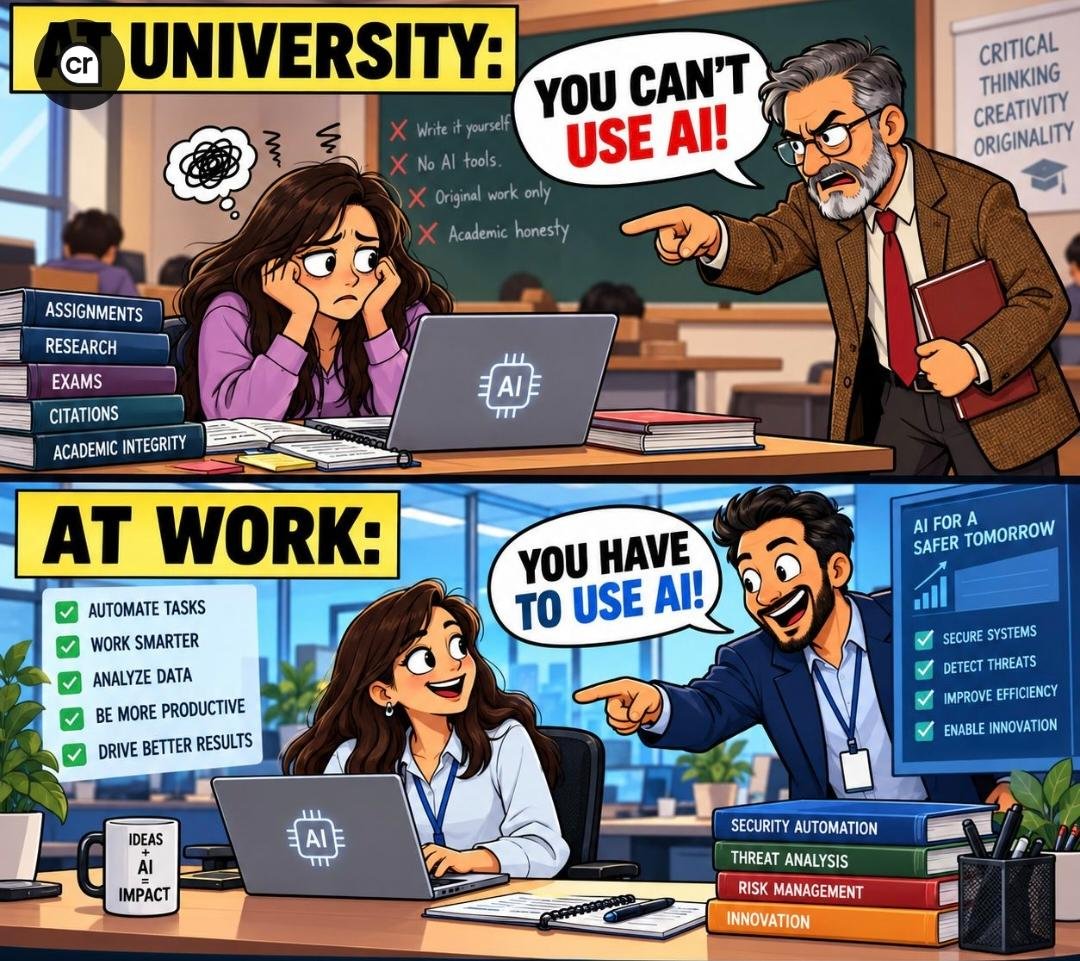
A meme has been circulating that captures a real problem. In the top panel, a stressed student sits in a university classroom while her professor points at her and says, “You can’t use AI!” The board behind him lists the rules: write it yourself, no AI tools, original work only. In the bottom panel, the same student is at her first job, and her manager is pointing at her again and saying, “You have to use AI!” The wall behind him lists automating tasks, working smarter, analyzing data and driving better results.
It’s funny because it’s true. In a few months, the same tool goes from academic misconduct to a performance expectation. The student didn’t change, and the tool didn’t change. Only the room did.
The real gap
Blaming professors for being strict misses the point. Academic integrity matters, and critical thinking, originality and honest work are the foundation of any education. The problem is that most universities have responded to AI with prohibition instead of preparation.
Meanwhile, employers are asking for something different. They want graduates who can automate repetitive work, analyze data quickly, write and review faster, and spot risks early. In fields like IT and cybersecurity, they want people who can use AI to detect threats, secure systems and manage risk at a speed no human team can match by hand.
A graduate who spent four years avoiding AI and then gets hired into an AI-driven workplace is underprepared. Education that treats the most important tool of the decade as contraband isn’t protecting students. It is leaving them behind.
This isn’t only an AI problem
AI exposes a deeper issue. In many programs, the curriculum is years behind the industry it claims to serve. Courses are built on textbooks that take years to update, taught by faculty who may have never worked in the field, and assessed through exams that reward memorization over judgment. Students graduate with theory but little experience in real workflows, real tools, real deadlines and real ambiguity.
AI just makes the gap impossible to ignore, because it changes the skills that matter faster than any curriculum committee can meet.
What universities can do today
None of this requires a ten-year reform plan. These changes can start this semester.
1. Replace blanket bans with clear policies. “No AI” is easy to write but impossible to enforce, and it teaches students to hide their usage instead of using it responsibly. A better policy says which tasks allow AI, which don’t, and why. Some assignments should be AI-free to build core skills. Others should require AI, with the student judged on how well they use it.
2. Assess the process, not just the final product. If a student can produce an essay with one prompt, the essay was never a good measure of learning. Ask students to submit their prompts, show their drafts, critique the AI’s output, and defend their reasoning in a short oral discussion. The skill being tested becomes judgment, not typing.
3. Teach AI literacy as a core subject. Every student, whatever the major, should understand how these systems work, where they fail, how they hallucinate, what bias looks like, and what data is safe to share. This is basic professional literacy now, the way spreadsheets and email were in earlier decades.
4. Bring industry into the classroom. Invite practitioners as guest lecturers, run projects with real companies, and build advisory boards that review the curriculum every year. A short loop between industry and academia is the best defense against outdated courses.
5. Train the teachers. Many faculty feel threatened by AI because nobody has shown them how to use it well. Universities should invest in training so professors can redesign assignments, not just police them.
How to teach AI fairly
Fairness is the hardest part, and it’s where good intentions often go wrong.
Access must be equal. If AI tools are expected, the university should provide them, so that students who can afford premium subscriptions don’t gain an advantage over those who can’t.
Rules must be transparent. Every course should state in the syllabus what is allowed, what isn’t, and how to disclose AI use. Students shouldn’t have to guess, and no one should be penalized for an unwritten rule.
Skills must be tested both ways. Students need to prove they can think without AI and also that they can work effectively with it. A pilot who only flies on autopilot is dangerous, and so is one who refuses to use it. Fair education covers both.
Detection tools should not be the judge. AI detectors are unreliable and have wrongly accused honest students, especially non-native English speakers. Accusations should rest on conversation and evidence of the student’s own understanding, not on a percentage score from a black box.
Integrity must be redefined, not abandoned. Academic honesty today means being transparent about how you did the work. Using AI and hiding it is dishonest. Using it and disclosing it, with your own thinking on top, is a professional skill.
The future workforce
The student in the meme isn’t confused because she lacks ability. She’s confused because two institutions that should be working toward the same goal are sending opposite signals. Universities exist to prepare people for life and work. If work now expects AI fluency, then education has a responsibility to teach it, along with the judgment, ethics and critical thinking that make AI use trustworthy.
The best graduates of the next decade won’t be the ones who avoided AI or the ones who depended on it blindly. They’ll be the ones who learned to question it, direct it and take responsibility for the result.
Universities have a choice. They can keep telling students “you can’t,” and watch employers say “you must” a few months later. Or they can close the gap now, and give students four years to learn what the workplace will demand on day one.