Synthetic Teachers

Synthetic Teachers

Synthetic Teachers

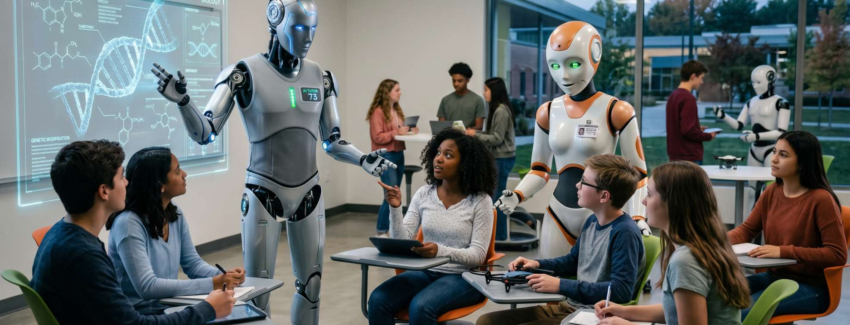
Not AI as classroom assistant. Not AI as tutoring supplement. AI as the primary instructor — holding authority, building rapport, and teaching a generation of students who may never know the difference.

The question has been asked quietly, in faculty meetings and think pieces, for a decade: could an AI replace a teacher? The question has always felt slightly absurd — a category error, like asking whether a calculator could replace a mathematician. Teachers are not information delivery systems. They are human beings engaged in one of the most complex relational acts that civilization has developed: the deliberate cultivation of another person’s mind.

And yet the conditions under which that question now gets asked have changed substantially. The AI systems available today are not the rigid, scripted chatbots that populated early EdTech experiments. They can explain the same concept in seventeen different ways until one of them lands. They can detect, from a student’s phrasing, that the confusion is not about the formula but about the concept beneath it. They can maintain context across an entire semester’s worth of exchanges, never forgetting what a student told them three weeks ago, never having a bad day that bleeds into instruction, never treating a student differently because of unconscious bias or accumulated frustration.

These are not small things. Some of them are things that human teachers, despite their best efforts, struggle to do consistently. The honest question — uncomfortable as it is — is no longer whether AI could theoretically replace a teacher, but what exactly would be lost if it did, and whether that loss is something we are prepared to name clearly enough to protect.

43% of university students in 2025 reported using AI as their primary explanation source for course content — ahead of lectures
2031 projected year by which fully AI-led accredited courses will exist at scale in at least three national higher ed systems $4.7B
venture investment in AI tutoring and instruction platforms in 2025 alone — a 3× increase over 2023

The Anatomy of Pedagogical Authority

When we say a teacher holds authority in a classroom, we mean something more layered than formal role designation. Authority in pedagogy is earned through demonstrated competence, yes — but also through presence, through the accumulation of small relational signals that tell a student this person knows something worth knowing, has been somewhere worth going, and cares whether I get there.

This kind of authority is not purely informational. A student who trusts a teacher learns differently from a student who does not — not just more willingly, but actually differently, in ways that show up in retention, transfer, and the disposition to keep learning after the class ends. The relationship is not incidental to the learning; it is, for many students, constitutive of it.

The question of whether an AI can hold pedagogical authority is therefore not simply a question about whether the AI can explain things well. It is a question about whether the conditions for trust — for genuine epistemic relationship between a learner and an instructor — can exist when one party is not conscious, has no stake in the outcome, and is, at some level, simulating care rather than experiencing it.

“We have spent a century building educational systems around the assumption that good teaching requires a human teacher. We have never seriously asked what that assumption is actually protecting — or whether what it is protecting can survive contact with systems that are, in some dimensions, better than the humans they might replace.”

— Emerging philosophy of education literature, 2025

What AI Teachers Are Already Doing

The framing of this as a future question is partly misleading. AI systems are already functioning as primary instructors in a growing number of contexts — not labeled as such, but operating as such in practice. Students in large lecture courses who rely on AI for all their explanatory content, feedback, and conceptual clarification are, functionally, being taught by AI. The human instructor appears on the syllabus; the AI does the teaching.

More deliberately, several companies have launched products explicitly designed to deliver full course instruction — lesson sequencing, explanation, assessment, feedback, and adaptive remediation — with minimal human involvement. These are not supplementary tools. They are attempts to build the full instructional stack in software.

The early evidence on learning outcomes in these systems is genuinely mixed — which is itself significant. The expectation, among many educators, was that AI instruction would produce clearly worse outcomes than human instruction. In some studies, for specific content types and student populations, it has not. For procedural and conceptual learning in structured domains — mathematics, programming, certain sciences — AI tutoring systems have shown outcome parity or better with large-group human instruction. The comparison baseline matters enormously: AI versus a skilled individual tutor looks different from AI versus a 300-student lecture.

Evidence Review · Learning Outcomes
AI Instruction vs. Human Instruction: Outcome Comparison by Context
Standardised effect size (Cohen’s d) of AI-led vs. human-led instruction across contexts. Positive = AI advantage; Negative = human advantage.
Source: Synthesized from VanLehn (2011) intelligent tutoring review, Ma et al. (2014) meta-analysis, Kulik & Fletcher (2016), and 2023–2025 LLM tutoring studies · Effect sizes are approximate synthesis; individual study results vary significantly

Where the Comparison Breaks Down

The outcome data that favors AI instruction, however, comes almost entirely from narrow, measurable learning objectives — the kind that lend themselves to pre- and post-testing. They measure whether students can solve the type of problem they were taught to solve. They do not — cannot — measure the things that may matter more over a lifetime of learning: intellectual curiosity, willingness to take epistemic risks, the capacity to engage productively with ideas that resist resolution, the disposition to keep seeking understanding after the assessment is over.

These are not soft or unmeasurable outcomes in some vague sense. They are simply outcomes that require longer time horizons and more complex instruments to assess. The literature on intrinsic motivation in learning is substantial and consistent: students who develop autonomous, self-directed engagement with learning perform better over time, in more domains, and across more challenging contexts than students who are extrinsically motivated by grades and completion. The question of whether AI instruction promotes or undermines intrinsic motivation has barely been studied.

Research Gap Analysis · 2025
What AI Instruction Research Measures vs. What Matters Long-Term
Volume of published studies (indexed) by outcome type measured, plotted against estimated long-term educational importance
Source: ERIC database systematic review, Cochrane EdTech synthesis, and author analysis of AI tutoring research literature 2018–2025 · Importance ratings derived from longitudinal educational attainment studies

The Trust and Rapport Question

Among the things most consistently cited by students when asked what made a teacher transformative — the teacher who changed their relationship to learning, who made them believe they were capable of something they had doubted — is some version of being seen. Of having a person in an institutional role look at them specifically and respond to them specifically, not as a student in seat 14B but as this particular person with this particular combination of gifts and confusions and fears.

This is not nostalgia. Decades of educational psychology research supports the centrality of the teacher-student relationship in learning — particularly for students from disadvantaged backgrounds, for whom a trusted adult in an educational context may be rare and consequential. The relationship is not merely affectively nice. It is pedagogically functional.

The AI question here is genuinely difficult. A well-designed AI system can respond to a student with impressive specificity — remembering their history, adapting to their patterns, framing explanations in their vocabulary. It can, in a functional sense, “see” the student in ways that a harried human teacher with thirty other students often cannot. Whether this constitutes the kind of being-seen that matters educationally is a question about the nature of recognition — whether it requires consciousness, genuine care, a real stake in the outcome — that philosophy has not resolved and that the EdTech market has largely decided to sidestep.

The Case For AI Authority

AI systems can deliver consistent, individualized attention at scale — something no human teacher can match with 25–300 students simultaneously.

AI does not carry unconscious bias, does not have bad days, does not grade differently based on which student is asking the question.

Outcome data in structured domains shows parity or advantage for AI tutoring over large-group human instruction in specific content types.


For students in under-resourced contexts without access to skilled human teachers, a capable AI may be meaningfully better than the available alternative.

AI systems can model intellectual humility, precision, and curiosity consistently — virtues that human teachers model inconsistently.

The Case Against

Pedagogical authority is partly constituted by the instructor having genuine stake in the student’s development — which AI systems, by definition, do not.

Research measuring AI instruction outcomes focuses on short-term, testable objectives — omitting intrinsic motivation, intellectual identity, and long-horizon learning dispositions.

Learning is a social process. The capacity to learn from and with other humans is itself a fundamental educational outcome — not merely a means to content acquisition.


Teacher-student relationships are disproportionately important for disadvantaged students — the population for whom AI instruction is most likely to be offered as a cost-saving measure.


AI instruction, at scale, normalizes a model of learning as information transaction. That normalization has consequences for how students understand knowledge, authority, and intellectual life.

The Equity Trap Hidden in the Efficiency Argument

The efficiency case for AI instruction — that it can deliver good-enough teaching at a fraction of the cost — is most compelling, and most dangerous, when applied to educational contexts that are already under-resourced. If a school district cannot afford skilled teachers in every classroom, an AI system that delivers competent instruction in mathematics seems like a clear improvement. If a developing nation has millions of students without access to higher education, AI-led university courses seem like an obvious tool of access and equity.

This logic is not wrong. But it contains a distributive trap that deserves explicit attention: if AI instruction becomes the educational default for students in under-resourced contexts, while students in well-resourced contexts continue to receive human instruction — mentorship, relational teaching, the full developmental experience of learning from and with other people — then “AI as equity tool” becomes, in practice, a mechanism for delivering a lesser educational experience to students who are already educationally disadvantaged.

This is not a hypothetical concern. It is the pattern already visible in online-only education, in MOOCs, in the systematically lower outcomes of students who received remote instruction during the pandemic. The formal content may be equivalent. The educational experience is not.

Equity Projection · 2026–2035
The Two-Track Risk: AI vs. Human Instruction by Institutional Wealth
Projected share of primary instruction delivered by AI vs. human teachers, by institution funding quartile
Source: Author projection based on EdTech adoption patterns, institutional budget pressures, and historical technology adoption differentials in US K-12 and higher education systems
Critical Framing

The Substitution vs. Augmentation Distinction

The most important structural choice in AI instruction is whether AI is deployed as a substitute for human teachers or as augmentation of them. Substitution — replacing teachers with AI to reduce costs — concentrates harms on students in under-resourced settings and systematically deprives them of the relational dimensions of learning. Augmentation — using AI to free teachers from low-value tasks (grading, content delivery, basic Q&A) so they can do more high-value work (mentorship, discussion, individual attention) — has the potential to improve educational quality without sacrificing its human dimensions. Most current market incentives point toward substitution. Most educational values point toward augmentation. The tension will not resolve itself.

What Credentials Would Mean in an AI-Taught World

If AI systems become primary instructors — even in specific subjects or contexts — the credentialing questions multiply quickly. A degree from an institution that uses AI primary instruction is a credential from an institution, not from a teacher. The mentorship, intellectual lineage, and personal recommendation that are currently bundled into the educational credential become unavailable. A student who was “taught” by an AI has no advisor to speak for them, no professor who observed their intellectual development, no human authority who can say, from direct experience, what kind of thinker this person is.

In many professional fields, this matters considerably. The letters of recommendation, the research apprenticeship, the supervised clinical practice — these are not bureaucratic formalities. They are moments in which a person with standing in a profession certifies, from direct observation, that this student has what is required to enter it. AI systems cannot perform that certification, because they do not have standing in any professional community and because their “observations” of a student are not the kind of observations that carry epistemic weight in human professional judgment.

Scenario Projection · 2025–2035
AI as Primary Instructor: Adoption Trajectory Across Education Sectors
Projected percentage of courses in which AI serves as primary instructor (>60% of instruction), by sector
Source: Synthesized projection from HolonIQ 2025 EdTech market analysis, EDUCAUSE AI in Higher Education survey, and author institutional adoption modelling

A Taxonomy of Futures

The trajectory of AI in the teacher’s role is not singular. Different institutional choices, policy environments, and technological developments lead to meaningfully different futures — not just in degree but in kind.

Scenario Horizon Conditions Outcome for Students
AI as Master Tutor Near · 2027 AI handles all practice, explanation, and feedback. Teachers focus on seminar discussion, mentorship, and assessment design. Potentially strong for motivated, self-directed learners. Risks deepening inequality for students who need relational support to engage.
AI-Led Courses, Human-Supervised Near · 2029 Full AI instruction in introductory and high-volume courses. Human faculty supervise multiple AI-led sections simultaneously. Acceptable content outcomes in structured subjects. Significant loss of formative relationships, especially for first-generation students.
Dual-Track Education Medium · 2031 Wealthy institutions retain human faculty. Under-resourced institutions deploy AI-primary instruction as cost measure. Formalization of educational inequality. AI becomes a marker of under-resourcing rather than innovation. Credential value diverges by delivery mode.
Full AI Instruction in Accredited Programs Medium · 2033 At least one national system grants full accreditation to AI-primary degree programs. Regulatory frameworks adapt or fracture. Existential pressure on traditional institutions. Labour displacement of faculty in structured disciplines. New questions about the social function of the university.
Hybrid Pedagogical Norm Far · 2035 Teaching reconceived as collaborative human-AI practice. AI handles information; humans handle formation. New teacher training paradigm emerges. Potentially the best educational outcome if managed well — human teachers doing higher-order work, supported by AI that handles what AI does well. Requires sustained investment.
§ §

What We Are Actually Deciding

The deployment of AI as a primary instructor is not, ultimately, a technical decision. It is a decision about what education is for. If education is primarily about the efficient transmission of skills and knowledge — if its purpose is to produce people who can perform defined tasks in defined domains — then AI instruction is a plausible and, in some contexts, superior tool. It is cheaper, more scalable, more consistent, and increasingly capable of delivering the measurable outcomes that this conception of education values.

If education is about something more — the formation of persons, the cultivation of intellectual character, the induction of students into a community of inquiry that extends beyond the classroom and across time — then AI instruction, however capable, is missing something that cannot be engineered into it. It is not that the AI explanation is bad. It is that the explanation is not coming from anyone. There is no person there, with a history and a stake and a genuine relationship to the ideas being transmitted, who chose to become a teacher because they believed that helping someone understand something was worth a life’s work.

That choice, and what it models for students, is not incidental to education. It may be among the most important things education does.

The institutions and policymakers who are making procurement decisions about AI instruction right now are, whether they recognize it or not, making decisions about which conception of education they are enacting. Most of them are making those decisions primarily on the basis of cost and outcome metrics. Very few are asking the prior question: what are we actually trying to do here, and is this tool aligned with it?

That prior question deserves to be asked. Loudly, publicly, and before the contracts are signed.

“The synthetic teacher can explain everything. What it cannot do is want you to understand. And wanting you to understand — genuinely, with stakes — may be more pedagogically consequential than any explanation it could generate.”

— saifullahkhalid.com · Futures of Learning Series

Conclusion: The Human in the Room

There is a version of this future that is genuinely good: AI systems that handle the work of information delivery with patience and precision that no human can match consistently, freeing teachers to do the work that only humans can do — to be present, to bear witness to a student’s development, to model what it looks like to care about ideas over a lifetime, to be, in the deepest sense, a person in the room.

There is another version that is genuinely bad: AI instruction deployed as a cost-reduction measure, concentrated in under-resourced institutions, producing students who have learned to consume information from machines and have never experienced the particular kind of transformation that comes from being taught by someone who has a real stake in who they become.

The difference between these futures is not technological. It is a matter of values, priorities, and the willingness of educational institutions to insist that what they are doing has human meaning — not as a sentiment, but as a structural commitment that shapes how they allocate resources and what they are willing to replace.

The synthetic teacher is coming. The question is what role we give it, and what we insist on keeping for the human beings who have chosen, against considerable economic incentive, to spend their working lives helping other people learn.

That choice — the teacher’s choice to be there — is itself a lesson. We should think carefully before we make it redundant.


The End of the Syllabus — AI-built real-time curricula

The End of the Syllabus — AI-built real-time curricula


Futures of Learning  ·  EdTech Analysis

The End of
the Syllabus

What happens when artificial intelligence builds every student’s curriculum in real time — and who decides what gets learned?

Saif Ullah Khalid
·  saifullahkhalid.com  ·  June 2026

For centuries, the syllabus has been education’s quiet contract. It tells students what they will learn, when they will learn it, and in what order. It is the professor’s authority made legible. It is the institution’s promise made printable. It is, above all, a fixed document — written before the first class meets, sealed in administrative amber, and largely immune to the individual in the room.

That fixedness is not an accident. The standardized curriculum emerged alongside mass education precisely because scalability demanded predictability. You cannot teach a thousand students without deciding, in advance, what a thousand students will encounter. The syllabus is the industrial solution to the industrial problem of education.

But AI does not operate at industrial scale by enforcing uniformity. It operates at industrial scale by enabling variation. And that distinction — quiet, technical, easily missed — may carry more consequence for how we structure learning than any pedagogical reform movement of the last hundred years.

“The syllabus was never a pedagogical ideal. It was a logistical compromise. Now that the logistics have changed, the question is whether we’re ready for what comes next.”

— Emerging perspective in adaptive learning research

62%
of higher ed institutions piloting some form of adaptive content delivery by 2026
faster mastery reported in adaptive vs. fixed-path learning environments (select studies)
$8.1B
projected global adaptive learning market by 2030, up from $1.4B in 2022

What a Real-Time Curriculum Actually Means

Most discussions of “personalized learning” remain disappointingly shallow — a student chooses their own pace through a fixed set of modules, perhaps with branching logic that routes them to remedial content when they struggle. This is personalization as navigation, not personalization as design. The syllabus remains; only the path through it shifts.

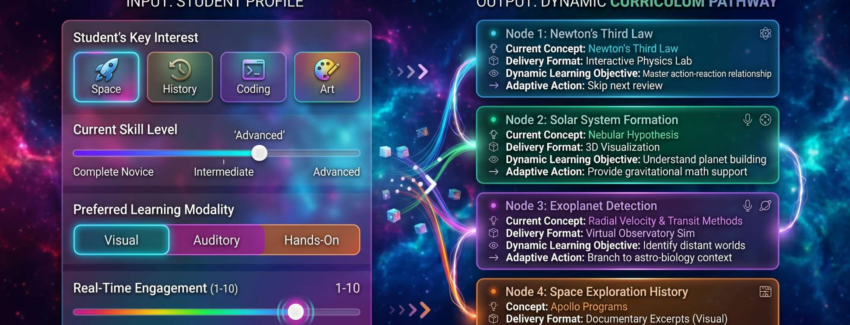
The more radical proposition — the one beginning to emerge from frontier AI systems — is something different: a curriculum that is not chosen from a menu but generated, moment to moment, in response to the learner. Not adaptive paths through fixed content, but adaptive content itself. Learning objectives, explanatory framings, practice problems, analogies, assessment sequences — all assembled on the fly, for this student, right now.

This is already partially real. Large language models can generate an unlimited variety of problems at calibrated difficulty. They can re-explain a concept through five different analogical frameworks if the first four don’t land. They can detect from a student’s response pattern that they understand the mechanics of a formula but misunderstand the underlying concept — and pivot accordingly. What they cannot yet do is reliably orchestrate this into a coherent, credentialed learning journey without significant human scaffolding.

The gap between “partially real” and “fully deployed” is where the next decade lives.

Projection · Global EdTech
Adoption of AI-Driven Adaptive Curriculum Systems
Percentage of degree-granting institutions with active AI curriculum personalization, by level of implementation
Source: Synthesized projections from HolonIQ, McKinsey Global Education Reports, and UNESCO EdTech analysis · Figures from 2026 onward are projections

The Authority Question Nobody Is Asking

When a professor writes a syllabus, they are making hundreds of invisible decisions. They decide that students should encounter foundational theory before application, or application before theory. They decide that this particular text is more worth reading than that one. They decide the sequence in which ideas accumulate meaning. They decide, in short, what an educated person in this domain looks like — and they build a path backward from that image.

These decisions are not neutral. They are shaped by disciplinary tradition, by the professor’s own intellectual biography, by institutional norms, by what was valued when they were trained. The syllabus carries all of this, silently, in its structure. It is a pedagogical philosophy made operational.

When an AI builds a curriculum in real time, it too is making all of these decisions. But the decisions are not the professor’s — they are the outputs of a system trained on a vast corpus of educational material, weighted by outcomes data, filtered by engagement metrics, and optimized for whatever objective function its designers chose. The philosophy is still there. It is simply harder to interrogate.

The Invisible Curriculum Problem

Every curriculum encodes values: what knowledge matters, whose frameworks are centered, which questions are considered foundational. A human-authored syllabus can be critiqued, contested, and revised through academic process. An AI-generated curriculum, refreshed in real time and personalized to the individual, offers no single document to critique. The values are distributed across billions of parameters — present everywhere, visible nowhere.

This is not a hypothetical concern. The history of educational technology is littered with systems that claimed neutrality while encoding particular assumptions about intelligence, learning style, cultural background, and the purpose of education. Adaptive learning platforms have already been shown to route students differently based on demographic signals. An AI curriculum generator trained on historical educational data will reproduce historical biases unless deliberate countermeasures are built in — and in most current systems, they are not.

Research Finding · Adaptive Systems
Where Learner Outcomes Diverge by System Type
Indexed learning outcomes across student groups in fixed-curriculum vs. AI-adaptive environments (100 = parity with highest-performing group)
Source: Synthesized from OECD PISA adaptive learning supplements, Gates Foundation adaptive learning cohort studies, and Stanford CREDO EdTech analysis
§

The Institutional Inertia Problem

Even if we resolve the philosophical questions, we face a structural one: the entire architecture of credentialed education is built around the syllabus as a unit of accountability. A course is what a syllabus says it is. A degree is an accumulation of courses. A transcript is a ledger of syllabi completed. Accreditation bodies, transfer credit systems, licensing boards, employers reading CVs — all of these depend on the legibility of a standardized curriculum.

If every student’s learning journey is uniquely generated, what exactly is being certified when a university grants a degree? Two students who both “completed” Introduction to Macroeconomics may have encountered entirely different content, in a different order, weighted toward different applications. The course name provides a veneer of equivalence over genuine divergence.

This is not necessarily a problem — it may accurately reflect the reality that learning has always been highly individual, and the standardized syllabus was always a fiction of shared experience. But it is a problem for the systems built on that fiction, and those systems do not dismantle quietly.

Structural Analysis · 2024–2035
The Credentialing Gap: Institutional Readiness vs. AI Capability
Indexed score (0–100) comparing AI curriculum generation capability against institutional infrastructure readiness to credential personalized learning
Source: Author projection based on AI capability benchmarks (MMLU-Pro, EduBench), accreditation reform timelines, and competency-based education adoption data

Three Futures, Honestly Considered

The trajectory from here is not predetermined. How this unfolds depends on choices that institutions, policymakers, technologists, and educators are beginning to make now — largely without acknowledging the stakes involved. Three plausible scenarios deserve honest examination.

Scenario A · Optimist

The Flourishing of the Learner

AI curriculum generation matures into a tool that genuinely serves individual potential. Accreditation reforms catch up through competency-based frameworks. Teachers evolve into learning architects — curating, contextualizing, and humanizing AI-generated pathways. Equity improves as systems are actively audited and debiased. The syllabus doesn’t die; it becomes a collaborative, living document.

Scenario B · Most Likely

The Hybrid Muddle

AI personalization is widely adopted at the margins — supplementary tutoring, practice generation, remediation — while core curricula remain fixed for credentialing purposes. Institutions get the optics of personalization without surrendering structural control. The gap between marketed capability and deployed reality stays wide. Change is real but slow, uneven, and heavily vendor-mediated.

Scenario C · Skeptic

The Efficiency Trap

AI curriculum tools are adopted primarily to reduce costs — fewer faculty, larger classes, cheaper content delivery. Personalization becomes a marketing term for algorithmic sorting. Students who struggle get routed to lower-demand pathways. The syllabus survives as a compliance document while real learning decisions are offloaded to systems nobody can audit. Equity outcomes worsen.

The honest assessment is that Scenario B is the current trajectory, with genuine risk of sliding toward Scenario C wherever cost pressures dominate. Scenario A requires active, sustained effort from people inside institutions — faculty governance, student advocacy, careful policy design — that is not yet mobilizing at scale.

§

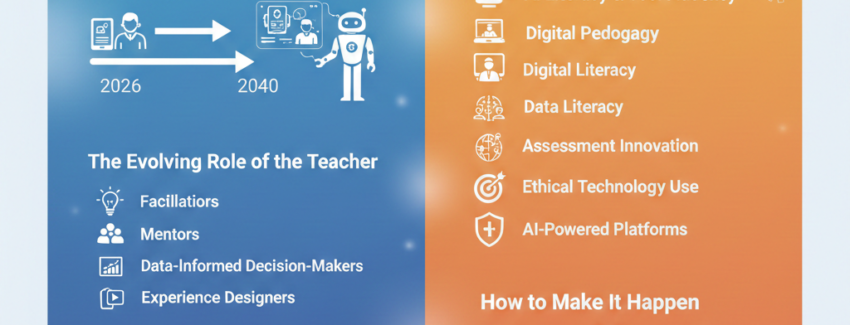
The Teacher’s Evolving Role

In every version of this future, the teacher is not eliminated — but the teacher’s job changes in ways that many current educators were not trained for and may not find appealing. The craft of writing a syllabus, of curating a reading list, of sequencing a semester with intentional narrative — these are forms of expertise that have taken careers to develop. AI systems that can generate “good enough” versions of these things in seconds do not respect that expertise; they render it invisible.

What remains, and what becomes more important, is the relational and contextual work that AI cannot do: knowing that this student’s disengagement is grief, not laziness; recognizing that this class is ready to go somewhere the curriculum didn’t anticipate; understanding that the concept landed wrong not because of explanation quality but because of something the students encountered last week in a different class. These are forms of intelligence that are embodied, contextual, and human.

The question is whether institutions will invest in developing teachers toward this higher-order role, or whether they will use AI as a justification for reducing instructional investment. The answer will vary by institution, by sector, and by the economic pressures of the moment. But it is the most consequential design choice in this entire transition.

Workforce Projection · Education Sector
Teacher Role Composition: From Content Delivery to Learning Architecture
Projected shift in how educators spend professional time — content delivery vs. relationship, facilitation, and design work
Source: Synthesized projection from OECD TALIS, McKinsey Future of Work in Education, Rand Corporation teacher role analysis

A Realistic Timeline to 2035

2024 – 2026 · Now

The Supplementary Phase

AI tools generate practice problems, provide tutoring, and offer alternative explanations. Core curricula remain fixed. Faculty adopt tools voluntarily; institutional policy lags. Vendors compete on “personalization” claims with limited evidence.

2026 – 2028 · Near

The Pilot and Proof Phase

Select institutions launch fully adaptive courses in high-volume subjects (introductory math, writing, language acquisition). Early outcome data begins to accumulate. Accreditation bodies begin preliminary frameworks for competency-based AI-mediated credentials. Faculty unions engage with governance questions.

2028 – 2031 · Medium

The Structural Reckoning

Credential portability becomes a genuine policy crisis. Employers begin requesting learning portfolios alongside transcripts. Equity lawsuits emerge around algorithmic routing in adaptive systems. Significant divergence opens between well-resourced institutions (investing in human-AI hybrid models) and under-resourced ones (defaulting to AI-only delivery).

2031 – 2035 · Far

The New Compact

A new model of credentialing — centered on demonstrated competency rather than syllabus completion — begins to achieve mainstream legitimacy in specific sectors. The fixed syllabus survives in many contexts but is increasingly understood as one valid approach among several rather than the default. The question of who governs AI curriculum systems becomes a major arena of institutional politics.

§

What Educators Should Do Right Now

None of this requires waiting for the future to arrive to act with intention. Educators and institutions who engage thoughtfully with these questions now will have more influence over how they resolve than those who engage reactively once the stakes are obvious.

Audit your existing curriculum for the decisions it encodes. Before asking whether AI can generate a better curriculum, understand what values and assumptions the current one expresses. Make those explicit. That clarity will be essential when evaluating what any AI-generated alternative reproduces or replaces.

Distinguish between AI as tool and AI as authority. There is a significant difference between using an AI system to generate practice problems (tool) and using it to determine what a student should learn next (authority). The first is relatively low-stakes pedagogically; the second is a governance decision that should involve faculty, students, and institutional leadership — not just vendors.

Engage with competency-based education frameworks now. Even if you never implement AI curriculum generation, the shift toward competency-based credentialing is real and accelerating. Understanding what it means to credential learning by demonstrated skill rather than seat time is increasingly essential literacy for educators in every sector.

Insist on algorithmic transparency from vendors. If your institution is adopting any adaptive learning platform, the questions to ask are: What objective is this system optimizing for? How is it handling demographic differences in its training data? Who audits its routing decisions and how often? Vendors who cannot answer these questions clearly should not receive institutional contracts.

“The syllabus was never a pedagogical ideal. It was a logistical compromise. Now that the logistics have changed, the question is whether we’re ready for what comes next — and who gets to decide.”

— saifullahkhalid.com

Conclusion: A Document and Its Discontents

The syllabus will not disappear overnight. Institutions are too invested in it, credentialing systems too built around it, faculty governance too organized through it. But the ground beneath it is shifting — slowly, then faster — as AI systems demonstrate that the fixed, pre-authored curriculum is not the only way to organize learning at scale.

The question is not whether this shift will happen. It is whether educators, institutions, and policymakers will engage with it early enough to shape it — to insist that AI curriculum systems are transparent, equitable, and pedagogically sound; to redesign credentialing in ways that serve learners rather than administrative convenience; to invest in teachers as architects of learning rather than simply reduce them to monitors of machines.

The end of the syllabus, if it comes, will not be a loss. Fixed curricula have always been a compromise — a way of serving many learners by serving none of them perfectly. The question is what we build in its place, and whether we build it with the same intentionality, the same care for the learner, and the same seriousness about what education is actually for.

That question is open. The people reading this have more influence over its answer than they may currently believe.


Is AI Making Us Smarter or Lazier?

Is AI Making Us Smarter or Lazier?

Opinion · May 2026

Is AI Making Us Smarter
or Lazier?

The Honest Answer

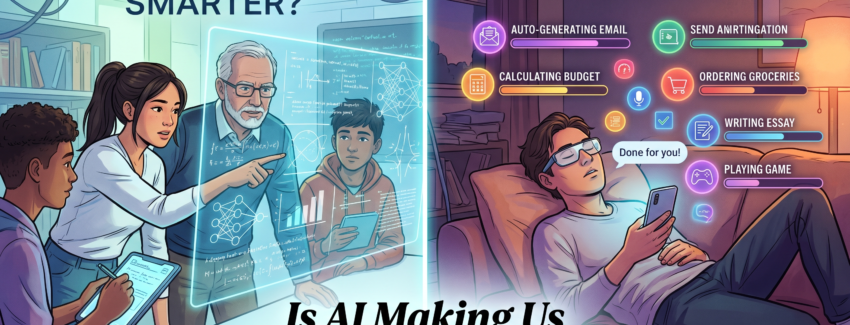
Let me tell you about two students.

The first one uses AI constantly. Every essay starts with a ChatGPT outline. Every tricky concept gets explained by Claude. Every homework problem gets at least a hint from an AI before real effort is applied. Their grades are good. Their output looks polished. Their teachers are impressed.

The second student uses AI sparingly — as a last resort after genuinely struggling with a problem. The work is messier. The process takes longer. Some of the outputs are rougher around the edges.

Here’s the question: which student is learning more?

The uncomfortable answer — backed by a growing body of research — is almost certainly the second one. And understanding why that’s the case is the most important thing any student, teacher, or parent can understand about AI right now.


The Case That AI Is Making Us Smarter

Let’s start with the argument in favor, because it’s real and it matters.

AI tools genuinely expand what people can do. A student who previously couldn’t get feedback on a draft until their teacher reviewed it on Friday can now get detailed, thoughtful feedback in seconds. A learner who was too shy to ask “basic” questions in class can ask an AI as many times as needed without embarrassment. A non-native speaker can get explanations in their own language with a single prompt.

These are not trivial gains. Access to personalized, on-demand educational support was once a privilege available only to students whose families could afford tutors. AI has democratized that access — imperfectly, but meaningfully.

The research reflects this too. Studies consistently show that students using AI-assisted learning tools produce higher-quality outputs than peers who don’t. Comprehension improves. Efficiency increases. Learning feels more accessible, more motivating, less intimidating.

For people who already have deep expertise in a domain, AI acts as a powerful force multiplier. An experienced doctor using AI diagnostics makes better decisions. A senior engineer using AI coding tools ships more reliable software. A veteran teacher using AI to generate lesson variations reaches more learning styles. When you bring existing knowledge and judgment to the table, AI amplifies both.

So yes — in the right hands, used the right way, AI absolutely makes people more capable.


The Case That AI Is Making Us Lazier

Now for the part that’s harder to admit — and more urgent.

The OECD’s Digital Education Outlook 2026 found that while students with access to general-purpose AI tools produce higher-quality outputs than their peers, this advantage disappears — and sometimes reverses — in exams when AI access is removed.

Read that again. Students who relied on AI to produce better work couldn’t reproduce that quality without it. The tool was doing the work. The student was operating the tool. Those are not the same thing.

The same report warned that offloading cognitive tasks to general-purpose chatbots creates risks of “metacognitive laziness and disengagement” — a sophisticated way of saying: if AI does your thinking for you often enough, you stop getting better at thinking.

A 2025 study by researcher Gerlich found a direct negative correlation between frequent AI tool usage and critical thinking abilities — and the effect was strongest in younger users. Not the students who used AI occasionally or strategically. The ones who used it heavily and habitually.

Meanwhile, a 2026 research paper on software developers found something striking: developers who fully delegated coding tasks to AI produced working code — but failed conceptual understanding tests afterward. They couldn’t debug what the AI had written. They had the output without the understanding. The output looked smart. The person hadn’t become smarter.

This is the core danger, and it has a name: cognitive offloading.


The Real Problem: Cognitive Offloading

Cognitive offloading is what happens when you transfer mental work to an external tool. Writing things down instead of memorizing them. Using GPS instead of building a mental map. Asking a calculator instead of doing mental arithmetic.

Some cognitive offloading is completely fine — even beneficial. Using GPS to navigate a new city frees up mental space to notice where you’re going. Using a calculator for complex arithmetic frees you to think about what the numbers mean.

The problem is when offloading replaces the development of a skill you haven’t built yet.

There’s a critical distinction that Psychology Today researcher Timothy Cook articulated clearly in early 2026:

“What AI does to a 45-year-old is likely categorically different than what it does to a 14-year-old. If I use AI to summarize a research paper, I’ve read hundreds of papers. I know what a good argument looks like — I’m offloading a task I already know how to do. A student who uses AI to summarize every paper may never develop that judgment at all.”

This is the crux. When an expert uses AI to skip a task they’ve already mastered, efficiency goes up and little is lost. When a learner uses AI to skip a task they haven’t mastered yet, they never master it.

Adults lose skills to AI. Children never build them. Those are two different problems — and the second one is the more serious one.


The Illusion of Understanding

There’s another phenomenon making this harder to see clearly: the fluency illusion.

When AI explains something clearly and engagingly, reading that explanation feels effortless. The ideas flow smoothly. You follow along without confusion. You finish and think: Yes, I understand that now.

Except — do you?

Cognitive science research consistently shows that ease of processing is a poor indicator of depth of understanding. Reading a brilliant explanation of how photosynthesis works is not the same as being able to explain photosynthesis yourself, apply it to a new context, or troubleshoot a plant biology problem. The smooth reading experience creates an illusion of competence that evaporates under any real test of knowledge.

When students use AI to get explanations — rather than to be questioned and challenged — they frequently experience this illusion. The material feels understood. The quiz or exam reveals it wasn’t.

The World Bank’s education blog framed this pointedly: “AI can make students produce smart answers without making them smarter thinkers.” That distinction is everything.


The Honest Answer: It Depends on How You Use It

Here’s where we arrive at the truth that neither AI optimists nor AI skeptics want to sit with: it’s not a binary.

AI is not inherently making us smarter. It is not inherently making us lazier. It is making us more of whatever we already are — and doing so faster and more efficiently than any tool that came before it.

If you use AI to… You are likely…
Quiz yourself and get challenging follow-up questions Getting smarter ?
Get answers to questions you haven’t attempted yourself Getting dependent ?
Get feedback on work you’ve genuinely attempted Getting smarter ?
Generate first drafts you lightly edit Skipping the learning ?
Ask “why” and “how” to deepen understanding Getting smarter ?
Read AI explanations passively without testing yourself Experiencing the fluency illusion ?

The research is fairly consistent: AI tools that are used with intentional pedagogical purpose — to challenge, question, and push the learner — produce real and sustained learning gains. AI tools used as shortcuts — to retrieve answers, summarize content passively, or generate outputs — produce the appearance of learning without the substance.


What This Means for Students

The uncomfortable truth for students is that the most valuable thing AI can do for your learning is make it harder — not easier.

An AI that asks you follow-up questions when you give a shallow answer is more valuable than an AI that just gives you the answer. An AI that pushes back on your argument is more valuable than one that agrees with everything you say. An AI that refuses to write your first draft but offers to critique one you wrote is more valuable than one that writes it for you.

The students who will thrive in a world saturated with AI won’t be the ones who learned to operate AI tools most efficiently. They’ll be the ones who used those tools to develop genuine understanding, independent judgment, and the ability to think when AI isn’t available — or when AI is wrong.

Because here’s the thing: AI is sometimes wrong. And if you’ve never built the underlying knowledge to catch it, you’ll pass along its mistakes with complete confidence. That’s not smarter. That’s a new and more dangerous kind of ignorance.


What This Means for Teachers and Schools

For educators, this research points to a clear design principle: the goal should never be to remove AI from students’ hands — it should be to design learning experiences that remain valuable even when AI is present.

That means shifting the emphasis from outputs (essays, answers, solutions) to processes (reasoning, argumentation, iteration, reflection). It means creating assessments that test understanding — not just the ability to produce polished text. It means teaching students the difference between using AI to produce and using AI to learn.

Schools that ban AI entirely are preparing students for a world that no longer exists. Schools that allow unrestricted AI access without pedagogical guidance are setting students up for the illusion of competence. The narrow, difficult path between those two failure modes is the one worth building.


The Verdict

So: is AI making us smarter or lazier?

The honest answer is: both, simultaneously, for different people, in different proportions — determined almost entirely by how they choose to engage with it.

AI is a cognitive mirror. It reflects and amplifies what you bring to it. Bring intellectual laziness, and it will help you produce lazy work faster than ever before. Bring genuine curiosity and a willingness to be challenged, and it will accelerate your growth in ways that weren’t previously possible.

The tool is not the story. The intention behind the tool is the story.

And right now, in classrooms and offices and bedrooms around the world, millions of people are making that choice — often without realizing they’re making it at all.

The Question Worth Asking

“Am I using this AI to produce something — or to understand something?”

Your answer to that question, repeated every day, will determine which kind of AI user you become.

Written by

Saifullah Khalid

Exploring AI, education, and human intelligence at saifullahkhalid.com

? Know someone who uses AI for everything? Or someone who refuses to touch it? Share this with both of them.

From Memorization to Mastery: How AI Is Finally Fixing the Way We Study

From Memorization to Mastery: How AI Is Finally Fixing the Way We Study

Educational Technology · May 2026

From Memorization to Mastery:
How AI Is Finally Fixing
the Way We Study

We’ve been studying wrong for decades. Highlighting, re-reading, cramming — science proved these don’t work. Now AI is making the right methods effortless.

Here’s an uncomfortable truth about how most of us were taught to study: it doesn’t work.

Highlight the textbook. Re-read your notes. Stare at flashcards the night before the exam. Make a summary. Read the summary. Repeat until your brain feels full.

Decades of cognitive science research have shown that these techniques — the ones most students use, the ones most teachers implicitly endorse — are among the least effective ways to actually learn something and retain it long-term.

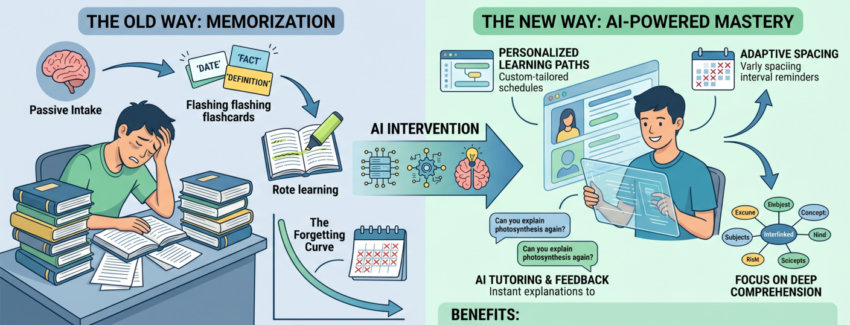
We’ve known this for years. The problem was never the research. The problem was that the better methods — spaced repetition, active recall, interleaving, elaborative interrogation — were harder to do alone. They required structure, consistency, and ideally, someone to quiz you and push back when you got something wrong.

Most students don’t have that. Until now.

AI is changing the equation. Not by replacing teachers or making studying “easier” in a shallow sense — but by making the right kind of hard effortlessly accessible to any student, anywhere, at any time.

This is the story of how that’s happening.


? First: Why Our Traditional Study Methods Fail

To understand why AI matters here, you need to understand the science of how memory actually works.

The brain doesn’t store information the way a hard drive does. You can’t just “save” something by reading it repeatedly. Memory is reconstructive — every time you retrieve a memory, you strengthen the neural pathway that leads to it. The act of retrieval is the learning.

This is why two of the most well-researched study techniques — active recall and spaced repetition — are so powerful:

  • Active recall means testing yourself on material rather than passively reviewing it. Closing the book and trying to remember — even imperfectly — strengthens memory far more than re-reading.
  • Spaced repetition means reviewing material at increasing intervals over time. Instead of cramming everything in one session, you revisit information just as you’re about to forget it — which is precisely when retrieval strengthens the memory most.

Studies going back to the early 20th century, and confirmed repeatedly since, show that students using these methods retain information significantly longer and with less total study time than students who use passive review methods.

So why doesn’t everyone study this way?

Because it’s hard to do alone. Active recall means you need someone — or something — to generate questions. Spaced repetition means you need a system that tracks what you know, what you don’t, and when to review each thing. For decades, the tools available (physical flashcard boxes, basic apps like early Anki) worked but required enormous self-discipline to use consistently.

AI removes that barrier entirely.


? How AI Is Implementing Learning Science at Scale

Modern AI tools are doing something remarkable: they’re taking what cognitive scientists have known for decades and making it the default experience for students. Here’s how:

1. AI-Generated Active Recall — On Demand

Instead of re-reading your notes, you can now paste any study material into an AI and ask: “Quiz me on this. Don’t give me multiple choice — ask me open-ended questions and tell me when I’m wrong.”

The AI becomes a tireless examiner. It can generate dozens of questions from a single chapter, vary the difficulty, ask follow-up questions when you give a shallow answer, and explain why you got something wrong — not just tell you the right answer.

This is active recall at scale, available at 2am before an exam, with no study partner required.

2. Adaptive Spaced Repetition

Tools like Anki have offered spaced repetition for years — but they required the student to create every flashcard manually, which most people didn’t sustain. AI changes this in two ways:

  • Automatic card generation: Upload your notes, get a complete flashcard deck in seconds. No manual entry.
  • Adaptive scheduling: AI systems that track your responses can identify which concepts you’re weakest on and prioritize them — rather than treating all material equally.

3. Socratic Questioning — The Most Underrated Study Method

One of the most powerful learning techniques is elaborative interrogation: asking why something is true, not just what is true. This forces the brain to connect new information to existing knowledge — which is what creates deep understanding rather than surface-level recall.

AI tutors can do this naturally. Instead of just answering your question, a well-prompted AI will ask: “Before I explain, what do you think might be happening here?” or “That’s right — but can you explain why?”

Khan Academy’s Khanmigo is explicitly designed around this Socratic model. Rather than giving students answers, it guides them toward figuring out answers themselves — which is dramatically more effective for long-term retention.

4. Interleaving — The Uncomfortable Method That Works

Most students study one topic completely before moving to the next (called “blocking”). Research consistently shows that mixing topics — called interleaving — produces better long-term retention, even though it feels harder and less productive in the moment.

AI can create interleaved study sessions automatically: mixing questions from Chapter 3, Chapter 7, and last week’s material in a single session, forcing the brain to constantly retrieve and differentiate between concepts — which is exactly how exam conditions work.


?? The AI Study Stack: Tools That Actually Work

Here are the specific tools leading this shift, and how to use them effectively:

Tool Best For Learning Technique
Claude / ChatGPT Socratic Q&A, concept explanation, essay feedback Active recall, elaborative interrogation
Khanmigo Math, science tutoring without giving answers Socratic method, guided discovery
Anki + AI Automatic flashcard generation from notes/PDFs Spaced repetition, active recall
Perplexity AI Research with cited sources, concept deep-dives Elaborative interrogation, source evaluation
NotebookLM Uploading course materials and querying them Active recall from personal notes

? A Real Study Session: What This Looks Like in Practice

Let’s make this concrete. Here’s what a science-backed AI study session looks like for a university student preparing for a biology exam:

Example Prompt to Claude

“I have a biology exam on cellular respiration in 3 days. Here are my notes: [paste notes]. Please do the following: First, identify the 5 concepts I most likely need to understand deeply. Then quiz me on them one at a time using open-ended questions. After each answer I give, tell me what I got right, what I missed, and ask a follow-up that pushes me deeper. Don’t give me the answer until I’ve tried at least twice.”

This single prompt creates a study session that incorporates active recall, elaborative interrogation, immediate feedback, and Socratic follow-up — all the high-impact techniques at once.

After 30 minutes of this kind of session, students report understanding the material in a way that hours of passive review never achieved. The reason is simple: the brain was working, not coasting.


?? The Risks: When AI Study Tools Go Wrong

This wouldn’t be an honest article without addressing the shadow side. AI study tools can actually harm learning when used incorrectly.

The Shortcut Trap

Asking AI to summarize a chapter for you and then reading the summary is still passive learning. It feels efficient — you covered the material in 3 minutes instead of 30 — but you haven’t done the retrieval work that creates memory. The summary is the AI’s understanding, not yours.

Over-Reliance Without Verification

AI tools can be wrong, especially on technical or niche topics. Students who accept AI explanations without cross-referencing authoritative sources risk learning incorrect information confidently — which is worse than not knowing at all.

The Fluency Illusion

When an AI explains something clearly and you think “I understand that,” you may be experiencing the fluency illusion — mistaking the ease of reading a good explanation for actual knowledge. The test is always: can you explain it back without looking? If not, you don’t know it yet.

The rule of thumb: AI should be the thing that tests you, not just the thing that tells you. Use it to generate questions more than answers.


? What This Means for Students, Teachers & Institutions

For Students

You now have access to a personalized tutor available 24/7 that can adapt to your pace, your weaknesses, and your schedule. The students who figure out how to use this well will have a significant advantage — not because AI does their work, but because they’ll develop genuine mastery faster than ever before.

For Teachers

The role of a teacher is shifting from information-deliverer to learning architect. If AI can handle explanations, practice problems, and basic feedback — teachers are freed to focus on what AI can’t do: building relationships, developing critical thinking, facilitating discussion, and inspiring students to care about learning at all.

For Institutions

Schools and universities that ban AI rather than teach students to use it wisely are preparing students for a world that no longer exists. The institutions leading the future are the ones designing curricula that treat AI as a tool to be mastered — like a calculator, like the internet — not a threat to be feared.


The Bottom Line

We have spent generations teaching students what to think about without adequately teaching them how to think — or how to learn. Traditional study methods optimized for the appearance of effort: filled notebooks, highlighted pages, long library sessions.

AI is finally making the science of learning accessible to everyone. Spaced repetition, active recall, Socratic questioning, interleaving — these aren’t new ideas. They’re just now, for the first time, available without friction.

The students who will thrive in the next decade won’t be the ones who memorized the most. They’ll be the ones who learned how to learn — and used every tool available to do it better.

AI is the most powerful learning tool ever put in a student’s hands. The question isn’t whether to use it. The question is whether you’ll use it wisely.


? Quick-Start: 5 AI Study Habits to Build This Week

  1. After reading any topic, ask Claude: “Quiz me on what I just read — open-ended questions only.”
  2. Paste your lecture notes into NotebookLM and ask: “What are the 5 things I most need to understand deeply here?”
  3. Use ChatGPT or Claude in Socratic mode: “Don’t give me the answer — guide me to it.”
  4. Generate a spaced repetition deck from your notes using AI — then actually review it daily.
  5. End every study session by asking AI: “Give me 3 questions I should be able to answer after this session. Test me.”

Written by

Saifullah Khalid

Writing about the future of education, AI, and human potential at saifullahkhalid.com

? Know a student who still highlights and re-reads? Share this with them — it might change how they study forever.

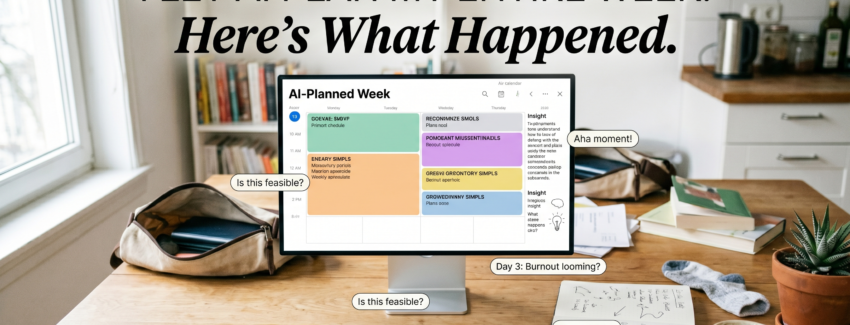
I Let AI Plan My Entire Week. Here’s What Happened.

I Let AI Plan My Entire Week. Here’s What Happened.

Personal Experiment · May 2026

I Let AI Plan My Entire Week.
Here’s What Happened.

One week. Zero manual planning. Every task, session, meal, and break — decided by AI. This is the honest, unfiltered account.

I’m someone who makes plans and then ignores them. Sound familiar?

Every Sunday night I sit down with good intentions — I open a notebook, maybe a Google Sheet — and I map out the week. Monday looks productive on paper. By Tuesday afternoon, it’s already fallen apart.

So when I started thinking seriously about AI productivity tools, a question hit me: What if I didn’t plan the week at all — and just let the AI do it?

Not just ask it for suggestions. I mean fully hand over the controls. Give it my goals, my deadlines, my energy levels, and let it build the entire week’s structure — hour by hour.

I ran this experiment for one full week. Here’s everything that happened.

? The Setup: Rules of the Experiment

Before I started, I set some ground rules to keep this honest:

  1. I would describe my week’s goals and constraints to the AI — deadlines, commitments, energy patterns, and personal priorities.
  2. The AI would generate a full daily schedule — including work blocks, study time, breaks, meals, exercise, and wind-down routines.
  3. I had to follow it for at least 80% of each day. No cherry-picking the easy parts.
  4. I could ask the AI to adjust mid-week, but only by telling it what changed — not by overriding it based on mood.
  5. At the end of each day, I would rate how it felt: productivity, stress, and satisfaction out of 10.

The AI I used was Claude (by Anthropic), with some cross-checking on ChatGPT for meal and exercise suggestions. I fed it a detailed prompt each morning with my current state, upcoming tasks, and any updates from the day before.

? What I Told the AI About Me

To generate a useful schedule, I had to be surprisingly honest. I gave Claude the following information at the start of the week:

“I have three work deliverables due this week, two online meetings, a blog post to write, and I want to start a consistent reading habit. I’m sharpest between 9am–12pm. I crash after lunch. I usually get a second wind around 4pm. I haven’t been exercising. I want to sleep by 11pm.”

That’s it. The AI took this and built a full Monday–Friday schedule, with time blocks, task labels, suggested break types (walking vs. screen-off rest), and even a note about which tasks to batch together for cognitive efficiency.

I was genuinely impressed before the week even started.

? Day-by-Day: What Actually Happened

Monday — The Honeymoon Day ? 8.5/10

Monday was surprisingly great. The AI had placed my deepest work (writing) in the 9–11am block, followed by emails and admin from 11–12. A proper lunch break at 12:30 — no screens. An afternoon meeting at 3pm, then light reading from 5–6pm. I followed it almost perfectly and ended the day feeling like I’d actually accomplished something. The key insight: the AI protected my peak hours. No meetings before noon.

Tuesday — The First Resistance ? 6/10

Tuesday had a 30-minute exercise block at 7:30am. I skipped it. Immediately felt guilty about breaking the plan. The AI had also scheduled a “focused reading” block at 8pm — which I attempted but found hard to sustain. What the AI couldn’t account for: I was more tired Tuesday than I predicted. When I updated it with that feedback, it adjusted Wednesday’s schedule to be lighter in the evening. That adaptive ability was genuinely useful.

Wednesday — The Sweet Spot ? 9/10

Wednesday was my best day of the week — and honestly, one of my most productive days in months. The AI had responded to my Tuesday fatigue by front-loading creative tasks in the morning and leaving afternoons for lighter admin. It also suggested a “theme” for the day: finish loose ends. Having a single daily theme was something I’d never tried before. It worked incredibly well. I cleared three things that had been sitting on my to-do list for two weeks.

Thursday — Where It Got Real ? 6.5/10

An unexpected personal obligation came up Thursday morning and knocked out two hours of my schedule. The AI couldn’t have predicted this. When I told it what happened, it helped me reprioritize in real-time — but the day felt choppy. This revealed an important limitation: AI planning assumes a predictable environment. Life often isn’t. The plan survived, but it required more manual intervention than any other day.

Friday — Reflection & Wrap-Up ? 8/10

The AI had scheduled Friday afternoon as a “review and reset” block — looking back at the week, noting what worked, and journaling. I hadn’t done a weekly review in years. It took 25 minutes and was genuinely clarifying. Friday felt intentional rather than like I was just surviving until the weekend. I ended the week having written my blog post, completed all three deliverables, and started a reading habit (3 out of 5 evenings — not perfect, but real progress).

? The Numbers: End-of-Week Scorecard

Metric Before AI Planning This Week
Tasks completed ~60% 85%
Average end-of-day stress (1–10, lower = better) 7 4.5
Deep work hours per day ~1.5 hrs ~3.2 hrs
Reading sessions completed 0 3
Evening wind-down routine followed 1/5 nights 4/5 nights

? What the AI Got Right

Let me give credit where it’s due. Here’s what impressed me most:

1. It Protected My Peak Hours

Without being asked, Claude scheduled all creative and high-cognitive tasks in the morning window I’d described as my “sharpest” time. No meetings before noon. No admin in the morning. This alone doubled my meaningful output.

2. It Batched Similar Tasks

The AI grouped emails, messages, and administrative work into one block rather than spreading them across the day. This reduced context-switching significantly. I hadn’t realized how much that fragmentation was costing me.

3. It Built In Recovery Time

Every day had an intentional “buffer” of 30–45 minutes — not assigned to any task. Just space. On most days, I used that buffer for something unexpected that came up. Without it, I would have fallen behind and stressed out.

4. It Gave Each Day an Identity

The “daily theme” concept was a revelation. Monday = start strong. Wednesday = clear the backlog. Friday = review and rest. This gave each day a personality beyond just a list of tasks.

?? Where the AI Fell Short

This wouldn’t be an honest review without acknowledging the gaps.

1. It Couldn’t Read My Emotional State

On Tuesday when I was more depleted than expected, the AI’s schedule still felt demanding. It adapted after I told it how I was feeling — but it couldn’t proactively sense that. A human mentor or coach might have noticed the signals before I did.

2. Unexpected Life Events Break the System

Thursday’s disruption showed that rigid AI planning can become a source of stress when reality diverges from the schedule. The AI needs human input to adapt, and that feedback loop takes time and effort.

3. It Optimized for Output, Not Always for Joy

The schedule was very efficient. But there were moments where it felt like I was executing a machine’s instructions rather than living my life. The AI didn’t know that sometimes I just want to go for an unscheduled walk without it being a “productivity tool.”

4. No Social or Relational Intelligence

The AI couldn’t account for the fact that a conversation with a friend might be more important than checking off a task. Human productivity isn’t purely output-based — relationships matter, and no AI planner currently weights that well.

? What This Taught Me About AI (And About Myself)

This experiment changed how I think about AI tools — not as replacements for thinking, but as mirrors that reflect back your own stated priorities.

When I told the AI what mattered to me, it held me to it. That accountability was the real value. The AI didn’t motivate me — but it did make it harder to lie to myself about how I was spending my time.

I also learned that the quality of what you get from AI planning is directly proportional to the quality of your self-knowledge. If I gave vague or dishonest inputs (“I have some tasks to do”), the outputs were generic. When I was specific and honest, the outputs were genuinely useful.

Most importantly: I was the one who decided to follow the plan or not. The AI didn’t make me more disciplined. It just removed the friction of figuring out what to do next — which, it turns out, was a bigger problem for me than I’d realized.

? Should You Try This?

Yes — with these caveats:

  • Start with a single day, not a full week. Ask the AI to plan just tomorrow and see how it feels before committing to more.
  • Be specific in your inputs. Tell it your energy patterns, non-negotiables, and what “a good day” means to you.
  • Give it feedback daily. The AI improves dramatically when you tell it what worked and what didn’t.
  • Don’t outsource your priorities — clarify them first. AI planning amplifies your values; if your values are unclear, the schedule will feel hollow.
  • Keep 20% of your day unscheduled. Buffer time is not wasted time — it’s the shock absorber for real life.

Final Verdict

Would I do it again? Absolutely. But I’d use AI planning as a starting point, not a rigid script. The best version of this experiment would be using AI to generate a 70% structure and leaving 30% to instinct, spontaneity, and the human things that no algorithm can fully understand.

We’re at an interesting moment in history where AI can genuinely help us become better versions of ourselves — more organized, more intentional, more productive. But it can’t want things for you. It can’t make you care. It can’t replace the deep human work of figuring out what actually matters.

That part? Still entirely on us.


Verification: 1544cdbd1105873e