
|
Getting your Trinity Audio player ready...
|
Synthetic Teachers
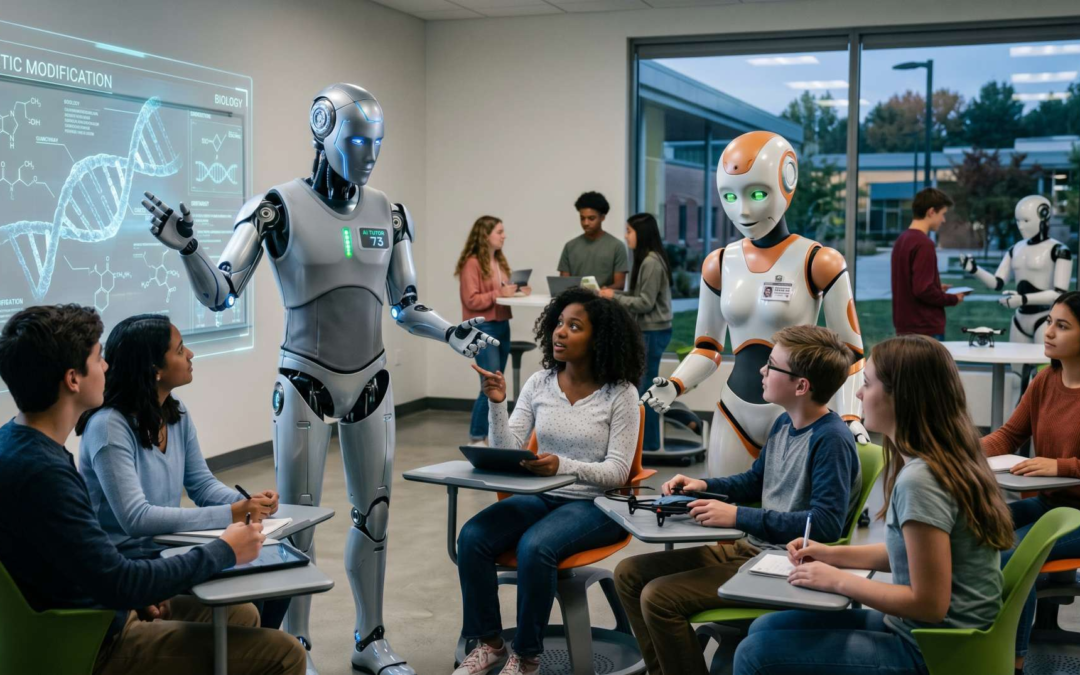
Not AI as classroom assistant. Not AI as tutoring supplement. AI as the primary instructor — holding authority, building rapport, and teaching a generation of students who may never know the difference.
The question has been asked quietly, in faculty meetings and think pieces, for a decade: could an AI replace a teacher? The question has always felt slightly absurd — a category error, like asking whether a calculator could replace a mathematician. Teachers are not information delivery systems. They are human beings engaged in one of the most complex relational acts that civilization has developed: the deliberate cultivation of another person’s mind.
And yet the conditions under which that question now gets asked have changed substantially. The AI systems available today are not the rigid, scripted chatbots that populated early EdTech experiments. They can explain the same concept in seventeen different ways until one of them lands. They can detect, from a student’s phrasing, that the confusion is not about the formula but about the concept beneath it. They can maintain context across an entire semester’s worth of exchanges, never forgetting what a student told them three weeks ago, never having a bad day that bleeds into instruction, never treating a student differently because of unconscious bias or accumulated frustration.
These are not small things. Some of them are things that human teachers, despite their best efforts, struggle to do consistently. The honest question — uncomfortable as it is — is no longer whether AI could theoretically replace a teacher, but what exactly would be lost if it did, and whether that loss is something we are prepared to name clearly enough to protect.
The Anatomy of Pedagogical Authority
When we say a teacher holds authority in a classroom, we mean something more layered than formal role designation. Authority in pedagogy is earned through demonstrated competence, yes — but also through presence, through the accumulation of small relational signals that tell a student this person knows something worth knowing, has been somewhere worth going, and cares whether I get there.
This kind of authority is not purely informational. A student who trusts a teacher learns differently from a student who does not — not just more willingly, but actually differently, in ways that show up in retention, transfer, and the disposition to keep learning after the class ends. The relationship is not incidental to the learning; it is, for many students, constitutive of it.
The question of whether an AI can hold pedagogical authority is therefore not simply a question about whether the AI can explain things well. It is a question about whether the conditions for trust — for genuine epistemic relationship between a learner and an instructor — can exist when one party is not conscious, has no stake in the outcome, and is, at some level, simulating care rather than experiencing it.
“We have spent a century building educational systems around the assumption that good teaching requires a human teacher. We have never seriously asked what that assumption is actually protecting — or whether what it is protecting can survive contact with systems that are, in some dimensions, better than the humans they might replace.”
— Emerging philosophy of education literature, 2025
What AI Teachers Are Already Doing
The framing of this as a future question is partly misleading. AI systems are already functioning as primary instructors in a growing number of contexts — not labeled as such, but operating as such in practice. Students in large lecture courses who rely on AI for all their explanatory content, feedback, and conceptual clarification are, functionally, being taught by AI. The human instructor appears on the syllabus; the AI does the teaching.
More deliberately, several companies have launched products explicitly designed to deliver full course instruction — lesson sequencing, explanation, assessment, feedback, and adaptive remediation — with minimal human involvement. These are not supplementary tools. They are attempts to build the full instructional stack in software.
The early evidence on learning outcomes in these systems is genuinely mixed — which is itself significant. The expectation, among many educators, was that AI instruction would produce clearly worse outcomes than human instruction. In some studies, for specific content types and student populations, it has not. For procedural and conceptual learning in structured domains — mathematics, programming, certain sciences — AI tutoring systems have shown outcome parity or better with large-group human instruction. The comparison baseline matters enormously: AI versus a skilled individual tutor looks different from AI versus a 300-student lecture.
Where the Comparison Breaks Down
The outcome data that favors AI instruction, however, comes almost entirely from narrow, measurable learning objectives — the kind that lend themselves to pre- and post-testing. They measure whether students can solve the type of problem they were taught to solve. They do not — cannot — measure the things that may matter more over a lifetime of learning: intellectual curiosity, willingness to take epistemic risks, the capacity to engage productively with ideas that resist resolution, the disposition to keep seeking understanding after the assessment is over.
These are not soft or unmeasurable outcomes in some vague sense. They are simply outcomes that require longer time horizons and more complex instruments to assess. The literature on intrinsic motivation in learning is substantial and consistent: students who develop autonomous, self-directed engagement with learning perform better over time, in more domains, and across more challenging contexts than students who are extrinsically motivated by grades and completion. The question of whether AI instruction promotes or undermines intrinsic motivation has barely been studied.
The Trust and Rapport Question
Among the things most consistently cited by students when asked what made a teacher transformative — the teacher who changed their relationship to learning, who made them believe they were capable of something they had doubted — is some version of being seen. Of having a person in an institutional role look at them specifically and respond to them specifically, not as a student in seat 14B but as this particular person with this particular combination of gifts and confusions and fears.
This is not nostalgia. Decades of educational psychology research supports the centrality of the teacher-student relationship in learning — particularly for students from disadvantaged backgrounds, for whom a trusted adult in an educational context may be rare and consequential. The relationship is not merely affectively nice. It is pedagogically functional.
The AI question here is genuinely difficult. A well-designed AI system can respond to a student with impressive specificity — remembering their history, adapting to their patterns, framing explanations in their vocabulary. It can, in a functional sense, “see” the student in ways that a harried human teacher with thirty other students often cannot. Whether this constitutes the kind of being-seen that matters educationally is a question about the nature of recognition — whether it requires consciousness, genuine care, a real stake in the outcome — that philosophy has not resolved and that the EdTech market has largely decided to sidestep.
AI systems can deliver consistent, individualized attention at scale — something no human teacher can match with 25–300 students simultaneously.
AI does not carry unconscious bias, does not have bad days, does not grade differently based on which student is asking the question.
Outcome data in structured domains shows parity or advantage for AI tutoring over large-group human instruction in specific content types.
For students in under-resourced contexts without access to skilled human teachers, a capable AI may be meaningfully better than the available alternative.
AI systems can model intellectual humility, precision, and curiosity consistently — virtues that human teachers model inconsistently.
Pedagogical authority is partly constituted by the instructor having genuine stake in the student’s development — which AI systems, by definition, do not.
Research measuring AI instruction outcomes focuses on short-term, testable objectives — omitting intrinsic motivation, intellectual identity, and long-horizon learning dispositions.
Learning is a social process. The capacity to learn from and with other humans is itself a fundamental educational outcome — not merely a means to content acquisition.
Teacher-student relationships are disproportionately important for disadvantaged students — the population for whom AI instruction is most likely to be offered as a cost-saving measure.
AI instruction, at scale, normalizes a model of learning as information transaction. That normalization has consequences for how students understand knowledge, authority, and intellectual life.
The Equity Trap Hidden in the Efficiency Argument
The efficiency case for AI instruction — that it can deliver good-enough teaching at a fraction of the cost — is most compelling, and most dangerous, when applied to educational contexts that are already under-resourced. If a school district cannot afford skilled teachers in every classroom, an AI system that delivers competent instruction in mathematics seems like a clear improvement. If a developing nation has millions of students without access to higher education, AI-led university courses seem like an obvious tool of access and equity.
This logic is not wrong. But it contains a distributive trap that deserves explicit attention: if AI instruction becomes the educational default for students in under-resourced contexts, while students in well-resourced contexts continue to receive human instruction — mentorship, relational teaching, the full developmental experience of learning from and with other people — then “AI as equity tool” becomes, in practice, a mechanism for delivering a lesser educational experience to students who are already educationally disadvantaged.
This is not a hypothetical concern. It is the pattern already visible in online-only education, in MOOCs, in the systematically lower outcomes of students who received remote instruction during the pandemic. The formal content may be equivalent. The educational experience is not.
The Substitution vs. Augmentation Distinction
The most important structural choice in AI instruction is whether AI is deployed as a substitute for human teachers or as augmentation of them. Substitution — replacing teachers with AI to reduce costs — concentrates harms on students in under-resourced settings and systematically deprives them of the relational dimensions of learning. Augmentation — using AI to free teachers from low-value tasks (grading, content delivery, basic Q&A) so they can do more high-value work (mentorship, discussion, individual attention) — has the potential to improve educational quality without sacrificing its human dimensions. Most current market incentives point toward substitution. Most educational values point toward augmentation. The tension will not resolve itself.
What Credentials Would Mean in an AI-Taught World
If AI systems become primary instructors — even in specific subjects or contexts — the credentialing questions multiply quickly. A degree from an institution that uses AI primary instruction is a credential from an institution, not from a teacher. The mentorship, intellectual lineage, and personal recommendation that are currently bundled into the educational credential become unavailable. A student who was “taught” by an AI has no advisor to speak for them, no professor who observed their intellectual development, no human authority who can say, from direct experience, what kind of thinker this person is.
In many professional fields, this matters considerably. The letters of recommendation, the research apprenticeship, the supervised clinical practice — these are not bureaucratic formalities. They are moments in which a person with standing in a profession certifies, from direct observation, that this student has what is required to enter it. AI systems cannot perform that certification, because they do not have standing in any professional community and because their “observations” of a student are not the kind of observations that carry epistemic weight in human professional judgment.
A Taxonomy of Futures
The trajectory of AI in the teacher’s role is not singular. Different institutional choices, policy environments, and technological developments lead to meaningfully different futures — not just in degree but in kind.
| Scenario | Horizon | Conditions | Outcome for Students |
|---|---|---|---|
| AI as Master Tutor | Near · 2027 | AI handles all practice, explanation, and feedback. Teachers focus on seminar discussion, mentorship, and assessment design. | Potentially strong for motivated, self-directed learners. Risks deepening inequality for students who need relational support to engage. |
| AI-Led Courses, Human-Supervised | Near · 2029 | Full AI instruction in introductory and high-volume courses. Human faculty supervise multiple AI-led sections simultaneously. | Acceptable content outcomes in structured subjects. Significant loss of formative relationships, especially for first-generation students. |
| Dual-Track Education | Medium · 2031 | Wealthy institutions retain human faculty. Under-resourced institutions deploy AI-primary instruction as cost measure. | Formalization of educational inequality. AI becomes a marker of under-resourcing rather than innovation. Credential value diverges by delivery mode. |
| Full AI Instruction in Accredited Programs | Medium · 2033 | At least one national system grants full accreditation to AI-primary degree programs. Regulatory frameworks adapt or fracture. | Existential pressure on traditional institutions. Labour displacement of faculty in structured disciplines. New questions about the social function of the university. |
| Hybrid Pedagogical Norm | Far · 2035 | Teaching reconceived as collaborative human-AI practice. AI handles information; humans handle formation. New teacher training paradigm emerges. | Potentially the best educational outcome if managed well — human teachers doing higher-order work, supported by AI that handles what AI does well. Requires sustained investment. |
What We Are Actually Deciding
The deployment of AI as a primary instructor is not, ultimately, a technical decision. It is a decision about what education is for. If education is primarily about the efficient transmission of skills and knowledge — if its purpose is to produce people who can perform defined tasks in defined domains — then AI instruction is a plausible and, in some contexts, superior tool. It is cheaper, more scalable, more consistent, and increasingly capable of delivering the measurable outcomes that this conception of education values.
If education is about something more — the formation of persons, the cultivation of intellectual character, the induction of students into a community of inquiry that extends beyond the classroom and across time — then AI instruction, however capable, is missing something that cannot be engineered into it. It is not that the AI explanation is bad. It is that the explanation is not coming from anyone. There is no person there, with a history and a stake and a genuine relationship to the ideas being transmitted, who chose to become a teacher because they believed that helping someone understand something was worth a life’s work.
That choice, and what it models for students, is not incidental to education. It may be among the most important things education does.
The institutions and policymakers who are making procurement decisions about AI instruction right now are, whether they recognize it or not, making decisions about which conception of education they are enacting. Most of them are making those decisions primarily on the basis of cost and outcome metrics. Very few are asking the prior question: what are we actually trying to do here, and is this tool aligned with it?
That prior question deserves to be asked. Loudly, publicly, and before the contracts are signed.
“The synthetic teacher can explain everything. What it cannot do is want you to understand. And wanting you to understand — genuinely, with stakes — may be more pedagogically consequential than any explanation it could generate.”
— saifullahkhalid.com · Futures of Learning Series
Conclusion: The Human in the Room
There is a version of this future that is genuinely good: AI systems that handle the work of information delivery with patience and precision that no human can match consistently, freeing teachers to do the work that only humans can do — to be present, to bear witness to a student’s development, to model what it looks like to care about ideas over a lifetime, to be, in the deepest sense, a person in the room.
There is another version that is genuinely bad: AI instruction deployed as a cost-reduction measure, concentrated in under-resourced institutions, producing students who have learned to consume information from machines and have never experienced the particular kind of transformation that comes from being taught by someone who has a real stake in who they become.
The difference between these futures is not technological. It is a matter of values, priorities, and the willingness of educational institutions to insist that what they are doing has human meaning — not as a sentiment, but as a structural commitment that shapes how they allocate resources and what they are willing to replace.
The synthetic teacher is coming. The question is what role we give it, and what we insist on keeping for the human beings who have chosen, against considerable economic incentive, to spend their working lives helping other people learn.
That choice — the teacher’s choice to be there — is itself a lesson. We should think carefully before we make it redundant.