
|
Getting your Trinity Audio player ready...
|
Every few years, education technology hands schools a new object to panic about. In 2023 it was the chatbot. Districts drafted emergency bans over a weekend, then quietly reversed them a semester later when it became clear the technology wasn’t going anywhere and the bans were unenforceable anyway. The whole episode was instructive—not because of what it said about AI, but because of what it revealed about how schools respond to structural change. They reach for a policy when what they need is an architecture.
That is the central problem this piece is meant to solve. The question facing K-12 leadership is no longer “should we allow ChatGPT?” That framing is already obsolete. The real question is whether an institution has the governance, capacity, and pedagogical design to absorb a general-purpose technology without either recklessly deploying it or reflexively rejecting it. Both extremes are failures of leadership. A ban outsources judgment to fear; uncritical adoption outsources judgment to vendors. Neither is a plan.
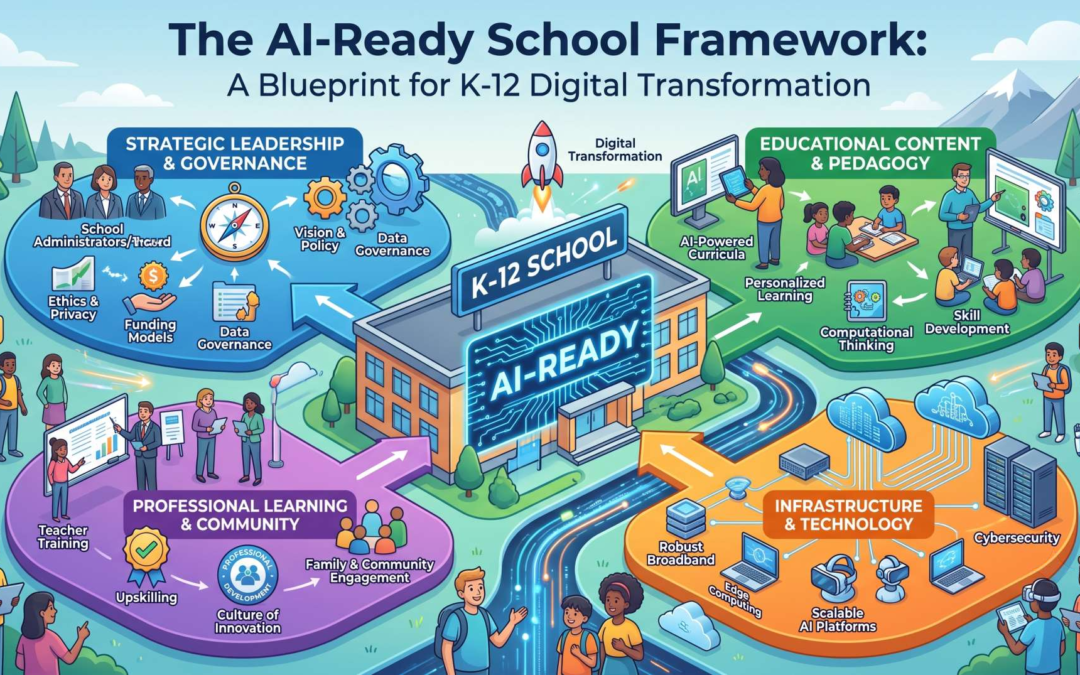
What follows is a framework—four load-bearing domains, sequenced deliberately, plus a maturity ladder that lets a district honestly assess where it stands. It is not a product recommendation and it is not a manifesto about the future of learning. It is a blueprint for the far less glamorous work of making a school system institutionally ready for tools it does not yet fully understand.
The False Binary at the Center of the Conversation
Start by naming the trap. The public discourse around AI in schools has organized itself around a single axis: enthusiasm versus prohibition. Vendors and conference keynotes occupy one end, promising personalized learning and teacher liberation. Anxious op-eds and hastily written acceptable-use policies occupy the other, warning about cheating and cognitive decline.
Both positions share a hidden assumption—that the decision is fundamentally about the tool. It is not. The tool is the least interesting variable. Whether a given AI model is impressive this quarter matters far less than whether the district that adopts it has answered a prior set of questions: Where does student data go? Who is accountable when the system errs? What are teachers actually being asked to change about their practice? What is the point of the assignment now that a machine can complete it?
A school that has answered those questions can adopt almost any tool safely. A school that has not will be endangered by the best tool on the market. This is why the framework treats AI as infrastructure rather than as a classroom novelty—and why the domains below are ordered the way they are. You cannot build capacity on an ungoverned data foundation, and you cannot redesign curriculum for people you haven’t trained.
Domain One: Data and Governance — The Foundation
Nothing else in this framework functions without this layer, and it is precisely the layer that gets skipped, because it is the one no student ever sees.
K-12 institutions occupy a uniquely regulated position. FERPA governs the privacy of education records; COPPA governs the collection of data from children under thirteen; many states layer their own student-privacy statutes on top. Consumer AI tools were, for the most part, not built with these constraints in mind. When a teacher pastes a struggling student’s essay into a general-purpose chatbot to generate feedback, that teacher may have just transmitted personally identifiable information about a minor to a third-party system with an opaque data-retention policy. No malice, no policy violation the teacher was aware of—just a governance vacuum doing what vacuums do.
The remedy is not a ban on tools. It is a governance stack that most districts already know how to build for other systems and simply haven’t extended to AI:
A vetted-tools list, maintained by a named person or committee, distinguishing enterprise or education-tier products with contractual data protections from consumer products that must never touch student data. The distinction is legally and practically enormous, and most staff have no idea it exists.
Data-flow clarity for every approved tool—a plain-language answer to “what does this system collect, where does it store it, how long does it keep it, and does it train on our inputs?” If the vendor cannot answer, that is the answer.
Procurement discipline that treats AI features as data-processing agreements, not as bullet points on a feature sheet. The moment a familiar LMS or assessment platform adds an AI layer, its data posture may have quietly changed. Renewal is the moment to re-vet, not rubber-stamp.
An incident pathway so that when something does go wrong—and it will—there is a route other than silence or improvisation.
This domain is unglamorous, and that is exactly why it is the test of serious leadership. A district that starts its “AI strategy” with a teacher-training day and skips governance has built a house starting with the curtains.
Domain Two: Educator Capacity — The Co-Pilot Problem
Once the foundation is sound, the work moves to people. And here the framework insists on a distinction that most professional development quietly elides: the difference between AI as a co-pilot and AI as a crutch.
A co-pilot extends a teacher’s judgment. It drafts a first-pass rubric the teacher then revises against what she knows about her class. It generates three versions of a word problem so she can differentiate without spending her prep period retyping. It surfaces a pattern in formative-assessment data that she interprets. In every case, professional expertise remains in command, and the tool absorbs the low-value labor that has been quietly eroding teacher time for years.
A crutch inverts that relationship. The tool generates the feedback and the teacher forwards it unread. The tool writes the lesson plan and the teacher delivers content she doesn’t fully understand. The tool grades the essays and no human ever reads the student’s actual thinking. The output may look identical to co-pilot use. The professional judgment underneath has quietly evacuated.
The uncomfortable truth is that most AI professional development fails precisely because it teaches the crutch while claiming to teach the co-pilot. It demonstrates impressive outputs, hands teachers a list of prompts, and calls it upskilling. It trains compliance, not judgment. Teachers leave able to operate the tool and no better equipped to decide when not to.
Capacity-building that works looks different. It is grounded in the teacher’s existing pedagogical expertise rather than treating AI as a replacement for it. It spends as much time on the failure modes—hallucinated facts, confident wrongness, subtle bias in generated examples, the way convenient defaults flatten instruction toward the generic—as on the capabilities. It is ongoing and job-embedded rather than a single inspirational session. And critically, it protects the teacher’s authority to override the machine, which means school culture has to reward that override rather than quietly punishing the teacher who is slower because she actually read the essays.
The goal is not teachers who use AI. The goal is teachers whose judgment is amplified by AI and never displaced by it. Those are not the same outcome, and no framework worth the name should pretend they are.
Domain Three: Curriculum and Assessment — The Redesign
This is where the technology stops being an operational question and becomes a pedagogical one. If a machine can produce a competent five-paragraph essay in four seconds, the five-paragraph essay is no longer measuring what teachers thought it measured. The instinct is to build detection tools and catch the cheaters. That is a losing arms race, and it misdiagnoses the problem. The assessment was already fragile; AI merely exposed the fragility.
The productive response is to ask what the assignment was actually for. If the essay existed to develop and demonstrate a student’s reasoning, then the assessment needs to make reasoning visible in ways a one-shot output cannot fake—drafts, revisions, oral defenses, in-class writing, annotation of one’s own choices, the messy documented process rather than the polished artifact. Process becomes the evidence. This is not a workaround forced on schools by AI; it is a return to something assessment arguably should have been doing all along.
Curriculum redesign runs alongside. Some skills genuinely diminish in value when a machine performs them competently. Others rise sharply: the ability to evaluate whether an AI output is correct, to detect where it is subtly wrong, to know what question to ask in the first place, to synthesize across sources a machine has merely summarized. These are not futuristic “21st-century skills” abstractions—they are concrete, teachable competencies, and they are increasingly the point of a K-12 education rather than an accessory to it.
The discipline this domain demands is resisting two temptations at once: bolting an “AI unit” onto the existing curriculum as a token gesture, and throwing out foundational knowledge on the theory that the machine now holds it. A student who cannot reason cannot supervise a machine that reasons badly. Foundational knowledge is not made obsolete by AI; it becomes the prerequisite for using AI responsibly.
Domain Four: Student Agency and Digital Citizenship — The Point
The three domains above serve this one. The purpose of a governed, capable, redesigned school is not efficiency. It is the formation of young people who can live and think alongside these systems without being diminished or deceived by them.
That means teaching students, at developmentally appropriate levels, what these tools are and are not: that a fluent answer is not a true one, that a confident tone is not evidence, that the system reflects the data and incentives of the people who built it. It means treating disclosure and honesty about AI use as a literacy to be taught rather than a crime to be caught—a distinction that changes the entire relationship between teacher and student. And it means attending to the quieter risks that governance frameworks tend to miss: the erosion of productive struggle when help is always one prompt away, and the emotional and developmental questions raised when students form habitual relationships with responsive, always-available systems.
A school can nail governance, train its teachers, and redesign its assessments, and still fail here if it produces students who are efficient users of AI and passive before it. Digital citizenship is not the soft add-on at the end of the framework. It is the outcome the rest of the framework exists to make possible.
A Maturity Ladder, Not a Finish Line
Because these domains are uneven work, districts need an honest way to locate themselves rather than a binary “AI-ready or not.” Four stages are useful:
Reactive — The district responds to AI incident by incident, through bans, panics, and one-off memos. No coherent data governance for AI. This is where most systems have been.
Managed — Governance exists: a vetted-tools list, procurement discipline, a data-flow policy. Teachers have basic guidance. AI is contained and safe, if not yet pedagogically integrated.
Integrated — Educator capacity is genuine and ongoing, assessment redesign is underway, and AI use is deliberate rather than defensive. The tool serves stated pedagogical goals.
Adaptive — Student agency and citizenship are woven through the curriculum, the district evaluates its own AI use for equity and effect, and it can absorb new tools without starting from zero each time.
The point of the ladder is candor. A district running flashy AI pilots while sitting at Reactive on governance is not innovating; it is exposed. Maturity is sequential for a reason.
The Work Nobody Applauds
The seductive version of AI in education is the demo: the personalized tutor, the instant feedback, the liberated teacher. The real version is a procurement review, a data-flow audit, a professional-development series that spends its afternoon on hallucination and bias, a department meeting about what an essay is now for. None of it makes a good keynote. All of it is what actually protects students and empowers teachers.
That is the strategist’s wager embedded in this framework: that the districts which thrive amid AI will not be the ones that adopted the flashiest tools fastest, but the ones that built the boring infrastructure first—governance before capacity, capacity before redesign, and all of it in service of students who can think for themselves in a world of machines that will happily think for them. The blueprint is not complicated. It is only demanding. And in a domain crowded with hype, demanding and boring may be the most forward-thinking posture a school can take.