
|
Getting your Trinity Audio player ready...
|
An insider’s perspective on closing the gap between education technology and school realities
After 11 years managing IT infrastructure at an international school, I’ve sat through countless vendor pitches, evaluations, and implementations. I’ve seen solutions that promised everything deliver very little. I’ve also watched genuinely innovative vendors struggle to gain traction because they didn’t understand how schools actually work.
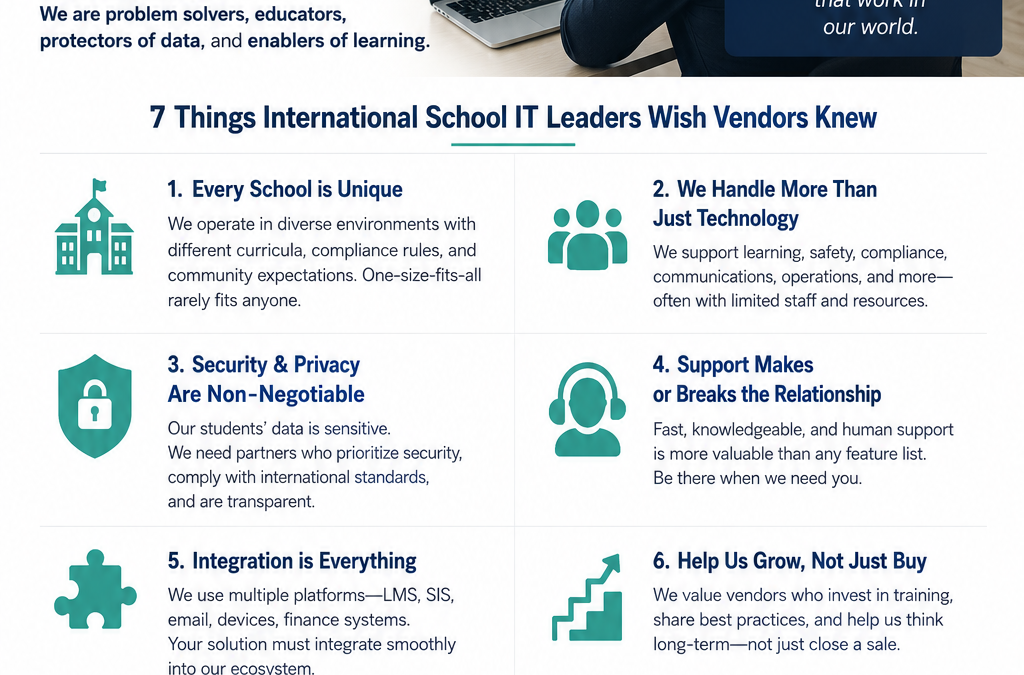
Whether you’re a vendor selling to schools or planning to be one, this article captures the unfiltered feedback that IT leaders in the GCC international school space wish could reach your ears—before you build, before you pitch, and before you wonder why adoption is slower than expected.
1. Schools Don’t Buy Problems; They Buy Stability
The biggest disconnect I see is between vendor storytelling and school buying psychology.
Vendors often lead with
“Your current system is broken. You need to transform.” Schools hear “This is risky and our IT director will be blamed if it fails.”
International schools, especially, are risk-averse. A school’s reputation is built on consistent delivery: exams happen on schedule, report cards are issued on time, grades are never lost. An IT platform that promises 50% efficiency gains but risks downtime during exam season is a non-starter, no matter how compelling the ROI.
What IT leaders actually want: “This solution works reliably for schools. Tell me about schools like mine that have implemented it and what happened.”
2. Implementation Timelines Are Fixed; Your Roadmap Is Not
Schools operate on academic calendars. Period. You cannot move your go-live date because your dev team needs two more sprints. You cannot ask for a six-week delay because of feature dependencies.
The ideal implementation window is during the summer break (typically June–August). That’s a hard constraint. Your roadmap must fit within that window. Your 18-month onboarding process, however sophisticated, won’t work.
I’ve seen vendors lose deals—not because their product wasn’t good—because they couldn’t guarantee a July go-live. Meanwhile, a slightly less feature-rich competitor who could make that date won the deal and the school was happy.
3. Training Budgets Are Smaller Than You Think
Vendors often price training separately and assume schools will invest heavily in it. Schools assume training is included.
Here’s the reality: International schools have finite professional development days. Teachers are already stretched. Your platform’s training module is competing for time with language instruction, curriculum alignment, and student wellbeing workshops.
The schools that succeed with new systems are those where the vendor built intuitive design into the product itself. Self-service walkthroughs, contextual help, templates, and sensible defaults matter far more than a comprehensive three-day training program.
4. Integration Trumps Innovation—Every Single Time
A school’s technology stack looks like this:
Academic system ? Finance system ? Assessment tool ? Alumni platform ? Parent communication ? Security system
Your shiny new product won’t replace all of these. It will exist alongside them. The real question isn’t “Is your platform innovative?” It’s “Can your API plug cleanly into our existing ecosystem?”
I’ve watched schools reject technically superior solutions because they required manual data entry into a third-party system. Meanwhile, a clunkier platform with solid REST API and CSV import/export won because it reduced friction.
5. Data Sovereignty and Compliance Are Non-Negotiable
A lot has changed in the GCC regarding data governance. Regulations around student data, teacher information, and financial records are tightening—especially in the UAE and Saudi Arabia.
International schools are now asking:
“Where is our data stored? Who can access it? What’s your data residency policy? Are you compliant with local regulations?”
If your answer is “We store everything in the US cloud” or “We’re not sure which server your data is on,” you’re already losing credibility. Schools need vendors with clear data governance, transparent privacy policies, and ideally, local compliance certifications.
6. Your Sales Cycle Will Be Longer Than You Expect
Selling to schools is not like selling to corporations. Decision-making involves multiple stakeholders: the IT director, the academic leadership, finance, sometimes even the board of directors.
Your pitch deck might be perfect for the IT director. But the Deputy Head of Academics wants to know pedagogical fit. The Finance Manager wants total cost of ownership. The Principal wants risk mitigation language.
I’ve seen vendors frustrated that a school took eight months to decide. From the school’s perspective, they were being appropriately cautious. Budget decisions at that level require multiple review cycles, and schools rarely make significant tech investments in a single fiscal year.
7. Support Responsiveness Matters More Than Feature Count
Your 200-feature platform is impressive. Your 30-minute support response time is non-negotiable.
When a school’s grading system goes down on report card day, IT leaders don’t care about roadmap priorities or quarterly planning. They need someone answering the phone within the hour. Schools remember vendors who show up in a crisis.
If you’re planning to build a school-focused product, think hard about support infrastructure. Offshore support centers often aren’t enough. Consider having at least one support person who understands the school calendar and can prioritize accordingly.
8. Reference Schools Are Everything
IT leaders in international schools talk to each other. The GCC international school community is tight-knit. Word travels fast.
If you tell me “We have 50 schools using our platform,” I want to call three of them. And here’s what I’m asking:
“Would you recommend this vendor to another school? Was the implementation on time? Did support actually help when you needed it? What do you wish you’d known before you signed?”
Schools that will honestly answer these questions are your most valuable asset. Curate them, listen to them, and let prospective customers speak with them freely. Schools trust other schools far more than they trust vendor marketing.
The Bottom Line
International schools aren’t waiting for the perfect technology solution. They’re waiting for a trusted partner who understands their calendar, respects their constraints, and shows up when things go wrong.
If you’re building for schools, spend less time on marketing keynotes and more time in conversations with IT directors and school finance managers. Ask them what keeps them up at night. Listen for the patterns. Build for those problems first.
The vendors winning in the education space aren’t necessarily the most innovative. They’re the ones who learned to think like school leaders—and built their products accordingly.