The Future of K–12 Education: 5, 10, 15 Years and Beyond

The Future of K–12 Education: 5, 10, 15 Years and Beyond

The Future of K–12 Education: 5, 10, 15 Years and Beyond

From Institutions to Learning Ecosystems

Education is transitioning from content delivery to capability development.

Next 5 Years (2025–2030): The AI Integration Phase

  • AI becomes a daily classroom assistant
  • Automated grading and feedback normalize
  • Hybrid learning models dominate
  • Teachers shift to facilitators and mentors
  • Digital portfolios replace report cards

Schools that delay AI integration will face relevance gaps, not just skill gaps.


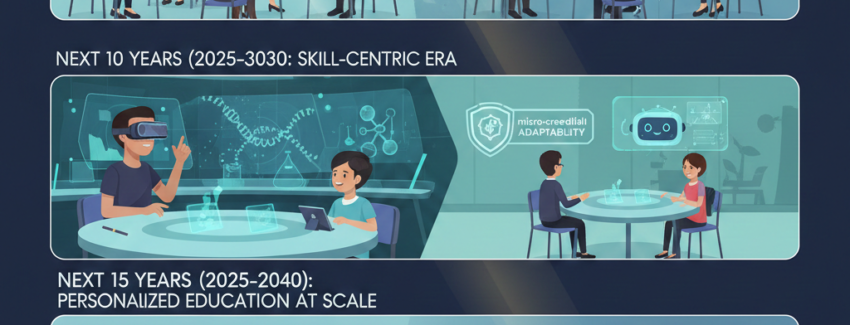
Next 10 Years (2030–2035): The Skill-Centric Era

  • Curriculum reorganized around skills, not subjects
  • Micro-credentials embedded into schooling
  • VR and simulation labs replace traditional labs
  • Emotional intelligence and adaptability assessed formally
  • AI tutors provide 24/7 learning support

Schools become learning experience centers, not buildings.

Next 15 Years (2035–2040): Personalized Education at Scale

  • Each student follows a unique learning pathway
  • Graduation is competency-based, not age-based
  • Teachers act as learning architects
  • Schools merge with higher education and industry
  • AI predicts learning needs before failure occurs

The concept of a “standard classroom” disappears.

Key Takeaway

The future of education is adaptive, intelligent, and human-centered. Systems that resist this evolution will not collapse—but they will slowly become irrelevant.

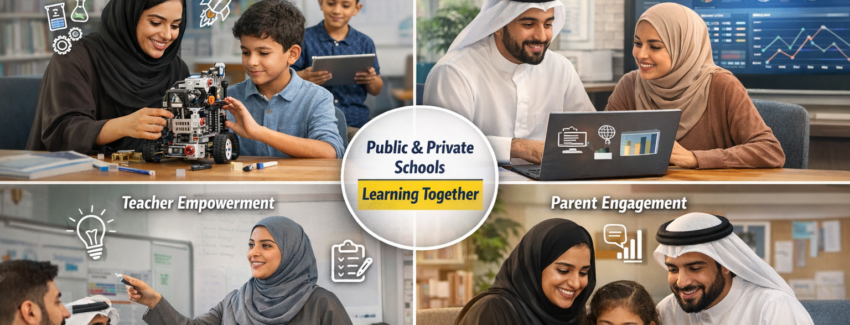
What Government Schools Can Learn From Private & International Schools

What Government Schools Can Learn From Private & International Schools

Reframing Public Education for the Next Era

Government schools across the GCC have historically excelled at scale, access, and equity, educating millions of students and forming the backbone of national development. However, private and international schools—operating under competitive pressure—have evolved faster in pedagogy, technology adoption, and learner personalization.

The goal is not privatization, but strategic cross-learning.


  1. Curriculum Agility and Pedagogical Flexibility

One of the strongest advantages of private and international schools is curriculum agility.

While government curricula are often centrally defined and standardized (which ensures fairness and national alignment), private schools:

  • Pilot project-based learning (PBL) faster
  • Integrate STEM, robotics, AI, and entrepreneurship earlier
  • Adapt assessment models quickly (rubrics, portfolios, competency-based grading)

What Government Schools Can Do:

  • Introduce modular curriculum extensions alongside national syllabi
  • Allow controlled pilot programs in selected schools
  • Enable teachers to co-design interdisciplinary projects without violating national standards

The future curriculum must be stable at the core, flexible at the edges.


  1. Technology as an Operational Backbone, Not an Add-On

Private schools treat technology as infrastructure, not decoration.

They commonly deploy:

  • School ERP systems (attendance, academics, finance, HR)
  • LMS platforms integrated with assessments
  • Parent portals with real-time visibility
  • Data dashboards for leadership decision-making

Government schools, by contrast, often use:

  • Fragmented systems
  • Manual processes at scale
  • Limited data integration between departments

What Government Schools Can Learn:

  • Centralized national ERP + LMS platforms reduce cost and chaos
  • Data-driven leadership enables proactive intervention
  • Automation frees teachers from administrative overload

When systems are unified, teachers teach more, students learn better, and leaders decide smarter.


  1. Teacher Empowerment and Professional Autonomy

Private and international schools invest heavily in continuous teacher development, often linking:

  • Performance to training
  • Training to classroom innovation
  • Innovation to student outcomes

Teachers are encouraged to:

  • Experiment with tools
  • Redesign lesson delivery
  • Personalize instruction

Government systems often emphasize compliance over creativity.

Strategic Shift Needed:

  • Move from “teacher supervision” to teacher enablement
  • Introduce AI-assisted lesson planning
  • Provide structured freedom within policy boundaries

Empowered teachers are the fastest catalyst for system-wide change.


  1. Parent Engagement as a Strategic Asset

Private schools treat parents as partners, not observers.

They use:

  • Weekly performance analytics
  • Digital communication platforms
  • Parent feedback loops

Government schools can benefit immensely from similar models at scale.

Impact:

  • Improved student accountability
  • Reduced behavioral issues
  • Stronger school-community trust


Key Takeaway

Government schools already have reach and legitimacy. By adopting agility, technology, and empowerment models from private education, they can modernize without sacrificing equity or national identity.

How to Deal With & Integrate AI Into the School Curriculum

How to Deal With & Integrate AI Into the School Curriculum

AI is no longer optional. Schools that fail to integrate AI risk becoming irrelevant in 3–5 years. Here’s a step-by-step plan for safe, effective AI integration.

  1. Teach AI as a Foundational Skill

AI should be treated like:

  • Mathematics
  • Reading
  • Digital literacy

Students must understand:

  • Basic AI concepts
  • How AI tools work
  • Ethical use
  • Data privacy
  1. Use AI to Personalize Learning

AI can:

  • Adjust lesson difficulty
  • Identify learning gaps
  • Provide summaries and explanations
  • Support inclusive education

This shifts the teacher role from “lecturer” to learning coach.


  1. Create AI Labs & Hands-On Activities

Schools should establish:

  • AI playgrounds
  • Robotics labs
  • No-code tools (Scratch, Machine Learning for Kids)
  • AI project exhibitions

Practical experience is essential.


  1. Add AI Modules to Every Subject

Examples:

  • English: AI writing & analysis
  • Math: AI-driven problem generators
  • Science: data modelling & simulations
  • Social Studies: AI ethics, digital citizenship


  1. Train Teachers Intensively

Teachers need:

  • AI safety training
  • Classroom use-case training
  • Awareness of AI risks
  • Certification pathways
    (Google, Microsoft, UNESCO, PISA-Aligned AI programs)
  1. Establish AI Use Policies

Schools must define:

  • What AI students may use
  • What AI teachers may use
  • Academic honesty policies
  • Data protection practices (aligned with PDPL or national laws)

Finally, I think, AI is not replacing teachers—it is empowering them. Early adopters will lead the future of education.


What Schools in Each GCC Country Should Do Next (2025–2030 Roadmap)

What Schools in Each GCC Country Should Do Next (2025–2030 Roadmap)

The GCC education ecosystem is evolving faster than ever. Each country—Saudi Arabia, UAE, Qatar, Bahrain, Kuwait, and Oman—has unique strengths, challenges, and government visions. This article outlines the strategic next steps schools in each country must take to remain competitive and future-ready.

Saudi Arabia — Vision 2030 Demand for Innovation

Saudi schools should prioritize:

  • Full digital transformation (LMS, ERP, attendance automation, AI-powered management)
  • STEM + robotics integration into weekly curriculum
  • Data-driven school operations
  • Teacher upskilling for AI literacy
  • Compliance adoption (PDPL, cybersecurity, accreditation)

Saudi Arabia has scale—and now needs modernization.


UAE — Maintaining Global Education Leadership

UAE schools should focus on:

  • Curriculum innovation with AI, space tech, digital finance
  • Personalized learning pathways
  • Partnerships with tech companies
  • Competency-based assessments

UAE already leads in international schooling; the next step is deeper innovation, not expansion.


Qatar — Enhancing Private Sector Quality

Qatari schools must:

  • Improve learning outcomes through analytics
  • Reduce curriculum fragmentation
  • Adopt unified digital portfolios for students
  • Strengthen teacher recruitment and professional development


Kuwait — Modernize Infrastructure

Kuwaiti schools must rapidly:

  • Upgrade digital infrastructure
  • Shift from textbook-heavy methods to project-based learning
  • Adopt AI tools to assist teachers


Bahrain — Strengthening International Curriculum Standards

Bahrain’s schools benefit from diversity but need:

  • Unified digital student systems
  • Increased STEM labs and AI labs
  • Enhanced cybersecurity readiness


Oman — Scaling Private Sector Innovation

Oman should focus on:

  • Diversifying curriculum offerings
  • Digitizing government schools
  • Teacher training in AI tools & modern pedagogy


Conclusion

Every GCC country has a unique path—and the schools that adopt AI, digital systems, compliance, and future-ready learning will lead the next decade.


Verification: 1544cdbd1105873e