|
Getting your Trinity Audio player ready... |
There is a version of blended learning that works. It is thoughtful, evidence-based, and designed around what students actually need. And then there is the version most institutions implement — a patchwork of in-person sessions bolted onto digital tools, held together by optimism and procurement budgets. The second version is far more common.
Blended learning has been a fixture of edtech discourse for over a decade. It promises the best of both worlds: the flexibility of online learning and the human connection of the classroom. In practice, it often delivers neither. Understanding why requires looking honestly at how institutions approach implementation — and what they consistently get wrong.
The Definition Problem
Before anything else, there is a foundational issue: most institutions do not have a shared definition of blended learning when they begin implementing it.
Ask ten educators at the same institution what blended learning means and you will likely get ten different answers. Some will describe flipped classrooms. Others will describe courses with an LMS component tacked on. Others will describe fully synchronous online sessions with no real redesign at all. This definitional ambiguity is not a minor inconvenience — it is the root cause of most implementation failures.
Without a shared model, there is no coherent design philosophy, no way to train faculty consistently, no way to evaluate whether the approach is working, and no way to course-correct when it is not. Institutions that skip this definitional step are not implementing blended learning. They are implementing vague digitization and calling it something more respectable.
The Tool-First Trap
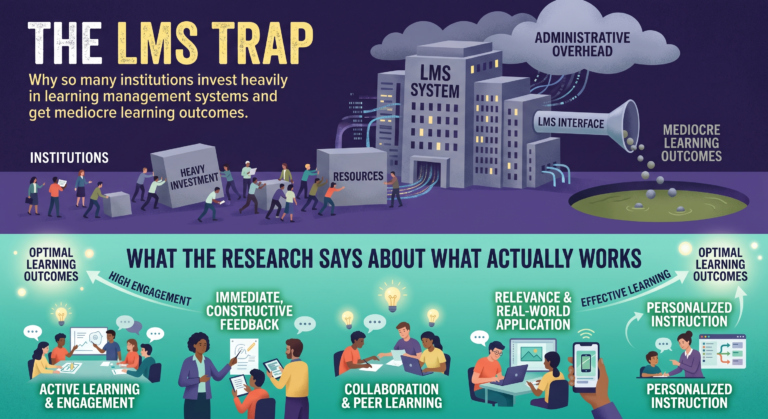
Perhaps the most common failure mode is what might be called the tool-first trap: institutions acquire technology, then work backwards to justify its use in the classroom.
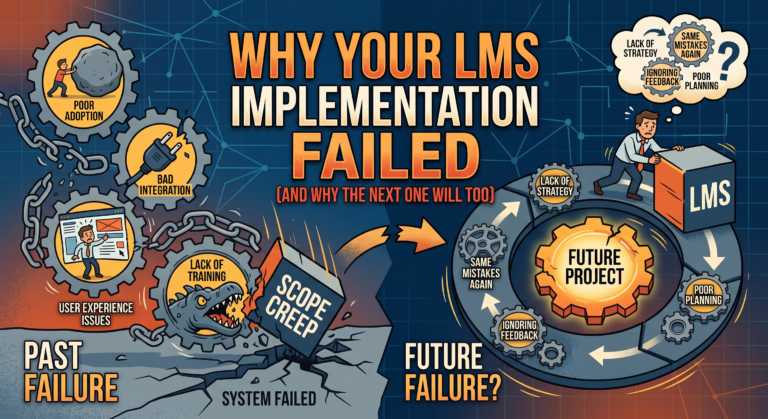
A university invests in a new video conferencing platform. Administrators encourage faculty to “integrate it into their blended approach.” Faculty, unsure what that means pedagogically, begin recording lectures and posting them online. Students, unsure what to do with the recordings, either ignore them or use them to skip class. Attendance drops. Engagement drops. The technology gets blamed. The real culprit — a complete absence of pedagogical intent — is never examined.
This pattern repeats across tools: LMS platforms, interactive polling software, digital whiteboards, AI tutoring systems. The technology arrives first. The learning design question — what are we trying to help students do, and does this tool serve that goal? — arrives late, if at all.
Effective blended learning inverts this sequence entirely. It begins with learning outcomes, moves to instructional strategies, and only then asks which tools, if any, might support those strategies. The difference sounds obvious. The implementation reality suggests it is not.
Faculty Are Not the Problem — Preparation Is
When blended learning fails, faculty are often implicitly or explicitly blamed. They resisted the model. They did not use the tools correctly. They kept reverting to lecture-heavy formats.
This framing is both unfair and analytically lazy. The more accurate diagnosis is that institutions routinely ask faculty to redesign their courses without providing the time, training, or instructional design support required to do it well.
Redesigning a course for blended delivery is not a weekend task. It requires rethinking how content is sequenced, what happens in synchronous versus asynchronous time, how student accountability is structured, and how feedback loops are maintained across both modalities. Faculty who have spent years developing effective in-person pedagogies cannot simply transpose those pedagogies onto a hybrid format. They need supported redesign time — and most institutions do not provide it.
A common compromise is the one-day workshop: a crash course in blended learning principles, a tour of available tools, and a vague mandate to “try something new this semester.” This is not preparation. It is institutional cover. It allows administrators to say that faculty were trained while leaving them functionally unsupported.
Institutions that get blended learning right tend to invest in sustained faculty development — multi-week course redesign cohorts, instructional designer partnerships embedded at the department level, and protected time for iteration and reflection. These are not glamorous investments. They do not appear in press releases. But they are what actually produces results.
The Synchronous-Asynchronous Imbalance
A well-designed blended course is intentional about what happens synchronously and what happens asynchronously. Most poorly designed ones are not.
The default pattern — lecture content moved online, class time kept largely unchanged — is the most common and arguably the most wasteful configuration. It treats synchronous time as a vessel for content delivery, which is precisely what synchronous time does worst. Students sitting together in a room (or on a video call) watching a recorded lecture are getting the worst of both formats: the scheduling constraint of synchronous learning without its interactive benefits, and the content flexibility of asynchronous learning without its self-pacing advantages.
Synchronous time is most valuable for things that require real-time human interaction: debate, collaborative problem-solving, peer feedback, Q&A, and the kind of mentoring that happens in dialogue. Asynchronous time is most valuable for content consumption, reflection, and practice at individual pace. When these functions are deliberately matched to the appropriate modality, blended learning delivers on its promise. When they are not, students experience it as doing more work for the same outcome.
Assessment That Was Never Redesigned
Assessment is where blended learning failures become most visible — and where institutions are most reluctant to look.
Blended models require assessment redesign. If the learning journey now spans two modalities, with students engaging in substantive activity both in-person and online, then evaluation instruments designed exclusively for in-person learning will not capture the full picture. They will also create perverse incentives: students will optimize for what is assessed, which means the online components — typically under-assessed — will be treated as optional.
Yet course assessment structures in most blended implementations are left largely untouched. The same midterm, the same final, the same in-class participation grade. What changes is the delivery channel, not the evaluation logic. This is not blended learning with a traditional assessment layer on top. It is traditional learning with some videos attached.
Meaningful assessment redesign in blended contexts typically involves portfolio-based evaluation, ongoing formative assessment across both modalities, peer assessment components, and reflection artifacts that require students to synthesize their learning across the full course experience. These approaches are more labor-intensive to design and evaluate. They are also far more aligned with what blended learning is supposed to accomplish.
The Equity Dimension Institutions Ignore
Blended learning’s flexibility is often presented as an equity win: students with work obligations, family responsibilities, or long commutes benefit from the asynchronous option. This is true as far as it goes — but institutions frequently stop the equity analysis there.
What they ignore is the equity differential in online engagement itself. Students from lower-income households are more likely to be studying in environments with noise, unreliable internet, shared devices, and competing demands on their attention. The “flexibility” of asynchronous learning can mean squeezing in coursework at midnight between shifts. The assumption that online learning is inherently more accessible systematically underweights these realities.
Blended learning done well accounts for this. It does not assume that all students experience the online component equivalently. It builds in support structures — flexible deadlines with clear parameters, low-bandwidth content alternatives, accessible synchronous sessions — that acknowledge the range of circumstances students are navigating. Most implementations assume a more uniform student experience than actually exists, and design accordingly.
What Getting It Right Looks Like
Effective blended learning shares a recognizable set of characteristics, regardless of institution type or subject matter.
It starts with a clear model — station rotation, flipped classroom, flex, or another defined approach — that the institution commits to and trains around consistently. It allocates synchronous time to high-interaction, high-value activities, not content delivery. It provides faculty with substantive course redesign support, not one-off workshops. It redesigns assessment to evaluate learning across both modalities. And it audits the student experience for equity, not just access.
None of this is complicated in theory. All of it is difficult in practice, because it requires institutions to invest in the unsexy infrastructure of learning design rather than the visible infrastructure of technology acquisition.
The schools and universities getting blended learning right are not necessarily the ones with the most sophisticated platforms. They are the ones that treated implementation as a pedagogical challenge first and a technology challenge second — and resourced it accordingly.