|
Getting your Trinity Audio player ready... |
The End of
the Syllabus
What happens when artificial intelligence builds every student’s curriculum in real time — and who decides what gets learned?
For centuries, the syllabus has been education’s quiet contract. It tells students what they will learn, when they will learn it, and in what order. It is the professor’s authority made legible. It is the institution’s promise made printable. It is, above all, a fixed document — written before the first class meets, sealed in administrative amber, and largely immune to the individual in the room.
That fixedness is not an accident. The standardized curriculum emerged alongside mass education precisely because scalability demanded predictability. You cannot teach a thousand students without deciding, in advance, what a thousand students will encounter. The syllabus is the industrial solution to the industrial problem of education.
But AI does not operate at industrial scale by enforcing uniformity. It operates at industrial scale by enabling variation. And that distinction — quiet, technical, easily missed — may carry more consequence for how we structure learning than any pedagogical reform movement of the last hundred years.
“The syllabus was never a pedagogical ideal. It was a logistical compromise. Now that the logistics have changed, the question is whether we’re ready for what comes next.”
— Emerging perspective in adaptive learning research
What a Real-Time Curriculum Actually Means
Most discussions of “personalized learning” remain disappointingly shallow — a student chooses their own pace through a fixed set of modules, perhaps with branching logic that routes them to remedial content when they struggle. This is personalization as navigation, not personalization as design. The syllabus remains; only the path through it shifts.
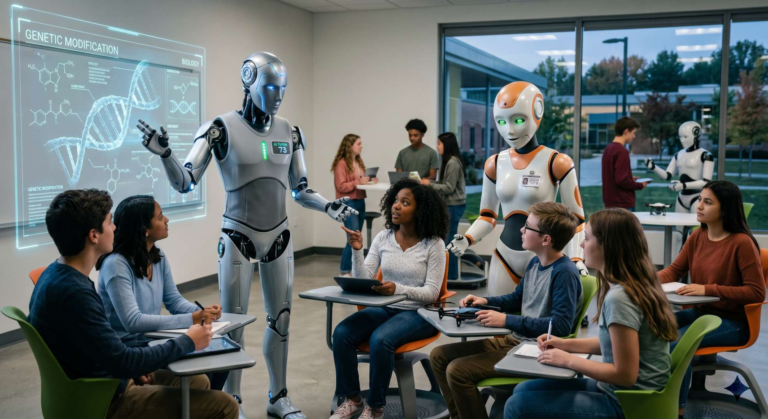
The more radical proposition — the one beginning to emerge from frontier AI systems — is something different: a curriculum that is not chosen from a menu but generated, moment to moment, in response to the learner. Not adaptive paths through fixed content, but adaptive content itself. Learning objectives, explanatory framings, practice problems, analogies, assessment sequences — all assembled on the fly, for this student, right now.
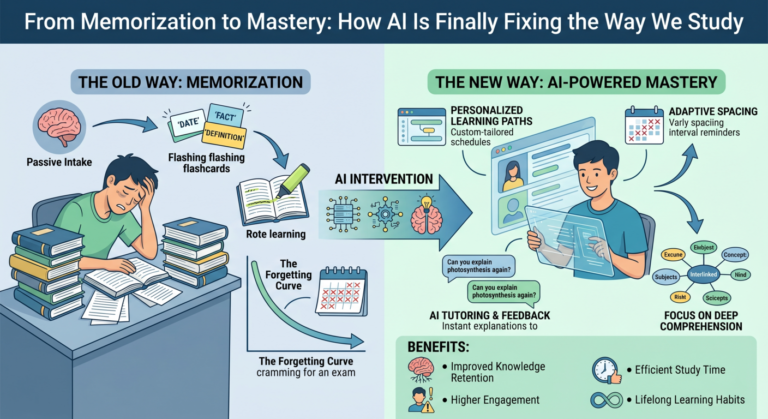
This is already partially real. Large language models can generate an unlimited variety of problems at calibrated difficulty. They can re-explain a concept through five different analogical frameworks if the first four don’t land. They can detect from a student’s response pattern that they understand the mechanics of a formula but misunderstand the underlying concept — and pivot accordingly. What they cannot yet do is reliably orchestrate this into a coherent, credentialed learning journey without significant human scaffolding.
The gap between “partially real” and “fully deployed” is where the next decade lives.
The Authority Question Nobody Is Asking
When a professor writes a syllabus, they are making hundreds of invisible decisions. They decide that students should encounter foundational theory before application, or application before theory. They decide that this particular text is more worth reading than that one. They decide the sequence in which ideas accumulate meaning. They decide, in short, what an educated person in this domain looks like — and they build a path backward from that image.
These decisions are not neutral. They are shaped by disciplinary tradition, by the professor’s own intellectual biography, by institutional norms, by what was valued when they were trained. The syllabus carries all of this, silently, in its structure. It is a pedagogical philosophy made operational.
When an AI builds a curriculum in real time, it too is making all of these decisions. But the decisions are not the professor’s — they are the outputs of a system trained on a vast corpus of educational material, weighted by outcomes data, filtered by engagement metrics, and optimized for whatever objective function its designers chose. The philosophy is still there. It is simply harder to interrogate.
The Invisible Curriculum Problem
Every curriculum encodes values: what knowledge matters, whose frameworks are centered, which questions are considered foundational. A human-authored syllabus can be critiqued, contested, and revised through academic process. An AI-generated curriculum, refreshed in real time and personalized to the individual, offers no single document to critique. The values are distributed across billions of parameters — present everywhere, visible nowhere.
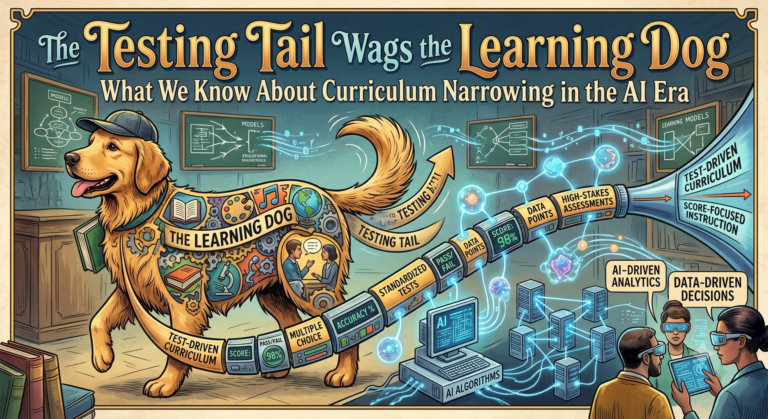
This is not a hypothetical concern. The history of educational technology is littered with systems that claimed neutrality while encoding particular assumptions about intelligence, learning style, cultural background, and the purpose of education. Adaptive learning platforms have already been shown to route students differently based on demographic signals. An AI curriculum generator trained on historical educational data will reproduce historical biases unless deliberate countermeasures are built in — and in most current systems, they are not.
The Institutional Inertia Problem
Even if we resolve the philosophical questions, we face a structural one: the entire architecture of credentialed education is built around the syllabus as a unit of accountability. A course is what a syllabus says it is. A degree is an accumulation of courses. A transcript is a ledger of syllabi completed. Accreditation bodies, transfer credit systems, licensing boards, employers reading CVs — all of these depend on the legibility of a standardized curriculum.
If every student’s learning journey is uniquely generated, what exactly is being certified when a university grants a degree? Two students who both “completed” Introduction to Macroeconomics may have encountered entirely different content, in a different order, weighted toward different applications. The course name provides a veneer of equivalence over genuine divergence.
This is not necessarily a problem — it may accurately reflect the reality that learning has always been highly individual, and the standardized syllabus was always a fiction of shared experience. But it is a problem for the systems built on that fiction, and those systems do not dismantle quietly.
Three Futures, Honestly Considered
The trajectory from here is not predetermined. How this unfolds depends on choices that institutions, policymakers, technologists, and educators are beginning to make now — largely without acknowledging the stakes involved. Three plausible scenarios deserve honest examination.
The Flourishing of the Learner
AI curriculum generation matures into a tool that genuinely serves individual potential. Accreditation reforms catch up through competency-based frameworks. Teachers evolve into learning architects — curating, contextualizing, and humanizing AI-generated pathways. Equity improves as systems are actively audited and debiased. The syllabus doesn’t die; it becomes a collaborative, living document.
The Hybrid Muddle
AI personalization is widely adopted at the margins — supplementary tutoring, practice generation, remediation — while core curricula remain fixed for credentialing purposes. Institutions get the optics of personalization without surrendering structural control. The gap between marketed capability and deployed reality stays wide. Change is real but slow, uneven, and heavily vendor-mediated.
The Efficiency Trap
AI curriculum tools are adopted primarily to reduce costs — fewer faculty, larger classes, cheaper content delivery. Personalization becomes a marketing term for algorithmic sorting. Students who struggle get routed to lower-demand pathways. The syllabus survives as a compliance document while real learning decisions are offloaded to systems nobody can audit. Equity outcomes worsen.
The honest assessment is that Scenario B is the current trajectory, with genuine risk of sliding toward Scenario C wherever cost pressures dominate. Scenario A requires active, sustained effort from people inside institutions — faculty governance, student advocacy, careful policy design — that is not yet mobilizing at scale.
The Teacher’s Evolving Role
In every version of this future, the teacher is not eliminated — but the teacher’s job changes in ways that many current educators were not trained for and may not find appealing. The craft of writing a syllabus, of curating a reading list, of sequencing a semester with intentional narrative — these are forms of expertise that have taken careers to develop. AI systems that can generate “good enough” versions of these things in seconds do not respect that expertise; they render it invisible.
What remains, and what becomes more important, is the relational and contextual work that AI cannot do: knowing that this student’s disengagement is grief, not laziness; recognizing that this class is ready to go somewhere the curriculum didn’t anticipate; understanding that the concept landed wrong not because of explanation quality but because of something the students encountered last week in a different class. These are forms of intelligence that are embodied, contextual, and human.
The question is whether institutions will invest in developing teachers toward this higher-order role, or whether they will use AI as a justification for reducing instructional investment. The answer will vary by institution, by sector, and by the economic pressures of the moment. But it is the most consequential design choice in this entire transition.
A Realistic Timeline to 2035
The Supplementary Phase
AI tools generate practice problems, provide tutoring, and offer alternative explanations. Core curricula remain fixed. Faculty adopt tools voluntarily; institutional policy lags. Vendors compete on “personalization” claims with limited evidence.
The Pilot and Proof Phase
Select institutions launch fully adaptive courses in high-volume subjects (introductory math, writing, language acquisition). Early outcome data begins to accumulate. Accreditation bodies begin preliminary frameworks for competency-based AI-mediated credentials. Faculty unions engage with governance questions.
The Structural Reckoning
Credential portability becomes a genuine policy crisis. Employers begin requesting learning portfolios alongside transcripts. Equity lawsuits emerge around algorithmic routing in adaptive systems. Significant divergence opens between well-resourced institutions (investing in human-AI hybrid models) and under-resourced ones (defaulting to AI-only delivery).
The New Compact
A new model of credentialing — centered on demonstrated competency rather than syllabus completion — begins to achieve mainstream legitimacy in specific sectors. The fixed syllabus survives in many contexts but is increasingly understood as one valid approach among several rather than the default. The question of who governs AI curriculum systems becomes a major arena of institutional politics.
What Educators Should Do Right Now
None of this requires waiting for the future to arrive to act with intention. Educators and institutions who engage thoughtfully with these questions now will have more influence over how they resolve than those who engage reactively once the stakes are obvious.
Audit your existing curriculum for the decisions it encodes. Before asking whether AI can generate a better curriculum, understand what values and assumptions the current one expresses. Make those explicit. That clarity will be essential when evaluating what any AI-generated alternative reproduces or replaces.
Distinguish between AI as tool and AI as authority. There is a significant difference between using an AI system to generate practice problems (tool) and using it to determine what a student should learn next (authority). The first is relatively low-stakes pedagogically; the second is a governance decision that should involve faculty, students, and institutional leadership — not just vendors.
Engage with competency-based education frameworks now. Even if you never implement AI curriculum generation, the shift toward competency-based credentialing is real and accelerating. Understanding what it means to credential learning by demonstrated skill rather than seat time is increasingly essential literacy for educators in every sector.
Insist on algorithmic transparency from vendors. If your institution is adopting any adaptive learning platform, the questions to ask are: What objective is this system optimizing for? How is it handling demographic differences in its training data? Who audits its routing decisions and how often? Vendors who cannot answer these questions clearly should not receive institutional contracts.
“The syllabus was never a pedagogical ideal. It was a logistical compromise. Now that the logistics have changed, the question is whether we’re ready for what comes next — and who gets to decide.”
— saifullahkhalid.com
Conclusion: A Document and Its Discontents
The syllabus will not disappear overnight. Institutions are too invested in it, credentialing systems too built around it, faculty governance too organized through it. But the ground beneath it is shifting — slowly, then faster — as AI systems demonstrate that the fixed, pre-authored curriculum is not the only way to organize learning at scale.
The question is not whether this shift will happen. It is whether educators, institutions, and policymakers will engage with it early enough to shape it — to insist that AI curriculum systems are transparent, equitable, and pedagogically sound; to redesign credentialing in ways that serve learners rather than administrative convenience; to invest in teachers as architects of learning rather than simply reduce them to monitors of machines.
The end of the syllabus, if it comes, will not be a loss. Fixed curricula have always been a compromise — a way of serving many learners by serving none of them perfectly. The question is what we build in its place, and whether we build it with the same intentionality, the same care for the learner, and the same seriousness about what education is actually for.
That question is open. The people reading this have more influence over its answer than they may currently believe.