
|
Getting your Trinity Audio player ready...
|
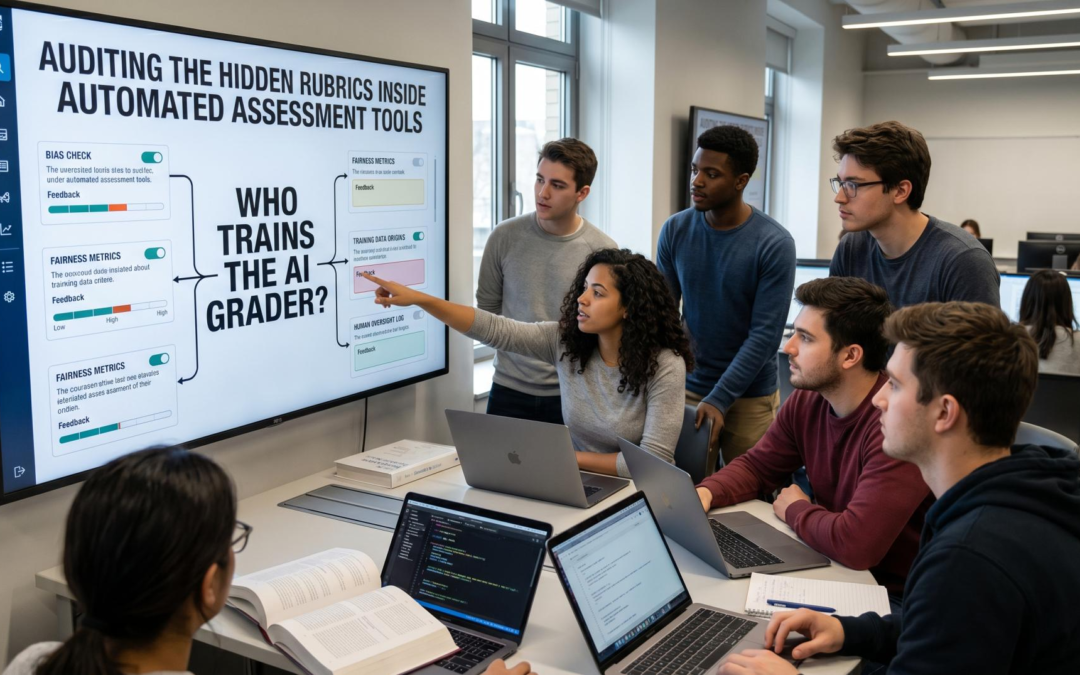
WHO TRAINS THE AI GRADER? AUDITING THE HIDDEN RUBRICS INSIDE AUTOMATED ASSESSMENT TOOLS
Automated grading tools are marketed on consistency and speed, and on both counts they often deliver. What they rarely deliver is transparency about what they’re actually rewarding, and that gap is becoming a real institutional liability as these tools move from grading multiple-choice quizzes into evaluating open-ended student writing and reasoning.
The Black Box of Automated Grading
Most institutions adopting AI grading tools know remarkably little about how the underlying model arrives at a score. Vendors describe their products in terms of outcomes, alignment with human grader scores, faster turnaround, reduced grading fatigue, but rarely disclose the actual rubric the model has learned to apply. That rubric isn’t written down anywhere a teacher can review it. It’s encoded implicitly in the patterns the model picked up during training, which means it can reward things no one ever intended it to reward.
What Rubrics Are Actually Encoded
Research on automated essay scoring has repeatedly found that these systems can latch onto superficial proxies, sentence length, vocabulary sophistication, even punctuation patterns, that correlate with quality in the training data without actually measuring the reasoning or argument quality teachers care about. A model trained on a set of human-graded essays will absorb whatever biases existed in that grading, including unconscious preferences for certain writing styles or familiar phrasing patterns that have nothing to do with the rigor of the underlying thinking. The institution adopting the tool inherits those biases without ever seeing them named.
The Case for Audits
This is not a new problem in principle. Algorithmic auditing is a mature practice in domains like lending and hiring, where the consequences of biased automated decisions are well understood and increasingly regulated. Education has been slower to apply the same scrutiny to assessment tools, partly because the stakes of a single grading decision feel smaller than a loan denial. But aggregated across an entire institution and an entire student population, a systematically biased grading rubric has the same kind of structural impact, just distributed more quietly.
Building an Audit Framework
Institutions don’t need to build sophisticated technical auditing capacity from scratch to start addressing this. A practical starting point is sample testing, periodically having human graders score a representative sample of the same student work the AI tool graded, and comparing not just the scores but the apparent reasoning behind discrepancies. Building a structured teacher review loop, where flagged or borderline AI scores get routed to a human grader before being finalized, catches the worst failures without abandoning the efficiency gains entirely. And procurement teams should be treating vendor transparency about training data and known failure modes as a contractual requirement, not a nice-to-have. A vendor unwilling to disclose what their model has been shown to over-reward or under-reward is asking institutions to adopt a rubric they’re not allowed to see.