The Classroom of Tomorrow Is Already Here

The Classroom of Tomorrow Is Already Here

Educational Technology · In-Depth

The Classroom of Tomorrow Is Already Here

How artificial intelligence, intelligent platforms, and the rise of online learning are fundamentally reshaping what it means to teach — and what it means to learn.

April 13, 2026  ·  12 min read  ·  For educators & school leaders

$404B
Global edtech market projected by 2025
60%
Of K–12 teachers now use AI tools regularly
Faster skill acquisition with adaptive learning systems
1.8B
Learners reached by online platforms globally

Walk into a forward-thinking school today and you might struggle to recognize it. One student is working through a personalized algebra module at her own pace, guided by an AI tutor that adjusts every question based on her last response. A teacher nearby is not lecturing — he is coaching, circulating among small groups, armed with real-time dashboards that flag which students are falling behind before they even raise their hand.

This is not a vision of 2035. It is happening right now — and for educators and administrators navigating this transformation, the challenge is no longer whether technology belongs in learning, but how to deploy it with wisdom, equity, and intention.

Part I — AI in Education: Beyond the Hype

Artificial intelligence has become the most discussed and most misunderstood force in modern education. Cut through the noise, and what emerges is a technology that is simultaneously more modest and more profound than its headlines suggest.

What AI is actually doing in classrooms

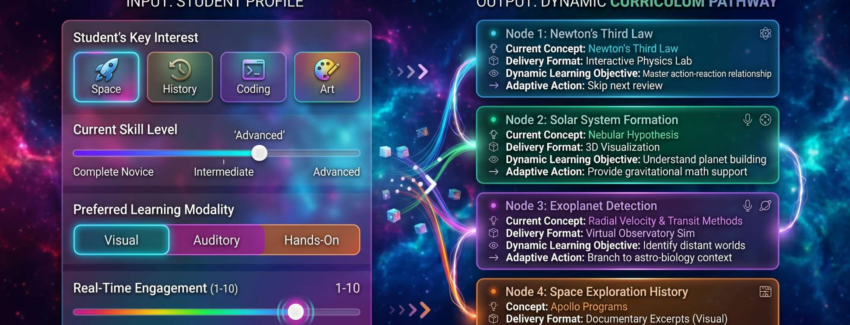
The most impactful AI applications in education are not robots replacing teachers. They are systems that do the cognitive heavy lifting that teachers were never designed to carry alone. Adaptive learning platforms like Khan Academy’s Khanmigo, Carnegie Learning, and Synthesis use machine learning to track thousands of micro-signals — response times, error patterns, topic avoidance — to build a unique learning profile for each student. The system then adjusts difficulty, pacing, and content type in real time.

For educators, this means something genuinely revolutionary: the ability to differentiate instruction at scale. A teacher managing thirty students has never, realistically, been able to personalize learning for each one. AI makes that personalization automatic, continuous, and invisible to the student — it simply feels like a curriculum that fits.

Practitioner Insight

AI-powered formative assessment tools are among the highest-leverage investments a school can make. They move feedback from summative (end-of-term) to continuous, allowing teachers to intervene weeks earlier than traditional grading would allow.

AI as a teacher’s co-pilot

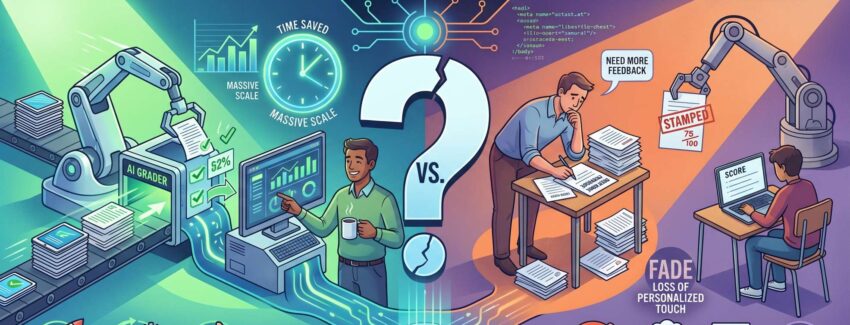
Beyond student-facing applications, AI is quietly transforming teacher workflows. Lesson planning tools can generate differentiated worksheets across three reading levels in seconds. Grading assistants can provide first-pass feedback on written work, freeing teachers to focus their attention on the qualitative judgments only a human can make — the student who is technically correct but clearly confused, or the essay that ticks every box but lacks a genuine voice.

Administrative AI is also reducing the invisible workload that drives educator burnout: attendance logging, parent communication drafting, IEP documentation, and scheduling are all areas where intelligent automation is reclaiming hours per week for teachers who need them.

“The best AI tools don’t replace teacher judgment — they create the conditions for more of it.”

The equity imperative

No discussion of AI in education is complete without confronting the equity gap. The schools most likely to have sophisticated AI infrastructure are already the best-resourced. Without deliberate policy intervention — subsidized licensing, device access programs, teacher training pipelines — edtech risks being another mechanism that widens the gap between advantaged and under-served learners.

School administrators have a critical role to play here: evaluating not just what a tool can do, but who it is designed for, whose data it trains on, and whether its recommendations reflect the full diversity of students it will serve.

Part II — The EdTech Platform Landscape

The tools market has matured dramatically. Where early edtech was often a digitized worksheet — content moved online without meaningful pedagogical redesign — a new generation of platforms is built around learning science from the ground up.

Learning Management Systems grow up

LMSs like Canvas, Schoology, and Google Classroom have evolved from content repositories into rich ecosystems. Modern platforms integrate video, discussion, formative assessment, analytics, and third-party app markets in a single environment. For administrators, the critical evaluation criteria have shifted from features to interoperability: can this platform share data with your student information system? Can it integrate with the specialist tools your special education or gifted programs rely on?

Collaborative and project-based tools

A generation of tools has emerged to support the pedagogies that research consistently shows produce the deepest learning: collaboration, project-based learning, and authentic audience. Platforms like Padlet, Flipgrid, Book Creator, and Canva for Education give students the ability to create, share, and receive feedback in multimodal formats that reflect how knowledge is actually communicated in professional life.

For School Leaders

Before adopting any new platform, audit your current tool stack for overlap and complexity. Teachers managing eight different logins will use none of them well. Consolidation — even at the cost of some functionality — typically improves adoption and outcomes.

Assessment reimagined

The traditional test is under pressure from two directions simultaneously: AI tools that can answer most knowledge-recall questions, and a deeper pedagogical consensus that performance tasks, portfolios, and authentic demonstrations of competency reveal learning that multiple-choice cannot. Platforms like Seesaw, Formative, and Peergrade are building new models of evidence-based assessment that are harder to automate and more meaningful to students.

Part III — The Future of Online Learning

Online learning has undergone two distinct revolutions. The first, accelerated by the pandemic, was one of necessity — schools moved online because they had to, and the results were mixed. The second, now underway, is one of design — institutions building online and hybrid experiences that are genuinely better than what a traditional classroom offers for certain learners, certain content, and certain contexts.

Hybrid as the default

The binary of “online” versus “in-person” is dissolving. Blended learning — where students move fluidly between independent digital work and collaborative in-person experience — is becoming the dominant model in progressive schools. When designed well, blended environments allow students to spend more time on the activities that most require human presence (discussion, mentorship, lab work, performance) and less time passively receiving information that a video or interactive module can deliver equally well.

Micro-credentials and modular learning

One of the most significant structural shifts in online education is the unbundling of the traditional course. Platforms like Coursera, edX, and a growing number of employer-backed programs are offering micro-credentials — focused, verifiable certificates of specific skills — that sit alongside or instead of degree programs. For educators, this represents both an opportunity and a disruption: an opportunity to certify and communicate the specific competencies students develop, and a disruption to the assumption that the semester-long course is the natural unit of learning.

The social problem — and its solutions

Online learning’s most persistent weakness is social. Learning is fundamentally relational, and screen-mediated interaction, however convenient, rarely replicates the spontaneity, warmth, and incidental connection of shared physical space. The best online programs are addressing this not by apologizing for the limitation, but by engineering intentional social structures: cohort models, live synchronous sessions, peer accountability partnerships, and community platforms that make the social layer explicit rather than incidental.

“Online learning fails when it tries to replicate the classroom. It succeeds when it builds something the classroom never could.”

What This Means for Educators and Administrators Today

The convergence of AI, mature platforms, and redesigned online learning creates both extraordinary opportunity and genuine complexity. For educators on the ground, the mandate is to resist two failure modes: uncritical adoption — implementing technology because it is new and generates excitement — and defensive resistance — treating every innovation as a threat to the human heart of teaching.

The most effective educators in this landscape are those who have internalized a simple evaluative question: does this tool give me or my students more time and space for the things that matter most? If an AI assistant frees forty minutes a week for one-on-one conversations with struggling students, that is a trade worth making. If a new platform adds cognitive load without a corresponding pedagogical return, it is not.

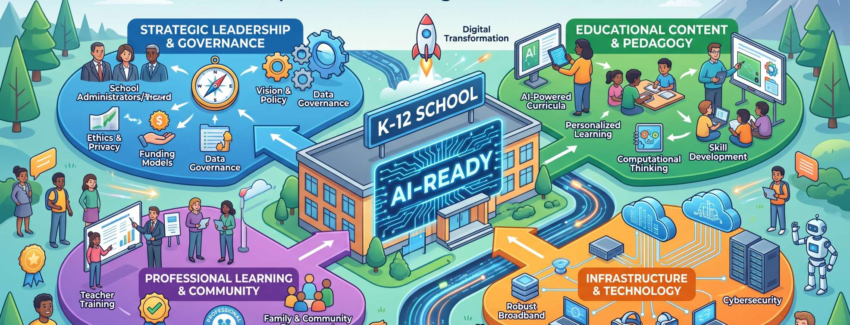
For school administrators, the strategic priority is infrastructure: not just device access and broadband, but the professional development pipelines, data governance frameworks, and community trust necessary to ensure that technology serves the school’s mission rather than reshaping it by default.

The classroom of tomorrow is not a destination that arrives fully formed. It is built, iteratively and collaboratively, by educators willing to experiment, reflect, and share — equipped with better tools than any generation of teachers has had before.

Artificial Intelligence
EdTech
Online Learning
School Leadership
Adaptive Learning
Blended Learning
Education Equity
The Future of School Management: How Digital Solutions Are Transforming Education

The Future of School Management: How Digital Solutions Are Transforming Education

There was a time when a school’s efficiency was measured by the thickness of its filing cabinet and the neatness of its ledgers. Attendance was called by name, fees were collected in cash, and report cards were typed or handwritten. For decades, this system worked — slowly, imperfectly, but it worked.

That time is over.

Today’s schools operate in an environment of accelerating complexity. Student populations are growing. Regulatory requirements are multiplying. Parents expect instant communication. Teachers are stretched thin. Administrators are drowning in data that tells them nothing because it lives in disconnected silos. The old ways are not just inefficient — they are actively holding schools back.

The schools that will thrive in the next decade are not necessarily the ones with the best teachers or the most resources. They are the ones that have the intelligence to build smarter operational foundations. And that foundation is digital.

This article explores how modern school management systems are reshaping the way educational institutions operate, what features matter most, what obstacles schools face in adoption, and where the industry is heading.


The Hidden Cost of Running a School the Old Way

Before talking about solutions, it is worth understanding the depth of the problem.

A typical school with 500 students handles thousands of daily data points — attendance records, homework submissions, fee payments, staff schedules, exam results, parent communications, maintenance requests, procurement approvals, and more. In a manually operated school, each of these is handled independently, often by different people using different tools, and rarely in real time.

The consequences are predictable:

Data errors accumulate quietly. A student marked absent on the wrong day. A fee recorded under the wrong account. A grade entered incorrectly and never caught. Each mistake is small. Collectively, they erode trust, drain time, and occasionally trigger compliance problems.

Information moves too slowly. When a parent calls to ask why their child’s grade dropped, the administrator has to pull a file. When a teacher wants to know how many students failed last month’s test across all sections, they have to manually compile results. Speed matters in education, and slow information costs decisions.

Communication is reactive, not proactive. Parents find out about problems after they have escalated. Schools send newsletters that go unread. Parent-teacher meetings happen twice a year instead of being a continuous conversation.

Financial tracking is opaque. Schools lose revenue to uncollected fees, underbilled services, and poor financial visibility. In countries like Saudi Arabia where ZATCA-compliant e-invoicing is now mandatory, manual financial systems are not just inefficient — they are a legal risk.

Teachers burn out on administration. A teacher who spends two hours a week on attendance, gradebooks, and progress reports loses over 80 hours a year on tasks that contribute nothing to actual teaching. Multiply that across a staff of 60 and the loss is staggering.

These are not minor inconveniences. They are structural weaknesses that limit a school’s ability to grow, compete, and deliver quality education.


What Is a School Management System and Why Does It Matter?

A School Management System (SMS) — also called a School ERP or School Information System — is a unified digital platform that connects every operational layer of a school into a single ecosystem.

Think of it this way: a hospital has a patient management system that connects admissions, doctors, pharmacy, billing, and records. A bank has a core banking system that connects accounts, transactions, compliance, and customer service. A school needs exactly the same kind of backbone — a central nervous system that makes every part work together.

A modern SMS connects:

Administration — admissions, enrollment, timetabling, staff management Academics — gradebooks, assessments, report cards, curriculum planning Finance — fee collection, invoicing, payroll, budgeting, compliance Communication — parent portals, teacher messaging, announcements, alerts Analytics — dashboards, performance tracking, predictive insights Compliance — attendance reporting, regulatory filings, audit trails

When these are unified under one platform, the school stops being a collection of departments and starts functioning as an intelligent organization.


Core Features That Define a High-Quality School Management System

Not all systems are equal. The quality of a school management platform can be judged by how deeply it solves real operational problems, not just how many features it lists on a brochure. Here is what truly matters:

  1. Smart Administration Automation

The administrative backbone of any school — admissions, student records, staff onboarding, timetable generation, classroom assignments — should be largely automated. Schools waste enormous amounts of time on tasks that a properly designed system can handle in seconds.

Automated timetable generation, for example, is a genuinely hard problem when done manually. Balancing teacher availability, room capacity, subject requirements, and student group allocations is a combinatorial challenge that can take days by hand. A smart system resolves it in minutes.

Admissions workflows — from application intake to document verification to enrollment confirmation — can be fully digitized, reducing processing time and eliminating lost paperwork. Student records become a single, always-accurate source of truth rather than a patchwork of spreadsheets and physical files.

  1. Financial Management and Regulatory Compliance

Money is where operational weakness most visibly hurts a school. Poor financial management leads to revenue leakage, compliance risk, and ultimately, unsustainable operations.

A capable SMS handles the full financial lifecycle: fee structure setup, invoice generation, payment collection, receipt issuance, arrears tracking, and financial reporting. Crucially, in Saudi Arabia, this must include ZATCA-compliant e-invoicing. Schools operating in the Kingdom that are not issuing tax-compliant digital invoices are already in violation of Phase 2 requirements that have been rolling out across sectors. A modern school system must have this built in, not bolted on.

Beyond compliance, good financial modules provide real-time dashboards showing outstanding balances, collection rates, revenue forecasts, and expense tracking. This kind of visibility is what separates schools that are financially in control from those that discover problems only at year-end.

  1. Parent Engagement and Communication

Parent engagement is one of the most underestimated drivers of student success and school reputation. Research consistently shows that students whose parents are actively involved perform better academically and behaviorally. Yet most schools communicate with parents through methods that were designed for a pre-smartphone world.

A modern SMS provides parents with a dedicated portal or mobile app where they can see their child’s attendance in real time, review grades as they are entered, receive instant push notifications for important events, pay fees online, and message teachers directly without going through the front office.

This is not a convenience feature. It is a trust-building infrastructure. Parents who feel informed and connected to their child’s school become advocates rather than complainants. Schools that invest in parent communication tools see measurably better satisfaction scores and retention rates.

  1. AI-Powered Academic Insights

This is where school management platforms are moving from being operational tools to genuine strategic assets.

Advanced systems now apply machine learning to the data they collect — attendance patterns, grade trajectories, assessment performance, behavioral incidents — to generate predictive insights. A student who was an A performer in the first term but has been declining steadily for eight weeks is not just having a bad week. They are at risk, and an AI-powered system can flag that for a counselor before the parent even notices.

These systems can identify which teaching interventions correlate most strongly with improvement in specific subject areas, which students are likely to require additional support in upcoming assessments, and which classrooms are consistently underperforming relative to comparable groups. This shifts school leadership from reacting to problems after the fact to anticipating and preventing them.

For schools that want to genuinely differentiate their educational quality — not just their marketing — AI-powered academic analytics is one of the highest-leverage investments they can make.

  1. Multi-School and SaaS Architecture

School groups, educational investment companies, and franchise school models have needs that single-school systems simply cannot meet. Managing 5, 10, or 30 campuses from a single operational center requires a fundamentally different architecture.

Modern platforms built on multi-tenant SaaS infrastructure allow a central administration team to oversee all campuses simultaneously — comparing performance, standardizing policies, consolidating financials, and enforcing compliance — while each campus retains enough autonomy to manage its own day-to-day operations.

Cloud-based delivery means the system scales without expensive on-premise infrastructure. It also means updates, security patches, and new features are rolled out centrally, without requiring IT intervention at each campus. For growing school groups in the GCC region, this is not a nice-to-have — it is a prerequisite for scalable operations.

  1. Bilingual and Localization Support

In Saudi Arabia and across the GCC, a school management system that does not fully support Arabic — including right-to-left text rendering, Arabic numerals, Hijri calendar options, and localized reporting formats — is not a serious solution. It is a product designed for somewhere else and awkwardly fitted to the region.

Bilingual support matters not just for the user interface but for all outputs: report cards, invoices, parent notifications, official compliance documents. Staff who are more comfortable in Arabic should not have to navigate an English-only system, and vice versa.

Localization also means compliance with local regulatory frameworks. Saudi Arabia’s Ministry of Education has specific reporting requirements. ZATCA has specific invoicing standards. VAT calculations must follow the Kingdom’s rules. A system that ignores these is not a school management system for Saudi Arabia — it is a generic product that happens to be available there.


The Real Benefits: Beyond the Feature List

Features are means, not ends. What schools actually care about are outcomes. Here is what a properly implemented digital school management system delivers in practice:

Time recovered for education. When teachers are freed from administrative burden, they teach. When administrators are not chasing paper, they lead. The hours saved by automation are not trivial — they are the margin between a school that is merely surviving and one that is thriving.

Data-driven leadership. School principals and boards who have access to real-time operational and academic dashboards make faster and better decisions. They see problems early, allocate resources accurately, and can present clear evidence of school performance to stakeholders, parents, and regulatory bodies.

Revenue protection. Digitized fee collection with automated reminders and online payment options consistently improves collection rates. Schools that have moved to digital financial management typically see a measurable reduction in arrears and revenue leakage within the first year.

Competitive differentiation. In markets where parents have choices, the experience a school provides — including how it communicates, how transparent it is, how accessible its information is — is a real competitive factor. A school that sends parents a real-time notification when their child’s fever is detected at the clinic is a school that is harder to leave.

Regulatory resilience. As governments in the GCC continue to expand digital compliance requirements, schools with modern digital infrastructure are ready. Schools that are still on paper will face increasing costs and risks as enforcement tightens.


The Obstacles Schools Must Prepare For

Digital transformation in education is not without friction. Schools that underestimate the implementation challenges often end up with expensive systems that are poorly adopted and do not deliver on their promise.

Cost and budget constraints are real, particularly for smaller private schools or government-funded institutions operating on tight budgets. The key framing, however, is return on investment rather than upfront cost. A system that reduces administrative headcount needs by one full-time position, improves fee collection by 5%, and eliminates a compliance fine more than pays for itself in year one.

Change resistance from staff is perhaps the most underestimated obstacle. Teachers and administrative staff who have worked a certain way for years do not automatically embrace new systems. Implementation without adequate training, internal champions, and a managed transition period routinely fails. The technology is rarely the problem. The human adoption process is.

Data security and privacy concerns deserve serious attention. Schools hold sensitive personal data on minors, which carries significant legal and ethical responsibilities. Any school management platform must demonstrate serious security practices: encrypted data storage, role-based access controls, audit logs, GDPR or applicable local data protection compliance, and clear data retention policies.

Integration with legacy systems is another practical challenge. Schools often have existing systems for payroll, library management, transport, or canteen operations that cannot simply be discarded overnight. A good school management platform should be able to integrate with existing tools via APIs or provide a clear and supported migration path.

Vendor selection is critical and deserves more due diligence than most schools give it. A system that looks impressive in a demo but has poor local support, an unresponsive development team, or a history of data breaches is worse than no system at all. Schools should demand references from comparable institutions, verify the vendor’s compliance credentials, and insist on data ownership guarantees in the contract.


Where the Industry Is Heading

The school management space is evolving rapidly, and the systems that exist today will look primitive compared to what is coming within the next five years.

AI will move from insights to action. Today’s AI features are largely advisory — they flag risks and surface patterns. Tomorrow’s systems will take action: automatically adjusting a struggling student’s learning pathway, reassigning teachers based on predicted workload peaks, or filing a compliance report without human intervention.

Personalized learning at scale will become a reality. The integration of school management systems with adaptive learning engines will allow schools to deliver genuinely personalized educational experiences — where each student’s curriculum, pacing, and support are continuously adjusted based on their performance data — without requiring superhuman effort from teachers.

Mobile will become the primary interface. The next generation of administrators, teachers, and parents will expect to do everything from a phone. Systems designed around desktop-first experiences will become obsolete.

Interoperability standards will define winners and losers. As governments and accreditation bodies begin requiring data sharing and reporting in standardized formats, the systems that are built on open, interoperable architectures will become the default choice. Proprietary, walled-garden platforms will face increasing resistance.

Full compliance automation will arrive. What today requires a human to review and submit will be handled entirely by the platform — from VAT filings to Ministry of Education reports to accreditation documentation. Schools will move from compliance management to compliance certainty.


Choosing the Right System for Your School

Given all of the above, the selection of a school management platform is one of the most consequential technology decisions a school leadership team will make. A few principles to guide it:

Start with the pain points, not the feature list. Every vendor will show you a feature matrix. What matters is whether the system solves the specific operational problems that are actually costing your school time, money, and quality. Build your evaluation criteria from your problems, not the vendor’s brochure.

Prioritize local compliance readiness. In Saudi Arabia, this means confirmed ZATCA compliance, Arabic language support, and alignment with Ministry of Education reporting requirements. Do not accept assurances — ask for documented evidence and live demonstrations.

Evaluate the vendor, not just the product. Software is only as good as the company behind it. Ask about response times for critical issues, the product roadmap, pricing model changes, and what happens to your data if the vendor closes. The relationship matters as much as the technology.

Plan for adoption, not just deployment. Budget for training, transition support, and an internal change management process. Assign internal champions who will advocate for the system and help colleagues through the learning curve. Measure adoption metrics alongside operational metrics.

Think long-term. A system that works well for 500 students should also work for 1,500. A system that meets today’s compliance requirements should be actively maintained to meet tomorrow’s. Build scalability and vendor commitment into your criteria from the start.


Final Thoughts

The question of whether schools should embrace digital management platforms was settled years ago. The evidence is unambiguous. Schools that have made this transition report measurable improvements in operational efficiency, financial performance, parent satisfaction, and educational outcomes. Schools that have not are working harder for worse results.

What remains is the question of how — how to choose the right platform, how to implement it effectively, how to bring staff along, and how to get the full return on the investment.

In a world where education is simultaneously becoming more competitive, more regulated, and more data-driven, the schools that thrive will be those that treat operational excellence not as an overhead cost to minimize, but as a strategic foundation to invest in.

Digital transformation in education is not about replacing the human heart of a school. It is about freeing that heart to do what it was always meant to do — educate, inspire, and build the next generation. The systems and spreadsheets were never the point. The students always were.

The technology exists today to run a school with a fraction of the administrative burden that existed a decade ago. The only remaining question is whether school leaders have the vision and courage to use it.


Strong Data Governance & Compliance

Strong Data Governance & Compliance

Trust, Ethics, and Security in the AI Age


Data is the engine behind every AI system — but without proper governance, it quickly becomes a risk rather than an asset. Schools that are truly ready for the AI era don’t treat data governance as an afterthought. They build it into the foundation.

Why This Matters Now

By 2040, educational institutions will be generating and storing more sensitive data than ever before — from student learning patterns and behavioral analytics to staff records and third-party platform integrations. The stakes are high, and the window to build the right systems is now.

Strong data governance means having clear, enforceable policies across five critical areas: who owns the data, who has consented to its use, who can access it, how long it is retained, and how AI systems are permitted to use it. Without clarity on all five, schools expose themselves — and the people they serve — to serious risk.

Compliance Is a Trust Signal, Not Just a Legal Obligation

Meeting national regulations and aligning with international standards such as GDPR or ISO 27001 does more than keep schools out of legal trouble. It sends a powerful message to families, regulators, and institutional partners: we take your trust seriously.

Compliance, done well, becomes a competitive advantage.

Ethical AI Requires Ethical Data Practices

Automated decisions — whether about student progress, resource allocation, or staff performance — carry real consequences. Ethical AI frameworks ensure those decisions are fair, explainable, and accountable. They prevent bias from being quietly embedded in algorithms and ensure that humans remain meaningfully in the loop.

Data governance is not separate from ethics. It is ethics, made operational.

The Bottom Line

A school that protects its data protects its students, its staff, its reputation, and its long-term future. In the AI age, data governance is not a compliance checkbox — it is a core institutional value.

Verification: 1544cdbd1105873e