|
Getting your Trinity Audio player ready...
|
Why “Is AI allowed?” is the wrong policy question, and what schools should ask instead.
A child comes home with an assignment: “Write an essay. Do not use AI.”
That same morning, the child may have sat in a technology class learning how AI works, how to prompt it, how to check its output, and how it is reshaping the world.
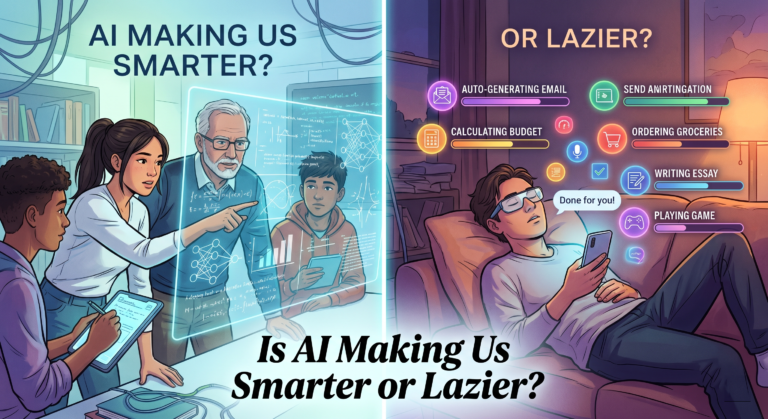
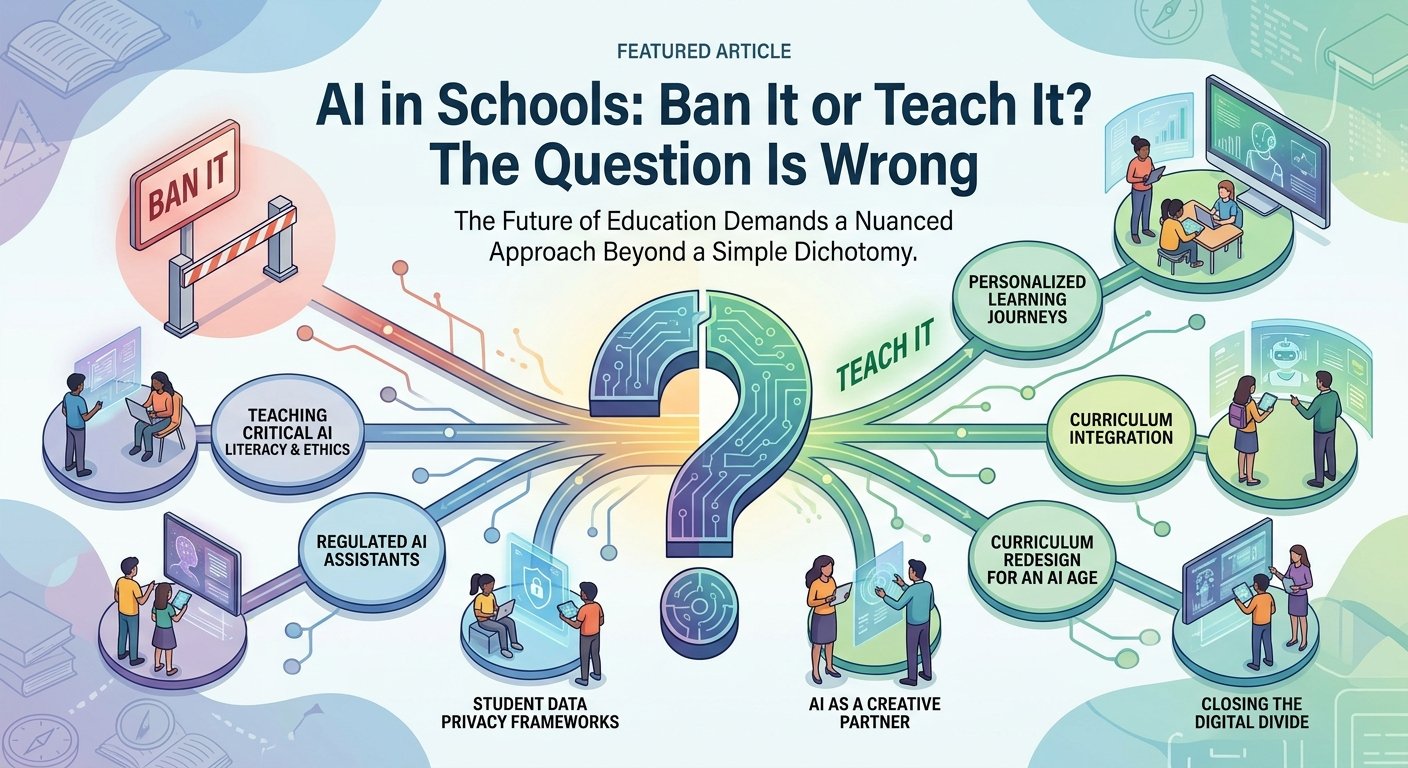
So which is it? Schools say they are preparing students for an AI-powered future, yet many forbid AI in the one place students practice for it. That contradiction is not a minor inconsistency. It shows that most schools have an AI rule but no AI policy.
The problem is not AI. It is what the task asks of the student.
AI can write essays, summarize sources, explain difficult concepts, translate, generate images, write code and give feedback. If a student pastes a prompt, submits the result and moves on, they have a finished product but none of the learning the assignment was designed to produce. That concern is legitimate.
But a blanket ban fails in a different way. Students will meet AI at university, at work and in daily life. Under a ban, some will use it secretly, without anyone teaching them its limits, its errors or its ethics. A ban doesn’t remove AI from a child’s life. It removes the adult guidance around it.
Schools can teach something more valuable than “Don’t use AI”: learn to use AI without losing your ability to think.
Creativity and judgment must stay with the student
If AI generates every idea, writes every paragraph and builds every presentation, students become dependent on it. Education should aim at the opposite. Students should learn to:
- Think independently
- Ask meaningful questions
- Research and evaluate information
- Form and defend their own opinions
- Solve problems and create original work
AI should support these abilities, not replace them. Compare two requests:
- “Write my essay about climate change.”
- “Give me five different perspectives on climate change that I could research.”
The first outsources the thinking. The second starts it. Teaching that difference is arguably the most important AI skill a school can pass on.
One policy for every subject doesn’t work
An English teacher may need to see independent writing. A computer science teacher may want students working with AI coding assistants. A business teacher may want students to critique AI-generated market research. An art teacher may want students to explore generative tools while debating originality. A science teacher may allow AI for brainstorming hypotheses but require independent verification.
These are different learning objectives, so “Is AI allowed?” is the wrong question. The right one is:
What is this assignment actually meant to teach?
If the objective is handwriting, spelling or independent composition, AI assistance defeats the point. If the objective is research, analysis, critical thinking or technology literacy, carefully structured AI use can deepen the learning.
A framework: make AI use visible
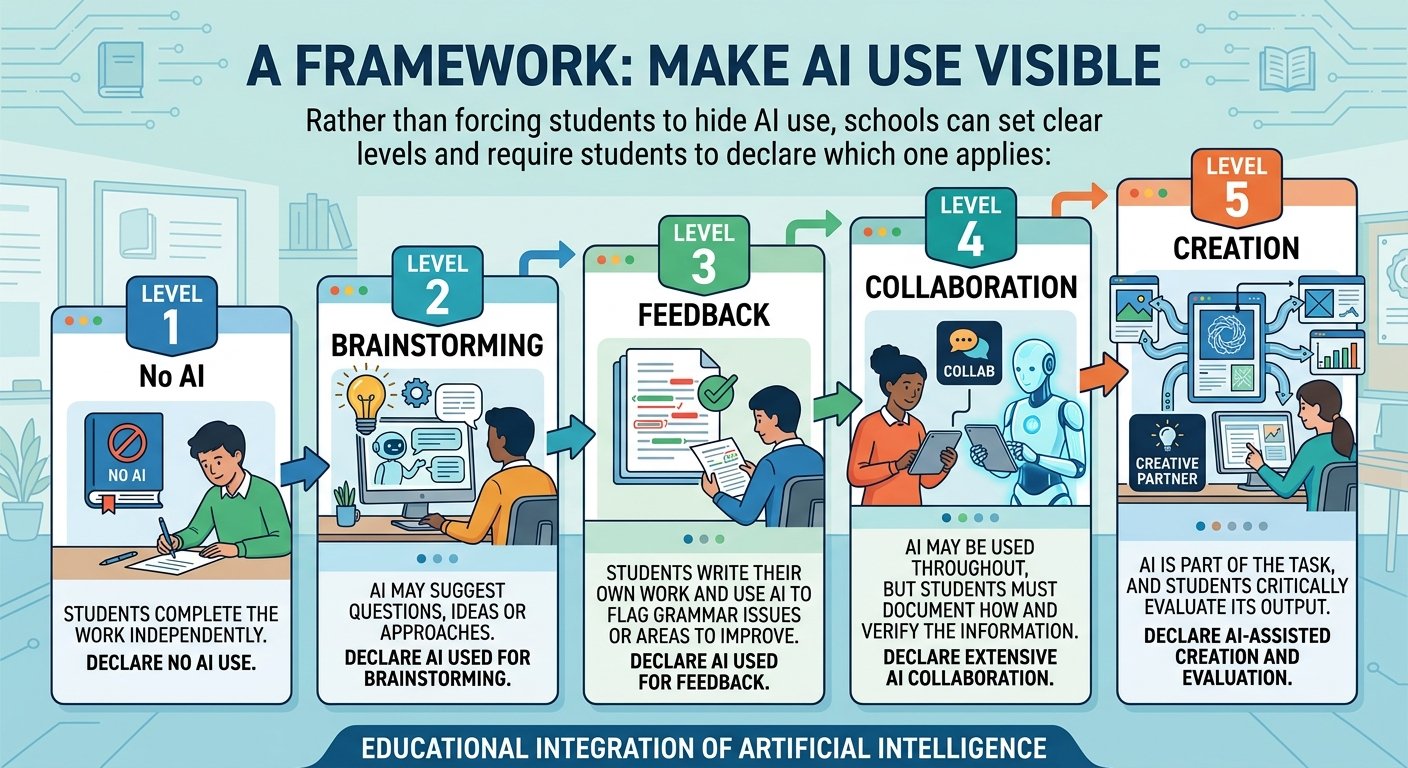
Rather than forcing students to hide AI use, schools can set clear levels and require students to declare which one applies:
- Level 1, No AI: Students complete the work independently.
- Level 2, Brainstorming: AI may suggest questions, ideas or approaches.
- Level 3, Feedback: Students write their own work and use AI to flag grammar issues or areas to improve.
- Level 4, Collaboration: AI may be used throughout, but students must document how and verify the information.
- Level 5, Creation: AI is part of the task, and students critically evaluate its output.
The principle underneath is simple. Using AI is not automatically cheating. Undisclosed use that replaces the required learning is the problem. Transparent, purposeful use can become part of the learning itself.
When a teacher wants an AI-free essay
Sometimes an AI-free assignment is exactly right. If a teacher wants evidence that a student can write an introduction, build an argument, organise paragraphs, use vocabulary and express personal ideas, then independent writing is the correct tool.
What matters is how it is communicated. Not “Don’t use AI because AI is bad,” but:
“For this assignment, we want to see your own writing skills, so please complete it without AI.”
That explains the purpose, and students respect a reason far more than a prohibition.
AI literacy is not optional
Students need to understand that AI is not an all-knowing teacher. It can state falsehoods confidently, invent references, misread questions and reflect biases in its training data. A convincing answer can be completely wrong.
The habit to build is one question: How do I know this is correct? That means verifying sources, comparing information, spotting unsupported claims and recognizing when the tool has failed. This will matter in almost every career these students enter.
Teachers need training, not just a rule
Handing teachers the instruction “prevent students from using AI” is not a strategy. Teachers need professional development in:
- AI literacy and its limitations
- Prompting
- Academic integrity in an AI context
- Designing assignments that encourage original thinking
- Using AI for feedback and assessment support
- Protecting student privacy
Above all, they need support in redesigning assessment. If an assignment can be completed perfectly by pasting one prompt into an AI tool, the assignment may be what needs to change.
Assess the process, not just the product
A polished essay now takes seconds. So instead of grading only the final document, teachers can assess the thinking behind it. Students could submit:
- Their initial ideas
- Research notes
- A first draft
- Their AI interactions, where permitted
- Their revisions
- The sources they verified
- A final version
- A short reflection on what they learned
This shows how the student thinks, and it is far harder to outsource.
The classroom as a place for human thinking
AI can generate information. Education is about judgment: What matters? What is true? What is ethical? What does the evidence support? What do I personally think?
The goal is not students who out-produce AI at generating text. It is students who can think, question, evaluate and create, and who can work with AI without surrendering those abilities.
A better school policy: one framework, stated on every assignment
Instead of leaving every teacher to improvise, schools can adopt a whole-school framework and label each assignment:
- AI prohibited: No generative AI may be used.
- AI permitted with limits: AI may be used for specific purposes such as brainstorming or proofreading.
- AI encouraged: Students are expected to use AI and critically evaluate the results.
- AI required: AI use is part of the learning objective.
This removes confusion for students, parents and teachers, and gives the school consistency across subjects.
The goal is not AI-free students
Our children will work in a world where AI touches almost every profession. The real question is whether they will use it responsibly or blindly.
Schools carry a difficult but exciting responsibility: protect the development of fundamental human skills while preparing students for a world where machines handle more and more cognitive tasks.
We should not let AI do the thinking for students. But we should not stop students from learning to think with AI either.
The future of education isn’t a choice between humans and AI. It is making sure AI stays a tool, and the human stays the thinker.
Questions for your school
- Does every assignment state its AI level, and does the student know why?
- Could your highest-stakes assignments be completed by a single prompt?
- Have teachers been trained, or only instructed?
Don’t know answers? – Contact me. We can sort this out together.