|
Getting your Trinity Audio player ready...
|
The headline that should worry every educator
On 15 November 2026, the person who came first in South Korea’s national tax accountant qualification exam went on camera and confessed. Appearing in a video on his lawyer’s YouTube channel with his face concealed by a mask, Han Won Seok confessed to using a miniature camera to photograph exam questions, sending them to an AI system and checking the answers on a smartphone. He has turned himself in to police.
The scores were extraordinary. He answered 159 of the 160 questions correctly in the first-stage exam in April, scoring 397.5 out of 400. Three months later, he scored 663 out of 800 in the second-stage written examination and was named the overall top scorer. He got a perfect score in tax law, a section where the average among all test-takers was 30.18 out of 100. He also admitted to using the same methods to cheat in the first round of the certified public accountant exam in March.
The government moved fast. Those found to have used AI to cheat in the tax accountancy exam will have their qualification revoked and will be banned from retaking the test for five years. And the scandal comes just days before the nation’s annual college entrance exam, which is now under the same suspicion.
It’s easy to treat this as one man’s moral failure. That would be a mistake. This case isn’t really about Han Won-seok. It shows a structural weakness that every school, university and licensing body now has.
Diagnosis: he wasn’t caught. He was too good.
Look at how this came out. The exam hall didn’t catch him and neither did the proctors. The Human Resources Development Service of Korea, which administers the tax accountant examination, initially said it found no concrete evidence supporting the cheating allegations. What gave him away was his score. His exceptionally high scores had fueled online speculation about possible cheating. Initially, he rejected suggestions that he had used AI-enabled equipment.
That’s the uncomfortable part. Suppose he had aimed for a comfortable pass instead of first place: a 75, a 68, a score that blends into the crowd of 722 candidates who passed out of 6,606 who took the second round. As far as we know, nobody would have noticed. He’d be a licensed tax accountant today.
So this isn’t really a story about a cheater who got caught. It’s a story about a cheater who was careless about being noticed. The ones who weren’t careless are still out there, in Korea and everywhere else.
The mechanism: why our exams are built to fail against AI
Most high-stakes exams, whether school finals, university entrance or professional licensing, rest on three assumptions that no longer hold:
- Questions are hard to get out of the room. A phone camera, a button camera and smart glasses each break this one. The question can leave the hall in a second.
- Answers are hard to get back in. Ten years ago an outside helper needed time and expertise. Generative AI answers almost instantly and is very good at exactly the closed, recall-heavy questions licensing exams use.
- A single sitting is a fair snapshot of what someone can do. Once the first two fail, the snapshot shows access to a tool, not competence.
Korean academics have already said this plainly. One Seoul National University professor who studies AI and assessment argued this week that relying on a single multiple-choice paper exam leaves an assessment system structurally at its most exposed to AI, and that exams should shift toward repeated, process-based evaluation of competence. A year earlier, after the mass online cheating case at Yonsei, academics warned recall-based exams are ‘obsolete’ and policing AI is ‘unrealistic’.
This also isn’t Korea’s first warning. In 2026 alone, a candidate in South Korea’s Financial Investment Analyst exam was caught using smart glasses equipped with generative AI to cheat, and the country prepared to overhaul technical qualification exam rules after five candidates were caught using AI-powered smart glasses. The tax exam case is just the first one that ended in a confession from someone who had passed, and from the person who came first.
The equity dimension: who actually pays for this
Three groups lose, and the cheater isn’t one of them.
Honest high achievers. Han himself said he was sorry that other passers are now under suspicion because of him. Every exceptional score now looks suspicious. The student who really did ace the paper now has to prove a negative, and if institutions respond with AI detectors and behaviour-flagging software, those tools don’t misfire evenly. Non-native speakers, neurodivergent candidates and people with unusual working styles get flagged more.
Candidates under pressure. The motive Han gave is worth reading closely. He described a failed business, money worries, and wanting to make his parents proud again after starting over in his early thirties. None of that excuses fraud. But it describes an environment where the credential is everything. Even Korea’s most prestigious humanities-track professional licenses — lawyer, certified public accountant and tax accountant — are no longer a safe path to employment, as oversupply and rapid advances in artificial intelligence squeeze entry-level jobs, and from 2023 to 2024, first-stage exam applicants increased by 33.5 percent for tax accountants. When a single sitting decides a career, the incentive to cheat goes up and the cost of a wrong accusation goes up with it.
People who can’t afford the hardware. Cheating with AI-enabled equipment costs money. A system that’s open to device-assisted cheating favours candidates who can buy the devices. That’s a privilege gap built into the exam, not just a gap in honesty.
How we fix it, and how we win
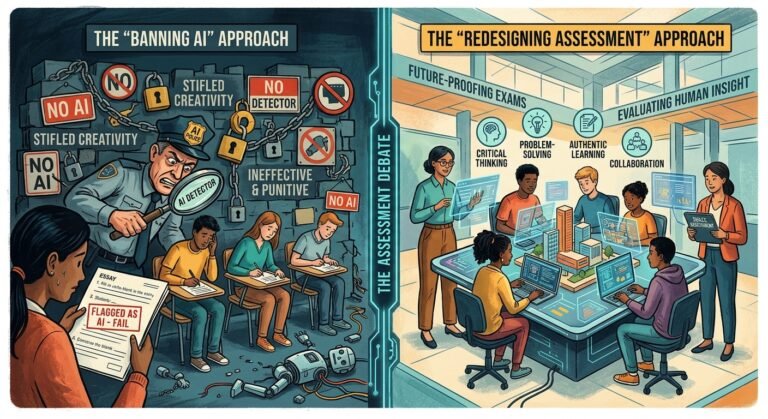
Detection alone is an arms race institutions will lose: cameras get smaller, glasses get harder to tell from ordinary ones, and AI gets faster. The answer has to happen at several levels at once.
1. Harden the hall, but don’t treat that as the strategy.
Device-free rooms, electronic signal detection, stricter checks on eyewear and personal items, and seating and proctoring rules that assume someone is trying. These are necessary as a short-term measure. They buy time. They don’t change the underlying problem.
2. Make statistical forensics routine.
Han was exposed by an outlier that the public noticed before the exam body did. Exam administrators should check every cohort for score anomalies, unlikely answer patterns, and gaps between performance on easy and hard items, before results are published. A pass that’s merely good can still be anomalous when you compare it with the candidate’s own subsections.
3. Add a human checkpoint for high-stakes outcomes.
A short oral defence or viva for top scorers, a sample of passers, or anyone flagged. Asking a candidate to explain two answers out loud costs little and is very hard to fake with a hidden camera. Doctoral programmes have used this for centuries for a reason.
4. Redesign assessment around process, not just the final product.
Spread assessment over time: supervised practicals, case work done in stages, portfolios with drafts, and in-person problem-solving where the candidate shows their reasoning. A single sitting can be hijacked, but a pattern of performance across many sittings is much harder to fake.
5. Separate AI-permitted tasks from AI-sealed tasks, explicitly.
This is the most important step for schools. Stop pretending homework is AI-free. Design some tasks where AI use is expected and assessed (how well did the student question, check and improve the AI’s output?) and a smaller set of sealed, supervised tasks that check core knowledge without it. Students need to know which is which, and teachers need the time to run both.
7. Lower the stakes of any single moment.
Where policy allows, use multiple sittings, staged licensing and supervised probation periods for new professionals. That reduces both the reward for cheating and the damage a false accusation can do.
8. Teach integrity as a professional skill, not a rule.
A tax accountant who can’t do the work without a hidden AI is a risk to every client they sign off on. Students respond better to “this is what your future clients are trusting you with” than to “don’t cheat or you’ll be punished.” This conversation has to start in Grade 6, not at the licensing exam.
What this means for learners
There’s a simple way to look at this for anyone preparing for an exam right now. If an AI can answer the questions, then passing the exam was never what made you valuable. What makes you valuable is what the AI can’t do for you in the room with a client, a patient or a class: judgement, explaining your reasoning, spotting what doesn’t add up, and owning the decision.
Han Won-seok had the top score and none of the competence it was supposed to certify. In a labour market that’s already squeezing entry-level jobs, that’s the worst position to be in: a credential you can’t back up when someone questions it.
What lies ahead
This is just the beginning. Here’s what I expect over the next few years:
- Cheating tools will become invisible. Smart glasses, earpieces and wearables that look like ordinary accessories will be cheap and widely available. Physical searches will catch fewer of them over time.
- Pre-publication audits will become standard. Exam boards will start checking results statistically before releasing them, the way banks check transactions for fraud.
- Oral and in-person components will come back. Expect licensing exams to add short spoken defences and supervised practicals. They’re expensive, but cheaper than a profession nobody trusts.
- Credentials will become continuous. Ongoing evidence of performance will count for more than a single certificate. The question will move from “did you pass?” to “can you show it, now and again later?”
- Schools will be forced to choose. Institutions that keep assessment built on one high-stakes exam will see more of these scandals. The ones that redesign now will be the ones whose qualifications still mean something.
The Korean scandal broke during the week of the college entrance exam. That timing is a warning to everyone in education. Exams built on recall and a single sitting were designed for a world without instant answers, and we’re no longer in that world. The response that will work is to make assessment harder to fake, not just to add more surveillance.