|
Getting your Trinity Audio player ready... |
An AI planning assistant can draft a week of lessons in a minute. An AI feedback tool can mark thirty essays before dinner. A parent message can be answered by a chatbot at midnight. Each of these is presented as relief for teachers. Taken together, they change what a school can expect from a teacher, and the change is not always in the teacher’s favour.
In an earlier piece I wrote about The School That Never Closes, where learning loses its timetable. This is the labour-side companion. If the school never closes, who is still working when it does not?
How efficiency turns into expectation
The pattern is familiar from every workplace technology. A tool saves time. The time saved is not handed back; it is absorbed into a higher baseline.
- The tool makes a task faster. Planning, feedback and communication all shrink.
- The new speed becomes the norm. If feedback can be returned in a day, a week starts to look slow.
- Responsiveness becomes a performance measure. Parents, leaders and platforms notice response times, and dashboards make them visible.
- The boundary erodes. Because the tools work at any hour, requests and replies drift into evenings and weekends.
- The saved time is spent on more output. More differentiated materials, more messages, more data entry.
None of these steps is announced as a policy. Each is a small drift. The result is a teacher who has more tools and less rest.
Where the pressure lands
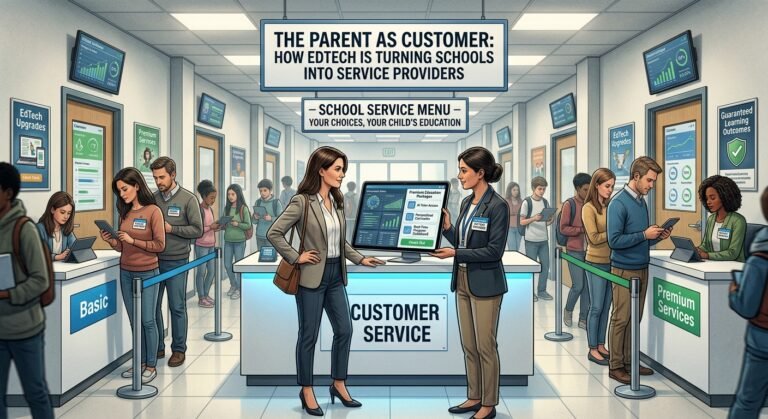
Real-time parent portals already raised the visibility of teachers’ work, a point I explored in The Parent as Customer. AI adds a second layer: if a tool can generate an individual plan for every student, the question becomes why a teacher has not.
The pressure also lands unevenly.
- Early-career teachers often feel least able to set limits and most pressed to show they are keeping up.
- Teachers with caring responsibilities outside work have the least flexibility to absorb extra evening hours.
- Teachers in under-resourced schools are told AI will close the gap in support staff, then discover that the gap has been moved onto them.
If the profession becomes harder to sustain, schools lose experienced people. That is a learning cost for students, not only a welfare issue for staff.
What schools can put in writing
Good intentions do not hold boundaries. Written terms do. Here is what leaders can commit to.
- Define response windows. State when staff are expected to reply to parents and colleagues, and when they are not. Apply the same rule to messages sent by automated tools.
- Keep after-hours automation off by default. If a tool can send or schedule messages at night, set it so that nothing is delivered to staff outside working hours unless it is urgent.
- Return saved time deliberately. When a tool reduces a task, decide in advance what the time is for: planning, rest, collaboration or fewer hours. Do not let it default to more output.
- Do not use responsiveness as a performance metric. Measure learning and practice quality instead of message speed.
- Set expectations for AI-generated materials. A teacher should not be asked to produce AI-differentiated versions of every resource simply because it is possible.
- Review workload each term. Ask staff, anonymously, which tools added work rather than removed it, and act on the answers.
- Put it in the policy. Workload terms belong alongside the AI policy and the tool register, not in an informal understanding.
The question for your next staff meeting
Pick one AI tool your teachers use. Ask: since we introduced it, has anyone’s working week got shorter? If the honest answer is no, the saved time went somewhere, and your staff are the ones paying for it.
Related Reading
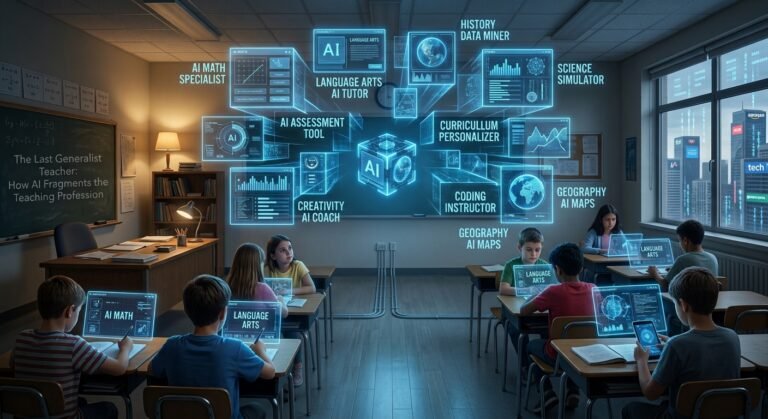
- The Last Generalist Teacher
- The School That Never Closes
- Why Teachers Are Becoming Data Analysts
- The Parent as Customer