AI, cyber security, Education, encryption, Finance, GCC, help
Ask a teacher what they did today and you will get a list that does not fit any job description. They explained photosynthesis, noticed that a quiet student had stopped eating lunch, rewrote a worksheet because the printed one had a mistake, mediated a dispute over a phone, marked twenty-eight essays, emailed a parent who was worried, adjusted tomorrow’s lesson because today’s ran long, and stayed after the bell because one student finally understood something and wanted to keep going.
That list is the job. Not the content delivery, not the marking, not the pastoral work, but all of it, held together in one person who knows the same thirty students in all of these dimensions at once. The teacher is a generalist in the oldest sense: someone whose value comes precisely from not being specialised.
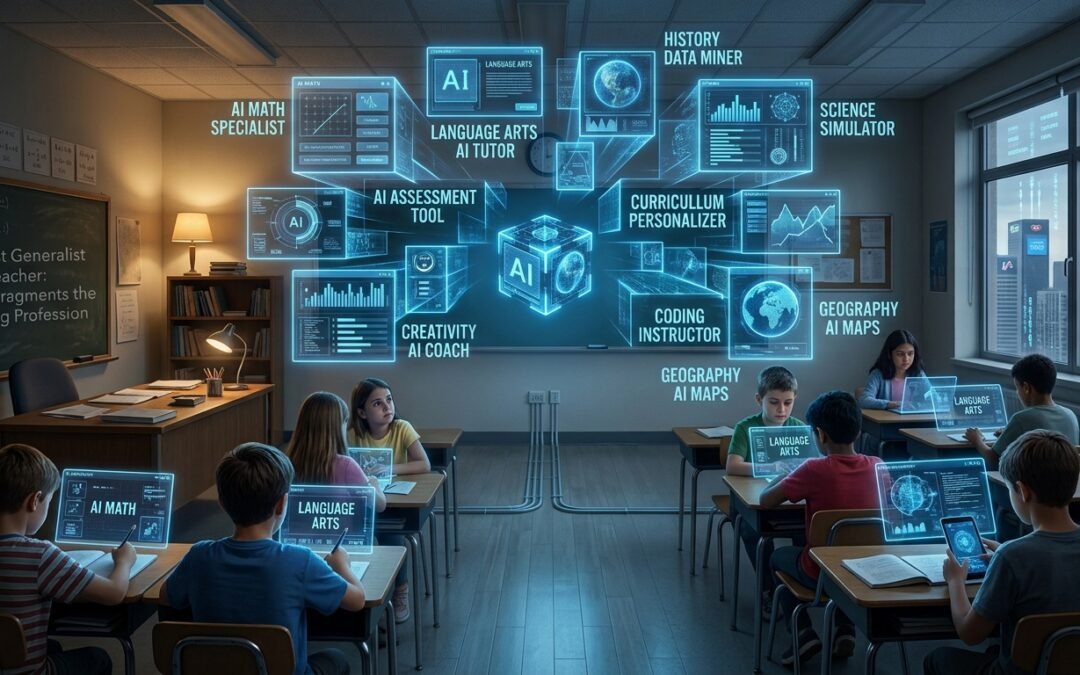
This is the role that AI is now dismantling. Not by replacing the teacher, which is the fear everyone talks about, but by pulling the role apart into components and then asking which components still need a human. The answer to that question, as it is currently being given, will produce a teaching profession that looks more professional, more specialised, and more efficient, and that is in fact hollowed out.
This article is about how that happens, why it is being sold as progress, and what school leaders can do to decide which parts of the role they are going to protect.
The generalist role and why it works
Teaching as a single, integrated role is not an accident of history. It emerged because the components of the job reinforce each other in ways that are easy to miss until they are separated.
The teacher who delivers the content is the teacher who marks the work, which means they see, in the marking, exactly which part of the explanation failed. The teacher who marks the work is the teacher who knows the student, which means they can tell the difference between a student who did not understand and a student who understood but had a bad week. The teacher who knows the student is the teacher standing at the front of the room, which means the relationship built over months makes the explanation land differently than it would from a stranger.
These are not separate tasks that happen to be done by one person. They are one task with several faces. Content knowledge without relationship is a lecture. Relationship without content is a chat. Assessment without either is a number. The generalist teacher is valuable because the integration is where the teaching actually happens.
There is also a simpler reason the role stayed integrated: it is cheap. One salary, one classroom, one adult responsible for thirty children across all dimensions. Every attempt to specialise the role has historically run into the cost of needing more adults.
AI changes that calculation, and that is where the trouble begins.
How the role fragments
The fragmentation does not arrive as a redesign of the profession. It arrives as a series of tools, each of which takes one face of the job and does it well enough.
Content delivery goes first, because it is the most legible. An AI tutor can explain photosynthesis to thirty students at thirty different levels, with infinite patience, at any hour. It does not get the explanation wrong because it is tired. It does not lose the thread because someone threw a pen. For the routine transmission of established knowledge, the tools are already good and getting better.
Assessment goes second. Automated marking of structured work is already common. Marking of extended writing is now within reach. Generated feedback is fluent, specific, and instant. A teacher who spent evenings marking now spends them reviewing what the system marked, and soon spends them on something else entirely.
Planning goes third. Lesson generation, differentiation, resource creation, curriculum sequencing: these are text-generation tasks and the tools are text generators. The teacher who used to build a lesson now selects and adjusts one.
What is left, once content, assessment, and planning are absorbed, is the human residue: the relationship, the noticing, the classroom management, the pastoral care, the judgement about when a rule should bend. And here is where the redesign happens, because once the residue is visible as a residue, it becomes possible to ask whether it, too, should be a specialist role.
So new titles appear. The learning designer, who configures the platforms and sequences the curriculum. The wellbeing coach, who handles the pastoral load. The assessment auditor, who checks that the automated marking is fair. The classroom facilitator, who supervises platform time and manages behaviour. The subject expert, retained for the difficult material the platform cannot handle, spread across many more students than before.
Each title comes with a job description, a training pathway, and, often, a lower salary than the generalist teacher it replaces. Each is defensible on its own terms. Together they are the end of the profession as it has existed.
Why this is sold as professionalization
The language around this shift is uniformly positive, and it is worth understanding why, because the positive framing is not dishonest. It is simply incomplete.
Specialisation is what professions do. Medicine specialised. Law specialised. Engineering specialised. In each case, specialisation was associated with deeper expertise, clearer standards, higher status, and better outcomes. When a school announces that it is creating a learning design team and a dedicated wellbeing function, it sounds like teaching is finally being taken as seriously as those other fields.
Workload is the other argument, and it is a real one. Teachers are exhausted. The generalist role has always been overloaded, and the load has grown as expectations have grown without any corresponding growth in time. Removing marking and planning from the teacher’s evening is a genuine relief. Telling a teacher they no longer have to be a counsellor, a data analyst, and a curriculum designer as well as an instructor is, on its face, kindness.
And there is the efficiency argument, which is rarely stated out loud but drives most of the decisions. A generalist teacher is an expensive way to deliver content that a platform can deliver. If the platform handles instruction, the school needs fewer subject specialists and can staff the residual functions with people who cost less. The specialised roles are attractive to leadership not because they are better but because they are cheaper, and the professionalisation language makes the cost saving look like an upgrade.
The problem is that teaching is not medicine. In medicine, the patient’s condition is the object of the work, and different specialists can examine it from different angles. In teaching, the relationship between the adult and the child is not an angle on the work. It is the work. Splitting it into a content specialist, a wellbeing specialist, and a supervision specialist does not give the child three experts. It gives the child three strangers, none of whom has the integrated picture that made the generalist effective.
What de-skilling looks like from the inside
De-skilling is a specific thing. It is not the loss of a job. It is the transformation of a job so that the judgement and knowledge it used to require are no longer needed, because they have been built into the tool or the process. The craftsman becomes the machine operator. The role survives; the skill does not.
Applied to teaching, it looks like this.
The facilitator supervising platform time does not need to know the subject. The platform knows the subject. The facilitator needs to keep the room quiet and escalate technical problems. Over time, the school stops hiring subject-qualified staff for that role, because subject qualification is no longer required. The facilitator’s judgement about whether a student is confused or bored or struggling at home is not exercised, because the platform is reporting engagement metrics and the facilitator’s job is to respond to those.
The assessment auditor reviewing automated marking does not need to be able to mark. They need to spot anomalies in the system’s output. Over time, the ability to look at a piece of student writing and know, from experience, what the student understood and what they were faking, atrophies, because it is not what the role does.
The learning designer sequencing platform content does not need to have taught. They need to understand the platform. Over time, the people designing what children learn are people who have never stood in front of a class, and the curriculum drifts toward what the platform makes easy rather than what children need.
The subject expert, now spread across two hundred students instead of thirty, cannot know any of them. Their expertise is real but it is delivered as a service, not a relationship, and it is reserved for the hard cases the platform escalates.
None of these people is doing a bad job. All of them are doing exactly what their role requires. The de-skilling is not in the individuals. It is in the system, which no longer requires anyone to hold the integrated judgement that the generalist held.
And the consequence lands on the children, who are now seen by many adults and known by none.
Which parts of the role to protect
Leaders cannot stop the tools from arriving, and should not try. The relief from marking and planning is real, and refusing it would be its own kind of harm. But leaders can decide, deliberately, which functions of the generalist role they are going to protect as integrated, human, and relational, and which they are willing to specialise or automate.
The following framework is a way of making that decision on purpose rather than by default.
Distinguish the transmissible from the relational. Some of what teachers do can be separated from the person doing it without loss: explaining a fixed body of content, marking against a rubric, producing differentiated worksheets. These are transmissible. Other things cannot be separated from the person: knowing which student needs pushing and which needs protecting, noticing the change in a child’s behaviour, deciding that today the lesson plan matters less than the conversation. These are relational. The transmissible can be automated or specialised with modest loss. The relational cannot be specialised without destroying it, because its value lies in the same person doing it across time and context.
Protect a minimum integrated relationship. Every student should have at least one adult who teaches them, assesses them, and knows them, in the same person, across a meaningful span of time. This is not a tutor-group arrangement where a form teacher sees them for ten minutes a day. It is a teaching relationship. The number of students that adult carries should be capped at a level that makes knowing them possible. If the platform handles content for the rest of the day, that is acceptable. If no such adult exists, the school has already fragmented the role, whether or not it has changed the job titles.
Keep subject knowledge in the room. Whoever is supervising learning should be able to teach what is being learned. This is not because the platform needs help explaining. It is because the adult’s judgement about whether learning is actually happening depends on knowing the subject. An adult who cannot tell a correct answer from a confident wrong one cannot supervise learning; they can only supervise behaviour.
Treat new roles as additions, not replacements. A wellbeing coach is a good thing to have. A learning designer is a good thing to have. They should be added to a school that retains generalist teachers, not created by carving up the generalist role. The test is simple: after the reorganisation, is there still someone who does what the generalist did? If the answer is that those functions are now distributed across four people, the profession has been fragmented, and it should be named as such in the plan.
Audit the training pipeline. If the school, or the system, is hiring facilitators without subject qualifications, learning designers without classroom experience, or assessment staff without marking experience, it is building the de-skilled profession one recruitment at a time. Hiring criteria are where the future of the role is actually decided.
Measure what the generalist did. The functions of the integrated role are invisible in most school data. Engagement, attainment, and attendance are tracked. The number of students who have an adult who knows them is not. Leaders should find a way to count it, because what is not counted is what gets specialised away.
The choice about the role
There is a version of this future that is good. It is one in which the tools take the transmissible load, teachers are freed from the evening marking and the weekend planning, and the generalist role survives with a smaller class and a lighter burden, doing the relational work that it was always best at. That version requires leaders to decide, in advance, that the integrated role is the thing to protect and the tools are the thing to fit around it.
The other version is the one that happens if no such decision is made. The tools take the transmissible load, the residue is specialised because specialisation is cheaper, the generalist is retired with a professional-sounding farewell, and the children are handed to a system that sees them from many angles and knows them from none.
The last generalist teacher will not be sacked. They will be promoted to learning designer, or moved to wellbeing, or given three hundred students and called a subject lead. The role will not end with a decision. It will end with a reorganisation that nobody called a decision. Which is exactly why the decision needs to be made now, explicitly, by the people who still have the authority to make it.

AI, cyber security, Education, encryption, GCC, improve
Every school runs on a clock that has almost nothing to do with how people learn. The bell rings at 7:45 because buses need to be back for the second run. Mathematics happens in period three because the mathematics teacher has period four free for Grade 9. The year begins in September and ends in June because that is how it has always been done, and because the calendar is now load-bearing for everything from teacher contracts to exam boards to the rhythm of family life.
None of this is a secret. Educators have complained about the timetable for as long as timetables have existed. What is new is that the technologies now entering schools are, for the first time, capable of dissolving the schedule entirely. AI tutors do not have a period four. Adaptive platforms do not close for the summer. Micro-credentials can be earned on a Tuesday evening in March or a Sunday morning in August, and the credential does not care which.
The previous installments of this series looked at what happens when the syllabus goes, when the teacher becomes partly synthetic, when emotion is surveilled, when memory is augmented, and when credentials detach from courses. This one looks at something quieter and more structural: what happens when learning loses its relationship with time. And, crucially, who loses that relationship first.
What the schedule actually does
It is tempting to treat the timetable as pure friction, an administrative leftover that technology will mercifully remove. That misreads it. The schedule performs several jobs at once, and most of them are invisible until they stop working.
First, it coordinates. A school is a place where hundreds of people need to be in specific rooms at specific times with specific resources. The timetable is the shared agreement that makes this possible. Remove it and coordination does not disappear; it becomes someone’s individual problem.
Second, it paces. A course with a fixed end date forces a rate of progress. Students who would drift are pulled along. Teachers who would over-elaborate are pulled back. The pace is often wrong for any given individual, but it is a pace, and a pace is a form of care.
Third, it protects. The school day marks out time that belongs to learning and, by implication, time that does not. The bell at 3:15 is a boundary. Homework blurs that boundary, but the existence of a formal end to the school day means that “not now” is a legitimate answer.
Fourth, it signals. Being in school during school hours communicates something to families, employers, and the state. Attendance is legible. Presence is countable. Truancy is definable. A great deal of child welfare infrastructure quietly depends on the fact that children are expected to be in a known place at a known time.
Fifth, and least discussed, it provides childcare. Schools are where children are while adults work. This is not a side effect. It is one of the reasons mass schooling was politically possible in the first place, and it remains one of the reasons it is politically untouchable.
Any technology that removes the schedule has to either replace these functions or push the cost of their absence onto someone. Understanding who that someone is requires looking at the mechanism.
How the schedule dissolves
The dissolution does not arrive as a policy. Nobody announces the end of the timetable. It happens through a sequence of individually reasonable decisions, each of which makes sense on its own.
It begins with supplementation. An AI tutoring platform is introduced for students who are behind. It is available after school, on weekends, during holidays. This is unambiguously good for the students who use it. The school’s learning now happens partly outside the school’s hours.
Then comes substitution. The platform performs well. A teacher is on leave and a replacement cannot be found. Rather than a supply teacher, the class is given structured platform time with a supervising adult. Then a struggling department finds that platform-led instruction for the routine parts of the curriculum frees teachers for the difficult parts. The proportion of learning that happens on a human schedule shrinks.
Then comes decoupling. Once a meaningful share of instruction is platform-delivered, the argument for fixed periods weakens. Why should a student who has mastered the content in September wait until June to be certified? Why should a student who needs more time be failed in June rather than passed in August? Competency-based progression follows, and it is, again, a genuine improvement for many students.
Then comes the contraction of the institution. If learning is asynchronous and assessment is on demand, the school building is needed for less. Timetabled contact hours fall. The school day shortens, or becomes optional for older students, or splits into a compulsory core and an elective periphery. Space is repurposed. Staff are reallocated. The physical school becomes a hub rather than a container.
At each step the language is about flexibility, personalization, and meeting learners where they are. At each step the schedule loses a little more of its coordinating, pacing, protecting, signaling, and childcare function. And at no step is anyone asked to decide whether they wanted those functions to go.
The critical detail is that this sequence does not happen at the same speed everywhere. It happens fastest where the pressure is greatest and the alternatives are fewest.
Who loses the schedule first
Here is the counter-intuitive part. The schools most likely to keep their timetable are the ones with the most resources. The schools most likely to lose it are the ones with the least.
Consider the logic from the perspective of a well-funded independent school. It has small classes, stable staffing, expensive facilities, and parents who are paying for exactly the structured, supervised, high-contact experience the timetable provides. The platform is an enrichment. The schedule stays.
Now consider an under-resourced public school with chronic staff shortages, oversubscribed classrooms, and a budget that cannot fund a supply teacher. The platform is not an enrichment. It is the only way to cover the curriculum. Substitution is not a choice; it is the alternative to nothing. Decoupling follows, because once instruction is largely platform-led, the fixed-period structure is expensive overhead. The school day contracts because the building and staff cannot be sustained at full capacity.
The result is a two-tier system in which structured, human-paced, protected time in a physical institution becomes a premium product, and unstructured, self-paced, platform-mediated learning becomes the default for everyone else. The schedule, which was once the great equalizer of schooling (everyone in the same room at the same time, whatever their home circumstances), becomes something you have to be able to afford.
This inverts the usual equity story about Ed-tech. The concern is normally that poor students will lack access to the technology. The more plausible risk is that they will have nothing but the technology.
What the loss of the schedule costs
When the schedule goes and is not replaced, the costs land on specific people in specific ways.
They land on families. If the school day is no longer a fixed block, childcare becomes a household problem. Families with a parent at home, or with money for supervision, absorb this. Families with two working parents, or one working parent, or no parents, do not. The child is either alone with a device or not learning at all.
They land on students who need pacing. Self-paced learning is a gift to the motivated and organized. It is a trap for everyone else. The research on massive open online courses is instructive here: enormous enrollment, tiny completion, with completion skewed heavily towards learners who already had degrees. Self-direction is a skill, it is unequally distributed, and it correlates with exactly the advantages the schedule was compensating for.
They land on the boundary between learning and everything else. When the platform is always available, “always available” becomes an expectation. The student who has not logged in this weekend is now visible as a student who has not logged in this weekend. The end of the school day, which once protected time for rest, family, play, and work, no longer exists as a structural fact. It has to be defended individually, and individuals with the least power defend it worst.
They land on child protection. The teacher who notices the bruise, the hunger, the change in behavior, does so because the child is in front of them five days a week. A learner model can detect disengagement. It cannot detect a child who is being harmed at home, and it certainly cannot act. Reducing contact hours reduces the surface area through which the institution sees the child.
And they land on the institution’s own legitimacy. A school that is a hub rather than a container has to justify its existence in a way a container never did. If most learning happens elsewhere, what is the building for? The honest answer is coordination, pacing, protection, signalling, and care. But a school that has already surrendered those functions has no answer left.
What institutions should do
The point is not to defend the timetable as it exists. The timetable is often genuinely bad: too rigid, too fragmented, indifferent to individual need, and built around adult convenience. The point is to be deliberate about what replaces it, and to treat the functions of the schedule as things to be preserved on purpose rather than lost by accident.
Name the functions before touching the structure. Before any change to the school day is made in response to a platform or a competency model, leadership should write down, explicitly, what the current schedule is doing for coordination, pacing, protection, signalling, and care. Each proposed change should then state which of these functions it affects and how that function will be delivered afterwards. If the answer is “it won’t be,” that is a decision, and it should be made by governors, not by default.
Protect contact hours as a floor, not a ceiling. Competency-based progression should decide when a student is certified, not how much time they spend with adults. A student who masters the content early should gain enrichment, mentoring, or depth, not fewer hours in the building. Contact time should be treated as a guaranteed entitlement that platform efficiency cannot erode.
Make the platform run on the school’s clock. Adaptive tools can be configured to respect boundaries. Assignments can have windows. Notifications can stop at a defined hour. Dashboards can be designed so that out-of-hours inactivity is not surfaced as a deficit. Institutions should negotiate these settings at procurement and refuse platforms that cannot honour a school day.
Build pacing into self-paced systems. If students are progressing at their own rate, someone must own the rate. That means named adults responsible for checking progress at fixed intervals, minimum-velocity expectations with human follow-up when they are missed, and cohort structures that keep students moving with peers even when content is individualized. Self-paced does not mean unsupervised.
Treat any contraction of the school day as a childcare and safeguarding decision. It should be assessed as such, with the families most affected consulted first and provision made before hours are cut, not after.
Watch the gap. If the school day is shortening in some schools and not others, that is a systemic equity signal, and it belongs in front of policymakers and boards, not buried in individual school reports. The measure to track is not platform adoption but protected, supervised, human-paced hours per student per week, disaggregated by the socio-economic profile of the school.
The choice that is not being made
The schedule was never neutral. It embodied a set of decisions about whose time mattered, what learning looked like, and where children belonged. Those decisions are now being revisited, but not by anyone in particular and not on purpose. They are being revisited by procurement cycles, staffing crises, and the quiet accumulation of platform hours.
The future of learning does not have to be a school that never closes. It could be a school that closes deliberately, at a time it chooses, having decided what to keep. But that requires institutions to see the timetable not as an obstacle to be automated away but as a piece of infrastructure whose functions they are responsible for. The schools that understand this will keep their students’ time. The schools that do not will find that their students’ time has been kept by someone else.
AI, cyber security, Education, GCC
Educational Technology · In-Depth
The Classroom of Tomorrow Is Already Here
How artificial intelligence, intelligent platforms, and the rise of online learning are fundamentally reshaping what it means to teach — and what it means to learn.
April 13, 2026 · 12 min read · For educators & school leaders
$404B
Global edtech market projected by 2025
60%
Of K–12 teachers now use AI tools regularly
3×
Faster skill acquisition with adaptive learning systems
1.8B
Learners reached by online platforms globally
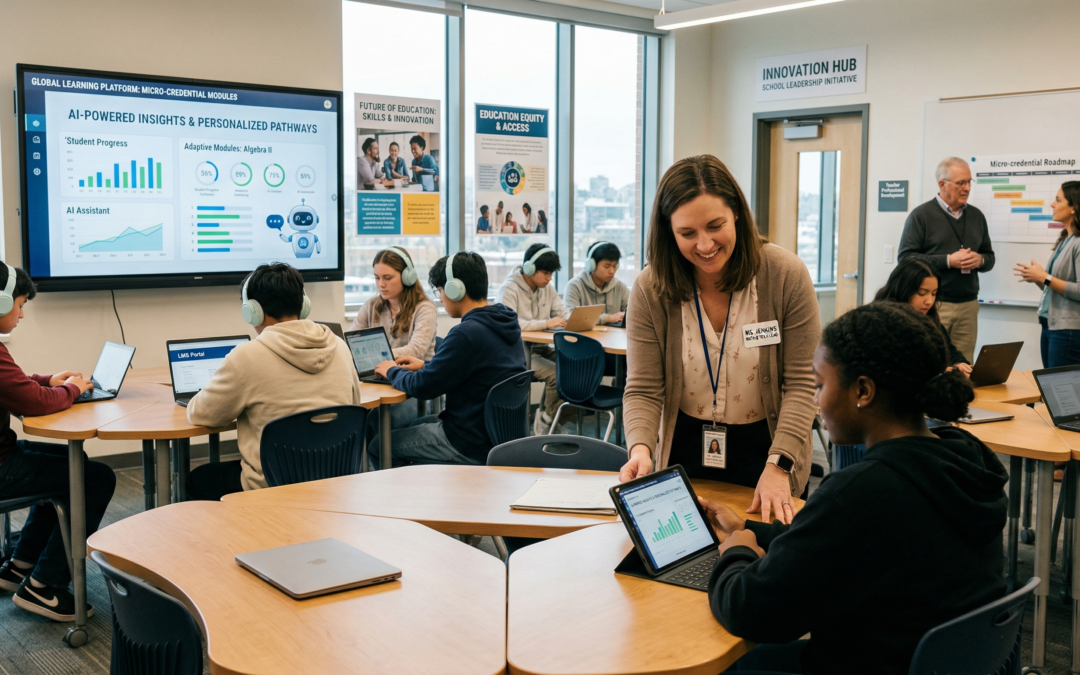
Walk into a forward-thinking school today and you might struggle to recognize it. One student is working through a personalized algebra module at her own pace, guided by an AI tutor that adjusts every question based on her last response. A teacher nearby is not lecturing — he is coaching, circulating among small groups, armed with real-time dashboards that flag which students are falling behind before they even raise their hand.
This is not a vision of 2035. It is happening right now — and for educators and administrators navigating this transformation, the challenge is no longer whether technology belongs in learning, but how to deploy it with wisdom, equity, and intention.
Part I — AI in Education: Beyond the Hype
Artificial intelligence has become the most discussed and most misunderstood force in modern education. Cut through the noise, and what emerges is a technology that is simultaneously more modest and more profound than its headlines suggest.
What AI is actually doing in classrooms
The most impactful AI applications in education are not robots replacing teachers. They are systems that do the cognitive heavy lifting that teachers were never designed to carry alone. Adaptive learning platforms like Khan Academy’s Khanmigo, Carnegie Learning, and Synthesis use machine learning to track thousands of micro-signals — response times, error patterns, topic avoidance — to build a unique learning profile for each student. The system then adjusts difficulty, pacing, and content type in real time.
For educators, this means something genuinely revolutionary: the ability to differentiate instruction at scale. A teacher managing thirty students has never, realistically, been able to personalize learning for each one. AI makes that personalization automatic, continuous, and invisible to the student — it simply feels like a curriculum that fits.
Practitioner Insight
AI-powered formative assessment tools are among the highest-leverage investments a school can make. They move feedback from summative (end-of-term) to continuous, allowing teachers to intervene weeks earlier than traditional grading would allow.
AI as a teacher’s co-pilot
Beyond student-facing applications, AI is quietly transforming teacher workflows. Lesson planning tools can generate differentiated worksheets across three reading levels in seconds. Grading assistants can provide first-pass feedback on written work, freeing teachers to focus their attention on the qualitative judgments only a human can make — the student who is technically correct but clearly confused, or the essay that ticks every box but lacks a genuine voice.
Administrative AI is also reducing the invisible workload that drives educator burnout: attendance logging, parent communication drafting, IEP documentation, and scheduling are all areas where intelligent automation is reclaiming hours per week for teachers who need them.
“The best AI tools don’t replace teacher judgment — they create the conditions for more of it.”
The equity imperative
No discussion of AI in education is complete without confronting the equity gap. The schools most likely to have sophisticated AI infrastructure are already the best-resourced. Without deliberate policy intervention — subsidized licensing, device access programs, teacher training pipelines — edtech risks being another mechanism that widens the gap between advantaged and under-served learners.
School administrators have a critical role to play here: evaluating not just what a tool can do, but who it is designed for, whose data it trains on, and whether its recommendations reflect the full diversity of students it will serve.
Part II — The EdTech Platform Landscape
The tools market has matured dramatically. Where early edtech was often a digitized worksheet — content moved online without meaningful pedagogical redesign — a new generation of platforms is built around learning science from the ground up.
Learning Management Systems grow up
LMSs like Canvas, Schoology, and Google Classroom have evolved from content repositories into rich ecosystems. Modern platforms integrate video, discussion, formative assessment, analytics, and third-party app markets in a single environment. For administrators, the critical evaluation criteria have shifted from features to interoperability: can this platform share data with your student information system? Can it integrate with the specialist tools your special education or gifted programs rely on?
Collaborative and project-based tools
A generation of tools has emerged to support the pedagogies that research consistently shows produce the deepest learning: collaboration, project-based learning, and authentic audience. Platforms like Padlet, Flipgrid, Book Creator, and Canva for Education give students the ability to create, share, and receive feedback in multimodal formats that reflect how knowledge is actually communicated in professional life.
For School Leaders
Before adopting any new platform, audit your current tool stack for overlap and complexity. Teachers managing eight different logins will use none of them well. Consolidation — even at the cost of some functionality — typically improves adoption and outcomes.
Assessment reimagined
The traditional test is under pressure from two directions simultaneously: AI tools that can answer most knowledge-recall questions, and a deeper pedagogical consensus that performance tasks, portfolios, and authentic demonstrations of competency reveal learning that multiple-choice cannot. Platforms like Seesaw, Formative, and Peergrade are building new models of evidence-based assessment that are harder to automate and more meaningful to students.
Part III — The Future of Online Learning
Online learning has undergone two distinct revolutions. The first, accelerated by the pandemic, was one of necessity — schools moved online because they had to, and the results were mixed. The second, now underway, is one of design — institutions building online and hybrid experiences that are genuinely better than what a traditional classroom offers for certain learners, certain content, and certain contexts.
Hybrid as the default
The binary of “online” versus “in-person” is dissolving. Blended learning — where students move fluidly between independent digital work and collaborative in-person experience — is becoming the dominant model in progressive schools. When designed well, blended environments allow students to spend more time on the activities that most require human presence (discussion, mentorship, lab work, performance) and less time passively receiving information that a video or interactive module can deliver equally well.
Micro-credentials and modular learning
One of the most significant structural shifts in online education is the unbundling of the traditional course. Platforms like Coursera, edX, and a growing number of employer-backed programs are offering micro-credentials — focused, verifiable certificates of specific skills — that sit alongside or instead of degree programs. For educators, this represents both an opportunity and a disruption: an opportunity to certify and communicate the specific competencies students develop, and a disruption to the assumption that the semester-long course is the natural unit of learning.
The social problem — and its solutions
Online learning’s most persistent weakness is social. Learning is fundamentally relational, and screen-mediated interaction, however convenient, rarely replicates the spontaneity, warmth, and incidental connection of shared physical space. The best online programs are addressing this not by apologizing for the limitation, but by engineering intentional social structures: cohort models, live synchronous sessions, peer accountability partnerships, and community platforms that make the social layer explicit rather than incidental.
“Online learning fails when it tries to replicate the classroom. It succeeds when it builds something the classroom never could.”
What This Means for Educators and Administrators Today
The convergence of AI, mature platforms, and redesigned online learning creates both extraordinary opportunity and genuine complexity. For educators on the ground, the mandate is to resist two failure modes: uncritical adoption — implementing technology because it is new and generates excitement — and defensive resistance — treating every innovation as a threat to the human heart of teaching.
The most effective educators in this landscape are those who have internalized a simple evaluative question: does this tool give me or my students more time and space for the things that matter most? If an AI assistant frees forty minutes a week for one-on-one conversations with struggling students, that is a trade worth making. If a new platform adds cognitive load without a corresponding pedagogical return, it is not.
For school administrators, the strategic priority is infrastructure: not just device access and broadband, but the professional development pipelines, data governance frameworks, and community trust necessary to ensure that technology serves the school’s mission rather than reshaping it by default.
The classroom of tomorrow is not a destination that arrives fully formed. It is built, iteratively and collaboratively, by educators willing to experiment, reflect, and share — equipped with better tools than any generation of teachers has had before.
Artificial Intelligence
EdTech
Online Learning
School Leadership
Adaptive Learning
Blended Learning
Education Equity
AI, cyber security, Education, GCC
Trust, Ethics, and Security in the AI Age
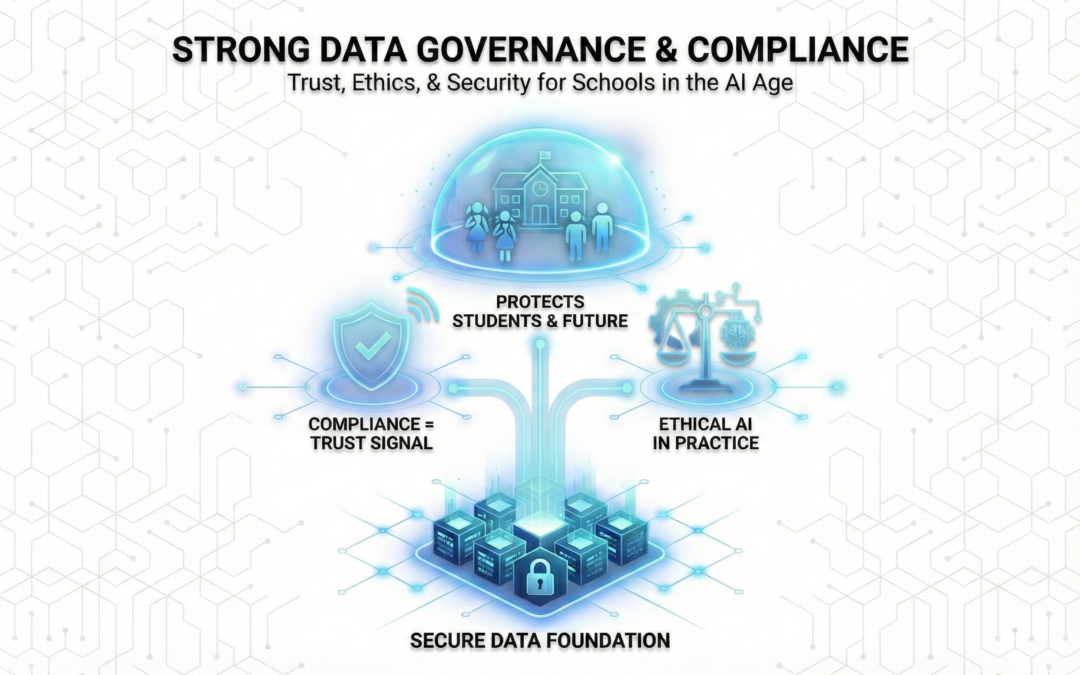
Data is the engine behind every AI system — but without proper governance, it quickly becomes a risk rather than an asset. Schools that are truly ready for the AI era don’t treat data governance as an afterthought. They build it into the foundation.
Why This Matters Now
By 2040, educational institutions will be generating and storing more sensitive data than ever before — from student learning patterns and behavioral analytics to staff records and third-party platform integrations. The stakes are high, and the window to build the right systems is now.
Strong data governance means having clear, enforceable policies across five critical areas: who owns the data, who has consented to its use, who can access it, how long it is retained, and how AI systems are permitted to use it. Without clarity on all five, schools expose themselves — and the people they serve — to serious risk.
Compliance Is a Trust Signal, Not Just a Legal Obligation
Meeting national regulations and aligning with international standards such as GDPR or ISO 27001 does more than keep schools out of legal trouble. It sends a powerful message to families, regulators, and institutional partners: we take your trust seriously.
Compliance, done well, becomes a competitive advantage.
Ethical AI Requires Ethical Data Practices
Automated decisions — whether about student progress, resource allocation, or staff performance — carry real consequences. Ethical AI frameworks ensure those decisions are fair, explainable, and accountable. They prevent bias from being quietly embedded in algorithms and ensure that humans remain meaningfully in the loop.
Data governance is not separate from ethics. It is ethics, made operational.
The Bottom Line
A school that protects its data protects its students, its staff, its reputation, and its long-term future. In the AI age, data governance is not a compliance checkbox — it is a core institutional value.