|
Getting your Trinity Audio player ready... |
The standard way to prepare staff for AI is a training day. Everyone sits in a hall, a presenter demonstrates tools, and teachers go back to classrooms the next morning with a list of links. Within weeks, most of what was shown has not been tried. The reason is simple: practice changes through repeated use, feedback and support, not through a single exposure.
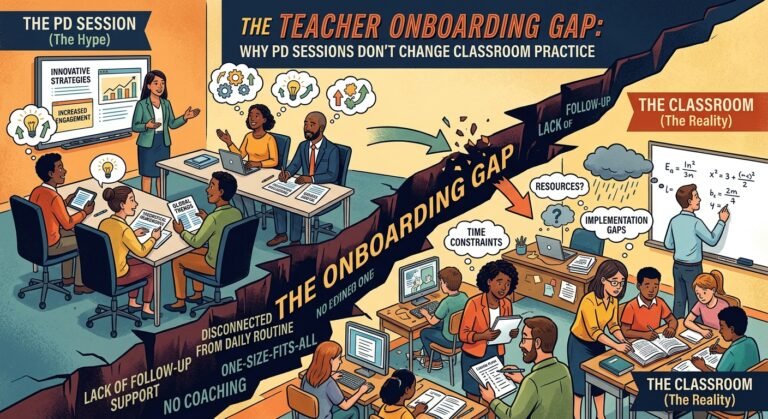
In The Teacher Onboarding Gap I argued that one-off sessions do not change classroom practice. This piece offers the alternative for AI specifically: a micro-coaching model that fits inside a normal school week.
Why AI is especially hard to train for
- The tools move. A skill taught in September may be out of date by March.
- Teachers start from very different places. One may be using AI daily and another may never have opened it.
- The risks are real. Student data, accuracy and academic integrity make casual experimentation less safe.
- There is no time. Teachers are already full. Any approach that adds hours will not survive.
The micro-coaching model
The model has four parts. Each is small, regular and tied to real classroom work.
- Peer-led pilots. Two or three teachers per department try a specific AI use in a real lesson for a few weeks, with a clear question: did it improve learning or save useful time? Teachers trust colleagues who have done it in their own classrooms more than outside presenters.
- A shared library. A simple, searchable collection of what worked: the task, the tool, the prompt, what went wrong and how it was fixed. Including failures is what makes it credible.
- Short monthly review cycles. Thirty to forty-five minutes, once a month, by department. Each teacher shares one thing tried, one result and one question. The agenda is fixed so it does not grow.
- On-demand coaching. A named person, ideally released from some duties, who can sit in on a lesson or help plan a task when a teacher asks.
What makes it work
- Protected time. The coaching must replace something. If it is simply added on, it will be dropped. Release time from meetings, cover duties or administrative tasks.
- Small, specific goals. “Use AI to produce three differentiated reading questions for next week” is a task. “Become confident with AI” is not.
- Safe ground rules. A simple list of what must never be entered into a tool and which tools are approved, drawn from your tool register, so experimentation is bounded.
- Visible leadership support. School leaders who try the tools, share their own mistakes and protect the time signal that it matters.
- Evidence of learning impact. Review student work, not only teacher satisfaction. If an AI use did not help students, say so and stop.
The equity dimension
Self-selected training favours the already confident. They volunteer, build skills and become the school’s AI voices, while others fall further behind. The result is a two-speed staff, a pattern I discuss in The Two-Speed Staff Problem.
Micro-coaching reduces this by meeting teachers where they are. Pairing a confident teacher with a hesitant one, and giving the hesitant one a low-stakes first task, brings more people in. Staff who are not teachers, such as teaching assistants, librarians and administrators, should be included too, since they also use these tools.
A simple 12-week starting plan
- Weeks 1 to 2. Agree ground rules and the approved tool list. Choose pilot teachers across subjects and experience levels.
- Weeks 3 to 8. Pilots test one specific use each. A monthly review meeting is held at the end of week 4 and week 8.
- Weeks 9 to 10. Add the best examples to the shared library. Write short, plain instructions for each.
- Weeks 11 to 12. A second wave of teachers adopts the tested uses. Pilots become the first coaches.
The question for your next PD plan
For each AI training event in your calendar, ask: what will a teacher do differently in the week after it, and who will help them do it? If there is no answer, you have scheduled information, not training.
Related Reading
- The AI-Ready School Framework
- Checklist Culture
- The Last Generalist Teacher
- What Teachers Actually Need from Their LMS