|
Getting your Trinity Audio player ready... |
Two years ago, most schools handled AI with a memo or a ban. In October 2026, governments are writing it into curricula, inspection frameworks and law. This week the Sharjah Private Education Authority (SPEA) added its own ethical framework. This guide pulls together what the main governments have published so you can compare them, followed by the patterns that repeat everywhere.
Sharjah: the newest framework
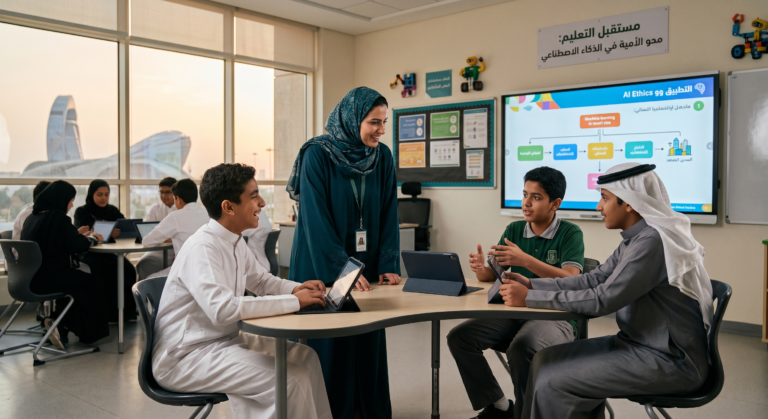
SPEA has launched an ethical framework for AI in educational institutions, with guidelines for teachers, students and school administrators. It stresses fairness, transparency, accountability, human oversight, cybersecurity and critical thinking, and tells users to verify AI-generated information.
For academic integrity, the rules cover AI use in assignments, projects and assessments. Students must disclose AI use where appropriate, and AI content must not replace their original work or undermine teachers. The framework also covers institutional media, with rules for AI in promotional materials to protect official symbols and visual identity and keep content accurate.
Note: I could only read news coverage of the framework, not the full document. Sharjah schools should read SPEA’s original text.
The wider UAE: several regulators, one direction
The UAE splits school oversight by emirate. The Ministry of Education covers the national level, ADEK regulates Abu Dhabi, KHDA regulates Dubai private schools, and SPEA manages Sharjah private schools.
- Ministry of Education, curriculum: AI became an official subject for kindergarten to Grade 12 in public schools from 2025-26. It sits under Group B subjects with no written exams, and 1,000 trained teachers were assigned to deliver it.
- Ministry of Education, usage rules: A February 2026 framework prohibits generative AI for students under 13 or below Year 7 and bans its use in formal exams and assessments. Use is allowed only with direct teacher oversight, unapproved platforms are prohibited, and personal data about students, teachers or parents must not be uploaded into AI systems.
- Abu Dhabi: ADEK is expanding an AI Education Initiative across 170-plus private schools, backed by a Technology and AI Policy. Schools must use AI tools that meet ADEK’s requirements. A school-sector summary also reports a twice-yearly AI Growth Test for Grades 4 to 12 and a KHDA literacy programme for Grades 6 to 8 in Dubai; confirm both with the regulators.
- Higher education: Cabinet Resolution No. 143 of 2026 sets violations and penalties for institutions, including academic integrity breaches that affect assessment results, with penalties rising for repeat breaches. There is no single UAE-wide AI assignment policy, so rules still vary by university.
Saudi Arabia: curriculum first, guidelines alongside
The first national AI curriculum rolled out in 2025-26, built by the Ministry of Education, MCIT, the curriculum centre and SDAIA. Alongside it, the Kingdom released a generative AI usage guide for schools aimed at ethical, responsible use that preserves the teacher’s central role, with students under 13 limited to direct supervision.
The push continues in 2026-27 with 50 new AI units and 22 updated subjects, plus AI tools developed with SDAIA and Humain to reduce teachers’ administrative load. In January 2026 SDAIA launched a national cross-disciplinary AI curriculum for university students and signed agreements with 14 universities.
China: AI literacy with hard limits
In May 2025 the Ministry of Education issued two guidelines: one builds a tiered AI education system, the other governs generative AI use. Primary pupils may not independently use AI tools that generate open-ended content, and AI may only play a supplementary role in teaching. Teachers are banned from using generative AI to replace their core teaching role, generative AI cannot be used in exams, and schools must keep whitelists of approved tools. In June 2026 a State Council outline for 2026-2030 called for AI education at every stage of schooling.
Singapore: slow, supervised, school-hosted
Singapore starts later than China. The education minister said Primary 4 pupils can begin using educational AI tools under supervision, and Primary 4 to 6 pupils use only AI tools designed for education, including those on the Student Learning Space. Proctored exams without AI keep checking mastery of fundamentals, and the ministry is studying AI’s impact on learning.
For universities and polytechnics, educators must tell students when AI is used in assessment, AI grading tools are validated before use, and data confidentiality safeguards apply. AI is prohibited where students must show independent mastery, and other assessments are redesigned around presentations and projects.
India: AI as a core subject from Class 3
On 2 April 2026 CBSE launched a Computational Thinking and AI curriculum for Classes 3 to 8, rolling out in 2026-27. Before this, over 18,000 CBSE schools offered AI as a skill subject from Class 6, and it was optional for Classes 9 to 12. Officials flagged that reaching over a crore teachers is the main challenge.
The European Union: law, not just guidance
The EU AI Act is binding, and education is a named high-risk area. The ban on emotion recognition in education and the AI literacy duty have applied since 2 February 2025. Annex III high-risk systems, which include education systems, now have until 2 December 2027, with reports tying the delay to the 2026 Digital Omnibus package. Schools must support AI literacy among staff who use AI systems. Those deploying high-risk systems must monitor them, keep logs for at least six months and tell affected people. Tools that grade work or shape student pathways are the likeliest to count as high-risk.
United Kingdom: guidance plus safety standards
England’s approach rests on three layers: product safety standards for generative AI (updated 19 January 2026), support materials for staff, and a core policy paper. KCSIE 2025, in force from 1 September 2025, covers generative AI under online safety, and the JCQ’s AI Use in Assessments guidance of 30 April 2025 is the binding document for coursework. The DfE says generative AI cannot replace the judgement and deep subject knowledge of a human expert. HEPI’s 2026 survey found 95% of UK undergraduates used AI in some form. Northern Ireland also issued its own circular in 2026.
United States: federal push, state-level rules
The April 2025 executive order sets up a White House task force and public-private partnerships for AI literacy. Department of Education guidance says federal funds can support AI tools such as tutoring and navigation platforms, and a rule finalized in April 2026, effective 13 May 2026, makes AI a discretionary-grant priority. Most classroom rules stay local: as of June 2026 no federal statute preempts state AI law, so state frameworks remain in force.
Australia: a national framework and a firmer regulator
Ministers approved the Framework for Generative AI in Schools in October 2023, for use from Term 1 2024, with six guiding principles and a commitment that schools should not use products that sell student data. In universities, TEQSA announced a shift to a regulatory-led approach from 2026, expecting providers to show how they manage risks to assessment integrity.
South Korea and Qatar: two more data points
Korea shows how ambition can outrun readiness: in August 2025 the National Assembly stripped AI digital textbooks of official-textbook status after only about 32 percent of schools adopted them. Qatar goes the other way, adding AI, data science and entrepreneurship across all stages in its 2026-27 curriculum, with AI framed as a supporting tool.
The global baseline: UNESCO
UNESCO set the template in 2023. Its guidance gives governments seven steps for regulating generative AI, including data protection standards, and sets an age limit of 13 for classroom use, while noting that many commentators think 13 is too young and have argued for 16. The UAE and Saudi under-13 rules follow this line.
Eight patterns across every jurisdiction
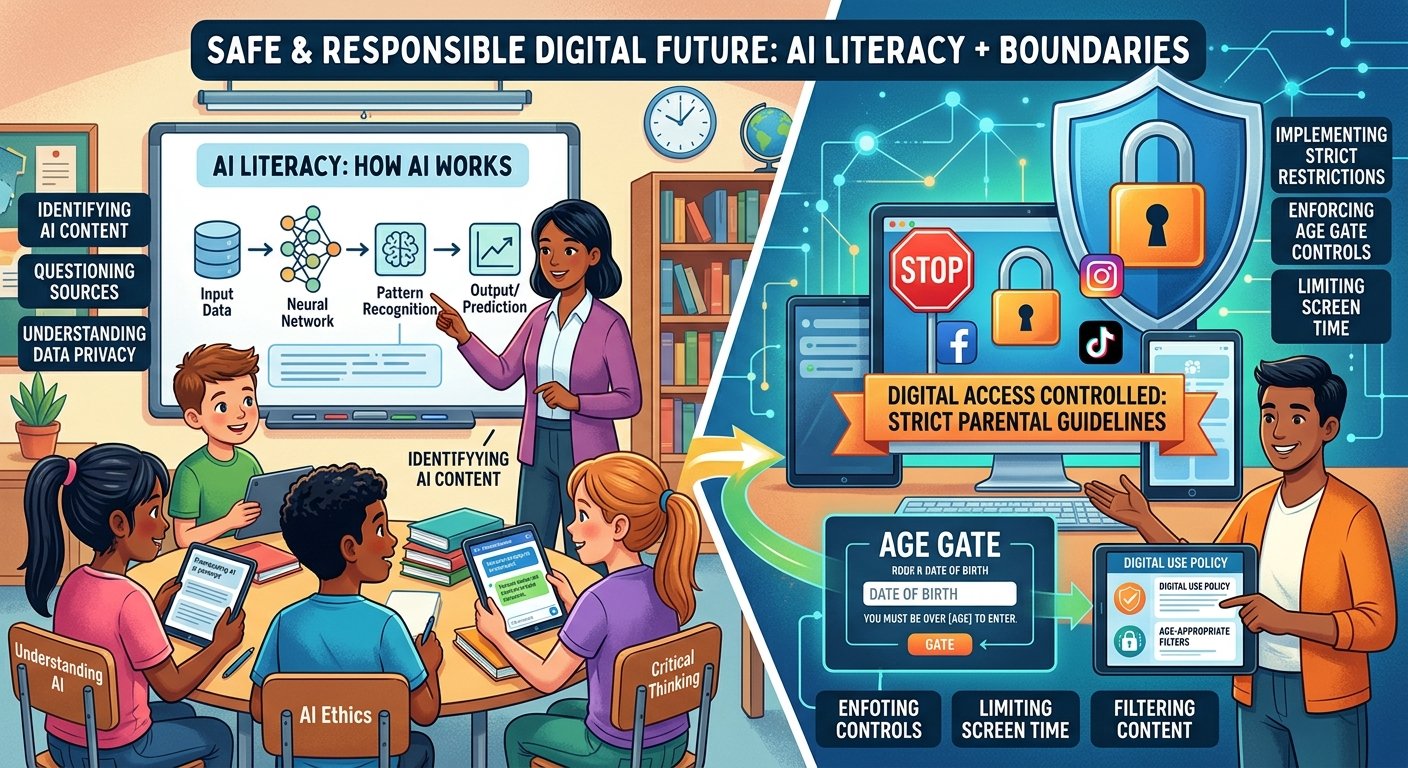
- Teach AI and restrict it at the same time. Nearly every country adds AI literacy while limiting independent use by young children.
- Age gates cluster around 13. The UAE, Saudi Arabia and UNESCO use 13; China bars unsupervised open-ended generation in primary school; Singapore waits until Primary 4.
- Humans stay in charge. Teachers cannot be replaced, and AI marking needs oversight.
- Exams are AI-free zones, with assessments redesigned around them.
- Approved tools only. The UAE, China, ADEK and Singapore require vetted or whitelisted platforms.
- Student data is the red line. The UAE, Australia and the EU all restrict how personal data enters AI systems.
- Disclosure is the norm. Sharjah and Singapore both ask for AI use to be declared.
- Regulators are getting stricter. The EU, TEQSA and the UAE higher-education resolution show a move from advice to enforcement.
Limits of this roundup
I did not find detailed school-level AI rules for Oman, Bahrain or Kuwait, or for Japan, Canada or Brazil, so they are left out. Some ADEK, KHDA and UAE university details come from secondary sources and should be checked against official documents before you rely on them. Policy is moving fast, and this reflects what was published up to 15 October 2026.
Next: see part two, how schools and universities can prepare before the regulations arrive.
Sources
- Gulf News: Sharjah ethical framework for AI
- Sharjah24: SPEA AI framework
- Gulf News: UAE under-13 rules
- Gulf News: UAE AI curriculum
- Gulf News: ADEK AI education
- Khaleej Times: UAE universities, Resolution 143
- Gulf News: Saudi AI guidelines
- Middle East AI News: Saudi 2026-27
- People’s Daily: China guidelines
- Singapore MOE: AI usage in schools
- CBSE AI curriculum explainer
- EU AI Act deadlines guide
- UK DfE guidance explainer
- US federal AI policy summary
- Australian Government: Framework for Generative AI in Schools
- UN News: UNESCO guidance
- Korea Times: AI textbooks
- Middle East AI News: Qatar