What Teachers Actually Need from Their LMS (And Aren’t Getting)

What Teachers Actually Need from Their LMS (And Aren’t Getting)

Institutions spend millions selecting and deploying learning management systems. But somewhere between the vendor demo and the daily classroom, the investment quietly stops working — and teachers quietly work around it.

“These systems were built for the people who buy them — not the people who use them.”
  • Feedback workflows built for admin, not teaching
  • Analytics that answer the wrong questions
  • Communication tools teachers route around
  • Standardization that crushes pedagogical design
  • Integrations that break in the real world

There is a peculiar dynamic at the center of most LMS adoption stories. Institutions evaluate platforms extensively — feature checklists, vendor demonstrations, pilot programs, procurement committees. They negotiate contracts, configure systems, train administrators. And then, somewhere in the gap between what the platform promised and what teachers actually do in the classroom, the investment begins to quietly underperform.

This gap has been examined from several directions: the procurement failure angle, the utilization data problem, the vendor incentive misalignment. What is examined less often is the teacher’s-eye view — what educators who use these systems daily actually need from them, what they consistently do not get, and why that mismatch persists across platform generations and institutional contexts.

The answer, when you ask teachers directly rather than surveying administrators, reveals something important: the features that matter most to effective teaching are not the ones that feature most prominently in vendor demonstrations. And the friction that matters most is not in the headline capabilities but in the daily workflow.

The Feedback Problem

Ask teachers what takes the most time in their LMS workflow and the answer is almost always the same: assessment and feedback. Creating assignments, receiving submissions, providing meaningful responses, tracking completion and revision cycles. This is the core instructional loop, and it is where most LMS platforms create the most friction.

The feedback interface in most platforms was designed for administrative completeness, not instructional efficiency. Teachers navigate multiple clicks to open a submission, switch to a different view to enter a grade, open another panel to enter comments, and repeat this process for every student in a class that may have thirty, sixty, or a hundred members.

Most LMS platforms treat each assignment as a discrete transaction. Good teaching treats feedback as a running conversation.

What teachers describe needing — and rarely have — is a feedback workflow that is fast enough to use consistently, rich enough to communicate meaningfully, and integrated enough that the feedback given on one assignment is visible and buildable-upon in the next.

Analytics That Answer the Right Questions

Learning analytics has been one of the most heavily marketed capabilities in LMS development over the past decade. Dashboards, engagement metrics, predictive risk scoring — platforms have invested significantly in generating data about student behavior and presenting it to instructors.

The problem is that most of the data generated answers questions that teachers are not asking, while failing to answer the questions they are.

Knowing that a student logged into the course three times last week is not actionable information for a teacher trying to support that student’s learning. Engagement proxies — clicks, time-on-page, login frequency — are plentiful in LMS analytics. Evidence of actual learning is scarce.

What teachers consistently describe wanting to know is simpler and harder: which students are struggling with specific concepts, not just which ones are disengaged? Where in the learning sequence are students getting lost? What patterns of misconception appear across the class that should inform how the next lesson is taught?

The gap between available analytics and useful analytics is not primarily a technical problem. It is a design priority problem. Engagement data satisfies institutional reporting requirements. So that is what gets built and marketed. Teachers, who could use learning data, are given engagement data and told it is insight.

Communication That Reflects How Teaching Works

Communication tools in most LMS platforms were built for a synchronous, course-bounded model of teaching: announcements go to all students, discussion boards contain threaded conversation, messaging happens within the platform’s inbox. This architecture made sense for a world where the course was the primary context for teacher-student interaction.

It maps poorly onto how teaching actually works in blended and online environments, where students have questions outside of course sessions, where the relevant group for a conversation is sometimes a subset of the class, where follow-up communications about assessment need to happen quickly and in contexts students actually monitor.

Teachers frequently report maintaining parallel communication infrastructure outside their LMS — email, messaging apps, video conferencing tools — because the LMS communication tools are too slow, too rigid, or too poorly integrated with how students actually check for messages. When teachers build shadow infrastructure around a system, the system is not serving their needs.

Flexibility Without Fragmentation

One of the persistent tensions in LMS design is between standardization and flexibility. Institutions want consistency: a common platform that all courses run on, with standardized navigation that students can rely on. Teachers want flexibility: the ability to organize their course according to their pedagogical logic rather than a platform template.

Most LMS platforms resolve this tension in favor of standardization — the institutionally rational choice. Platform templates tend to favor chronological or topic-based organization. Teachers whose courses are organized around inquiry cycles, project phases, or conceptual progressions find themselves mapping their instructional logic onto a structural container it was not designed for. The content gets in, but the coherence is lost.

Course organization is not just an administrative convenience — it is a pedagogical communication. The way a course is structured tells students what the teacher thinks the learning journey is. When that structure is flattened into a generic module format, something real is lost.

The Integration Problem

Modern teaching increasingly involves a range of tools beyond the LMS: video platforms, collaborative editors, polling tools, AI writing assistants, simulation software. The LMS is supposed to be the hub that connects these tools and gives students a coherent experience.

In practice, LMS integrations are one of the most consistent sources of teacher frustration. LTI connections break or behave inconsistently. Grade passback from third-party tools fails silently. Institutional IT policies restrict which external tools can be integrated. The “ecosystem” that vendors demonstrate in sales presentations looks considerably different from the fragile patchwork that teachers actually manage.

What the Gap Reveals

The distance between what teachers need from their LMS and what they are getting is not primarily a product quality problem. The major platforms are sophisticated pieces of software. The gap is a design philosophy problem: these systems were built around administrative requirements and the concerns of procurement committees — not around the daily workflow of teaching.

The Verdict

A system with slightly fewer features that teachers actually use is more valuable than a system with every possible capability that teachers route around.

Closing this gap requires institutions to involve teachers substantively in LMS evaluation and selection — not as a consultation checkbox but as a genuine design constraint. It requires asking not just “can this platform do X?” but “can teachers actually do X efficiently in this platform’s daily workflow?”

The LMS that teachers need is not technically beyond reach. It is a system that makes feedback fast and meaningful, that delivers analytics teachers can actually act on, that communicates the way teaching communicates, and that stays out of the way when it is not needed. Whether the market will build it depends on whether institutions start demanding it.

EdTech
LMS
Learning Management Systems
Instructional Design
Higher Education
Pedagogy
The Digital Divide Is No Longer Just About Access

The Digital Divide Is No Longer Just About Access

We solved the hardware problem — and discovered a harder one. The new divide is about skills, literacy, and who actually benefits when everyone is online.

10 min read
Equity & EdTech
4

Dimensions of the
New Digital Divide
01

Skills Gap
02

Algorithmic Literacy
03

Bandwidth Inequality
04

Quality Concentration

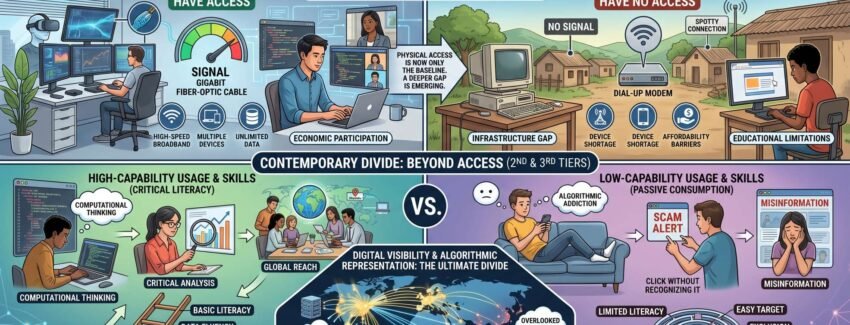
For most of the past two decades, the digital divide in education was framed as a hardware and connectivity problem. Students without computers could not participate in digital learning. Students without reliable internet were excluded from online resources. The solution, in this framing, was infrastructure: get devices into homes, build out broadband, and the gap would close.

Significant progress has been made on those terms. Device ownership among school-age children has risen substantially. Connectivity programs have expanded, accelerated in part by pandemic-era emergency funding. By the most basic metrics — do students have a device, do they have internet access — the divide has narrowed in many contexts.

And yet educational outcomes have not converged. The gaps in achievement, engagement, and academic trajectory that the digital divide was supposed to explain have not closed in proportion to the infrastructure investment. Something else is going on.

What is going on is that the digital divide has changed shape. The old divide was binary: connected or not, device-owning or not. The new divide is multidimensional, harder to see in survey data, and far more resistant to infrastructure-only solutions.

01 — The Skills Gap Device Ownership Does Not Solve

Having a laptop does not mean knowing how to use it for learning. This seems obvious when stated directly, but it is a distinction that educational technology policy has consistently underweighted.

Students arrive at secondary and post-secondary institutions with radically different levels of digital competency — not in the consumer sense (most students are fluent with social media and entertainment platforms) but in the academic and productive sense. The ability to evaluate online sources critically, to organize research across multiple tools, to collaborate asynchronously in structured ways, to manage files and workflows — these skills are unevenly distributed, and the distribution correlates strongly with socioeconomic background.

“The device is the same. The repertoire of use is very different.”

On affluent vs. lower-income students’ relationship with technology

When institutions assume that digital fluency follows from digital access, they systematically underserve the students who most need explicit skills development. Online learning environments that take for granted students’ ability to navigate LMS platforms, manage notifications, and self-regulate their study behavior are not neutral — they structurally advantage students who arrived with those skills already.

02 — Algorithmic Literacy as the New Baseline

A dimension of the new digital divide that has emerged more recently — and that educational institutions have been slow to address — is the uneven distribution of algorithmic literacy: the ability to understand, critically evaluate, and navigate algorithmically curated information environments.

Students who lack algorithmic literacy are not simply unaware of how recommendation systems work in the abstract. They are practically disadvantaged in their ability to conduct research, evaluate sources, recognize filter bubbles, and distinguish between organic information and commercially or politically motivated content. In an information environment where nearly all digital content is algorithmically filtered, this is not a niche competency. It is a fundamental requirement for educated participation in public life.

A student who does not understand why certain results appear at the top of a search page, or how content recommendation systems shape what they read and believe, is at a real academic disadvantage — regardless of whether they have broadband internet.

03 — Bandwidth Inequality and the Myth of Equivalent Experience

Even among students who have internet access, the quality of that access varies enormously — and those variations have significant educational consequences that institutions tend not to account for.

A student in a well-resourced household with gigabit fiber internet, a dedicated study space, and a modern laptop has a fundamentally different online learning experience than a student sharing mobile hotspot data with family members, studying on an older device in a shared living space with frequent interruptions. Both students have “access.” Their experience of an asynchronous online course is not comparable.

Instructional design that does not account for bandwidth variability is instructional design that systematically disadvantages lower-income students. This includes the default reliance on high-definition video for content delivery, synchronous sessions without asynchronous alternatives, and assessment platforms that time out or fail on unstable networks.

04 — The Concentration of Quality in Digital Learning

A less-discussed dimension of the new digital divide is the growing concentration of high-quality digital learning resources among institutions and students with resources to access them.

The most sophisticated adaptive learning platforms, the most thoughtfully designed online courses, the most capable AI tutoring systems — these are not evenly distributed. They tend to be deployed at well-resourced institutions that can afford premium EdTech subscriptions, that have instructional design staff to implement them properly, and that serve student populations with the background skills to use them effectively.

The result is a digital learning quality gap that mirrors and reinforces existing educational inequity. Technology that was supposed to democratize access to high-quality learning is, in its current distribution pattern, doing something closer to the opposite — giving better tools to students who were already better positioned.

What Institutions Can Actually Do

Acknowledging the new shape of the digital divide is not an argument for pessimism. It is an argument for more targeted and honest intervention. On the skills gap: institutions should treat digital academic literacy as a core competency that requires explicit instruction. On bandwidth inequality: instructional design standards should include low-bandwidth alternatives as a baseline requirement, not an accommodation. On algorithmic literacy: this belongs in the curriculum as an integrated thread, not a standalone elective. On resource distribution: procurement decisions have equity implications that are rarely part of the formal analysis.

The old digital divide asked whether students could get online. The new one asks what happens to them when they do — and whether the digital learning environment they encounter is designed with their actual circumstances in mind. That is a harder question, with no infrastructure solution. But it is the right question to be asking.

EdTech
Digital Divide
Equity
Higher Education
Online Learning
Blended Learning


Blended Learning Done Wrong: Why Most Hybrid Models Fail Before They Start

Blended Learning Done Wrong: Why Most Hybrid Models Fail Before They Start

There is a version of blended learning that works. It is thoughtful, evidence-based, and designed around what students actually need. And then there is the version most institutions implement — a patchwork of in-person sessions bolted onto digital tools, held together by optimism and procurement budgets. The second version is far more common.

Blended learning has been a fixture of edtech discourse for over a decade. It promises the best of both worlds: the flexibility of online learning and the human connection of the classroom. In practice, it often delivers neither. Understanding why requires looking honestly at how institutions approach implementation — and what they consistently get wrong.

The Definition Problem

Before anything else, there is a foundational issue: most institutions do not have a shared definition of blended learning when they begin implementing it.

Ask ten educators at the same institution what blended learning means and you will likely get ten different answers. Some will describe flipped classrooms. Others will describe courses with an LMS component tacked on. Others will describe fully synchronous online sessions with no real redesign at all. This definitional ambiguity is not a minor inconvenience — it is the root cause of most implementation failures.

Without a shared model, there is no coherent design philosophy, no way to train faculty consistently, no way to evaluate whether the approach is working, and no way to course-correct when it is not. Institutions that skip this definitional step are not implementing blended learning. They are implementing vague digitization and calling it something more respectable.

The Tool-First Trap

Perhaps the most common failure mode is what might be called the tool-first trap: institutions acquire technology, then work backwards to justify its use in the classroom.

A university invests in a new video conferencing platform. Administrators encourage faculty to “integrate it into their blended approach.” Faculty, unsure what that means pedagogically, begin recording lectures and posting them online. Students, unsure what to do with the recordings, either ignore them or use them to skip class. Attendance drops. Engagement drops. The technology gets blamed. The real culprit — a complete absence of pedagogical intent — is never examined.

This pattern repeats across tools: LMS platforms, interactive polling software, digital whiteboards, AI tutoring systems. The technology arrives first. The learning design question — what are we trying to help students do, and does this tool serve that goal? — arrives late, if at all.

Effective blended learning inverts this sequence entirely. It begins with learning outcomes, moves to instructional strategies, and only then asks which tools, if any, might support those strategies. The difference sounds obvious. The implementation reality suggests it is not.

Faculty Are Not the Problem — Preparation Is

When blended learning fails, faculty are often implicitly or explicitly blamed. They resisted the model. They did not use the tools correctly. They kept reverting to lecture-heavy formats.

This framing is both unfair and analytically lazy. The more accurate diagnosis is that institutions routinely ask faculty to redesign their courses without providing the time, training, or instructional design support required to do it well.

Redesigning a course for blended delivery is not a weekend task. It requires rethinking how content is sequenced, what happens in synchronous versus asynchronous time, how student accountability is structured, and how feedback loops are maintained across both modalities. Faculty who have spent years developing effective in-person pedagogies cannot simply transpose those pedagogies onto a hybrid format. They need supported redesign time — and most institutions do not provide it.

A common compromise is the one-day workshop: a crash course in blended learning principles, a tour of available tools, and a vague mandate to “try something new this semester.” This is not preparation. It is institutional cover. It allows administrators to say that faculty were trained while leaving them functionally unsupported.

Institutions that get blended learning right tend to invest in sustained faculty development — multi-week course redesign cohorts, instructional designer partnerships embedded at the department level, and protected time for iteration and reflection. These are not glamorous investments. They do not appear in press releases. But they are what actually produces results.

The Synchronous-Asynchronous Imbalance

A well-designed blended course is intentional about what happens synchronously and what happens asynchronously. Most poorly designed ones are not.

The default pattern — lecture content moved online, class time kept largely unchanged — is the most common and arguably the most wasteful configuration. It treats synchronous time as a vessel for content delivery, which is precisely what synchronous time does worst. Students sitting together in a room (or on a video call) watching a recorded lecture are getting the worst of both formats: the scheduling constraint of synchronous learning without its interactive benefits, and the content flexibility of asynchronous learning without its self-pacing advantages.

Synchronous time is most valuable for things that require real-time human interaction: debate, collaborative problem-solving, peer feedback, Q&A, and the kind of mentoring that happens in dialogue. Asynchronous time is most valuable for content consumption, reflection, and practice at individual pace. When these functions are deliberately matched to the appropriate modality, blended learning delivers on its promise. When they are not, students experience it as doing more work for the same outcome.

Assessment That Was Never Redesigned

Assessment is where blended learning failures become most visible — and where institutions are most reluctant to look.

Blended models require assessment redesign. If the learning journey now spans two modalities, with students engaging in substantive activity both in-person and online, then evaluation instruments designed exclusively for in-person learning will not capture the full picture. They will also create perverse incentives: students will optimize for what is assessed, which means the online components — typically under-assessed — will be treated as optional.

Yet course assessment structures in most blended implementations are left largely untouched. The same midterm, the same final, the same in-class participation grade. What changes is the delivery channel, not the evaluation logic. This is not blended learning with a traditional assessment layer on top. It is traditional learning with some videos attached.

Meaningful assessment redesign in blended contexts typically involves portfolio-based evaluation, ongoing formative assessment across both modalities, peer assessment components, and reflection artifacts that require students to synthesize their learning across the full course experience. These approaches are more labor-intensive to design and evaluate. They are also far more aligned with what blended learning is supposed to accomplish.

The Equity Dimension Institutions Ignore

Blended learning’s flexibility is often presented as an equity win: students with work obligations, family responsibilities, or long commutes benefit from the asynchronous option. This is true as far as it goes — but institutions frequently stop the equity analysis there.

What they ignore is the equity differential in online engagement itself. Students from lower-income households are more likely to be studying in environments with noise, unreliable internet, shared devices, and competing demands on their attention. The “flexibility” of asynchronous learning can mean squeezing in coursework at midnight between shifts. The assumption that online learning is inherently more accessible systematically underweights these realities.

Blended learning done well accounts for this. It does not assume that all students experience the online component equivalently. It builds in support structures — flexible deadlines with clear parameters, low-bandwidth content alternatives, accessible synchronous sessions — that acknowledge the range of circumstances students are navigating. Most implementations assume a more uniform student experience than actually exists, and design accordingly.

What Getting It Right Looks Like

Effective blended learning shares a recognizable set of characteristics, regardless of institution type or subject matter.

It starts with a clear model — station rotation, flipped classroom, flex, or another defined approach — that the institution commits to and trains around consistently. It allocates synchronous time to high-interaction, high-value activities, not content delivery. It provides faculty with substantive course redesign support, not one-off workshops. It redesigns assessment to evaluate learning across both modalities. And it audits the student experience for equity, not just access.

None of this is complicated in theory. All of it is difficult in practice, because it requires institutions to invest in the unsexy infrastructure of learning design rather than the visible infrastructure of technology acquisition.

The schools and universities getting blended learning right are not necessarily the ones with the most sophisticated platforms. They are the ones that treated implementation as a pedagogical challenge first and a technology challenge second — and resourced it accordingly.

The LMS Trap

The LMS Trap

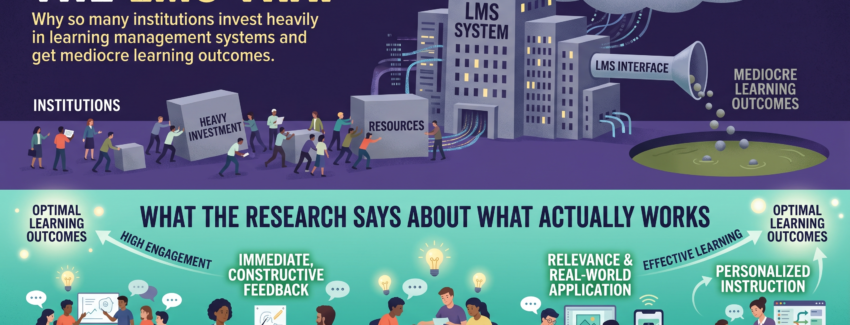
The LMS Trap: Why Institutions Spend Millions on Learning Platforms and Get Mediocre Results

Every few years, a university or school district announces a major investment in a new learning management system. There are demos, committee approvals, migration timelines, and professional development sessions. Administrators speak about transformation. Teachers are trained. Students are onboarded.

And then, quietly, almost nothing changes.

The LMS becomes a place to upload files. Grades get posted. Announcements go out. The course catalog moves online. But the actual experience of learning — the thing the institution spent hundreds of thousands of dollars to improve — remains largely the same, or gets worse.

This is the LMS trap: a pattern in which institutions invest heavily in learning management systems and receive mediocre outcomes in return. It is widespread, well-documented, and poorly understood — even by the institutions caught in it.


The Numbers Behind the Problem

The LMS market is one of the fastest-growing segments in educational technology. Global revenues exceeded $23 billion in 2024, with projections pointing to $70 billion or more by the end of the decade. These are not niche figures — they represent the accumulated purchasing decisions of thousands of institutions across higher education, corporate training, and K–12 schooling.

Higher education leads adoption, with approximately 85% of universities and colleges globally using some form of LMS. Corporate training follows at around 70%, and K–12 adoption sits near 48% — a figure that accelerated significantly during the COVID-19 pandemic.

Yet adoption tells us nothing about effectiveness. And this is precisely where the picture gets complicated. Across sector after sector, research finds the same pattern: widespread deployment of LMS platforms paired with underwhelming learning outcomes, low feature utilization, and persistent teacher frustration.


The Feature Utilization Gap

Modern LMS platforms are remarkable in their ambition. Platforms like Canvas, Moodle, Blackboard, and D2L Brightspace offer dozens of tools: adaptive learning paths, sophisticated analytics dashboards, peer collaboration spaces, video integration, competency tracking, gamification layers, and rubric-based assessment engines.

Most of these features go unused.

Research consistently finds that institutions actively use between 20% and 30% of their LMS’s available functionality. Content delivery — uploading slides, PDFs, and recorded lectures — is near-universal. Basic assessments like quizzes and assignment submission are moderately used. But the features designed to improve learning outcomes — adaptive content, learning analytics, collaborative tools — are barely touched.

The analytics gap is particularly revealing. Nearly every major LMS includes dashboards that can identify at-risk students, flag engagement drops, and surface early warning signals. These tools exist precisely because the data is there — every login, click, submission, and forum post is logged. Yet studies find that fewer than one in four instructors regularly consult these dashboards, and fewer still use them to adjust instruction in real time.

“Most faculty use the LMS the same way they used email — as a delivery mechanism. The pedagogical transformation vendors promise is not happening at scale.” — EDUCAUSE Review, 2023


Why the Trap Closes Around Institutions

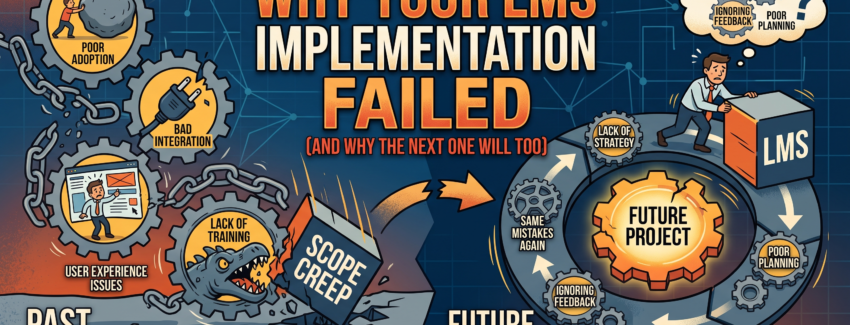
The LMS trap is not primarily a technology problem. The platforms themselves are often technically sophisticated and genuinely capable. The trap is a procurement and implementation problem — a mismatch between what institutions buy and why they buy it.

Procurement is driven by compliance and administration, not learning.

Most LMS selection processes are committee-driven, with representation from IT, compliance, finance, and academic administration. Pedagogy is often underrepresented, and the faculty who will actually use the system frequently have little influence over the final decision.

This produces purchasing criteria weighted toward administrative efficiency — grade book integration, SIS compatibility, FERPA compliance, uptime guarantees — rather than pedagogical capability. The result is a system selected for the wrong reasons, then handed to educators without the support needed to use it well.

Implementation ends where learning begins.

The typical LMS implementation follows a predictable arc: technical setup, data migration, a round of training sessions, a go-live date. After that, support thins out. The institution has “deployed” the system and considers the job done.

But the actual challenge — changing how teachers design and deliver learning — is not a technical event. It is a slow, ongoing professional development process. That process almost never gets the sustained investment it requires. What institutions call implementation is really just installation.

The path of least resistance points away from transformation.

Teachers are busy. Adding a sophisticated new tool to an already demanding workload requires time and incentive. Without both, faculty default to using the LMS the way they used whatever came before: as a document repository and gradebook. The system is technically present, pedagogically absent.

This is not a failure of motivation. It is a rational response to institutional structures that do not reward pedagogical innovation, do not protect time for experimentation, and do not provide ongoing support for faculty learning.


What the Research Says Actually Works

The contrast between tool-first and pedagogy-first approaches is stark when measured against actual learning outcomes. When researchers compare institutions that invested primarily in LMS capability with those that prioritized instructional design, faculty development, and blended approaches, the outcomes tell a clear story.

Knowledge retention is 20+ percentage points higher in pedagogy-first environments. Student engagement — measured through participation rates, voluntary activity, and self-reported motivation — is sharply higher. Completion rates improve. And skill transfer, the hardest outcome to achieve and the one most employers actually care about, shows the widest gap of all.

These differences are not marginal. They are the difference between a system that works and one that looks like it should.

What pedagogy-first looks like in practice:

Pedagogy-first institutions share several characteristics that distinguish them from their tool-first counterparts. They invest in instructional design staff who work alongside faculty as partners, not just technical support. They treat LMS adoption as an ongoing professional development challenge, not a one-time training event. They give faculty protected time to redesign courses, experiment with tools, and reflect on what works.

Critically, they also resist the pressure to use every feature a platform offers. The best-performing courses tend to use a small number of tools very well — not the full feature set used superficially.


The Vendor Relationship Problem

There is a structural asymmetry in the LMS market that makes this problem harder to solve. Vendors profit from initial sales and annual contracts, not from learning outcomes. Their incentives are aligned with feature development, market expansion, and contract renewal — not with whether students in Amman or Atlanta actually learned something.

This produces a market where platforms compete on feature count, integration breadth, and UI modernity rather than on evidence of learning impact. Institutions buy the shiniest platform, not the most effective one. And because measuring learning outcomes is genuinely difficult — more difficult than counting features — institutions often cannot tell the difference until years of mediocre results force the question.

The honest answer is that no LMS vendor can fully deliver on the transformation they imply in their sales material. The transformation has to come from within the institution, from the humans who design and deliver learning. The platform is infrastructure, not intervention.


A More Honest Framework for LMS Investment

Institutions that want to escape the LMS trap need to reframe how they think about the investment entirely. The platform budget is not the education budget. Licensing fees are the smallest part of what it actually costs to change how learning happens.

A more honest accounting would treat the LMS as infrastructure — like classroom furniture or network connectivity — and invest the bulk of the education budget in the things that research shows actually move outcomes: instructional design capacity, faculty professional development, learning analytics literacy, and evidence-based course design.

This is a harder sell internally. “We need more instructional designers” is less compelling in a budget meeting than “We’re migrating to a platform with AI-powered adaptive learning.” But it is what the evidence supports.


The Question Worth Asking Before the Next Contract

Most institutions will renew their LMS contracts. The switching costs are high, the migration is painful, and the new platform usually promises the same things the old one did. That is fine. The platform is not the problem.

The question worth asking before the next renewal is not “which LMS should we buy?” It is “what would it take to actually use what we already have well?” And then: “are we willing to invest in that?”

Because the data is clear. The tools are capable. What is missing is not technology. It is the sustained, patient, unfashionable work of helping educators become better designers of learning — with or without a new platform.

That work does not generate press releases. But it is the only thing that has ever actually worked.


Verification: 1544cdbd1105873e