|
Getting your Trinity Audio player ready... |
A news is circulating this week with a simple headline: 10 days of remote study. According to reports on Saudi Arabia’s Ministry of Education, the ministry is moving toward trialling remote study for up to ten days per school year. The headline is small. What it signals is not.
Within hours, the usual leaps appeared in the comments and in group chats: if ten days can go online, why not fifty? If schools can go online, why not shops, malls and offices? Will physical schools simply vanish within two or three years?
This article takes those questions seriously, and answers them with more skepticism than the headlines invite. The short version: governments are choosing hybrid, not online-only, and they are doing so for reasons that have little to do with believing screens teach better. The long version follows.
What the policy actually says
As reported in news summaries of the ministry’s plan (leaders should verify against the official circular once it is published), the framework looks like this:
- Remote study of up to 10 days per year, as a trial.
- 3 days by decision of the Director of Education in a region.
- 2 days designated for specific regions: Makkah, the Eastern Province, Tabuk and Najran.
- 5 days at the discretion of the school principal, under defined controls.
- Delivery is synchronous, live, through approved educational platforms. It is not a day off with homework attached.
- Exclusions: the first and last two weeks of the school year, Sundays and Thursdays, exam days, and the days immediately before holidays and long breaks.
- Parents must be told about remote days in advance.
Read the design carefully. Remote days are fenced away from the moments that matter most for attendance, assessment and routine: the start of the year, the end of the year, the edges of the school week, exams, and pre-holiday days when attendance is fragile anyway. This is not a policy designed to replace the school day. It is a policy designed to protect it, by giving the system a controlled alternative when the physical day cannot happen.
The delegation structure is just as telling. Three days sit with regional directors, five with principals, two are tied to specific regions. The ministry is distributing the decision to the people closest to disruptions, whether weather, crowding, events or local emergencies. The reporting does not explain why those four regions were singled out. That is worth watching.
Why governments are drifting toward online or hybrid
The honest answer is that governments are rarely persuaded that online learning is pedagogically superior. They are persuaded by five structural pressures.
1. Continuity risk. Closing schools is politically and economically expensive. Since 2020, every education ministry knows what a forced closure looks like when no remote option exists. Saudi Arabia lived through this: remote education ran through the Madrasati platform and linked television channels for most of the 2020-21 academic year, and the ministry kept extending it by royal decree, term by term. A structured ten-day mechanism is the permanent, low-drama version of that emergency capacity. It is a fire drill that sometimes counts as a school day.
2. Sunk investment. Platforms, devices, licenses and training were bought at scale during the pandemic. An idle platform is a visible waste. Regular remote days keep the infrastructure warm, keep teachers practiced and justify the next budget cycle.
3. Capacity and cost pressure. Growing student populations, building maintenance, transport and staffing are all fixed costs that scale badly. Remote days relieve some pressure on all four. No ministry says this out loud, but it is in every spreadsheet.
4. Disruption as the new normal. Heat, flooding, dust storms, mass events and public-health scares are becoming routine planning inputs rather than rare exceptions. A school day that can flex is a resilient school day.
5. National digital strategy. A digitally capable education system is part of the story governments tell about modernization. A tested remote mechanism is a credential in that story.
Notice what is absent from this list: evidence that students learn more remotely. The motive is resilience and efficiency. That distinction matters for everything that follows.
Will physical schools vanish in 2-3 years?
No. And the policy in front of us is the best evidence against it. A ministry that believed schools were about to become obsolete would not carefully fence remote days away from exams, opening weeks and closing weeks, require advance notice to parents, and cap the total at ten. It would build the exit ramp wider, not narrower.
The vanishing-schools prediction fails because it misunderstands what a school is. A school bundles at least five functions, and instruction is only one of them:
- Custody. Schools are the daily arrangement that lets parents work. A remote day for a seven-year-old is a working-parent crisis with a login screen.
- Socialization. Learning to negotiate, collaborate, disagree and belong happens in shared space, with other people who did not choose each other.
- Supervised practice. Labs, sports, arts, workshops and practical training do not transfer to a laptop.
- Assessment integrity. Proctored, comparable examinations still need controlled rooms, and the AI era has made that harder to give up, not easier.
- Equalization. A school is the one place where every child gets a desk, a teacher, a meal and a connection, whatever their home looks like.
Online delivery can replace the first function partially for older students and almost not at all for younger ones. It cannot replace the rest.
What will actually change in 2-3 years
The realistic movement is unbundling, not disappearance. Expect more of the following:
- Flexible timetables, with scheduled remote days becoming a normal feature of the calendar.
- Content delivery shifting online while physical time is reserved for discussion, practice, labs and relationships.
- Remote options for specialist subjects, small-cohort courses and rural schools that cannot staff every subject.
- Greater dependence on platforms, vendors and national infrastructure, with matching governance obligations.
- A widening gap between schools that design remote days well and schools that simply broadcast lessons.
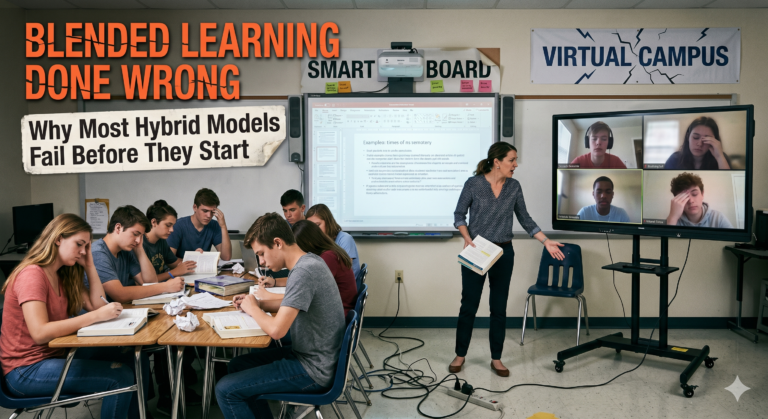
For a deeper look at the timetable question, see The School That Never Closes, and for why hybrid so often fails in practice, Blended Learning Done Wrong, both linked below.
The part nobody puts in the press release: what remote days cost
The pandemic years left a broad, well-documented lesson: remote learning, at scale and under pressure, produced uneven results, and the damage concentrated among younger children, struggling readers and students with the weakest home conditions. A ten-day trial is not a pandemic. But the same mechanisms operate at small scale:
- The synchronous fatigue problem. A six-hour live schedule is not a school day moved to a screen. Attention, motor needs and social energy do not survive that translation, especially in primary grades.
- The parent load. Remote days move supervision, troubleshooting and motivation onto households. Families with flexible work cope. Families without flexibility absorb the cost silently.
- The teacher workload multiplier. Preparing a live remote lesson that actually works is more work, not less, particularly when the same teacher still owes the in-person class its usual quality.
- The equity gap. Device quality, bandwidth, a quiet room, an adult nearby and a child’s own attention span are all unevenly distributed. A remote day makes every one of those gaps visible.
- The platform single point of failure. When a national or regional cohort logs in at 8am, the approved platforms are the system. If they stumble, the school day stumbles with them.
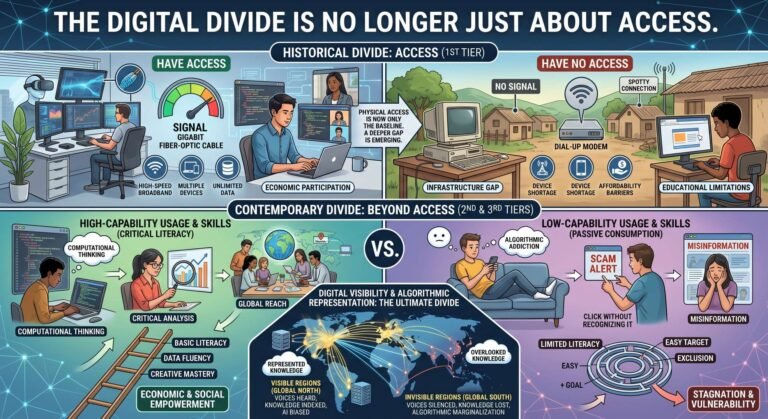
None of this argues against the trial. It argues for designing the remote day as a real instructional product, not a logistical workaround. For more on the access side, see The Digital Divide Is No Longer Just About Access.
Will malls and other businesses vanish into online too?
The same logic applies, and the same overreach appears. Online commerce has grown for two decades, and each disruption has pulled more routine buying onto screens. But physical retail has not vanished in the way early predictions claimed. In many markets the pandemic spike in online shopping partly reverted once people could move freely again.
What is happening is unbundling, as with schools. A mall performs several functions: transaction, discovery, entertainment, social meeting, brand experience and, increasingly, logistics and pickup. Transactions migrate online fastest. The rest do not migrate easily, because they are about people being together. The outcome is likely to be fewer purely transactional stores, more experience-led and service-led spaces, and stores doubling as fulfilment points.
A good test works for schools, malls and offices alike: ask what the physical place does that a screen cannot. If the honest answer is nothing, the place is vulnerable. If the answer is care, trust, craft, community or hands-on practice, it is not.
What happens if the whole world goes online-only?
A truly online-only world is not a likely endpoint, but the thought experiment is useful because it reveals which risks we are already accepting in the hybrid world.
Infrastructure becomes the single point of failure. A power cut, a cable cut or a cloud outage would stop education, commerce, banking and government at the same moment. Resilience planning for a hybrid society is hard. For an online-only society it is existential.
Platform concentration becomes sovereignty risk. Whoever owns the learning platforms, the identity systems and the payment rails effectively owns the national operating layer. Questions of data residency, vendor exit and local control stop being IT topics and become national ones. I wrote about this from the CIO’s side in AI, Sovereignty, and Resiliency.
Cybersecurity becomes a public safety issue. If all schooling is online, a ransomware attack is a school closure. Student data, which is among the most sensitive data any institution holds, sits behind every login.
Surveillance becomes the default mode of supervision. Online-only education requires monitoring attendance, attention and integrity through software. That means proctoring, analytics and behavioral tracking, with all the consent, bias and privacy questions they bring.
Social skills and peer learning thin out. Children learn how to be around people by being around people. Our earlier piece The Disappearing Peer looks at what is lost when classmates are replaced by screens and tutors.
Cities and economies reorganize. Commuting, school-run traffic, canteens, transport, retail footfall, office real estate and the service jobs around them all depend on people moving through physical space. Removing that movement does not just save money. It removes whole local economies.
Inequality hardens. In an online-only world, a good connection and a good home environment become the entry tickets to education and work. The households that lack them are not just disadvantaged, they are invisible to the system.
So the likely future is not online-only. It is hybrid, unevenly distributed, and governed by whoever designs the hybrid rules well. The risk is not that schools vanish. The risk is that they quietly hollow out: the building stays, the timetable softens, the human contact thins, and nobody decides it.
What leaders should do now
For ministries, school owners, principals and IT leaders, the ten-day trial is an opportunity to build the capability properly before it scales. A practical framework:
- Define the remote day. Decide what a remote day is for: continuity, flexibility or a new instructional mode. Each requires a different design.
- Shorten and shape the live time. Replace the full-day broadcast with shorter live blocks, offline tasks, and age-appropriate pacing. Treat younger grades separately.
- Run an equity audit before the first remote day. Count devices, connectivity and supervision at home. Prepare fallbacks: loan devices, low-bandwidth modes, on-site supervised rooms for students who cannot learn from home.
- Protect teacher time. Provide ready-to-teach remote lesson formats and clear limits so remote days do not become unpaid extra work.
- Stress-test the platform. Load testing, identity and access, backup communication channels and an outage plan are prerequisites, not nice-to-haves.
- Govern the data. Decide what is recorded, who sees it, how long it is kept, and what the vendor may do with it. Write it down before the first lesson.
- Measure learning, not logins. Compare outcomes and wellbeing on remote and in-person days. Publish the results internally. Adjust before expanding.
- Tell parents early and plainly. The advance-notice rule is good policy. Pair it with clear guidance on what children need and what parents are not expected to do.
- Decide what stays physical. Write down, explicitly, the functions of your school that must remain in person. If you cannot name them, someone else will decide for you.
The bottom line
The ten-day remote study trial is not the beginning of the end of the physical school. It is the formalization of a lesson the world learned the hard way: systems that cannot flex will break. Governments want the flexibility of online with the stability of physical, and hybrid is how they hope to get both.
The question worth asking is not whether schools, malls and offices will vanish. It is who benefits and who is left behind as they quietly become part-physical, part-digital, and what we decide to keep human on purpose.
Related Reading
- The School That Never Closes: When Learning Loses Its Schedule
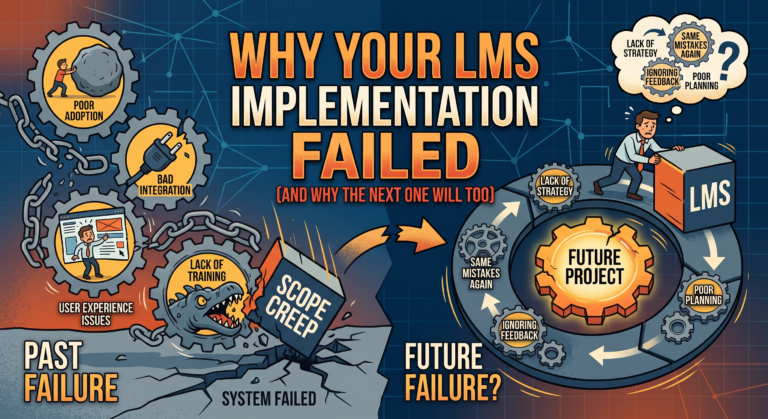
- Blended Learning Done Wrong: Why Most Hybrid Models Fail Before They Start
- The Digital Divide Is No Longer Just About Access
- The Disappearing Peer
- AI, Sovereignty, and Resiliency: What CIOs Must Prioritize NOW
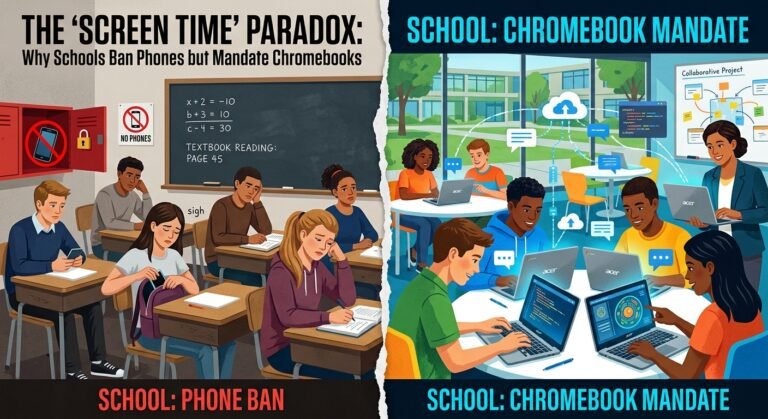
- The Screen Time Paradox: Why Schools Ban Phones but Mandate Chromebooks