|
Getting your Trinity Audio player ready...
|
Most AI used in GCC classrooms today runs on infrastructure outside the region, is trained mainly on English-language internet data, and reflects the assumptions of the societies that built it. For a quick homework question that may not matter. For a national education system integrating AI into curriculum, assessment and student support, it matters a great deal. Sovereign AI in education, AI that is hosted, governed and culturally grounded within the region, is moving from a policy idea to an infrastructure priority.
Three Layers of Sovereignty
- Data sovereignty: where student data is processed and stored, and which laws govern it. Data protection and cybersecurity frameworks in the region increasingly favour in-country processing for sensitive data.
- Model sovereignty: who controls the model, its updates and its availability. Dependence on a foreign provider means policy changes elsewhere can affect classrooms here.
- Cultural and linguistic sovereignty: whether the model understands Arabic in its varieties, local history, religion, values and curriculum.
The Language Gap
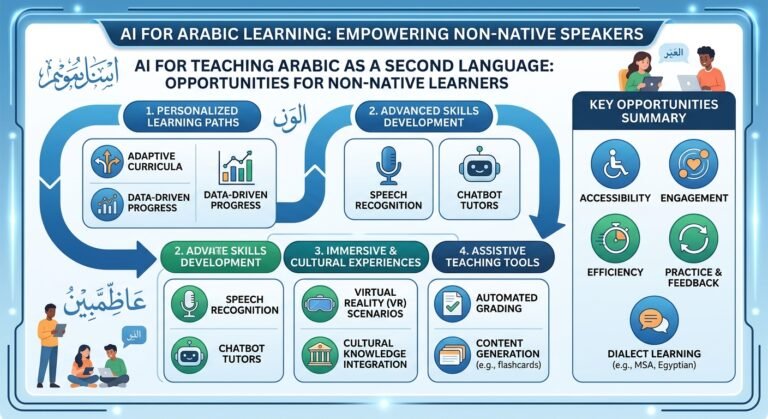
Arabic is spoken by hundreds of millions of people, yet it remains under-represented in the data most global models are trained on, particularly for dialects and educational content. Students learning in Arabic often receive weaker AI support than those learning in English. Regional investment in Arabic-capable models is narrowing that gap, but schools should test tools in Arabic, not assume parity.
The Values Question
AI models make thousands of implicit judgements: which examples to use, which perspectives are “balanced,” which topics to avoid. Those judgements reflect training data and developer policies. An education system has a legitimate interest in AI that respects its cultural context while still teaching students to think critically and engage with diverse views.
The Equity Dimension
Elite international schools can afford premium global tools and English-medium instruction. Public and Arabic-medium schools depend more on locally appropriate solutions. Sovereign AI is not only a security issue; it is a question of whether every student in the region gets AI support of equal quality in the language they learn in.
What School Leaders Can Do Now
- Ask every AI vendor where data is processed and whether in-region hosting is available.
- Test tools in Arabic with real curriculum content before purchase.
- Align AI procurement with national data protection and cybersecurity requirements.
- Avoid single-vendor dependence; design for the ability to switch models.
- Follow national AI strategies and approved tool lists as they develop.
Frequently Asked Questions
What is sovereign AI in education?
It refers to AI systems whose data, hosting, governance and cultural grounding are controlled within a country or region rather than depending entirely on foreign providers.
Why does data residency matter for schools?
Student data is sensitive, and national laws may restrict its transfer abroad. In-region processing simplifies compliance and reduces risk.
Is AI good at Arabic for education?
It is improving quickly, but quality varies by tool and dialect. Schools should test with real curriculum content in Arabic.