AI, cyber security, Education, encryption, GCC
Opinion · May 2026
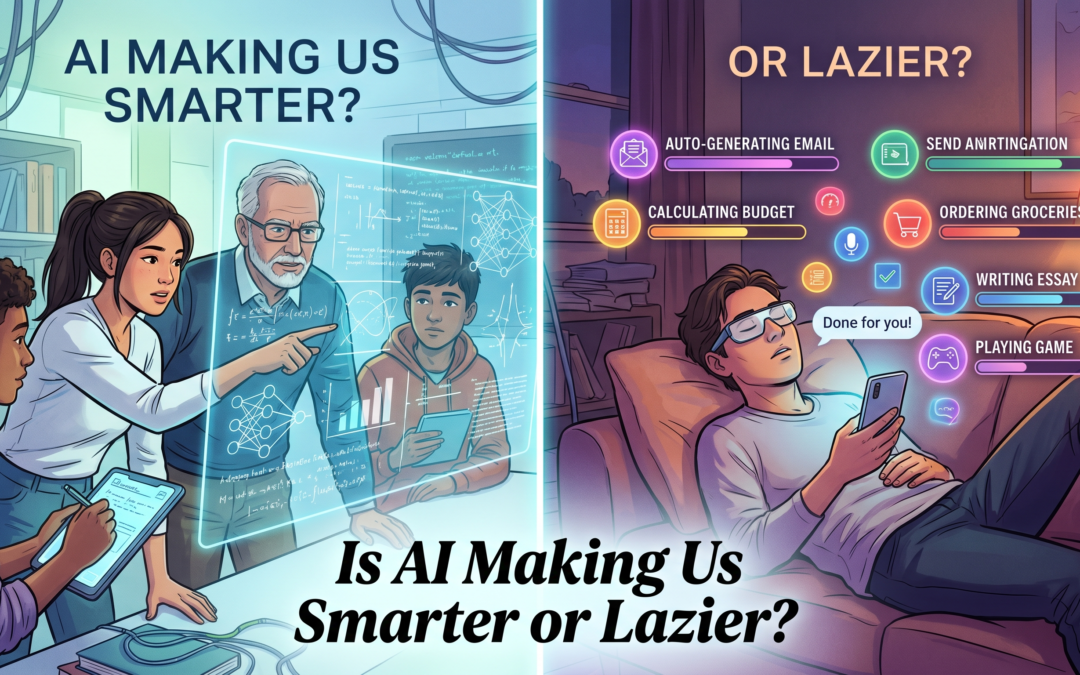
Is AI Making Us Smarter
or Lazier?
The Honest Answer
Let me tell you about two students.
The first one uses AI constantly. Every essay starts with a ChatGPT outline. Every tricky concept gets explained by Claude. Every homework problem gets at least a hint from an AI before real effort is applied. Their grades are good. Their output looks polished. Their teachers are impressed.
The second student uses AI sparingly — as a last resort after genuinely struggling with a problem. The work is messier. The process takes longer. Some of the outputs are rougher around the edges.
Here’s the question: which student is learning more?
The uncomfortable answer — backed by a growing body of research — is almost certainly the second one. And understanding why that’s the case is the most important thing any student, teacher, or parent can understand about AI right now.
The Case That AI Is Making Us Smarter
Let’s start with the argument in favor, because it’s real and it matters.
AI tools genuinely expand what people can do. A student who previously couldn’t get feedback on a draft until their teacher reviewed it on Friday can now get detailed, thoughtful feedback in seconds. A learner who was too shy to ask “basic” questions in class can ask an AI as many times as needed without embarrassment. A non-native speaker can get explanations in their own language with a single prompt.
These are not trivial gains. Access to personalized, on-demand educational support was once a privilege available only to students whose families could afford tutors. AI has democratized that access — imperfectly, but meaningfully.
The research reflects this too. Studies consistently show that students using AI-assisted learning tools produce higher-quality outputs than peers who don’t. Comprehension improves. Efficiency increases. Learning feels more accessible, more motivating, less intimidating.
For people who already have deep expertise in a domain, AI acts as a powerful force multiplier. An experienced doctor using AI diagnostics makes better decisions. A senior engineer using AI coding tools ships more reliable software. A veteran teacher using AI to generate lesson variations reaches more learning styles. When you bring existing knowledge and judgment to the table, AI amplifies both.
So yes — in the right hands, used the right way, AI absolutely makes people more capable.
The Case That AI Is Making Us Lazier
Now for the part that’s harder to admit — and more urgent.
The OECD’s Digital Education Outlook 2026 found that while students with access to general-purpose AI tools produce higher-quality outputs than their peers, this advantage disappears — and sometimes reverses — in exams when AI access is removed.
Read that again. Students who relied on AI to produce better work couldn’t reproduce that quality without it. The tool was doing the work. The student was operating the tool. Those are not the same thing.
The same report warned that offloading cognitive tasks to general-purpose chatbots creates risks of “metacognitive laziness and disengagement” — a sophisticated way of saying: if AI does your thinking for you often enough, you stop getting better at thinking.
A 2025 study by researcher Gerlich found a direct negative correlation between frequent AI tool usage and critical thinking abilities — and the effect was strongest in younger users. Not the students who used AI occasionally or strategically. The ones who used it heavily and habitually.
Meanwhile, a 2026 research paper on software developers found something striking: developers who fully delegated coding tasks to AI produced working code — but failed conceptual understanding tests afterward. They couldn’t debug what the AI had written. They had the output without the understanding. The output looked smart. The person hadn’t become smarter.
This is the core danger, and it has a name: cognitive offloading.
The Real Problem: Cognitive Offloading
Cognitive offloading is what happens when you transfer mental work to an external tool. Writing things down instead of memorizing them. Using GPS instead of building a mental map. Asking a calculator instead of doing mental arithmetic.
Some cognitive offloading is completely fine — even beneficial. Using GPS to navigate a new city frees up mental space to notice where you’re going. Using a calculator for complex arithmetic frees you to think about what the numbers mean.
The problem is when offloading replaces the development of a skill you haven’t built yet.
There’s a critical distinction that Psychology Today researcher Timothy Cook articulated clearly in early 2026:
“What AI does to a 45-year-old is likely categorically different than what it does to a 14-year-old. If I use AI to summarize a research paper, I’ve read hundreds of papers. I know what a good argument looks like — I’m offloading a task I already know how to do. A student who uses AI to summarize every paper may never develop that judgment at all.”
This is the crux. When an expert uses AI to skip a task they’ve already mastered, efficiency goes up and little is lost. When a learner uses AI to skip a task they haven’t mastered yet, they never master it.
Adults lose skills to AI. Children never build them. Those are two different problems — and the second one is the more serious one.
The Illusion of Understanding
There’s another phenomenon making this harder to see clearly: the fluency illusion.
When AI explains something clearly and engagingly, reading that explanation feels effortless. The ideas flow smoothly. You follow along without confusion. You finish and think: Yes, I understand that now.
Except — do you?
Cognitive science research consistently shows that ease of processing is a poor indicator of depth of understanding. Reading a brilliant explanation of how photosynthesis works is not the same as being able to explain photosynthesis yourself, apply it to a new context, or troubleshoot a plant biology problem. The smooth reading experience creates an illusion of competence that evaporates under any real test of knowledge.
When students use AI to get explanations — rather than to be questioned and challenged — they frequently experience this illusion. The material feels understood. The quiz or exam reveals it wasn’t.
The World Bank’s education blog framed this pointedly: “AI can make students produce smart answers without making them smarter thinkers.” That distinction is everything.
The Honest Answer: It Depends on How You Use It
Here’s where we arrive at the truth that neither AI optimists nor AI skeptics want to sit with: it’s not a binary.
AI is not inherently making us smarter. It is not inherently making us lazier. It is making us more of whatever we already are — and doing so faster and more efficiently than any tool that came before it.
| If you use AI to… |
You are likely… |
| Quiz yourself and get challenging follow-up questions |
Getting smarter ? |
| Get answers to questions you haven’t attempted yourself |
Getting dependent ? |
| Get feedback on work you’ve genuinely attempted |
Getting smarter ? |
| Generate first drafts you lightly edit |
Skipping the learning ? |
| Ask “why” and “how” to deepen understanding |
Getting smarter ? |
| Read AI explanations passively without testing yourself |
Experiencing the fluency illusion ? |
The research is fairly consistent: AI tools that are used with intentional pedagogical purpose — to challenge, question, and push the learner — produce real and sustained learning gains. AI tools used as shortcuts — to retrieve answers, summarize content passively, or generate outputs — produce the appearance of learning without the substance.
What This Means for Students
The uncomfortable truth for students is that the most valuable thing AI can do for your learning is make it harder — not easier.
An AI that asks you follow-up questions when you give a shallow answer is more valuable than an AI that just gives you the answer. An AI that pushes back on your argument is more valuable than one that agrees with everything you say. An AI that refuses to write your first draft but offers to critique one you wrote is more valuable than one that writes it for you.
The students who will thrive in a world saturated with AI won’t be the ones who learned to operate AI tools most efficiently. They’ll be the ones who used those tools to develop genuine understanding, independent judgment, and the ability to think when AI isn’t available — or when AI is wrong.
Because here’s the thing: AI is sometimes wrong. And if you’ve never built the underlying knowledge to catch it, you’ll pass along its mistakes with complete confidence. That’s not smarter. That’s a new and more dangerous kind of ignorance.
What This Means for Teachers and Schools
For educators, this research points to a clear design principle: the goal should never be to remove AI from students’ hands — it should be to design learning experiences that remain valuable even when AI is present.
That means shifting the emphasis from outputs (essays, answers, solutions) to processes (reasoning, argumentation, iteration, reflection). It means creating assessments that test understanding — not just the ability to produce polished text. It means teaching students the difference between using AI to produce and using AI to learn.
Schools that ban AI entirely are preparing students for a world that no longer exists. Schools that allow unrestricted AI access without pedagogical guidance are setting students up for the illusion of competence. The narrow, difficult path between those two failure modes is the one worth building.
The Verdict
So: is AI making us smarter or lazier?
The honest answer is: both, simultaneously, for different people, in different proportions — determined almost entirely by how they choose to engage with it.
AI is a cognitive mirror. It reflects and amplifies what you bring to it. Bring intellectual laziness, and it will help you produce lazy work faster than ever before. Bring genuine curiosity and a willingness to be challenged, and it will accelerate your growth in ways that weren’t previously possible.
The tool is not the story. The intention behind the tool is the story.
And right now, in classrooms and offices and bedrooms around the world, millions of people are making that choice — often without realizing they’re making it at all.
The Question Worth Asking
“Am I using this AI to produce something — or to understand something?”
Your answer to that question, repeated every day, will determine which kind of AI user you become.
Written by
Saifullah Khalid
Exploring AI, education, and human intelligence at saifullahkhalid.com
? Know someone who uses AI for everything? Or someone who refuses to touch it? Share this with both of them.
AI, cyber security, Education, encryption, GCC, help
Educational Technology · May 2026
From Memorization to Mastery:
How AI Is Finally Fixing
the Way We Study
We’ve been studying wrong for decades. Highlighting, re-reading, cramming — science proved these don’t work. Now AI is making the right methods effortless.
Here’s an uncomfortable truth about how most of us were taught to study: it doesn’t work.
Highlight the textbook. Re-read your notes. Stare at flashcards the night before the exam. Make a summary. Read the summary. Repeat until your brain feels full.
Decades of cognitive science research have shown that these techniques — the ones most students use, the ones most teachers implicitly endorse — are among the least effective ways to actually learn something and retain it long-term.
We’ve known this for years. The problem was never the research. The problem was that the better methods — spaced repetition, active recall, interleaving, elaborative interrogation — were harder to do alone. They required structure, consistency, and ideally, someone to quiz you and push back when you got something wrong.
Most students don’t have that. Until now.
AI is changing the equation. Not by replacing teachers or making studying “easier” in a shallow sense — but by making the right kind of hard effortlessly accessible to any student, anywhere, at any time.
This is the story of how that’s happening.
? First: Why Our Traditional Study Methods Fail
To understand why AI matters here, you need to understand the science of how memory actually works.
The brain doesn’t store information the way a hard drive does. You can’t just “save” something by reading it repeatedly. Memory is reconstructive — every time you retrieve a memory, you strengthen the neural pathway that leads to it. The act of retrieval is the learning.
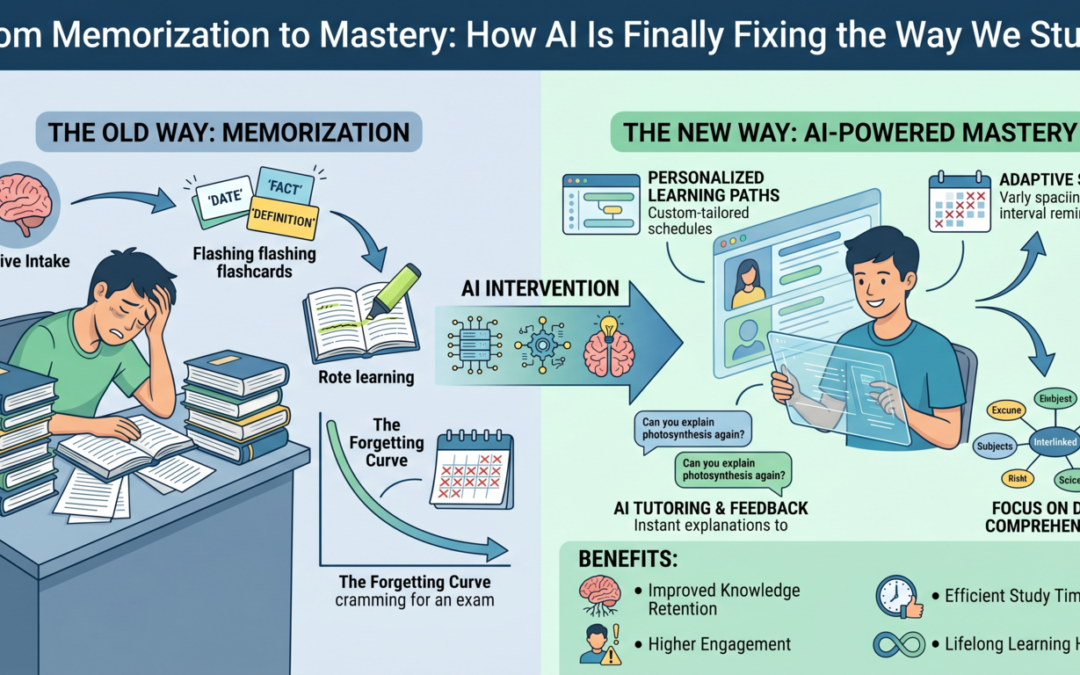
This is why two of the most well-researched study techniques — active recall and spaced repetition — are so powerful:
- Active recall means testing yourself on material rather than passively reviewing it. Closing the book and trying to remember — even imperfectly — strengthens memory far more than re-reading.
- Spaced repetition means reviewing material at increasing intervals over time. Instead of cramming everything in one session, you revisit information just as you’re about to forget it — which is precisely when retrieval strengthens the memory most.
Studies going back to the early 20th century, and confirmed repeatedly since, show that students using these methods retain information significantly longer and with less total study time than students who use passive review methods.
So why doesn’t everyone study this way?
Because it’s hard to do alone. Active recall means you need someone — or something — to generate questions. Spaced repetition means you need a system that tracks what you know, what you don’t, and when to review each thing. For decades, the tools available (physical flashcard boxes, basic apps like early Anki) worked but required enormous self-discipline to use consistently.
AI removes that barrier entirely.
? How AI Is Implementing Learning Science at Scale
Modern AI tools are doing something remarkable: they’re taking what cognitive scientists have known for decades and making it the default experience for students. Here’s how:
1. AI-Generated Active Recall — On Demand
Instead of re-reading your notes, you can now paste any study material into an AI and ask: “Quiz me on this. Don’t give me multiple choice — ask me open-ended questions and tell me when I’m wrong.”
The AI becomes a tireless examiner. It can generate dozens of questions from a single chapter, vary the difficulty, ask follow-up questions when you give a shallow answer, and explain why you got something wrong — not just tell you the right answer.
This is active recall at scale, available at 2am before an exam, with no study partner required.
2. Adaptive Spaced Repetition
Tools like Anki have offered spaced repetition for years — but they required the student to create every flashcard manually, which most people didn’t sustain. AI changes this in two ways:
- Automatic card generation: Upload your notes, get a complete flashcard deck in seconds. No manual entry.
- Adaptive scheduling: AI systems that track your responses can identify which concepts you’re weakest on and prioritize them — rather than treating all material equally.
3. Socratic Questioning — The Most Underrated Study Method
One of the most powerful learning techniques is elaborative interrogation: asking why something is true, not just what is true. This forces the brain to connect new information to existing knowledge — which is what creates deep understanding rather than surface-level recall.
AI tutors can do this naturally. Instead of just answering your question, a well-prompted AI will ask: “Before I explain, what do you think might be happening here?” or “That’s right — but can you explain why?”
Khan Academy’s Khanmigo is explicitly designed around this Socratic model. Rather than giving students answers, it guides them toward figuring out answers themselves — which is dramatically more effective for long-term retention.
4. Interleaving — The Uncomfortable Method That Works
Most students study one topic completely before moving to the next (called “blocking”). Research consistently shows that mixing topics — called interleaving — produces better long-term retention, even though it feels harder and less productive in the moment.
AI can create interleaved study sessions automatically: mixing questions from Chapter 3, Chapter 7, and last week’s material in a single session, forcing the brain to constantly retrieve and differentiate between concepts — which is exactly how exam conditions work.
?? The AI Study Stack: Tools That Actually Work
Here are the specific tools leading this shift, and how to use them effectively:
| Tool |
Best For |
Learning Technique |
| Claude / ChatGPT |
Socratic Q&A, concept explanation, essay feedback |
Active recall, elaborative interrogation |
| Khanmigo |
Math, science tutoring without giving answers |
Socratic method, guided discovery |
| Anki + AI |
Automatic flashcard generation from notes/PDFs |
Spaced repetition, active recall |
| Perplexity AI |
Research with cited sources, concept deep-dives |
Elaborative interrogation, source evaluation |
| NotebookLM |
Uploading course materials and querying them |
Active recall from personal notes |
? A Real Study Session: What This Looks Like in Practice
Let’s make this concrete. Here’s what a science-backed AI study session looks like for a university student preparing for a biology exam:
Example Prompt to Claude
“I have a biology exam on cellular respiration in 3 days. Here are my notes: [paste notes]. Please do the following: First, identify the 5 concepts I most likely need to understand deeply. Then quiz me on them one at a time using open-ended questions. After each answer I give, tell me what I got right, what I missed, and ask a follow-up that pushes me deeper. Don’t give me the answer until I’ve tried at least twice.”
This single prompt creates a study session that incorporates active recall, elaborative interrogation, immediate feedback, and Socratic follow-up — all the high-impact techniques at once.
After 30 minutes of this kind of session, students report understanding the material in a way that hours of passive review never achieved. The reason is simple: the brain was working, not coasting.
?? The Risks: When AI Study Tools Go Wrong
This wouldn’t be an honest article without addressing the shadow side. AI study tools can actually harm learning when used incorrectly.
The Shortcut Trap
Asking AI to summarize a chapter for you and then reading the summary is still passive learning. It feels efficient — you covered the material in 3 minutes instead of 30 — but you haven’t done the retrieval work that creates memory. The summary is the AI’s understanding, not yours.
Over-Reliance Without Verification
AI tools can be wrong, especially on technical or niche topics. Students who accept AI explanations without cross-referencing authoritative sources risk learning incorrect information confidently — which is worse than not knowing at all.
The Fluency Illusion
When an AI explains something clearly and you think “I understand that,” you may be experiencing the fluency illusion — mistaking the ease of reading a good explanation for actual knowledge. The test is always: can you explain it back without looking? If not, you don’t know it yet.
The rule of thumb: AI should be the thing that tests you, not just the thing that tells you. Use it to generate questions more than answers.
? What This Means for Students, Teachers & Institutions
For Students
You now have access to a personalized tutor available 24/7 that can adapt to your pace, your weaknesses, and your schedule. The students who figure out how to use this well will have a significant advantage — not because AI does their work, but because they’ll develop genuine mastery faster than ever before.
For Teachers
The role of a teacher is shifting from information-deliverer to learning architect. If AI can handle explanations, practice problems, and basic feedback — teachers are freed to focus on what AI can’t do: building relationships, developing critical thinking, facilitating discussion, and inspiring students to care about learning at all.
For Institutions
Schools and universities that ban AI rather than teach students to use it wisely are preparing students for a world that no longer exists. The institutions leading the future are the ones designing curricula that treat AI as a tool to be mastered — like a calculator, like the internet — not a threat to be feared.
The Bottom Line
We have spent generations teaching students what to think about without adequately teaching them how to think — or how to learn. Traditional study methods optimized for the appearance of effort: filled notebooks, highlighted pages, long library sessions.
AI is finally making the science of learning accessible to everyone. Spaced repetition, active recall, Socratic questioning, interleaving — these aren’t new ideas. They’re just now, for the first time, available without friction.
The students who will thrive in the next decade won’t be the ones who memorized the most. They’ll be the ones who learned how to learn — and used every tool available to do it better.
AI is the most powerful learning tool ever put in a student’s hands. The question isn’t whether to use it. The question is whether you’ll use it wisely.
? Quick-Start: 5 AI Study Habits to Build This Week
- After reading any topic, ask Claude: “Quiz me on what I just read — open-ended questions only.”
- Paste your lecture notes into NotebookLM and ask: “What are the 5 things I most need to understand deeply here?”
- Use ChatGPT or Claude in Socratic mode: “Don’t give me the answer — guide me to it.”
- Generate a spaced repetition deck from your notes using AI — then actually review it daily.
- End every study session by asking AI: “Give me 3 questions I should be able to answer after this session. Test me.”
Written by
Saifullah Khalid
Writing about the future of education, AI, and human potential at saifullahkhalid.com
? Know a student who still highlights and re-reads? Share this with them — it might change how they study forever.