|
Getting your Trinity Audio player ready...
|
Compliance feels like a checkbox. Submit the audit, pass the inspection, move on. But in the GCC, cybersecurity compliance isn’t just regulation—it’s infrastructure. Get it wrong, and you’re either paying fines, losing customers, or both. Get it right, and you build trust that becomes competitive advantage.
I’ve spent the last decade managing cybersecurity frameworks for schools, helping startups scale their tech stack, and advising SMEs on Saudi labor compliance. What I’ve learned: most GCC businesses treat compliance as something IT handles in isolation. That’s backward. Compliance is a business decision.
This article is a practical map of the frameworks that matter in the GCC, common mistakes I see, and how to actually implement them without drowning in documentation.
The Landscape: What Applies to You
The GCC has no single cybersecurity “law.” Instead, there are sector-specific mandates, regional standards, and implicit expectations. Here’s what you need to know:
1. NCA ECC (National Cybersecurity Authority — Essential Cybersecurity Controls)
Who: Any organization handling critical national infrastructure, financial data, or government contracts in Saudi Arabia.
What: A framework (not a certification) that establishes baseline controls for incident response, access management, data protection, and risk management. It’s modeled on NIST but tailored for Saudi context.
Reality check: If you’re a school, healthcare provider, bank, telecom, or government contractor, you need this. If you’re a startup with no government contracts, it’s still worth understanding because your enterprise customers will ask.
Key controls:
- Incident response planning (not just having a plan—actually testing it quarterly)
- Multi-factor authentication for all critical accounts
- Data classification and encryption at rest and in transit
- Regular penetration testing and vulnerability assessments
- Backup and disaster recovery procedures
- Audit logging and monitoring
Common mistake: Building a 200-page compliance document and filing it away. Compliance lives in your processes, not your binder. Your IT team should be able to show (not tell) that these controls work.
2. ZATCA POS Compliance (Saudi Arabia’s Invoice Standardization)
Who: Any business selling goods or services in Saudi Arabia that issues invoices.
What: ZATCA (Zakat, Tax and Customs Authority) mandates that all Point-of-Sale systems integrate with their e-invoicing platform. Your POS must now:
- Generate QR codes on invoices
- Submit real-time sales data to ZATCA
- Maintain tamper-proof audit trails
- Support both B2B and B2C invoicing formats
Timeline: Phase 1 (Bronze) started in December 2021. Phase 2 (Gold—full real-time integration) is now live. If you’re still running a standalone POS, you’re out of compliance.
Reality check: This is not optional. Audits are increasing, and penalties start at 5,000 SAR per non-compliant invoice. For high-volume businesses, that’s catastrophic.
What you need:
- A POS system certified by ZATCA (or ZATCA-compliant middleware)
- Integration with ZATCA’s API for real-time submission
- Proper user access controls and audit trails
- Staff training on the system (they will mess it up at first)
Common mistake: Buying a certified POS system and assuming you’re done. Certification is table stakes. You still need proper integration, staff training, and monitoring for errors. One misconfigured field and ZATCA flags you.
3. GDPR Lite: MISA (Middle East Information Security and Privacy Accreditation)
Who: Organizations handling personal data of GCC residents or operating in the GCC.
What: Not legally binding like GDPR, but increasingly expected by customers, partners, and acquirers. It covers:
- Data protection and privacy
- Consent management
- Right to deletion and portability
- Breach notification
Reality check: Most GCC businesses ignore MISA because it’s not a hard requirement. That’s changing as regional standards mature and customer expectations rise.
Common mistake: Assuming privacy is someone else’s problem. It’s not. If you’re in HR, customer management, or fintech, you’re handling personal data. Document how you collect, store, use, and delete it.
4. ISO 27001 (Information Security Management System)
Who: Anyone who wants to be taken seriously by enterprise customers.
What: An international standard for building, documenting, and auditing an information security management system (ISMS). It covers:
- Risk assessment
- Access control
- Incident management
- Vendor management
- Employee training
- Audit procedures
Reality check: ISO 27001 certification costs money, takes time, and requires ongoing audits. But it’s the language enterprise customers speak. If you’re selling B2B SaaS or services to large corporations, you’ll eventually need it.
Common mistake: Pursuing certification just to put it on your website. Certification is proof of a working system, not a substitute for one. If you implement 27001 half-heartedly, your first security incident will expose the gaps.
The Implementation Reality
Here’s what actually matters: compliance frameworks are menus, not prescriptions. You don’t implement all of NCA ECC or ISO 27001 on day one. You start with risk.
Step 1: Risk Assessment (Do This First)
Before you implement anything, ask: What data do we handle, and what could go wrong?
Examples:
- School: Student records, financial data, exam results. Risk: breach = student privacy violation + legal liability + reputation damage.
- Fintech: Customer bank accounts, transaction history. Risk: breach = fraud, customer loss, regulatory action.
- SME retail: Inventory, supplier data, customer payment info. Risk: breach = operational disruption, customer churn.
Document your top 5-10 risks. For each, estimate likelihood and impact. This drives your compliance roadmap.
Step 2: Baseline Compliance by Sector
If you’re in healthcare: NCA ECC is mandatory. GDPR-lite for patient data. Incident response and backup procedures are non-negotiable.
If you’re in fintech: NCA ECC + ZATCA integration (if you’re selling). ISO 27001 is nearly required. Penetration testing annually.
If you’re a SaaS company selling to enterprises: ISO 27001 or working toward it. SOC 2 Type II if you’re selling to North American customers. Vulnerability scanning and incident response procedures.
If you’re a school or education platform: NCA ECC if government-affiliated. Data protection for students (GDPR-lite). Backup and disaster recovery. Teacher/admin access controls.
If you’re a retail/SME: ZATCA compliance (mandatory). Basic data protection (encrypt customer payment data, never store full credit card numbers). Incident response plan (at minimum, know who to call).
Step 3: Implement, Don’t Certify (Yet)
Start with the controls, not the certificates:
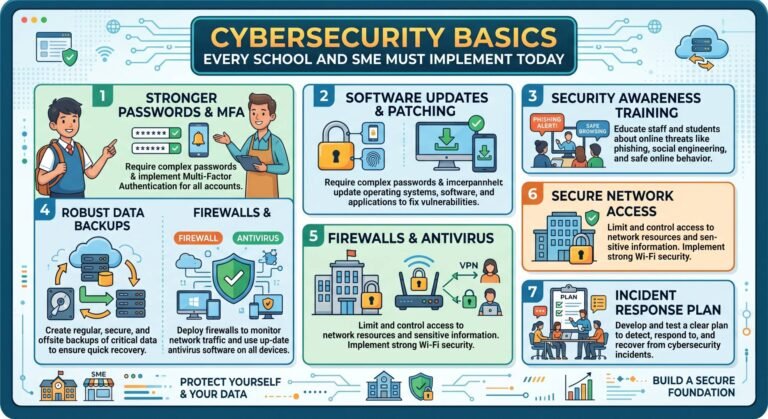
- Access control: Who can access what? Use role-based access. Implement MFA for anything sensitive. Audit login attempts monthly.
- Data encryption: Data at rest (encrypted hard drives, database encryption). Data in transit (HTTPS, VPNs). Keys managed separately from data.
- Incident response: Write a 1-page playbook: if we get hacked, who do we call, what do we do first, how do we communicate? Run a tabletop exercise once a year.
- Backup and recovery: Backups at least weekly. Test restore procedures quarterly (not just hoping backups work).
- Vendor management: If you use third-party services (cloud, payment processor, CRM), audit their security practices. Get contracts with data protection clauses.
- Audit logging: Keep logs of who accessed what, when. Review them monthly for anomalies. This sounds bureaucratic—it’s actually your first line of defense.
- Staff training: Annual security training. Phishing simulations quarterly. This catches 80% of breaches.
Step 4: Get External Validation (When You’re Ready)
Once your controls are working, consider:
- Penetration testing: Hire a firm to try to hack you. Fix what they find.
- Vulnerability assessment: Scan your systems for known weaknesses.
- ISO 27001 audit: If you’re selling B2B or targeting enterprises, this is worth it.
Cost varies: penetration testing (5K–50K SAR depending on scope), vulnerability scanning (2K–10K), ISO 27001 (initial audit: 20K–100K+, annual surveillance: 10K–30K).
Common Mistakes I See
1. Compliance theater. Beautiful policy documents, zero implementation. This fails the moment someone actually checks.
2. Compliance without ownership. “IT handles compliance.” No. Compliance is a business decision. Your CEO and board need to understand your risk posture. IT executes, but business owns it.
3. One-time implementation. You implement NCA ECC in 2024, get audited, and forget about it. Compliance is ongoing. Threats evolve, tools change, staff turn over. Review your controls quarterly.
4. Ignoring third-party risk. Your cloud provider gets breached. Your payment processor leaks customer data. Your email provider is compromised. These are your risks too. Audit your vendors.
5. No incident response. “We’ll figure it out if it happens.” You won’t. Write it down now. Practice it in a tabletop exercise. When the real breach happens, you’ll be glad you did.
6. Underestimating ZATCA. Treating it like a one-time integration. ZATCA audits are increasing. Errors compound. Treat ZATCA compliance like your business depends on it—because it does.
The Competitive Advantage
Here’s the thing most GCC businesses miss: compliance can be competitive advantage.
If you’re a B2B SaaS company and your competitor hasn’t passed ISO 27001 but you have, you win enterprise deals. If you’re a school and you can certify that student data is encrypted and backed up daily, parents trust you more. If you’re a fintech and you can prove multi-factor authentication and fraud detection, customers feel safe.
Compliance isn’t just risk mitigation—it’s trust made concrete.
Your Compliance Roadmap
Here’s a simple framework to get started:
Month 1-2: Assess
- Document your data (what you handle, where it lives)
- List your top 10 risks
- Map applicable regulations (NCA, ZATCA, GDPR-lite, ISO 27001?)
Month 3-4: Implement Core Controls
- Access control (who can access what)
- Encryption (data at rest and in transit)
- Incident response procedure
- Backup and recovery
Month 5-6: Operationalize
- Audit logging and monitoring
- Vendor security audit
- Staff training
- Quarterly compliance review
Month 7-12: Validate (Optional)
- Penetration testing
- Vulnerability assessment
- ISO 27001 or SOC 2 audit (if required)
This timeline assumes you have a basic IT infrastructure and committed leadership. Adjust based on your starting point.
Final Thought
Compliance feels like overhead. It’s not. In the GCC, where business moves fast and regulations are tightening, compliance is infrastructure. You build it once, maintain it continuously, and it becomes a moat around your business.
Your competitors are probably ignoring it. That’s your opportunity.
What’s your compliance status? If you’re a GCC business leader trying to navigate NCA, ZATCA, or enterprise customer requirements, I’d like to hear what’s holding you back. Reach out—compliance is complex, but it doesn’t have to be mysterious.