AI, cyber security, Education, encryption, GCC
Opinion · May 2026
Is AI Making Us Smarter
or Lazier?
The Honest Answer
Let me tell you about two students.
The first one uses AI constantly. Every essay starts with a ChatGPT outline. Every tricky concept gets explained by Claude. Every homework problem gets at least a hint from an AI before real effort is applied. Their grades are good. Their output looks polished. Their teachers are impressed.
The second student uses AI sparingly — as a last resort after genuinely struggling with a problem. The work is messier. The process takes longer. Some of the outputs are rougher around the edges.
Here’s the question: which student is learning more?
The uncomfortable answer — backed by a growing body of research — is almost certainly the second one. And understanding why that’s the case is the most important thing any student, teacher, or parent can understand about AI right now.
The Case That AI Is Making Us Smarter
Let’s start with the argument in favor, because it’s real and it matters.
AI tools genuinely expand what people can do. A student who previously couldn’t get feedback on a draft until their teacher reviewed it on Friday can now get detailed, thoughtful feedback in seconds. A learner who was too shy to ask “basic” questions in class can ask an AI as many times as needed without embarrassment. A non-native speaker can get explanations in their own language with a single prompt.
These are not trivial gains. Access to personalized, on-demand educational support was once a privilege available only to students whose families could afford tutors. AI has democratized that access — imperfectly, but meaningfully.
The research reflects this too. Studies consistently show that students using AI-assisted learning tools produce higher-quality outputs than peers who don’t. Comprehension improves. Efficiency increases. Learning feels more accessible, more motivating, less intimidating.
For people who already have deep expertise in a domain, AI acts as a powerful force multiplier. An experienced doctor using AI diagnostics makes better decisions. A senior engineer using AI coding tools ships more reliable software. A veteran teacher using AI to generate lesson variations reaches more learning styles. When you bring existing knowledge and judgment to the table, AI amplifies both.
So yes — in the right hands, used the right way, AI absolutely makes people more capable.
The Case That AI Is Making Us Lazier
Now for the part that’s harder to admit — and more urgent.
The OECD’s Digital Education Outlook 2026 found that while students with access to general-purpose AI tools produce higher-quality outputs than their peers, this advantage disappears — and sometimes reverses — in exams when AI access is removed.
Read that again. Students who relied on AI to produce better work couldn’t reproduce that quality without it. The tool was doing the work. The student was operating the tool. Those are not the same thing.
The same report warned that offloading cognitive tasks to general-purpose chatbots creates risks of “metacognitive laziness and disengagement” — a sophisticated way of saying: if AI does your thinking for you often enough, you stop getting better at thinking.
A 2025 study by researcher Gerlich found a direct negative correlation between frequent AI tool usage and critical thinking abilities — and the effect was strongest in younger users. Not the students who used AI occasionally or strategically. The ones who used it heavily and habitually.
Meanwhile, a 2026 research paper on software developers found something striking: developers who fully delegated coding tasks to AI produced working code — but failed conceptual understanding tests afterward. They couldn’t debug what the AI had written. They had the output without the understanding. The output looked smart. The person hadn’t become smarter.
This is the core danger, and it has a name: cognitive offloading.
The Real Problem: Cognitive Offloading
Cognitive offloading is what happens when you transfer mental work to an external tool. Writing things down instead of memorizing them. Using GPS instead of building a mental map. Asking a calculator instead of doing mental arithmetic.
Some cognitive offloading is completely fine — even beneficial. Using GPS to navigate a new city frees up mental space to notice where you’re going. Using a calculator for complex arithmetic frees you to think about what the numbers mean.
The problem is when offloading replaces the development of a skill you haven’t built yet.
There’s a critical distinction that Psychology Today researcher Timothy Cook articulated clearly in early 2026:
“What AI does to a 45-year-old is likely categorically different than what it does to a 14-year-old. If I use AI to summarize a research paper, I’ve read hundreds of papers. I know what a good argument looks like — I’m offloading a task I already know how to do. A student who uses AI to summarize every paper may never develop that judgment at all.”
This is the crux. When an expert uses AI to skip a task they’ve already mastered, efficiency goes up and little is lost. When a learner uses AI to skip a task they haven’t mastered yet, they never master it.
Adults lose skills to AI. Children never build them. Those are two different problems — and the second one is the more serious one.
The Illusion of Understanding
There’s another phenomenon making this harder to see clearly: the fluency illusion.
When AI explains something clearly and engagingly, reading that explanation feels effortless. The ideas flow smoothly. You follow along without confusion. You finish and think: Yes, I understand that now.
Except — do you?
Cognitive science research consistently shows that ease of processing is a poor indicator of depth of understanding. Reading a brilliant explanation of how photosynthesis works is not the same as being able to explain photosynthesis yourself, apply it to a new context, or troubleshoot a plant biology problem. The smooth reading experience creates an illusion of competence that evaporates under any real test of knowledge.
When students use AI to get explanations — rather than to be questioned and challenged — they frequently experience this illusion. The material feels understood. The quiz or exam reveals it wasn’t.
The World Bank’s education blog framed this pointedly: “AI can make students produce smart answers without making them smarter thinkers.” That distinction is everything.
The Honest Answer: It Depends on How You Use It
Here’s where we arrive at the truth that neither AI optimists nor AI skeptics want to sit with: it’s not a binary.
AI is not inherently making us smarter. It is not inherently making us lazier. It is making us more of whatever we already are — and doing so faster and more efficiently than any tool that came before it.
| If you use AI to… |
You are likely… |
| Quiz yourself and get challenging follow-up questions |
Getting smarter ? |
| Get answers to questions you haven’t attempted yourself |
Getting dependent ? |
| Get feedback on work you’ve genuinely attempted |
Getting smarter ? |
| Generate first drafts you lightly edit |
Skipping the learning ? |
| Ask “why” and “how” to deepen understanding |
Getting smarter ? |
| Read AI explanations passively without testing yourself |
Experiencing the fluency illusion ? |
The research is fairly consistent: AI tools that are used with intentional pedagogical purpose — to challenge, question, and push the learner — produce real and sustained learning gains. AI tools used as shortcuts — to retrieve answers, summarize content passively, or generate outputs — produce the appearance of learning without the substance.
What This Means for Students
The uncomfortable truth for students is that the most valuable thing AI can do for your learning is make it harder — not easier.
An AI that asks you follow-up questions when you give a shallow answer is more valuable than an AI that just gives you the answer. An AI that pushes back on your argument is more valuable than one that agrees with everything you say. An AI that refuses to write your first draft but offers to critique one you wrote is more valuable than one that writes it for you.
The students who will thrive in a world saturated with AI won’t be the ones who learned to operate AI tools most efficiently. They’ll be the ones who used those tools to develop genuine understanding, independent judgment, and the ability to think when AI isn’t available — or when AI is wrong.
Because here’s the thing: AI is sometimes wrong. And if you’ve never built the underlying knowledge to catch it, you’ll pass along its mistakes with complete confidence. That’s not smarter. That’s a new and more dangerous kind of ignorance.
What This Means for Teachers and Schools
For educators, this research points to a clear design principle: the goal should never be to remove AI from students’ hands — it should be to design learning experiences that remain valuable even when AI is present.
That means shifting the emphasis from outputs (essays, answers, solutions) to processes (reasoning, argumentation, iteration, reflection). It means creating assessments that test understanding — not just the ability to produce polished text. It means teaching students the difference between using AI to produce and using AI to learn.
Schools that ban AI entirely are preparing students for a world that no longer exists. Schools that allow unrestricted AI access without pedagogical guidance are setting students up for the illusion of competence. The narrow, difficult path between those two failure modes is the one worth building.
The Verdict
So: is AI making us smarter or lazier?
The honest answer is: both, simultaneously, for different people, in different proportions — determined almost entirely by how they choose to engage with it.
AI is a cognitive mirror. It reflects and amplifies what you bring to it. Bring intellectual laziness, and it will help you produce lazy work faster than ever before. Bring genuine curiosity and a willingness to be challenged, and it will accelerate your growth in ways that weren’t previously possible.
The tool is not the story. The intention behind the tool is the story.
And right now, in classrooms and offices and bedrooms around the world, millions of people are making that choice — often without realizing they’re making it at all.
The Question Worth Asking
“Am I using this AI to produce something — or to understand something?”
Your answer to that question, repeated every day, will determine which kind of AI user you become.
Written by
Saifullah Khalid
Exploring AI, education, and human intelligence at saifullahkhalid.com
? Know someone who uses AI for everything? Or someone who refuses to touch it? Share this with both of them.
AI, cyber security, Education, encryption, GCC
Global EdTech Report · May 2026
How 5 Countries Around the World
Are Using AI in the Classroom
Right Now
While some schools debate whether to allow AI, others have already deployed it nationally. Here’s what’s actually happening — and what every educator and student can learn from it.
The debate about AI in education often sounds like this: Should we allow it? Is it cheating? What about academic integrity?
Meanwhile, somewhere between Reykjavík and Singapore, that debate has already been replaced by a different question: How do we do this well?
Around the world, a growing number of countries aren’t waiting for the perfect policy framework or the perfect AI tool. They’re running pilots, building curricula, training teachers, and learning in real time — while the rest of the world watches and debates.
This article is a tour of five of those countries. What they’re doing, why it matters, and — most importantly — what lessons any educator, parent, or student can take away, regardless of where they are in the world.
??
1. Iceland — The World’s First National AI Teacher Pilot
? Focus: Teacher support | ? Tools: Claude (Anthropic) + Gemini (Google) | ? Pilot: Oct 2025 – Apr 2026
When Anthropic and Iceland’s Ministry of Education and Children announced their partnership in November 2025, headlines called it “one of the world’s first comprehensive national AI education pilots.” And while the scale was modest — around 300 teachers across the country — the intent was anything but.
The Icelandic pilot, run through the Educational and School Services Centre (MMS) in collaboration with the Icelandic Teachers’ Union, gave participating teachers access to both Claude and Gemini for a six-month period. The goal wasn’t to hand students AI tools. It was to give teachers back their time.
Icelandic Minister of Education Guðmundur Ingi Kristinsson framed it clearly: “Artificial intelligence is here to stay. It is developing at a tremendous pace, and it is important to harness its power while at the same time preventing harm.”
What teachers could do with it:
- Generate and adapt lesson plans for different learner levels
- Analyze complex texts and mathematical problems
- Create differentiated materials for students with special needs
- Reduce administrative workload — the single biggest time drain teachers report
Critically, the pilot was structured around teacher voice. Participants completed regular surveys, attended optional workshops, and fed directly into national policy decisions about whether — and how — AI should be formally adopted in Icelandic education.
? The Lesson: Starting with teachers — not students — is a powerful approach. When educators understand and trust AI tools, they’re better equipped to guide how students engage with them. Teacher buy-in isn’t a nice-to-have; it’s the foundation.
??
2. Singapore — The Smart Nation Classroom
? Focus: Personalized learning + teacher AI literacy | ? Tools: National AI platform (AICET) | ? Target: AI-ready by 2030
Singapore doesn’t do things halfway. Its national “Smart Nation” strategy — with the explicit goal of positioning the country as a world leader in AI by 2030 — includes education as a central pillar, not an afterthought.
The research center AICET, hosted by AI Singapore and funded by the Smart Nation and Digital Government Office, works directly with the Ministry of Education to launch projects aimed at improving the national education system. By 2026, AI training for teachers is being offered at every level — from those just entering the profession to experienced educators seeking to upskill.
What makes Singapore’s approach distinctive is its focus on personalization at scale. The system being developed includes:
- An AI-enabled companion that provides each student with customized feedback and motivation
- Automated grading systems that free teachers from repetitive marking
- Machine learning tools that identify how individual students respond to different classroom materials and activities
- AI modules integrated into primary school computer science curricula
Singapore also runs the Student Learning Space (SLS) — a national digital platform where AI tools help students access personalized content aligned to their current level. For students with special needs, the system adapts to provide accessible, scaffolded learning experiences.
The underlying philosophy: every child deserves a learning experience designed for them, not for an average student who doesn’t actually exist. AI makes that possible at national scale.
? The Lesson: AI’s biggest educational promise isn’t making content delivery faster — it’s making learning genuinely personal. Singapore is betting that adaptive, individualized education will produce better outcomes than any one-size-fits-all curriculum ever could.
??
3. UAE — AI as a Formal School Subject, From Kindergarten to Grade 12
? Focus: National AI curriculum + classroom tool adoption | ? Tools: ChatGPT, Gemini, Claude, Alef Platform | ? Live: 2025–2026 academic year
The UAE made a bold move in 2025: it became one of the first countries in the world to introduce AI as a formal school subject for every student from kindergarten through Grade 12, integrated into the national curriculum starting in the 2025–2026 academic year.
UAE Minister of Education Sarah Al Amiri announced the curriculum covering seven key domains: fundamental AI concepts, data and algorithms, software literacy, ethical awareness, real-world applications, innovation and project design, and policies and community engagement. Over 1,000 specially trained teachers are delivering the subject, supported by a dedicated quality monitoring committee.
But the UAE’s AI integration goes beyond a single subject. Private schools across the country are now allowing students to use generative AI tools — including ChatGPT, Gemini, Claude, and others — for assignments and homework, provided they verify and cite sources appropriately. At Dubai Schools Al Khawaneej, Principal Jamie Efford described their approach:
“We take a deliberate and education-first approach to artificial intelligence in the classroom. Our focus is not simply on access to tools, but on developing AI literacy, critical thinking and responsible use.”
The UAE’s Alef Education platform — an AI-powered adaptive learning system — already serves 1.4 million students across five countries, making it one of the largest AI-in-education deployments in the world.
? The Lesson: Making AI a subject — not just a tool — changes everything. Students don’t just learn with AI; they learn about AI: how it works, its ethical dimensions, its limitations. That’s the difference between a generation that uses AI and a generation that understands it.
??
4. South Korea — AI-Smart Textbooks and Personalized Homework
? Focus: Adaptive learning + AI textbooks | ? Tools: National AI curriculum platform, KERIS | ? Status: Rolled out to one-third of schools
South Korea has moved faster than almost any other country in converting classroom ambition into operational reality. Within the span of roughly a year, it went from AI pilot programs to deploying AI-enhanced smart textbooks in a third of its schools — a rollout speed that’s remarkable by any standard.
The Korean Ministry of Education’s KERIS (Korea Education and Research Information Service) unit has been designing and piloting extensive teacher development programs around AI. A key feature: the Ministry’s Future of Education Center runs model classrooms where educators and policymakers from around the world can visit and experience what AI-integrated learning looks like in practice.
South Korea’s approach is highly focused on adaptive homework and assignments. AI systems analyze each student’s educational level, learning tendencies, and behavioral patterns to dynamically adjust what they’re assigned — so a student struggling with fractions gets more foundational practice, while a student who’s mastered the concept is pushed ahead. No two students receive exactly the same homework.
The longer-term vision is even more ambitious: every child in South Korea will eventually have access to a personalized AI tutor and a connected online learning platform — allowing teachers to focus on higher-order skills like collaboration, critical thinking, and creativity, while AI handles the repetitive reinforcement work.
? The Lesson: Adaptive homework — work that adjusts to the individual learner in real time — is one of the most concrete, immediate wins AI offers in education. South Korea is proving it’s not science fiction. It’s policy.
??
5. Finland — AI With Ethics at the Center
? Focus: Equity, ethics, and teacher-centered AI | ? Tools: AI in Learning research platform, free national courses | ? Status: Ongoing national commitment
If Singapore represents AI-in-education as national infrastructure, Finland represents it as national philosophy.
Finland — long regarded as one of the world’s gold standards in education — has approached AI not with the urgency of rapid deployment, but with the deliberateness of a country that takes pedagogy seriously. Its national commitment includes offering free online AI coursework to all citizens — not just students, not just teachers, but anyone — in a bold move toward universal AI literacy.
The AI in Learning project, a collaboration between international researchers and companies, is producing scholarly work on the ethical use of AI in education and developing an intelligent digital system that assesses student wellness — feeding insights back to both students and educators. The goal is not just smarter learning, but healthier learning.
Finland’s approach offers a counterpoint to the speed-first models of Singapore and South Korea. Finnish educators are asking harder questions: What are the risks of cognitive offloading? How do we ensure AI serves equity rather than widening gaps? What does responsible AI deployment look like for a teacher-centered system that values professional autonomy?
Finland also runs one of the most respected international courses on AI in education through the European School Education Platform — bringing educators from across Europe to Helsinki to see firsthand how Finnish schools are thinking through AI integration. The course isn’t about getting the most out of AI tools. It’s about getting AI integration right.
? The Lesson: Speed isn’t always the goal. Finland is proving that thoughtful, ethics-first AI integration — that prioritizes teachers, equity, and student wellbeing — may ultimately produce more sustainable and beneficial outcomes than rapid deployment for its own sake.
?? Side-by-Side: What Each Country Prioritizes
| Country |
Primary Focus |
Who Benefits Most |
Stage |
| ?? Iceland |
Reducing teacher admin burden |
Teachers |
Pilot completed |
| ?? Singapore |
Personalized learning at scale |
Students (esp. special needs) |
Systemic rollout |
| ?? UAE |
AI literacy as a core subject |
All students K–12 |
National curriculum live |
| ?? South Korea |
Adaptive homework + AI textbooks |
Students (personalized pace) |
One-third of schools |
| ?? Finland |
Ethical, equity-focused AI |
Citizens + teachers |
Ongoing research + training |
? What Does This Mean for the Rest of the World?
The countries featured here aren’t outliers or exceptions. They’re early data points in a trend that’s accelerating globally. By early 2026, over half of U.S. states have schools reporting AI use in classrooms. Estonia launched its “AI Leap” program for 20,000 teenagers. Greece partnered with OpenAI to bring ChatGPT to secondary schools. China’s Squirrel AI adaptive tutoring system now reaches 24 million learners.
The pattern is consistent: countries that treat AI as infrastructure — rather than a disruption to be managed — are moving faster and learning more.
For educators reading this from any country: you don’t need a national mandate to start. You need one class, one use case, and one week of honest experimentation. The schools leading in 2030 are being built by teachers who started thinking about this in 2026.
For students: you are entering a world where AI fluency is becoming as foundational as digital literacy was in the 2000s. The question isn’t whether you’ll use these tools — it’s whether you’ll understand them well enough to use them wisely.
For policymakers: the global evidence is accumulating. The countries sitting out this transition won’t avoid the disruption — they’ll just arrive at it less prepared.
? 5 Lessons Any School Can Apply Today
- Start with teachers, not students. Build AI confidence in educators first — it creates better student outcomes downstream. (Iceland’s model)
- Teach AI as a subject, not just a tool. Students who understand how AI works use it more responsibly and effectively. (UAE’s model)
- Use AI to personalize, not standardize. Adaptive learning that meets each student where they are is the real prize. (Singapore + South Korea)
- Ethics can’t be an afterthought. Questions about equity, bias, and cognitive development need to be part of every AI integration plan. (Finland’s model)
- Pilot, measure, then scale. Every country on this list started small and learned before committing nationally. Evidence-first isn’t slow — it’s smart.
Written by
Saifullah Khalid
Covering AI, education, and the future of learning at saifullahkhalid.com
? Know an educator who’s still on the fence about AI? Share this with them — the world isn’t waiting.
AI, cyber security, Education, encryption, GCC, help
Educational Technology · May 2026
From Memorization to Mastery:
How AI Is Finally Fixing
the Way We Study
We’ve been studying wrong for decades. Highlighting, re-reading, cramming — science proved these don’t work. Now AI is making the right methods effortless.
Here’s an uncomfortable truth about how most of us were taught to study: it doesn’t work.
Highlight the textbook. Re-read your notes. Stare at flashcards the night before the exam. Make a summary. Read the summary. Repeat until your brain feels full.
Decades of cognitive science research have shown that these techniques — the ones most students use, the ones most teachers implicitly endorse — are among the least effective ways to actually learn something and retain it long-term.
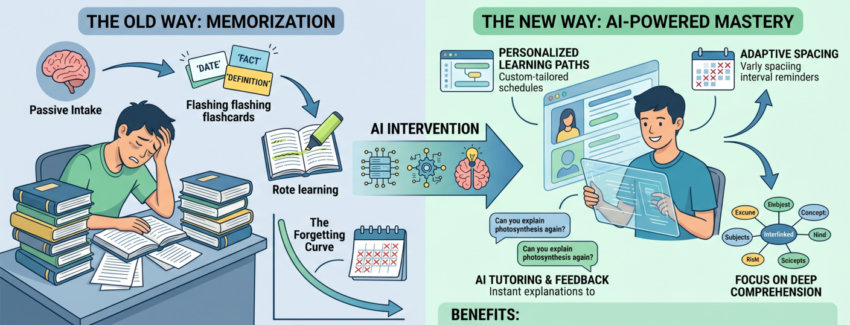
We’ve known this for years. The problem was never the research. The problem was that the better methods — spaced repetition, active recall, interleaving, elaborative interrogation — were harder to do alone. They required structure, consistency, and ideally, someone to quiz you and push back when you got something wrong.
Most students don’t have that. Until now.
AI is changing the equation. Not by replacing teachers or making studying “easier” in a shallow sense — but by making the right kind of hard effortlessly accessible to any student, anywhere, at any time.
This is the story of how that’s happening.
? First: Why Our Traditional Study Methods Fail
To understand why AI matters here, you need to understand the science of how memory actually works.
The brain doesn’t store information the way a hard drive does. You can’t just “save” something by reading it repeatedly. Memory is reconstructive — every time you retrieve a memory, you strengthen the neural pathway that leads to it. The act of retrieval is the learning.
This is why two of the most well-researched study techniques — active recall and spaced repetition — are so powerful:
- Active recall means testing yourself on material rather than passively reviewing it. Closing the book and trying to remember — even imperfectly — strengthens memory far more than re-reading.
- Spaced repetition means reviewing material at increasing intervals over time. Instead of cramming everything in one session, you revisit information just as you’re about to forget it — which is precisely when retrieval strengthens the memory most.
Studies going back to the early 20th century, and confirmed repeatedly since, show that students using these methods retain information significantly longer and with less total study time than students who use passive review methods.
So why doesn’t everyone study this way?
Because it’s hard to do alone. Active recall means you need someone — or something — to generate questions. Spaced repetition means you need a system that tracks what you know, what you don’t, and when to review each thing. For decades, the tools available (physical flashcard boxes, basic apps like early Anki) worked but required enormous self-discipline to use consistently.
AI removes that barrier entirely.
? How AI Is Implementing Learning Science at Scale
Modern AI tools are doing something remarkable: they’re taking what cognitive scientists have known for decades and making it the default experience for students. Here’s how:
1. AI-Generated Active Recall — On Demand
Instead of re-reading your notes, you can now paste any study material into an AI and ask: “Quiz me on this. Don’t give me multiple choice — ask me open-ended questions and tell me when I’m wrong.”
The AI becomes a tireless examiner. It can generate dozens of questions from a single chapter, vary the difficulty, ask follow-up questions when you give a shallow answer, and explain why you got something wrong — not just tell you the right answer.
This is active recall at scale, available at 2am before an exam, with no study partner required.
2. Adaptive Spaced Repetition
Tools like Anki have offered spaced repetition for years — but they required the student to create every flashcard manually, which most people didn’t sustain. AI changes this in two ways:
- Automatic card generation: Upload your notes, get a complete flashcard deck in seconds. No manual entry.
- Adaptive scheduling: AI systems that track your responses can identify which concepts you’re weakest on and prioritize them — rather than treating all material equally.
3. Socratic Questioning — The Most Underrated Study Method
One of the most powerful learning techniques is elaborative interrogation: asking why something is true, not just what is true. This forces the brain to connect new information to existing knowledge — which is what creates deep understanding rather than surface-level recall.
AI tutors can do this naturally. Instead of just answering your question, a well-prompted AI will ask: “Before I explain, what do you think might be happening here?” or “That’s right — but can you explain why?”
Khan Academy’s Khanmigo is explicitly designed around this Socratic model. Rather than giving students answers, it guides them toward figuring out answers themselves — which is dramatically more effective for long-term retention.
4. Interleaving — The Uncomfortable Method That Works
Most students study one topic completely before moving to the next (called “blocking”). Research consistently shows that mixing topics — called interleaving — produces better long-term retention, even though it feels harder and less productive in the moment.
AI can create interleaved study sessions automatically: mixing questions from Chapter 3, Chapter 7, and last week’s material in a single session, forcing the brain to constantly retrieve and differentiate between concepts — which is exactly how exam conditions work.
?? The AI Study Stack: Tools That Actually Work
Here are the specific tools leading this shift, and how to use them effectively:
| Tool |
Best For |
Learning Technique |
| Claude / ChatGPT |
Socratic Q&A, concept explanation, essay feedback |
Active recall, elaborative interrogation |
| Khanmigo |
Math, science tutoring without giving answers |
Socratic method, guided discovery |
| Anki + AI |
Automatic flashcard generation from notes/PDFs |
Spaced repetition, active recall |
| Perplexity AI |
Research with cited sources, concept deep-dives |
Elaborative interrogation, source evaluation |
| NotebookLM |
Uploading course materials and querying them |
Active recall from personal notes |
? A Real Study Session: What This Looks Like in Practice
Let’s make this concrete. Here’s what a science-backed AI study session looks like for a university student preparing for a biology exam:
Example Prompt to Claude
“I have a biology exam on cellular respiration in 3 days. Here are my notes: [paste notes]. Please do the following: First, identify the 5 concepts I most likely need to understand deeply. Then quiz me on them one at a time using open-ended questions. After each answer I give, tell me what I got right, what I missed, and ask a follow-up that pushes me deeper. Don’t give me the answer until I’ve tried at least twice.”
This single prompt creates a study session that incorporates active recall, elaborative interrogation, immediate feedback, and Socratic follow-up — all the high-impact techniques at once.
After 30 minutes of this kind of session, students report understanding the material in a way that hours of passive review never achieved. The reason is simple: the brain was working, not coasting.
?? The Risks: When AI Study Tools Go Wrong
This wouldn’t be an honest article without addressing the shadow side. AI study tools can actually harm learning when used incorrectly.
The Shortcut Trap
Asking AI to summarize a chapter for you and then reading the summary is still passive learning. It feels efficient — you covered the material in 3 minutes instead of 30 — but you haven’t done the retrieval work that creates memory. The summary is the AI’s understanding, not yours.
Over-Reliance Without Verification
AI tools can be wrong, especially on technical or niche topics. Students who accept AI explanations without cross-referencing authoritative sources risk learning incorrect information confidently — which is worse than not knowing at all.
The Fluency Illusion
When an AI explains something clearly and you think “I understand that,” you may be experiencing the fluency illusion — mistaking the ease of reading a good explanation for actual knowledge. The test is always: can you explain it back without looking? If not, you don’t know it yet.
The rule of thumb: AI should be the thing that tests you, not just the thing that tells you. Use it to generate questions more than answers.
? What This Means for Students, Teachers & Institutions
For Students
You now have access to a personalized tutor available 24/7 that can adapt to your pace, your weaknesses, and your schedule. The students who figure out how to use this well will have a significant advantage — not because AI does their work, but because they’ll develop genuine mastery faster than ever before.
For Teachers
The role of a teacher is shifting from information-deliverer to learning architect. If AI can handle explanations, practice problems, and basic feedback — teachers are freed to focus on what AI can’t do: building relationships, developing critical thinking, facilitating discussion, and inspiring students to care about learning at all.
For Institutions
Schools and universities that ban AI rather than teach students to use it wisely are preparing students for a world that no longer exists. The institutions leading the future are the ones designing curricula that treat AI as a tool to be mastered — like a calculator, like the internet — not a threat to be feared.
The Bottom Line
We have spent generations teaching students what to think about without adequately teaching them how to think — or how to learn. Traditional study methods optimized for the appearance of effort: filled notebooks, highlighted pages, long library sessions.
AI is finally making the science of learning accessible to everyone. Spaced repetition, active recall, Socratic questioning, interleaving — these aren’t new ideas. They’re just now, for the first time, available without friction.
The students who will thrive in the next decade won’t be the ones who memorized the most. They’ll be the ones who learned how to learn — and used every tool available to do it better.
AI is the most powerful learning tool ever put in a student’s hands. The question isn’t whether to use it. The question is whether you’ll use it wisely.
? Quick-Start: 5 AI Study Habits to Build This Week
- After reading any topic, ask Claude: “Quiz me on what I just read — open-ended questions only.”
- Paste your lecture notes into NotebookLM and ask: “What are the 5 things I most need to understand deeply here?”
- Use ChatGPT or Claude in Socratic mode: “Don’t give me the answer — guide me to it.”
- Generate a spaced repetition deck from your notes using AI — then actually review it daily.
- End every study session by asking AI: “Give me 3 questions I should be able to answer after this session. Test me.”
Written by
Saifullah Khalid
Writing about the future of education, AI, and human potential at saifullahkhalid.com
? Know a student who still highlights and re-reads? Share this with them — it might change how they study forever.
AI, cyber security, Education, GCC
Educational Technology · In-Depth
The Classroom of Tomorrow Is Already Here
How artificial intelligence, intelligent platforms, and the rise of online learning are fundamentally reshaping what it means to teach — and what it means to learn.
April 13, 2026 · 12 min read · For educators & school leaders
$404B
Global edtech market projected by 2025
60%
Of K–12 teachers now use AI tools regularly
3×
Faster skill acquisition with adaptive learning systems
1.8B
Learners reached by online platforms globally
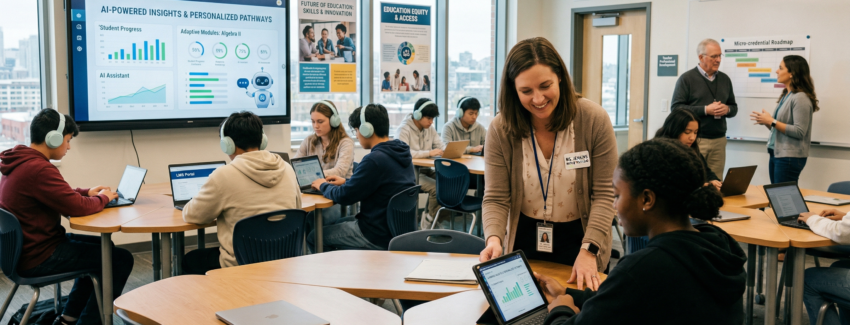
Walk into a forward-thinking school today and you might struggle to recognize it. One student is working through a personalized algebra module at her own pace, guided by an AI tutor that adjusts every question based on her last response. A teacher nearby is not lecturing — he is coaching, circulating among small groups, armed with real-time dashboards that flag which students are falling behind before they even raise their hand.
This is not a vision of 2035. It is happening right now — and for educators and administrators navigating this transformation, the challenge is no longer whether technology belongs in learning, but how to deploy it with wisdom, equity, and intention.
Part I — AI in Education: Beyond the Hype
Artificial intelligence has become the most discussed and most misunderstood force in modern education. Cut through the noise, and what emerges is a technology that is simultaneously more modest and more profound than its headlines suggest.
What AI is actually doing in classrooms
The most impactful AI applications in education are not robots replacing teachers. They are systems that do the cognitive heavy lifting that teachers were never designed to carry alone. Adaptive learning platforms like Khan Academy’s Khanmigo, Carnegie Learning, and Synthesis use machine learning to track thousands of micro-signals — response times, error patterns, topic avoidance — to build a unique learning profile for each student. The system then adjusts difficulty, pacing, and content type in real time.
For educators, this means something genuinely revolutionary: the ability to differentiate instruction at scale. A teacher managing thirty students has never, realistically, been able to personalize learning for each one. AI makes that personalization automatic, continuous, and invisible to the student — it simply feels like a curriculum that fits.
Practitioner Insight
AI-powered formative assessment tools are among the highest-leverage investments a school can make. They move feedback from summative (end-of-term) to continuous, allowing teachers to intervene weeks earlier than traditional grading would allow.
AI as a teacher’s co-pilot
Beyond student-facing applications, AI is quietly transforming teacher workflows. Lesson planning tools can generate differentiated worksheets across three reading levels in seconds. Grading assistants can provide first-pass feedback on written work, freeing teachers to focus their attention on the qualitative judgments only a human can make — the student who is technically correct but clearly confused, or the essay that ticks every box but lacks a genuine voice.
Administrative AI is also reducing the invisible workload that drives educator burnout: attendance logging, parent communication drafting, IEP documentation, and scheduling are all areas where intelligent automation is reclaiming hours per week for teachers who need them.
“The best AI tools don’t replace teacher judgment — they create the conditions for more of it.”
The equity imperative
No discussion of AI in education is complete without confronting the equity gap. The schools most likely to have sophisticated AI infrastructure are already the best-resourced. Without deliberate policy intervention — subsidized licensing, device access programs, teacher training pipelines — edtech risks being another mechanism that widens the gap between advantaged and under-served learners.
School administrators have a critical role to play here: evaluating not just what a tool can do, but who it is designed for, whose data it trains on, and whether its recommendations reflect the full diversity of students it will serve.
Part II — The EdTech Platform Landscape
The tools market has matured dramatically. Where early edtech was often a digitized worksheet — content moved online without meaningful pedagogical redesign — a new generation of platforms is built around learning science from the ground up.
Learning Management Systems grow up
LMSs like Canvas, Schoology, and Google Classroom have evolved from content repositories into rich ecosystems. Modern platforms integrate video, discussion, formative assessment, analytics, and third-party app markets in a single environment. For administrators, the critical evaluation criteria have shifted from features to interoperability: can this platform share data with your student information system? Can it integrate with the specialist tools your special education or gifted programs rely on?
Collaborative and project-based tools
A generation of tools has emerged to support the pedagogies that research consistently shows produce the deepest learning: collaboration, project-based learning, and authentic audience. Platforms like Padlet, Flipgrid, Book Creator, and Canva for Education give students the ability to create, share, and receive feedback in multimodal formats that reflect how knowledge is actually communicated in professional life.
For School Leaders
Before adopting any new platform, audit your current tool stack for overlap and complexity. Teachers managing eight different logins will use none of them well. Consolidation — even at the cost of some functionality — typically improves adoption and outcomes.
Assessment reimagined
The traditional test is under pressure from two directions simultaneously: AI tools that can answer most knowledge-recall questions, and a deeper pedagogical consensus that performance tasks, portfolios, and authentic demonstrations of competency reveal learning that multiple-choice cannot. Platforms like Seesaw, Formative, and Peergrade are building new models of evidence-based assessment that are harder to automate and more meaningful to students.
Part III — The Future of Online Learning
Online learning has undergone two distinct revolutions. The first, accelerated by the pandemic, was one of necessity — schools moved online because they had to, and the results were mixed. The second, now underway, is one of design — institutions building online and hybrid experiences that are genuinely better than what a traditional classroom offers for certain learners, certain content, and certain contexts.
Hybrid as the default
The binary of “online” versus “in-person” is dissolving. Blended learning — where students move fluidly between independent digital work and collaborative in-person experience — is becoming the dominant model in progressive schools. When designed well, blended environments allow students to spend more time on the activities that most require human presence (discussion, mentorship, lab work, performance) and less time passively receiving information that a video or interactive module can deliver equally well.
Micro-credentials and modular learning
One of the most significant structural shifts in online education is the unbundling of the traditional course. Platforms like Coursera, edX, and a growing number of employer-backed programs are offering micro-credentials — focused, verifiable certificates of specific skills — that sit alongside or instead of degree programs. For educators, this represents both an opportunity and a disruption: an opportunity to certify and communicate the specific competencies students develop, and a disruption to the assumption that the semester-long course is the natural unit of learning.
The social problem — and its solutions
Online learning’s most persistent weakness is social. Learning is fundamentally relational, and screen-mediated interaction, however convenient, rarely replicates the spontaneity, warmth, and incidental connection of shared physical space. The best online programs are addressing this not by apologizing for the limitation, but by engineering intentional social structures: cohort models, live synchronous sessions, peer accountability partnerships, and community platforms that make the social layer explicit rather than incidental.
“Online learning fails when it tries to replicate the classroom. It succeeds when it builds something the classroom never could.”
What This Means for Educators and Administrators Today
The convergence of AI, mature platforms, and redesigned online learning creates both extraordinary opportunity and genuine complexity. For educators on the ground, the mandate is to resist two failure modes: uncritical adoption — implementing technology because it is new and generates excitement — and defensive resistance — treating every innovation as a threat to the human heart of teaching.
The most effective educators in this landscape are those who have internalized a simple evaluative question: does this tool give me or my students more time and space for the things that matter most? If an AI assistant frees forty minutes a week for one-on-one conversations with struggling students, that is a trade worth making. If a new platform adds cognitive load without a corresponding pedagogical return, it is not.
For school administrators, the strategic priority is infrastructure: not just device access and broadband, but the professional development pipelines, data governance frameworks, and community trust necessary to ensure that technology serves the school’s mission rather than reshaping it by default.
The classroom of tomorrow is not a destination that arrives fully formed. It is built, iteratively and collaboratively, by educators willing to experiment, reflect, and share — equipped with better tools than any generation of teachers has had before.
Artificial Intelligence
EdTech
Online Learning
School Leadership
Adaptive Learning
Blended Learning
Education Equity
AI, cyber security, Education, GCC
There was a time when a school’s efficiency was measured by the thickness of its filing cabinet and the neatness of its ledgers. Attendance was called by name, fees were collected in cash, and report cards were typed or handwritten. For decades, this system worked — slowly, imperfectly, but it worked.
That time is over.
Today’s schools operate in an environment of accelerating complexity. Student populations are growing. Regulatory requirements are multiplying. Parents expect instant communication. Teachers are stretched thin. Administrators are drowning in data that tells them nothing because it lives in disconnected silos. The old ways are not just inefficient — they are actively holding schools back.
The schools that will thrive in the next decade are not necessarily the ones with the best teachers or the most resources. They are the ones that have the intelligence to build smarter operational foundations. And that foundation is digital.
This article explores how modern school management systems are reshaping the way educational institutions operate, what features matter most, what obstacles schools face in adoption, and where the industry is heading.
The Hidden Cost of Running a School the Old Way
Before talking about solutions, it is worth understanding the depth of the problem.
A typical school with 500 students handles thousands of daily data points — attendance records, homework submissions, fee payments, staff schedules, exam results, parent communications, maintenance requests, procurement approvals, and more. In a manually operated school, each of these is handled independently, often by different people using different tools, and rarely in real time.
The consequences are predictable:
Data errors accumulate quietly. A student marked absent on the wrong day. A fee recorded under the wrong account. A grade entered incorrectly and never caught. Each mistake is small. Collectively, they erode trust, drain time, and occasionally trigger compliance problems.
Information moves too slowly. When a parent calls to ask why their child’s grade dropped, the administrator has to pull a file. When a teacher wants to know how many students failed last month’s test across all sections, they have to manually compile results. Speed matters in education, and slow information costs decisions.
Communication is reactive, not proactive. Parents find out about problems after they have escalated. Schools send newsletters that go unread. Parent-teacher meetings happen twice a year instead of being a continuous conversation.
Financial tracking is opaque. Schools lose revenue to uncollected fees, underbilled services, and poor financial visibility. In countries like Saudi Arabia where ZATCA-compliant e-invoicing is now mandatory, manual financial systems are not just inefficient — they are a legal risk.
Teachers burn out on administration. A teacher who spends two hours a week on attendance, gradebooks, and progress reports loses over 80 hours a year on tasks that contribute nothing to actual teaching. Multiply that across a staff of 60 and the loss is staggering.
These are not minor inconveniences. They are structural weaknesses that limit a school’s ability to grow, compete, and deliver quality education.
What Is a School Management System and Why Does It Matter?
A School Management System (SMS) — also called a School ERP or School Information System — is a unified digital platform that connects every operational layer of a school into a single ecosystem.
Think of it this way: a hospital has a patient management system that connects admissions, doctors, pharmacy, billing, and records. A bank has a core banking system that connects accounts, transactions, compliance, and customer service. A school needs exactly the same kind of backbone — a central nervous system that makes every part work together.
A modern SMS connects:
Administration — admissions, enrollment, timetabling, staff management Academics — gradebooks, assessments, report cards, curriculum planning Finance — fee collection, invoicing, payroll, budgeting, compliance Communication — parent portals, teacher messaging, announcements, alerts Analytics — dashboards, performance tracking, predictive insights Compliance — attendance reporting, regulatory filings, audit trails
When these are unified under one platform, the school stops being a collection of departments and starts functioning as an intelligent organization.
Core Features That Define a High-Quality School Management System
Not all systems are equal. The quality of a school management platform can be judged by how deeply it solves real operational problems, not just how many features it lists on a brochure. Here is what truly matters:
- Smart Administration Automation
The administrative backbone of any school — admissions, student records, staff onboarding, timetable generation, classroom assignments — should be largely automated. Schools waste enormous amounts of time on tasks that a properly designed system can handle in seconds.
Automated timetable generation, for example, is a genuinely hard problem when done manually. Balancing teacher availability, room capacity, subject requirements, and student group allocations is a combinatorial challenge that can take days by hand. A smart system resolves it in minutes.
Admissions workflows — from application intake to document verification to enrollment confirmation — can be fully digitized, reducing processing time and eliminating lost paperwork. Student records become a single, always-accurate source of truth rather than a patchwork of spreadsheets and physical files.
- Financial Management and Regulatory Compliance
Money is where operational weakness most visibly hurts a school. Poor financial management leads to revenue leakage, compliance risk, and ultimately, unsustainable operations.
A capable SMS handles the full financial lifecycle: fee structure setup, invoice generation, payment collection, receipt issuance, arrears tracking, and financial reporting. Crucially, in Saudi Arabia, this must include ZATCA-compliant e-invoicing. Schools operating in the Kingdom that are not issuing tax-compliant digital invoices are already in violation of Phase 2 requirements that have been rolling out across sectors. A modern school system must have this built in, not bolted on.
Beyond compliance, good financial modules provide real-time dashboards showing outstanding balances, collection rates, revenue forecasts, and expense tracking. This kind of visibility is what separates schools that are financially in control from those that discover problems only at year-end.
- Parent Engagement and Communication
Parent engagement is one of the most underestimated drivers of student success and school reputation. Research consistently shows that students whose parents are actively involved perform better academically and behaviorally. Yet most schools communicate with parents through methods that were designed for a pre-smartphone world.
A modern SMS provides parents with a dedicated portal or mobile app where they can see their child’s attendance in real time, review grades as they are entered, receive instant push notifications for important events, pay fees online, and message teachers directly without going through the front office.
This is not a convenience feature. It is a trust-building infrastructure. Parents who feel informed and connected to their child’s school become advocates rather than complainants. Schools that invest in parent communication tools see measurably better satisfaction scores and retention rates.
- AI-Powered Academic Insights
This is where school management platforms are moving from being operational tools to genuine strategic assets.
Advanced systems now apply machine learning to the data they collect — attendance patterns, grade trajectories, assessment performance, behavioral incidents — to generate predictive insights. A student who was an A performer in the first term but has been declining steadily for eight weeks is not just having a bad week. They are at risk, and an AI-powered system can flag that for a counselor before the parent even notices.
These systems can identify which teaching interventions correlate most strongly with improvement in specific subject areas, which students are likely to require additional support in upcoming assessments, and which classrooms are consistently underperforming relative to comparable groups. This shifts school leadership from reacting to problems after the fact to anticipating and preventing them.
For schools that want to genuinely differentiate their educational quality — not just their marketing — AI-powered academic analytics is one of the highest-leverage investments they can make.
- Multi-School and SaaS Architecture
School groups, educational investment companies, and franchise school models have needs that single-school systems simply cannot meet. Managing 5, 10, or 30 campuses from a single operational center requires a fundamentally different architecture.
Modern platforms built on multi-tenant SaaS infrastructure allow a central administration team to oversee all campuses simultaneously — comparing performance, standardizing policies, consolidating financials, and enforcing compliance — while each campus retains enough autonomy to manage its own day-to-day operations.
Cloud-based delivery means the system scales without expensive on-premise infrastructure. It also means updates, security patches, and new features are rolled out centrally, without requiring IT intervention at each campus. For growing school groups in the GCC region, this is not a nice-to-have — it is a prerequisite for scalable operations.
- Bilingual and Localization Support
In Saudi Arabia and across the GCC, a school management system that does not fully support Arabic — including right-to-left text rendering, Arabic numerals, Hijri calendar options, and localized reporting formats — is not a serious solution. It is a product designed for somewhere else and awkwardly fitted to the region.
Bilingual support matters not just for the user interface but for all outputs: report cards, invoices, parent notifications, official compliance documents. Staff who are more comfortable in Arabic should not have to navigate an English-only system, and vice versa.
Localization also means compliance with local regulatory frameworks. Saudi Arabia’s Ministry of Education has specific reporting requirements. ZATCA has specific invoicing standards. VAT calculations must follow the Kingdom’s rules. A system that ignores these is not a school management system for Saudi Arabia — it is a generic product that happens to be available there.
The Real Benefits: Beyond the Feature List
Features are means, not ends. What schools actually care about are outcomes. Here is what a properly implemented digital school management system delivers in practice:
Time recovered for education. When teachers are freed from administrative burden, they teach. When administrators are not chasing paper, they lead. The hours saved by automation are not trivial — they are the margin between a school that is merely surviving and one that is thriving.
Data-driven leadership. School principals and boards who have access to real-time operational and academic dashboards make faster and better decisions. They see problems early, allocate resources accurately, and can present clear evidence of school performance to stakeholders, parents, and regulatory bodies.
Revenue protection. Digitized fee collection with automated reminders and online payment options consistently improves collection rates. Schools that have moved to digital financial management typically see a measurable reduction in arrears and revenue leakage within the first year.
Competitive differentiation. In markets where parents have choices, the experience a school provides — including how it communicates, how transparent it is, how accessible its information is — is a real competitive factor. A school that sends parents a real-time notification when their child’s fever is detected at the clinic is a school that is harder to leave.
Regulatory resilience. As governments in the GCC continue to expand digital compliance requirements, schools with modern digital infrastructure are ready. Schools that are still on paper will face increasing costs and risks as enforcement tightens.
The Obstacles Schools Must Prepare For
Digital transformation in education is not without friction. Schools that underestimate the implementation challenges often end up with expensive systems that are poorly adopted and do not deliver on their promise.
Cost and budget constraints are real, particularly for smaller private schools or government-funded institutions operating on tight budgets. The key framing, however, is return on investment rather than upfront cost. A system that reduces administrative headcount needs by one full-time position, improves fee collection by 5%, and eliminates a compliance fine more than pays for itself in year one.
Change resistance from staff is perhaps the most underestimated obstacle. Teachers and administrative staff who have worked a certain way for years do not automatically embrace new systems. Implementation without adequate training, internal champions, and a managed transition period routinely fails. The technology is rarely the problem. The human adoption process is.
Data security and privacy concerns deserve serious attention. Schools hold sensitive personal data on minors, which carries significant legal and ethical responsibilities. Any school management platform must demonstrate serious security practices: encrypted data storage, role-based access controls, audit logs, GDPR or applicable local data protection compliance, and clear data retention policies.
Integration with legacy systems is another practical challenge. Schools often have existing systems for payroll, library management, transport, or canteen operations that cannot simply be discarded overnight. A good school management platform should be able to integrate with existing tools via APIs or provide a clear and supported migration path.
Vendor selection is critical and deserves more due diligence than most schools give it. A system that looks impressive in a demo but has poor local support, an unresponsive development team, or a history of data breaches is worse than no system at all. Schools should demand references from comparable institutions, verify the vendor’s compliance credentials, and insist on data ownership guarantees in the contract.
Where the Industry Is Heading
The school management space is evolving rapidly, and the systems that exist today will look primitive compared to what is coming within the next five years.
AI will move from insights to action. Today’s AI features are largely advisory — they flag risks and surface patterns. Tomorrow’s systems will take action: automatically adjusting a struggling student’s learning pathway, reassigning teachers based on predicted workload peaks, or filing a compliance report without human intervention.
Personalized learning at scale will become a reality. The integration of school management systems with adaptive learning engines will allow schools to deliver genuinely personalized educational experiences — where each student’s curriculum, pacing, and support are continuously adjusted based on their performance data — without requiring superhuman effort from teachers.
Mobile will become the primary interface. The next generation of administrators, teachers, and parents will expect to do everything from a phone. Systems designed around desktop-first experiences will become obsolete.
Interoperability standards will define winners and losers. As governments and accreditation bodies begin requiring data sharing and reporting in standardized formats, the systems that are built on open, interoperable architectures will become the default choice. Proprietary, walled-garden platforms will face increasing resistance.
Full compliance automation will arrive. What today requires a human to review and submit will be handled entirely by the platform — from VAT filings to Ministry of Education reports to accreditation documentation. Schools will move from compliance management to compliance certainty.
Choosing the Right System for Your School
Given all of the above, the selection of a school management platform is one of the most consequential technology decisions a school leadership team will make. A few principles to guide it:
Start with the pain points, not the feature list. Every vendor will show you a feature matrix. What matters is whether the system solves the specific operational problems that are actually costing your school time, money, and quality. Build your evaluation criteria from your problems, not the vendor’s brochure.
Prioritize local compliance readiness. In Saudi Arabia, this means confirmed ZATCA compliance, Arabic language support, and alignment with Ministry of Education reporting requirements. Do not accept assurances — ask for documented evidence and live demonstrations.
Evaluate the vendor, not just the product. Software is only as good as the company behind it. Ask about response times for critical issues, the product roadmap, pricing model changes, and what happens to your data if the vendor closes. The relationship matters as much as the technology.
Plan for adoption, not just deployment. Budget for training, transition support, and an internal change management process. Assign internal champions who will advocate for the system and help colleagues through the learning curve. Measure adoption metrics alongside operational metrics.
Think long-term. A system that works well for 500 students should also work for 1,500. A system that meets today’s compliance requirements should be actively maintained to meet tomorrow’s. Build scalability and vendor commitment into your criteria from the start.
Final Thoughts
The question of whether schools should embrace digital management platforms was settled years ago. The evidence is unambiguous. Schools that have made this transition report measurable improvements in operational efficiency, financial performance, parent satisfaction, and educational outcomes. Schools that have not are working harder for worse results.
What remains is the question of how — how to choose the right platform, how to implement it effectively, how to bring staff along, and how to get the full return on the investment.
In a world where education is simultaneously becoming more competitive, more regulated, and more data-driven, the schools that thrive will be those that treat operational excellence not as an overhead cost to minimize, but as a strategic foundation to invest in.
Digital transformation in education is not about replacing the human heart of a school. It is about freeing that heart to do what it was always meant to do — educate, inspire, and build the next generation. The systems and spreadsheets were never the point. The students always were.
The technology exists today to run a school with a fraction of the administrative burden that existed a decade ago. The only remaining question is whether school leaders have the vision and courage to use it.