Live a Better Life

Live a Better Life

8-rules-to-a

1. Remember that work is not the only facet to your life. In these demanding times, it’s easy to focus more on the workplace.  Finding a time to “play” is just as important.  Making special time to enjoy interests, hobbies, and family, not only makes life happier and enjoyable, but helps us be more productive on the job as well.

2. Realize that you are just as important as other people — and say “no” when your obligations and responsibilities are too much.  You can only spread yourself so thin before you’re no good for yourself or anyone else.

3. Don’t compare yourself to other people – at work or in your personal life.  In the first place, no one knows what other people are going through.  More importantly, when you compare yourself to other people, you always tend to see yourself on the “short end” and everyone else seems better to you somehow.  Making comparisons is never a good or helpful thing for you to do.

4. Make a scheduled time every day for relaxation.

This is not a “lazy” relaxation, but a time when you regroup, let go of your stress, and read something that is positive and uplifting.  This is a good time to go over any therapy that you’re working on.  Having a “relaxation” time or a “quiet time” every day strengthens you, allows the stress and tension in your life to evaporate, and keeps you on a positive, even keel.

6. Take time to laugh at yourself and the situations you find yourself in.  Laughter is a powerful, positive medicine, and the calmer and more peaceful you can take things, the happier your life will be.

7. Surround yourself with friends who are positive, encouraging, and helpful.  This has a nice reciprocal benefit: As you are positive and encouraging to others, your friends become positive and encouraging to you.  We all need this continuing, positive encouragement to make solid, positive progress in life.

8. If you have problems getting your feelings and opinions out, learn the techniques of self-assertion, rather than using anger or avoidance and bottling them all up inside.  Burying your feelings and pushing them deep down into yourself only creates blockages in your growth and progress as a human being.

9. Relax, calm down, take things slower.  The cliché is passé, but there’s a big element of truth to it: When you stop to smell the roses, the world is just a brighter, happier, and more beautiful place to live.

Life Goals

Life Goals

It is important to remember, when thinking about what you would like to achieve in your life, that change is inevitable.  Your circumstances and priorities will change through your life, you may realise, at the age of 40 that you are never going to be a concert pianist – as you had planned when you were 19.  However if you take the right steps from the age of 19 then there is nothing to stop you achieving this potential goal.

When thinking about your lifetime goals, make them challenging and exciting, base them on your strengths but make them relevant to you and ultimately achievable.

It may be useful to categorise life goals:

  • Academic goals – what knowledge and/or qualifications do you want to achieve?
  • Career goals – where would you like your career to take you, what level do you want to reach?
  • Monetary goals – what do you aim to earn at given point in your life?
  • Ethical goals – do you want to volunteer some of your time to a good cause or get involved in local events, politics etc.?
  • Creative goals – how do you want to progress creatively or artistically?
  • Domestic goals – how would you like your domestic life to be in the future?
  • Physical goals – do you want to develop you skill in a certain sport or other physical activity?

Once you have thought about your life goals you can start to plan how best to achieve them.  Set yourself smaller goals for the future.  In ten years I will be…  in five years I will be… etc.  Work out plans of action with smaller and smaller sub-goals until you can arrive at an action plan that you can start working on now.


Making Your Goals SMART:

It can be useful to make your goals and sub-goals fit the SMART criteria.

That is goals should be:

  • S Specific – make each goal specific, so you know exactly what it is.
  • M Measurable – make each goal measurable so you know how you are progressing.
  • A Attainable – don’t set impossible goals, make sure each goal and sub-goal is attainable.
  • R Relevant – make your goals relevant.  Ensure your sub-goals are relevant to your life goals.
  • T Timed – set time-limits or deadlines for when to achieve each goal.

Keep Motivated

Finally it is important to keep track of what you want to achieve and stay motivated to do so.  To keep your motivation levels up try to:

  1. Learn and Acquire Knowledge.  Read, study and talk to people – knowledge and information are key for feeding your mind and keeping you curious and motivated. See our section: Study Skills for some tips on how to make your learning more effective.
  2. Keep the Company of Enthusiastic People.  Try to avoid negative people and seek out positive, well-motivated people.  It is a lot easier to be motivated if the people around you are.
  3. Keep Positive. Keep a positive attitude, see problems and set-backs as learning opportunities.
  4. Know Your Strengths and Weaknesses.  Work on ironing out your weaknesses and building on your strengths.
  5. Do it.  Try not to procrastinate, assess the risks but keep working towards your goals.
  6. Get Help and Help Others. Don’t be afraid to ask other for help and don’t hold back if you can help them.  Seeing other people succeed will help to motivate you to do the same.
Plan-Do-Check-Act (PDCA)

Plan-Do-Check-Act (PDCA)

Implementing New Ideas in a Controlled Way

Also known as the PDCA Cycle, or Deming Cycle

Create a model before you build the final solution.

© iStockphoto/suprun

Something needs to change: Something’s wrong, and needs to be fixed, and you’ve worked hard to create a credible vision of where you want it to be in future. But are you 100% sure that you’re right? And are you absolutely certain that your solution will work perfectly, in every way?

Where the consequences of getting things wrong are significant, it often makes sense to run a well-crafted pilot project. That way if the pilot doesn’t deliver the results you expected, you get the chance to fix and improve things before you fully commit your reputation and resources.

So how do you make sure that you get this right, not just this time but every time? The solution is to have a process that you follow when you need to make a change or solve a problem; A process that will ensure you plan, test and incorporate feedback before you commit to implementation.

A popular tool for doing just this is the Plan-Do-Check-Act Cycle. This is often referred to as the Deming Cycle or the Deming Wheel after its proponent, W Edwards Deming. It is also sometimes called the Shewhart Cycle.

Deming is best known as a pioneer of the quality management approach and for introducing statistical process control techniques for manufacturing to the Japanese, who used them with great success. He believed that a key source of production quality lay in having clearly defined, repeatable processes. And so the PDCA Cycle as an approach to change and problem solving is very much at the heart of Deming’s quality-driven philosophy.


Step 1: Plan

First, identify exactly what your problem is. You may find it useful to use tools like Drill Down  , Cause and Effect Diagrams  , and the 5 Whys   to help you really get to the root of it. Once you’ve done this, it may be appropriate for you to
map the process   that is at the root of the problem.

Next, draw together any other information you need that will help you start sketching out solutions.
Step 2: Do

This phase involves several activities:

Generate possible solutions.
Select the best of these solutions, perhaps using techniques like Impact Analysis   to scrutinize them.
Implement a pilot project on a small scale basis, with a small group, or in a limited geographical area, or using some other trial design appropriate to the nature of your problem, product or initiative.

Our section on Practical Creativity includes several tools that can help you generate ideas and solutions. Our section on Decision Making includes a number of tools that will help you to choose in a scientific and dispassionate way between the various potential solutions you generate.
Note:

The phrase “Plan Do Check Act” or PDCA is easy to remember, but it’s important you are quite clear exactly what “Do” means. “”Do” means “Try” or “Test”. It does not mean “Implement fully.” Full implementation happens in the “Act” phase.
Step 3: Check

In this phase, you measure how effective the pilot solution has been, and gather together any learnings from it that could make it even better.

Depending on the success of the pilot, the number of areas for improvement you have identified, and the scope of the whole initiative, you may decide to repeat the “Do” and “Check” phases, incorporating your additional improvements.

Once you are finally satisfied that the costs would outweigh the benefits of repeating the Do-Check sub-cycle any more, you can move on to the final phase.
Step 4: Act

Now you implement your solution fully. However, your use of the PDCA Cycle doesn’t necessarily stop there. If you are using the PDCA or Deming Wheel as part of a continuous improvement initiative, you need to loop back to the Plan Phase (Step 1), and seek out further areas for improvement.
When to Use the Deming Cycle

The Deming Cycle provides a useful, controlled problem solving process. It is particularly effective for:

Helping implement Kaizen   or Continuous Improvement approaches, when the cycle is repeated again and again as new areas for improvement are sought and solved.
Identifying new solutions and improvement to processes that are repeated frequently. In this situation, you will benefit from extra improvements built in to the process many times over once it is implemented.
Exploring a range of possible new solutions to problems, and trying them out and improving them in a controlled way before selecting one for full implementation.
Avoiding the large scale wastage of resources that comes with full scale implementation of a mediocre or poor solution.

Clearly, use of a Deming Cycle approach is slower and more measured than a straightforward “gung ho” implementation. In true emergency situations, this means that it may not be appropriate (however, it’s easy for people to think that situations are more of an emergency than, in reality, they really are…)

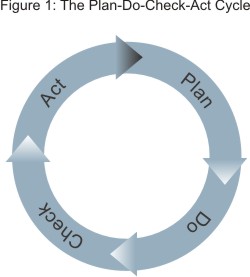
The four phases in the Plan-Do-Check-Act Cycle involve:

  • Plan: Identifying and analyzing the problem.
  • Do: Developing and testing a potential solution.
  • Check: Measuring how effective the test solution was, and analyzing whether it could be improved in any way.
  • Act: Implementing the improved solution fully.

These are shown in Figure 1 below.

There can be any number of iterations of the “Do” and “Check” phases, as the solution is refined, retested, re-refined and retested again.

How to Use the Tool

The PDCA Cycle encourages you to be methodical in your approach to problem solving and implementing solutions. Follow the steps below every time to ensure you get the highest quality solution possible.

A Theory of Personal Development

A Theory of Personal Development

Some changes are forced upon people by circumstances beyond their control, others occur because of life events or through choice.  This page identifies skills you need to enable you to set goals and to enable personal empowerment.  These skills can help you to make relevant, positive and effective choices and decisions for your future.

Personal development is a lifelong process which enables people to assess their skills and qualities, to consider their aims in life and to set goals which will help them to maximize their potential.  Although early life development and early formative experiences within the family, at school, etc. can help to shape us as adults, personal development should not stop later in life.  This page contains information and advice that is designed to help you to think about your personal development and ways in which you can work towards goals and your full potential.

Theory

There are many ideas surrounding personal development, one of which is detailed below – Abraham Maslow’s process of Self Actualisation.

Self Actualisation

Maslow (1970) suggests that all individuals have an in-built need for personal development which occurs through the process called self-actualisation.

The extent to which people are able to develop depends on certain needs being met and these needs form a hierarchy.  Only when one level of need is satisfied can a higher one be developed.  As change occurs throughout life, however, the level of need motivating someone’s behaviour at any one time will also change.

  • At the bottom of the hierarchy are the basic physiological needs for food, drink, sex and sleep, i.e., the basics for survival.
  • Second are the needs for safety and security in both the physical and economic sense.
  • Thirdly, progression can be made to satisfying the need for love and belonging.
  • The fourth level refers to meeting the need for self-esteem and self-worth.  This is the level most closely related to ‘self-empowerment’.
  • The fifth level is the need to know and understand the environment, this level includes more abstract ideas such as curiosity and the search for meaning or purpose.
  • The sixth relates to aesthetic needs of beauty, symmetry and order.  At the top of Maslow’s hierarchy, is the need for self-actualisation.

Maslow (1970, p.383) says that all individuals have the need to see themselves as competent and autonomous, also that every person has limitless room for growth.

Self-actualisation refers to the desire that everybody has ‘to become everything that they are capable of becoming’.  In other words, it refers to self-fulfilment and the need to reach full potential as a unique human being.

For Maslow, the path to self-actualisation involves being in touch with your feelings, experiencing life fully and with total concentration.

Maslow, A. H. (1970), Motivation and Personality, (2nd Edition), Harper & Row, New York.

Verification: 1544cdbd1105873e