GCC, help
Prophets, Empires & the Modern World Part VI : The Reckoning — From the Twelve-Day War to the Edge of the Abyss
Where History Arrives
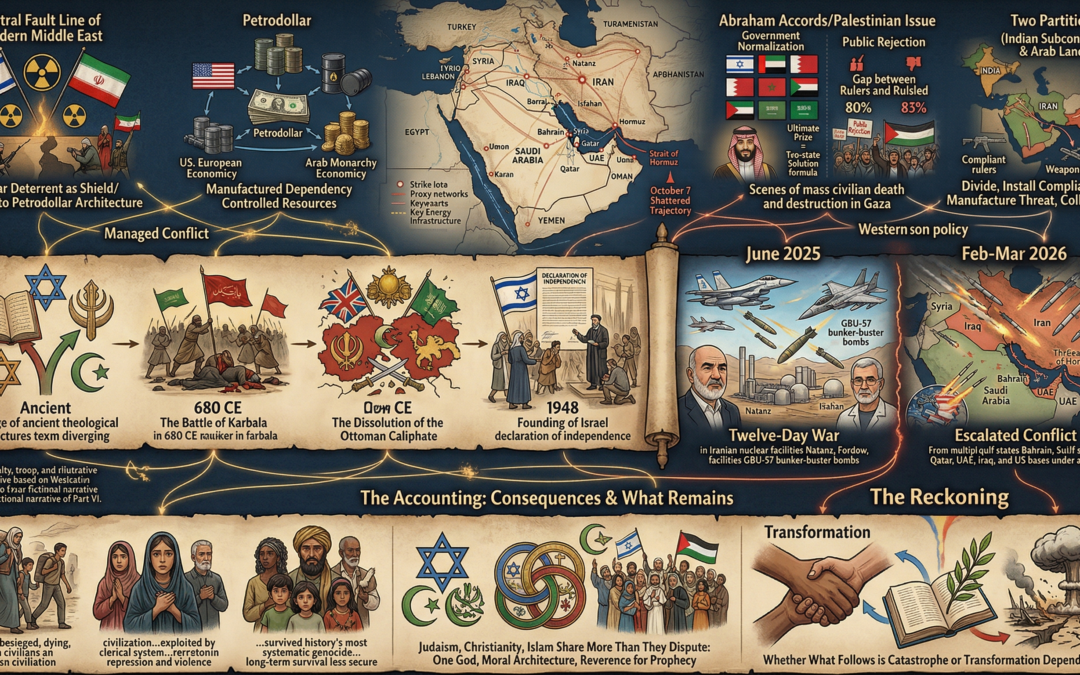
There is a particular kind of vertigo that comes from watching a long historical argument collapse into the present tense. Across five installments, this series has traced a thread that begins with the theological fractures between Judaism, Christianity, and Islam; winds through the trauma of Karbala and the slow death of the Ottoman Caliphate; passes through the immigration waves that reshaped Palestine and the founding of Israel in 1948; and arrives at the geopolitical architecture of petrodollars, proxy networks, and manufactured dependency that has defined the Middle East for eighty years.
We argued, in Part V, that this architecture was not accidental — that Israel was embedded in the Arab world as a permanent source of strategic anxiety, that Arab monarchies were kept in a loop of fear and financial dependence, and that Iran’s crime, in Western eyes, was not its theocracy but its insistence on controlling its own resources. We noted that the confrontation between Israel and Iran was building toward something. We could not have known, at the time of writing, how quickly it would arrive.
In June 2025, it arrived.
The Twelve-Day War
Israel launched attacks on Iran in June 2025, targeting nuclear facilities, military sites, and regime infrastructure. The opening salvo was devastating in its precision. Conducted by 200 Israeli fighter jets striking more than a hundred targets, it killed top military leaders — most notably Hossein Salami, the head of the Islamic Revolutionary Guard Corps; Mohammed Bagheri, the chief of staff of the armed forces; and Amir Ali Hajizadeh, the commander of the IRGC’s air force — as well as several nuclear scientists.
Nine days later, the United States entered directly. On June 22, 2025, the United States Air Force and Navy attacked three nuclear facilities in Iran under the code name Operation Midnight Hammer. The Fordow Uranium Enrichment Plant, the Natanz Nuclear Facility, and the Isfahan Nuclear Technology Center were targeted with fourteen GBU-57A/B bunker-buster bombs carried by B-2 Spirit stealth bombers and Tomahawk missiles fired from a submarine.
The Iranian Health Ministry reported that around 1,062 people were killed. In Israel, 29 people were killed. A ceasefire was announced on June 24, 2025. The conflict lasted twelve days.
The debate over what the strikes actually achieved will continue for years. The Israeli-US military campaign inflicted heavy damage but did not eliminate Iran’s nuclear program. Iran’s nuclear knowledge, its stockpile of enriched uranium, its centrifuge manufacturing capacity, its third underground enrichment site, and its determination to keep the program going remain. The IAEA director-general assessed that Iran could resume uranium enrichment in a matter of months. The CIA director offered a more optimistic assessment, claiming facilities were “severely damaged” and would take years to rebuild. The truth, as is often the case in military assessments issued under political pressure, probably lies somewhere between these two positions.
What is not in dispute is the strategic significance of what happened. For the first time in decades, American forces struck Iranian soil directly. The red line that had been approached so many times — through sanctions, through proxy wars, through covert assassinations of nuclear scientists, through the Stuxnet cyberattack — had been crossed. The confrontation that this series identified as the central fault line of the modern Middle East had become a shooting war.
The Prophecy That Wasn’t a Prophecy
In Part V of this series, we made an observation that now reads as almost prophetic: that America’s concern about Iran’s nuclear program was not primarily about the bomb itself, but about what the bomb represented — a guarantee against regime change, a shield behind which Iran could consolidate its influence over Iraq, Syria, Lebanon, and Yemen, and a direct challenge to the petrodollar architecture that has sustained Western dominance of the Middle East since 1945.
We also noted the practical paradox: that Iran could not use a nuclear weapon against Israel without destroying Muslim-majority cities in the blast radius, and could not reach the American mainland without capabilities it did not possess. The nuclear program, we argued, was a deterrent — not an offensive tool.
Prior to Israel’s attack, there was no imminent threat posed by Iran’s nuclear program, and diplomacy had not been exhausted. U.S. intelligence agencies assessed that Iran’s leaders had not yet decided to build a bomb, and it would take a year or more to assemble a deliverable warhead. The IAEA director-general stated plainly, days before the American strikes, that his agency “did not have proof of a systemic effort by Iran to move into a nuclear weapon.” These were not minor caveats buried in classified documents. They were the considered assessments of the world’s leading nuclear monitoring body, delivered publicly, before the bombs fell.
The strikes proceeded regardless.
This gap — between the stated justification and the known facts — is not incidental. It is the heart of the matter. The Twelve-Day War was not a response to an imminent threat. It was the culmination of a decades-long project to destroy Iran’s capacity for strategic autonomy. Understanding this does not require excusing Iran’s behavior — its support for proxy militias, its domestic repression, its repeated threats against Israel are all real and documented. It requires only reading the sequence of events honestly: negotiations were underway, diplomacy was not exhausted, and the strikes were launched anyway.
The War That Would Not End
The ceasefire of June 24, 2025 did not hold as a political settlement. On February 28, 2026, Israel launched coordinated strikes on Iranian targets, including sites in and around Tehran. Trump announced that the operation’s objective was “to defend the American people by eliminating imminent threats from the Iranian regime.”
Iran responded to these strikes with missile and drone attacks against Israel, while also targeting other countries in the region that host US military facilities — including Bahrain, Saudi Arabia, Qatar, the United Arab Emirates, and Iraq. The conflict had metastasized. What began as a targeted campaign against nuclear facilities was now a regional war, with missiles falling on Gulf capitals, American military bases under attack, and the Strait of Hormuz — through which nearly a fifth of the world’s oil and gas passes — under threat of closure. The Iranian parliament approved a motion calling for the closure of the Strait of Hormuz as a retaliatory measure. Whether or not Tehran would follow through, the mere possibility sent tremors through global energy markets.
The world that exists as this series concludes — in March 2026 — is more dangerous than the world that existed when we began. The architecture this series has described, built over a century, is now cracking under its own weight.
The Abraham Accords: A Dream Interrupted
One of the most consequential near-events of this era was the normalization of relations between Saudi Arabia and Israel — a deal that, had it been completed, would have represented the most significant reconfiguration of Middle Eastern politics since the founding of Israel itself.
This arrangement was reportedly nearing completion shortly before Hamas carried out its attack on Israel on October 7, 2023, and included undefined assurances that steps would be taken to improve the lives of Palestinians. The Abraham Accords, signed in 2020 between Israel and the UAE, Bahrain, Morocco, and Sudan, had already broken the Arab consensus that normalization must be preceded by Palestinian statehood. Saudi Arabia, the custodian of Islam’s holiest cities and the most symbolically significant Arab state, was to be the capstone.
October 7 shattered that trajectory. The war in Gaza that followed produced scenes of mass civilian death, famine, and destruction that Arab publics could not ignore — regardless of what their governments were willing to sign. In a survey conducted across sixteen Arab countries between December 2023 and January 2024, 89 percent of respondents rejected recognition of Israel outright, compared to 4 percent who supported it. In the case of Saudi Arabia, those rejecting normalization had grown by 30 percent in a single year.
Saudi Arabia plays a unique role as the “ultimate prize” of normalization. The kingdom differs fundamentally from the small Gulf states — in size, in its responsibility as custodian of the holy places for the Muslim world, and in its position on the Palestinian issue. Following MBS’s visit to Washington in November 2025, Saudi Crown Prince Mohammed bin Salman told reporters: “We want to be part of the Abraham Accords, but we want also to be sure that we secure a clear path toward a two-state solution.” The formula has not changed in substance since the Arab Peace Initiative of 2002: normalization in exchange for a Palestinian state. Israel has never accepted this formula, and shows no sign of accepting it now.
What the Abraham Accords revealed, however, is something important: that Arab governments and Arab publics are not the same thing. The governments were willing to normalize. The publics were not. This gap between rulers and ruled — sustained for decades by the very structure of authoritarianism that American policy has supported — may be the most dangerous fissure in the entire system. When it closes, it will close suddenly.
The Two Partitions, Revisited
We began this series with theology and ended with missiles. But the connective tissue between them has always been the same: the question of who controls the land, the resources, and the narrative of sacred geography.
Britain partitioned two worlds after World War II — the Indian subcontinent and the Arab lands of the former Ottoman Empire. Both partitions were designed to produce managed conflict: conflict sufficient to generate dependency, but not so catastrophic as to destroy the revenue stream. India and Pakistan have fought four wars, come to the nuclear brink twice, and continue to purchase weapons from the same Western suppliers. Palestine was absorbed into Israel, its people dispersed across refugee camps and diminished territories, their cause alternately championed and abandoned by Arab governments who used it as political currency while investing their oil revenues in Western banks.
The pattern in both cases is the same: divide the people, install compliant rulers, manufacture a permanent security threat, and collect the proceeds. When a leader breaks the arrangement — as Gaddafi did, as Saddam did, as Mossadegh did in Iran in 1953, as Khomeini did in 1979 — the machinery of removal is activated. The assets are frozen. The opposition is funded. The narrative is shifted. And if none of that works, the bombers are dispatched.
What has changed, in 2026, is that the machinery is visible. The justifications have worn thin. The gap between what Western governments say — about democracy, sovereignty, international law, and human rights — and what they do has become impossible to paper over with diplomatic language. The IAEA said Iran posed no imminent nuclear threat. The bombs fell anyway. The UN Security Council has passed resolutions on Palestinian rights for seventy years. They have been vetoed or ignored. The International Court of Justice issued a ruling on the situation in Gaza. It was disregarded.
The question is not whether the world can see this clearly. The question is what it will do about it.
What Remains
This series has not been an argument for any particular political solution. It has been an attempt to trace honestly how the present came to be — through theology, through empire, through oil, through the long aftermath of decisions made in the corridors of London and Washington and, before them, in the courts of the Umayyads and the Ottomans.
The Muslim world sits at a crossroads that it has occupied before. After the fall of the Abbasid Caliphate to the Mongols in 1258, it recovered. After the slow dissolution of the Ottoman Caliphate — which we examined in Part III — it fractured into the nation-states that now struggle against each other in ways that serve everyone’s interests except their own peoples’. After Karbala, the wound took centuries to express itself in geopolitical form. History is patient in ways that contemporary politics is not.
What the current moment demands is clarity about causes. The Israeli-Palestinian conflict is not, at its root, a religious war between Jews and Muslims. It is a political conflict over land, sovereignty, and resources — one that has been systematically theologized by all sides, because theological framing is more emotionally mobilizing and more difficult to negotiate than political framing. The Iran-Israel confrontation is not, at its root, a clash of civilizations. It is a competition over regional hegemony and resource control — one that has been framed as an existential ideological war because that framing serves the interests of those who profit from the conflict.
The Palestinian people are not abstractions in this story. They are a population of millions, displaced, besieged, and dying — in numbers that, as this final installment is written, continue to rise. The Iranian people are not abstractions. They are a civilization of extraordinary depth and antiquity, whose legitimate grievances against external interference have been exploited by a clerical system that has its own record of repression and violence. The Israeli people are not abstractions. They are the descendants of a people who survived history’s most systematic genocide, built a state against extraordinary odds, and now find themselves led by governments whose policies are making their long-term survival less, not more, secure.
None of these peoples are served by the architecture of permanent war. All of them are imprisoned by it.
The Thread That Began in the Desert
We began this series with a question embedded in the origins of monotheism itself: what happens when the children of a single revelation diverge so profoundly that they can no longer recognize each other? Judaism, Christianity, and Islam share more than they dispute. They share a God, a moral architecture, a reverence for prophecy, and a belief that history is moving toward something — toward justice, toward judgment, toward an accounting.
The accounting, in the form that history delivers it, does not come with trumpets. It comes in the form of consequences — of actions taken and not taken, of opportunities for peace declined, of the slow accumulation of injustice until the weight of it becomes insupportable.
We are living, in 2026, in the middle of that accumulation. Whether what follows is catastrophe or transformation depends on choices that have not yet been made — by leaders who have not yet found the courage to make them, and by peoples who are only beginning to understand how thoroughly they have been managed.
The prophets are gone. The empires are dying. What remains is us — and the question of what kind of modern world we choose to build from the wreckage of the one being destroyed.
Uncategorized
Prophets, Empires & the Modern World
Part IV: The Slow Collision — From Karbala to the Creation of Israel
One Faith, Three Trajectories
To understand why the modern Middle East is what it is — why Jerusalem is contested, why Jews and Muslims stand on opposite sides of a conflict that shows no sign of resolution — you have to go back further than 1948. You have to go back to the very architecture of the Abrahamic faiths themselves.
The Torah was the first of God’s revealed books to humanity; the Psalms of David, the second. Both contain references to a final prophet — a Messiah — whose coming would mark the completion of divine guidance to mankind. This expectation was embedded in Israelite tradition, in the teachings of David and Solomon, and it became the central tension around which the three great monotheistic religions would fracture.
When Jesus appeared, the early Christians identified him as the promised Messiah. The Jews refused. For Judaism, the prophetic chain stopped at that moment of refusal — not out of stubbornness, as its critics often charge, but out of genuine theological conviction that the criteria for the Messiah had not been met. Jesus himself, according to the Gospel of John, appears to have indicated that the one who was to come would be after him — and would be the final prophet. Christianity, nonetheless, declared Jesus to be the Messiah, the Son of God, and the seal of divine revelation. And so Christianity, too, stopped at its own moment.
When the Prophet Muhammad arrived six centuries later with the final message, both traditions rejected it. The Jews, who had already closed their prophetic canon, saw no reason to reopen it. The Christians, having already assigned the role of final prophet to Jesus, could not accommodate another. And so three distinct communities solidified around three distinct stopping points — separated by theology, yet bound together by an extraordinary amount of shared belief: one God, angels, revealed scripture, and the Day of Judgment. In the words of the Quran itself, they are communities of a single chain.
One geographical fact bound all three together: Jerusalem. The Torah was revealed in its orbit. The Psalms and the Solomonic tradition pointed toward it. Jesus preached, suffered, and — according to Christian belief — rose from the dead within its walls. And Islam, though it emerged in Mecca and Medina and eventually reoriented its prayer toward the Kaaba, retained a deep spiritual connection to Jerusalem through the Prophet’s Night Journey and Ascension. For seven centuries after Jesus, Jews and Christians managed, through war and accommodation, to find an uneasy coexistence around the city. Then Islam arrived — and the city acquired a third claimant.
The Wound at Karbala and Its Political Aftermath
The Muslim community had been torn in two before it fully consolidated. The Battle of Siffin during the caliphate of Ali ibn Abi Talib set the Islamic world on a trajectory that would define its political geography for centuries. The Hijaz — the sacred heartland of Islam, encompassing Mecca and Medina — fell under the authority of Ali’s household. Syria came under Muawiyah ibn Abi Sufyan, who established the Umayyad dynasty with Damascus as its capital. After the assassinations of Ali and later his son Hasan, even the Hijaz was absorbed into the Umayyad state. Only Mecca and Medina retained a certain moral distance.
Then came Karbala. In 680 CE, on the tenth of Muharram, Husayn ibn Ali — the grandson of the Prophet — was killed along with nearly all the male members of his family on the plains of Iraq, at the hands of the Umayyad army of Yazid ibn Muawiyah. Only Husayn’s son Ali ibn Husayn, known as Zayn al-Abidin, survived, spared by illness. The massacre was militarily decisive but morally catastrophic for the Umayyads. It handed their opponents an indictment that could never be fully answered. As we examined in Part III of this series, the shadow of Karbala would stretch across centuries, eventually shaping the fault lines of modern geopolitics.
For the Umayyads, one consequence was practical and immediate: they had conquered a vast empire but could not comfortably enter its holiest cities. The Hijaz became psychologically — and at times physically — hostile territory. Pilgrimage to Mecca, one of Islam’s most fundamental obligations, became politically complicated.
The Caliph Who Reengineered Holiness
It was in this context that one of the most consequential architectural decisions in human history was made.
Abd al-Malik ibn Marwan was the fifth Umayyad caliph, ruling from 685 to 705 CE — a reign of twenty years that transformed both the administration and the physical landscape of the Islamic world. He was, by most accounts, a formidable ruler: a member of the first generation of born Muslims, his early life in Medina was occupied with religious pursuits. He standardized the coinage of the caliphate, arabized its bureaucracy, and crushed a series of internal revolts that had threatened Umayyad rule.
One revolt in particular forced his hand. Abdullah ibn al-Zubayr, based in Mecca, had challenged Umayyad legitimacy and controlled the Kaaba — the most sacred site in Islam. When Abd al-Malik began construction on the Dome of the Rock, he had not yet retaken control of the Kaaba.
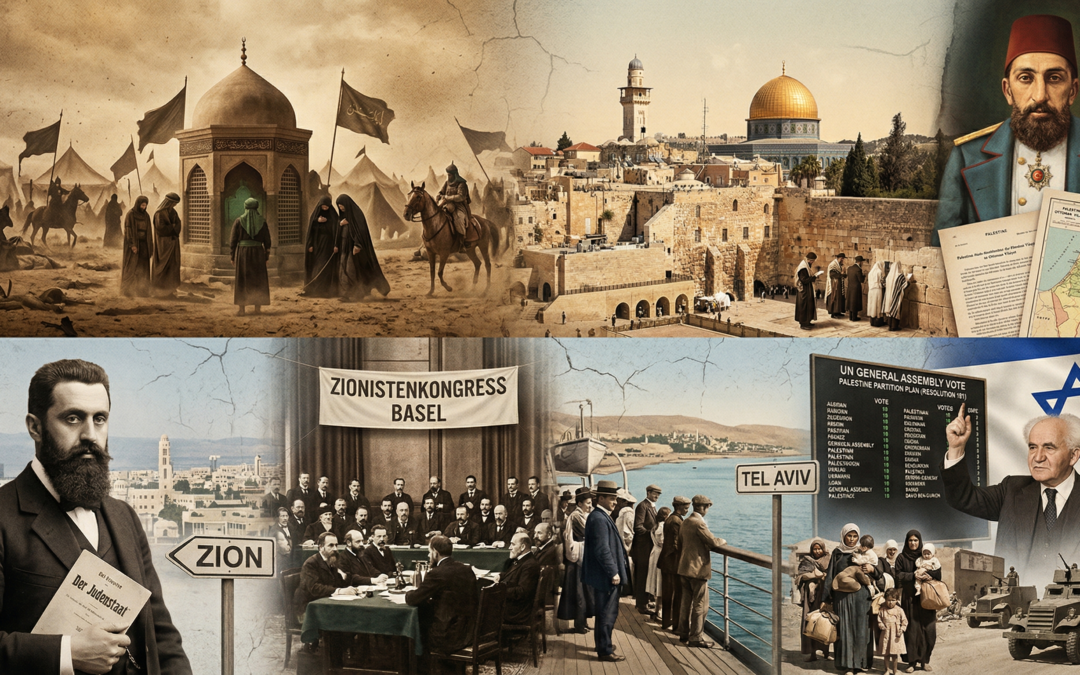
Between 685 and 692 CE, Abd al-Malik commissioned the construction of an extraordinary monument on the Temple Mount in Jerusalem — the Dome of the Rock, known in Arabic as Qubbat al-Sakhra. Construction was ordered during the Second Fitna (the second Islamic civil war), and completed in 691–692 CE. The monument stands upon the site of the Second Jewish Temple, which was destroyed by the Romans in 70 CE. The two principal architects were Raja ibn Haywa, a Muslim theologian and jurist from Beisan (Beit She’an, in present-day northern Israel — not Damascus, as some sources erroneously claim), and Yazid ibn Salam, a client of Abd al-Malik from Jerusalem.
Why did Abd al-Malik build it? This question has generated genuine controversy among historians for over a millennium. One widely accepted explanation holds that Abd al-Malik intended the Dome of the Rock as a monument of Islamic victory over Christianity — a statement of Islam’s unique theological position within the Abrahamic religious landscape of Jerusalem, home of the two older revealed faiths. The inscriptions inside the dome, which directly address Christian theology by rejecting the Trinity and the divinity of Jesus, strongly support this interpretation.
A more controversial explanation, recorded by the 9th-century historian al-Yaqubi, alleges that Abd al-Malik sought to divert pilgrims away from Mecca — where his rival Ibn al-Zubayr was using the Hajj season to extract pledges of allegiance from Syrian Muslims — and toward Jerusalem instead. According to this account, Abd al-Malik told his subjects that the Rock from which the Prophet ascended to heaven could serve in place of the Kaaba for their obligatory circumambulation.
Most modern historians reject this account as anti-Umayyad propaganda, likely originating in Shia or Abbasid sources hostile to the Umayyad legacy, and consider it implausible that Abd al-Malik would attempt to replace one of Islam’s Five Pillars. However, other scholars caution against dismissing it entirely, noting that such accounts cannot be conclusively disproven. What is not disputed is the result: the Dome of the Rock became one of the most spectacular structures in the world — the oldest extant Islamic monument — and it permanently and irrevocably transformed the sacred geography of Jerusalem.
What matters for our story is what Abd al-Malik built over and upon. The Temple Mount — known to Muslims as al-Haram al-Sharif, the Noble Sanctuary — was the site of Solomon’s Temple and the Second Temple that replaced it after the Babylonian exile. It was the holiest ground in Judaism. Among Jews, the Rock at the center of the Dome is considered the spot where Abraham prepared to sacrifice Isaac and the site of Solomon’s original Temple. Among Muslims, it is the very rock from which the Prophet Muhammad was taken up to heaven during the Mi’raj. By constructing this monument on the ruins of both Jewish temples, Abd al-Malik — whatever his precise intentions — ensured that the most politically charged patch of earth in the world would become inextricably tied to Muslim sovereignty. The problem this created has not been resolved to this day.
Zion: A Mountain, A Symbol, A Movement
Before we arrive at the 20th century and the founding of Israel, we need to understand one word that has come to define a global political movement: Zion.
Zion, or Mount Zion, is a hill in Jerusalem — adjacent to the Temple Mount. It is the site of the Tomb of David, making it sacred to both Jews and Christians. It was on this hill that Jesus observed the Last Supper; it was here that Mary, according to Christian tradition, passed away; it is here that important Christian churches of Jerusalem stand. The six-pointed Star of David — the hexagram that appears on the Israeli flag — became associated with the Davidic royal tradition and appears prominently on David’s tomb on Mount Zion.
In 586 BCE, the Babylonian king Nebuchadnezzar conquered Jerusalem, destroyed Solomon’s Temple, and deported the Jews to Babylon. During their captivity, some Jews settled near a place called Tel Aviv — an Akkadian/Hebrew phrase meaning “hill of the spring flood” or “mound of ruins.” When they finally returned to Jerusalem under Cyrus the Great, they rebuilt on the ruins of Solomon’s Temple — what historians call the Second Temple. When modern Jewish immigrants began building their first modern city in Palestine in 1909, they named it Tel Aviv — a deliberate act of historical memory, reclaiming the name associated with their ancient exile and turning it into a symbol of homecoming.
It was during the Babylonian captivity that the concept of political return to Zion — a disciplined, organized effort to recover the ancestral homeland through leveraging relationships with great powers — was first practiced in recorded history. When Cyrus conquered Babylon in 539 BCE and issued his famous decree permitting the Jews to return to their homeland, it represented, from a Zionist perspective, the prototype of all future Jewish political organizing: a minority people using their relationships with the dominant imperial power to reclaim their ancestral land. Twenty-five centuries later, an Austro-Hungarian journalist named Theodor Herzl would consciously revive this tradition.
The Man Who Dreamed a State Into Existence
Theodor Herzl (1860–1904) was a Hungarian-born, Vienna-based journalist and lawyer who became the father of modern political Zionism. Born on May 2, 1860, in Pest (the eastern half of what is now Budapest), he moved to Vienna with his family in 1878 following the death of his sister. He studied law at the University of Vienna, where he briefly pursued a legal career before devoting himself entirely to journalism and literature. He eventually became the Paris correspondent and later the literary editor of the prestigious Viennese newspaper Neue Freie Presse.
[Correction note: Some earlier accounts describe Herzl as a “Swiss journalist” — this is incorrect. Herzl was Austro-Hungarian, born in Budapest and based in Vienna throughout his career. The First Zionist Congress was held in Basel, Switzerland, but Herzl himself was not Swiss. This distinction matters because Herzl’s identity as a product of Central European Jewish emancipation — educated, assimilated, and yet still exposed to violent antisemitism — was precisely what drove his political vision.]
Herzl was, by his own account, not particularly preoccupied with Jewish identity in his early life. That began to change in 1894, when he covered the Dreyfus Affair as Paris correspondent — the trial of Alfred Dreyfus, a Jewish French army captain falsely convicted of espionage — and witnessed the explosion of antisemitic sentiment in what was supposed to be the most enlightened country in Europe. It is worth noting that some modern scholars, examining Herzl’s diaries closely, believe the Dreyfus affair’s impact on his conversion to Zionism has been somewhat overstated in the popular account; several argue that the rise to power of the antisemitic demagogue Karl Lueger in Vienna in 1895 may have had an equal or greater influence. Herzl himself, however, stated that the Dreyfus case was the decisive turning point.
In February 1896, Herzl published the pamphlet Der Judenstaat — The Jewish State — arguing that after centuries of restrictions, pogroms, and hostilities, the Jews of Europe had no secure future in the countries that persecuted them. His argument was not primarily religious but political: the Jews were a nation, and a nation required a state.
In August 1897, Herzl convened the First Zionist Congress in Basel, Switzerland. The original venue in Munich had been blocked by opposition from local Jewish leaders who feared the event would jeopardize their community’s standing, so Basel was chosen as an alternative. Approximately 200 delegates from seventeen countries attended — the precise number is disputed in the historical record, with figures ranging from 197 to 208 — along with 26 press correspondents. After the Congress, Herzl wrote privately in his diary on September 3, 1897, with characteristic precision: “At Basel I founded the Jewish State. If I said this out loud today I would be greeted by universal laughter. Perhaps in five years, and certainly in fifty, everyone will know it.” The UN General Assembly passed its partition resolution for Palestine exactly fifty years later, in November 1947. The State of Israel was declared fifty-one years after Herzl’s diary entry, in May 1948.
The Congress established the World Zionist Organization and adopted the Basel Program, declaring Zionism’s goal as securing a publicly recognized, legally guaranteed homeland for the Jewish people in Palestine.
The Ottoman Wall
Palestine in the late 19th century was part of the Ottoman Empire, and Jewish settlement there was heavily restricted. The Ottoman authorities had, since 1882, formally prohibited Jewish settlement specifically in Palestine while permitting Jewish immigration elsewhere in the empire. By 1845, the Jewish population of all of Palestine stood at roughly 12,000 out of a total population of several hundred thousand — representing approximately 4 percent of the inhabitants.
Herzl set about changing this through high-stakes diplomacy. In May 1901, he secured a personal audience with Sultan Abdul Hamid II in Istanbul — the first time the Sultan had openly received him. Herzl proposed that Jewish financiers could consolidate the Ottoman Empire’s enormous foreign debt in exchange for a charter granting Jewish settlement rights and some form of autonomy in Palestine. The Sultan received him warmly on the personal level, presenting him with the Grand Cordon of the Order of Mejidiye, the highest Turkish decoration, and a diamond tie pin.
However, the diplomatic outcome was a complete failure. The Sultan was willing to allow Jewish immigration to other parts of the empire, but Palestine was explicitly excluded. As subsequent negotiations made clear, Abdul Hamid refused to issue any charter linking debt relief to Jewish settlement in Palestine. His position was unambiguous — and historically famous. He reportedly told intermediaries that he would not sell “even a foot” of that land, for it belonged to his people who had won it with their blood. Herzl described the Sultan as a man who, despite personal warmth, would not move on the fundamental question.
[Important correction: The claim that “by 1902 the Ottomans had relaxed restrictions on Jewish immigration to Palestine” as a result of Herzl’s negotiations is historically inaccurate. Herzl’s negotiations with Abdul Hamid II failed entirely. The Sultan never granted a charter for Palestine. Jewish immigration to Palestine during this period grew despite Ottoman restrictions — primarily because European Jews with foreign citizenship used the capitulations system (protections granted to foreign nationals by their home governments’ consulates) to circumvent Ottoman immigration rules. Herzl himself died in 1904 having never secured a formal Ottoman concession for Palestine.]
Jewish immigration nevertheless continued and accelerated, driven by pogroms and persecution in Eastern Europe and funded by wealthy Jewish philanthropists such as Baron Edmond de Rothschild. According to demographic estimates from this period, the Jewish population of Palestine had grown from around 12,000 in the mid-19th century to somewhere between 60,000 and 85,000 by 1914 — scholars give varying figures. Demographic estimates for the total population of Ottoman Palestine at the outbreak of World War I also vary considerably between sources. Based on scholarly analysis of Ottoman census data, the most widely cited estimates place the total population at roughly 600,000–750,000 people at that time, the overwhelming majority being Muslim and Christian Arabs, with Jews representing approximately 8–12 percent of the total.
Britain’s Promise and the Partition of the Arab World
The decisive external intervention came in 1917. Arthur James Balfour, Britain’s Foreign Secretary, issued a letter dated November 2, 1917, to Lionel Walter Rothschild, 2nd Baron Rothschild, a leader of the British Jewish community, expressing the British government’s support for the establishment of a national home for the Jewish people in Palestine. The letter contained the critical safeguard that nothing should be done to prejudice the civil and religious rights of the existing non-Jewish communities in Palestine — a qualification that would prove hollow in practice. The Balfour Declaration, as it came to be known, was the first formal endorsement by a major world power of the Zionist project.
The context matters. World War I had broken the Ottoman Empire. The victorious Allied powers divided the Arab territories of the former empire into administrative units: Iraq, Syria, Lebanon, Transjordan, and Palestine. Most of these eventually became independent states. Palestine alone was designated a British Mandate — with the Balfour Declaration embedded as its underlying ideological framework. The Arab world, which had fought alongside Britain against the Ottomans in part on promises of independence and self-determination, found itself partitioned and administered by European colonial powers instead. This was not an accident. It was a design.
Between 1920 and 1947, under the British Mandate, Jews from Europe and beyond immigrated to Palestine in waves. By 1948, the Jewish population had reached approximately 630,000. The Arab population — Muslim and Christian combined — was still the majority at over 1.2 million, but the demographic and political balance had been fundamentally transformed within a single generation.
The Birth of Israel
In 1947, an exhausted Britain handed the Palestine question to the newly formed United Nations. On November 29, 1947, the UN General Assembly passed Resolution 181, proposing the partition of Palestine into a Jewish state, an Arab state, and an internationally administered Jerusalem.
The Arab states rejected the partition. The Zionist leadership accepted it and immediately moved to consolidate their position. David Ben-Gurion, who had spent decades building the Haganah and other Jewish paramilitary organizations into a formidable fighting force, reorganized them into the Israel Defense Forces (IDF). On May 14, 1948, as the British Mandate expired, Ben-Gurion declared the establishment of the State of Israel. Within hours, the United States recognized the new state. The first Arab-Israeli war began immediately.
In that war, approximately 700,000–750,000 Palestinian Arabs fled or were expelled from their homes — an event Palestinians call the Nakba, the Catastrophe. The infant state of Israel, facing multiple Arab armies, not only survived but expanded significantly beyond the boundaries the UN partition plan had allocated to it. Ben-Gurion became Israel’s first Prime Minister — the father of a nation whose ideological foundations had been laid in a Basel concert hall fifty-one years earlier.
The story does not end with Israel’s founding. In a sense, it begins there. The dispossession of 1948 left a wound in the Arab world that has never healed — a wound intersecting with the older trauma of Karbala, with the collapse of the Ottoman Caliphate just twenty-four years earlier, and with the emergence of new ideological movements that would transform the struggle for Palestine into a civilizational confrontation. In Part V, we will examine how the fall of the Caliphate in 1924 — the severing of the last institutional link between the Muslim world and its political identity — transformed the conditions under which Israel was born, and ask what it means that two of the most consequential events in modern Islamic history happened within a single generation.
Corrections and Editorial Notes
The following factual errors were identified and corrected in this installment:
1. Herzl’s nationality and residence. He was born in Budapest (then part of the Austro-Hungarian Empire) and lived and worked in Vienna. He is correctly described as Austro-Hungarian, not Swiss. The First Zionist Congress was held in Basel, Switzerland, because Herzl’s preferred venues — Munich and Vienna — faced opposition from local Jewish community leaders who feared the event would endanger their hard-won civil standing.
2. The Dome of the Rock architect Raja ibn Haywa. He was from Beisan (Beit She’an, in present-day northern Israel), not Damascus.
3. Abd al-Malik’s motivation for building the Dome of the Rock. The claim that the monument was built specifically to divert Hajj pilgrims away from Mecca is a historically contested thesis recorded by the 9th-century Shia historian al-Yaqubi. The majority of modern scholars regard it as anti-Umayyad propaganda and consider it implausible that a caliph would attempt to override one of Islam’s Five Pillars. The more widely accepted view is that the Dome was built as a monument of Islamic triumph and theological distinctiveness over Christianity. Both interpretations have been represented accurately in this text.
4. Herzl’s Ottoman negotiations — the most significant factual correction. The original source material claims that Herzl’s 1901 meeting with Sultan Abdul Hamid II resulted in relaxed Ottoman restrictions on Jewish immigration to Palestine by 1902. This is historically incorrect. Herzl’s negotiations with the Sultan failed completely. Abdul Hamid II refused to grant any charter linking Palestinian land to Jewish settlement, regardless of financial incentives offered. The Sultan reportedly told intermediaries he would never sell Ottoman land. Herzl himself departed Istanbul in diplomatic failure and died in 1904 without securing any Ottoman agreement. Jewish immigration to Palestine grew during this period not because of Ottoman concessions but despite Ottoman restrictions, primarily through the capitulations system that protected foreign nationals from Ottoman legal jurisdiction.
5. Palestine’s population in 1914. The text’s original figure of “1.3 million people, roughly 1.1 million Muslim Arabs, 200,000 Christian Arabs, and 85,000 Jews” is overstated. Scholarly estimates based on Ottoman census data and demographic analysis place the total population of Ottoman Palestine at the outbreak of World War I at approximately 600,000–750,000, not 1.3 million. Justin McCarthy’s detailed study of Ottoman census data gives approximately 657,000 Muslim Arabs, 81,000 Christian Arabs, and 59,000 Jews. Other demographic estimates give higher Jewish figures (up to 94,000) but the total population figures remain well below 1.3 million. The text has been revised to reflect this range with appropriate scholarly qualification.
6. Herzl’s diary entry and the timing of Israel’s founding. The original text states Herzl “was off by exactly one year” when he predicted the Jewish state would be recognized within fifty years. In fact, the UN partition resolution — the formal international recognition of the principle of Jewish statehood — was passed exactly fifty years after his diary entry (November 1947 vs. September 1897). The Declaration of Independence was proclaimed fifty-one years later (May 1948). The text has been clarified to reflect this distinction accurately.
AI, cyber security, Education, GCC, help
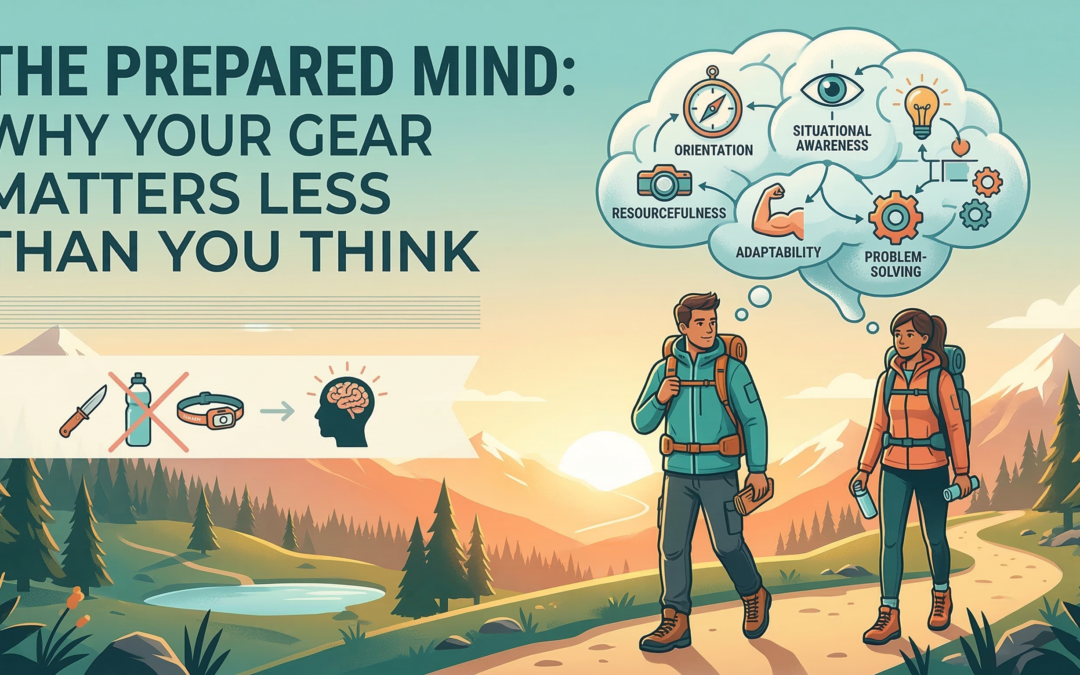
The Prepared Mind: Why Your Gear Matters Less Than You Think
Walk into any preparedness forum, any survival subreddit, any emergency planning conversation, and you will find no shortage of lists. Water storage quantities. Recommended caloric density per person per day. The merits of particular flashlight brands. The debate between freeze-dried and canned. The gear conversations are endless, detailed, and genuinely useful in their place.
But the research on who actually survives crises — and more importantly, who functions effectively during them — keeps pointing somewhere else. It points to the space between the ears.
What the Survivors Said
Researchers who study disaster survival have interviewed hundreds of people who made it through serious emergencies: shipwrecks, plane crashes, building collapses, prolonged civil conflict, extended displacement. One of the consistent findings is that physical resources, while important, are rarely the decisive factor. What separates people who keep functioning from those who freeze or collapse is a cluster of mental habits and thinking patterns that can be described, studied, and to a meaningful extent, practiced.
Laurence Gonzales, who spent years studying survival psychology, found that survivors tend to share a specific cognitive profile. They are able to accept the reality of their situation quickly, without denial. They can make decisions under uncertainty without waiting for complete information. They break overwhelming situations into small, manageable actions. And they maintain what he calls “the will to keep going” — not through bravado or denial, but through a kind of flexible, grounded determination.
None of these are personality traits you are born with. They are mental habits that develop through practice and deliberate thinking.
The Problem With Gear Dependency
There is a particular failure mode in preparedness culture worth naming honestly. It is the belief that sufficient equipment equals sufficient preparation. If you have the right bag, the right tools, the right stores, you will be ready.
The problem is that crises are characterized by exactly the conditions that make predetermined plans unreliable. Things break. Circumstances are not what you expected. The situation evolves faster than your equipment can accommodate. The person who has trained their mind to adapt is almost always better positioned than the person who has trained only for a specific scenario.
This is not a theoretical concern. After major disasters, emergency responders consistently report encountering people with substantial supplies who were effectively paralyzed — unable to make decisions because the situation did not match the scenario they had prepared for. Meanwhile, people with fewer resources but sharper mental flexibility were already solving problems and helping others.
Gear is the hardware. The prepared mind is the operating system. Without the software, the hardware sits idle.
Mental Models That Actually Help
So what does a prepared mind actually look like in practice? The research and practitioner literature point to a few specific cognitive patterns.
The first is what the military calls “situational awareness” and what psychologists describe more broadly as accurate, ongoing environmental reading. It is the habit of paying attention to your surroundings in a non-anxious but deliberate way — noticing exits, resources, potential problems, and the behavior of people around you before anything goes wrong. This is not paranoia. It is the difference between someone who is already oriented when a situation deteriorates and someone who is starting from zero.
The second is what stress researchers call “cognitive reappraisal” — the ability to reframe a frightening or overwhelming situation into one that is challenging but navigable. People who do this naturally tend to experience the physiological symptoms of stress — elevated heart rate, heightened alertness — as useful signals rather than disabling ones. They are still afraid, but fear becomes fuel rather than fog.
The third is decision-making under incomplete information. Most people, when facing a decision without full data, either freeze and wait or become reckless. The prepared mind does something different — it makes the best available decision with what is currently known, acts on it, observes the outcome, and adjusts. This iterative approach, sometimes called a “OODA loop” in tactical contexts, is not complicated. But it requires practice to execute under pressure, because pressure naturally pushes people toward either paralysis or impulsivity.
The fourth is what might be called “resource inventory thinking” — the habit of looking at whatever is available, however limited, and asking what it makes possible. Rather than cataloging what is absent, the prepared mind starts with what is present. This cognitive shift sounds minor but produces dramatically different behavior. It is the difference between a person who says “I don’t have my emergency kit” and shuts down, and a person who says “I have a car, a phone with partial battery, and twenty minutes — what can I do with that?”
Stress Inoculation and Why It Matters
One of the most well-supported findings in performance psychology is that mild to moderate stress exposure, in a controlled setting, substantially improves functioning under real stress later. This is the principle behind military training, surgical simulation, and high-stakes athletic preparation. You do not perform well under pressure by avoiding pressure. You perform well under pressure by having experienced pressure before, in progressively more demanding forms.
For civilians, this does not mean putting yourself in danger. It means occasionally practicing the kinds of decisions and actions that would matter in an emergency. Navigating somewhere unfamiliar without digital assistance. Spending a night without power by choice, not by accident. Walking through a realistic mental scenario of a local emergency and thinking through your actual, specific responses rather than a comfortable abstraction.
These exercises feel slightly awkward and unnecessary right up until they are not. What they are building is not skill in the narrow sense — they are building familiarity with discomfort, tolerance for uncertainty, and the confidence that comes from having demonstrated to yourself that you can function when things are not normal.
The Emotional Dimension
It would be incomplete to discuss the prepared mind without discussing the emotional foundations that make it possible. Research on resilience consistently identifies a few emotional capacities that matter most in crisis: the ability to self-regulate under acute stress, a stable sense of purpose or meaning that persists through adversity, and the capacity to maintain connection with others even when circumstances are difficult.
The last point is underrated in most preparedness thinking. Human beings under extreme stress need social contact. They need to feel that they are part of something — a family, a group, a community — that extends beyond their individual survival. People who have those connections intact tend to make better decisions, maintain their functioning longer, and recover faster after the crisis resolves.
This means that one of the most genuinely preparatory things a person can do has nothing to do with gear or supplies. It is to invest in relationships with people around them — not instrumentally, not transactionally, but as a genuine human priority. When something happens, that network is not just emotionally sustaining. It is practically essential.
Starting Where You Are
The prepared mind is not a state you arrive at permanently. It is a set of habits you practice continuously, imperfectly, in ordinary life. The situational awareness you build by paying attention during a routine commute. The decision-making flexibility you develop by working through hypotheticals. The stress tolerance you accumulate through small, voluntary exposures to discomfort.
None of this requires a dramatic lifestyle change or a large investment. It requires the recognition that the most reliable piece of equipment you will ever have in a crisis is the mind you bring to it — and that minds, unlike flashlights, improve with use.
AI, cyber security, Education, encryption, GCC, help
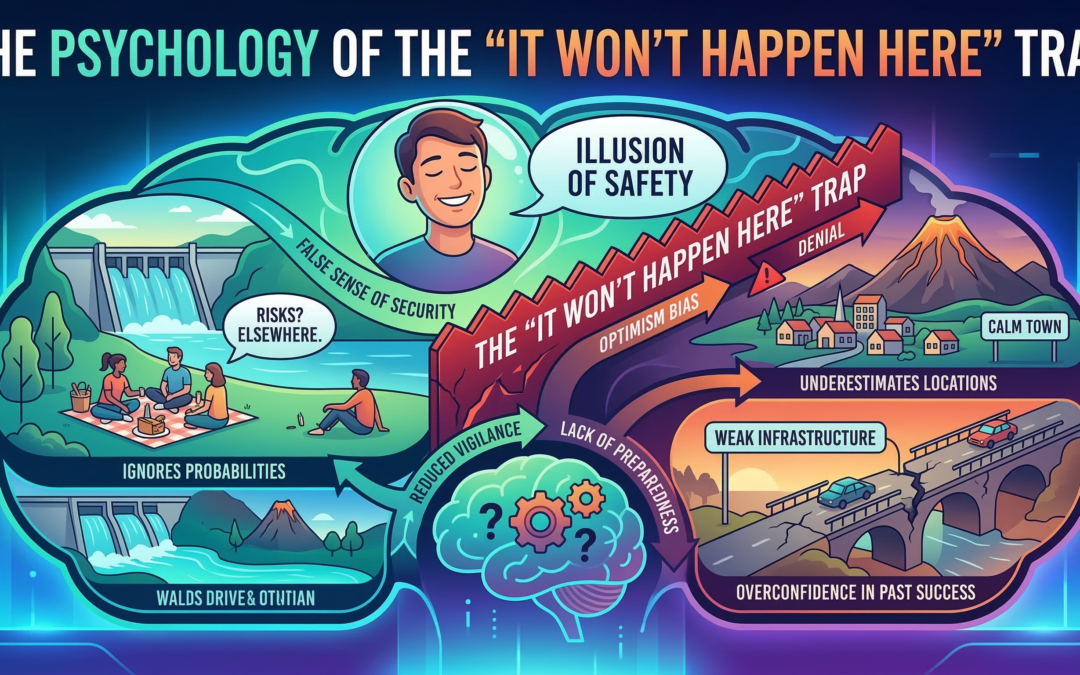
The Psychology of the “It Won’t Happen Here” Trap
There is a particular kind of confidence that lives in people who have never experienced a serious disaster. It is not arrogance, exactly. It is something quieter and more stubborn — a background assumption that the bad things happening elsewhere will continue to happen elsewhere. Researchers have a name for it: optimism bias. And it is one of the most reliably dangerous mental habits a person can have.
The Brain’s Comfort Math
When we hear about a flood in another country, a wildfire destroying a town three states over, or a grid failure paralyzing a city we’ve never visited, our brains perform a quiet calculation. We note the distance. We note the differences between there and here. We conclude, without much conscious effort, that the gap between their situation and ours is protective.
This is not irrational on its face. Distance and context do matter. But the brain doesn’t stop at reasonable inference — it goes further. It inflates the differences and deflates the similarities. It treats the gap as a guarantee rather than a variable. The result is a person who is genuinely, sincerely convinced that their city, their neighborhood, their household is sitting in a kind of permanent exception.
Psychologists studying this pattern have found it across cultures and income levels. It is not a failure of intelligence. Some of the most analytically sharp people hold this belief most firmly, because they are better at constructing arguments for why the exception applies to them.
Normalcy Bias: The Freeze Beneath the Surface
Closely related to optimism bias is what researchers call normalcy bias — the tendency to underestimate both the likelihood and the severity of a disaster because nothing like it has happened before in your experience.
Normalcy bias is why people in the path of a Category 5 hurricane stay home. It is why workers in the World Trade Center went back to their desks after the first plane hit, waiting for an announcement telling them what to do. It is why entire towns have watched floodwaters rise slowly and chosen not to move, because the water had never come this far before.
The brain uses the past as a map for the future. When the future contains something that has no precedent in your personal history, the brain struggles to model it accurately. It defaults to the nearest familiar pattern and treats the situation as less severe than the evidence suggests. This is not a bug in human cognition — it was adaptive for most of human history, when genuine novelty was rare. But in a world with cascading infrastructure, extreme weather, and complex supply chains, it quietly gets people killed.
Why Intelligent People Are Not Immune
There is a common assumption that education and critical thinking inoculate a person against these biases. The research consistently says otherwise. In some cases, higher analytical ability actually increases a person’s capacity to rationalize away warning signs, because they can build more sophisticated justifications for staying put.
This phenomenon — sometimes called “smart person’s paralysis” in disaster psychology literature — shows up repeatedly in post-disaster interviews. Survivors frequently describe their pre-event reasoning as airtight. They had thought through the scenarios. They had weighed the probabilities. They had concluded that the risk was being overstated, that authorities were being overcautious, that the historical record did not support the alarm.
The problem was not that they lacked information. The problem was that they applied their intelligence to confirming a conclusion they had already emotionally committed to — that this was not their crisis to manage.
The Role of Social Proof
Human beings are profoundly social in their risk assessment. We do not evaluate danger purely on objective information. We evaluate it in part by watching what people around us are doing.
When a warning is issued and most of your neighbors stay home, that behavior registers as data. If the people who live here, who know this place, are not leaving — then maybe it is not as serious as the alert suggests. This is not foolishness. In ordinary life, reading social cues is a highly reliable shortcut. The problem is that in a genuine emergency, social cues are often wrong, because everyone is looking at everyone else and making the same calculation simultaneously.
This dynamic helps explain how communities can be almost unanimously wrong in the face of a real threat. Nobody panicked, so nobody moved, so nobody survived to correct the assumption.
What Actually Shifts the Pattern
The research on what changes these patterns is humbling. Information campaigns, on their own, do not work particularly well. Telling people that disasters happen, that they could happen here, that the statistics support concern — this moves the needle less than anyone would hope.
What does work, to a meaningful degree, is prior personal experience. People who have lived through a serious emergency — even a relatively minor one — carry that experience as a reference point that overrides abstract reasoning. They do not need to imagine what it feels like because they already know.
The second thing that works is what researchers call “protective action” framing — giving people something specific and manageable to do. Vague threat awareness tends to produce anxiety and inaction. Specific, achievable preparation tends to produce engagement. The brain resists helplessness. When preparation is framed as a series of small, doable steps rather than a confrontation with terrifying possibilities, people are significantly more likely to act.
The third is community. When preparation is normalized in a social group — when neighbors talk about it, when it is not treated as paranoia or eccentricity — individuals within that group are far more likely to take it seriously. Social proof cuts both ways.
What This Means Practically
None of this requires believing that catastrophe is imminent. The point is not to live in a state of elevated fear. The point is to notice when your confidence that “it won’t happen here” is not actually based on evidence — when it is a feeling dressed up as analysis.
The question worth sitting with is simple: if a serious disruption did happen in your area — extended power failure, supply chain collapse, civil unrest, extreme weather — what would your first 48 hours actually look like? Not theoretically. Practically. What do you have, what do you lack, and who would you call?
Most people find that question uncomfortable not because the answer is hopeless, but because they have never thought it through. That discomfort is information. It is the optimism bias noticing that it has been caught.

AI, cyber security, Education
The Future of AI in Education: How Schools Will Change by 2030
There is a version of this story that sounds like science fiction: personalized robot tutors, classrooms without teachers, exams graded by algorithm. That version makes for good headlines but misses what is actually happening. The real story is quieter, more complicated, and in many ways more interesting. AI is not about to replace schools. It is going to change what happens inside them — slowly in some places, rapidly in others — and by 2030, the classroom most of us grew up in will look noticeably different.
The numbers alone signal how serious the shift already is. The global AI in education market was valued at roughly $7 billion in 2025 and is projected to reach $136 billion by 2035. Student AI tool usage stands at 86%, with nearly a quarter of students using these tools every single day. These are not niche adoption figures. This is a technology that has already entered the classroom whether schools invited it or not.
The Personalization Problem — Finally Getting Solved
For most of the history of formal education, teachers have faced an impossible task: deliver one lesson to thirty students who learn at different speeds, have different gaps in their knowledge, and respond to completely different teaching styles. The best educators have always known this. They’ve just never had the tools to do much about it at scale.
AI changes that equation. Generative AI tools can instantly create learning content tailored to different academic backgrounds and levels, while also helping students address specific gaps in their knowledge. An AI tutoring system can identify, in real time, that a student understands the concept but struggles with its application — and adjust accordingly. No waiting for a test. No waiting for a parent-teacher meeting.
The results from early research are striking. A 2025 Harvard University physics study found that students using AI tutors learned more than twice as much in less time compared to those in traditional active-learning classrooms. Students using an enhanced AI tutor achieved a 127% improvement in outcomes, compared to 48% with a standard AI chatbot. These are not marginal gains.
By 2030, personalized learning pathways will be standard in well-resourced schools. A student who masters fractions quickly will move on without waiting for the rest of the class. A student who keeps stumbling on the same concept will get a different explanation — maybe a visual one, maybe a simpler analogy — instead of hearing the same lesson repeated louder.
The Teacher’s Job Is Changing, Not Disappearing
Every conversation about AI in education eventually arrives at the same anxious question: are teachers going to lose their jobs? The honest answer is no — but their jobs are going to change, and significantly.
The more useful framing is not replacement but redistribution. Teachers spend enormous amounts of time on tasks that do not require a human being: generating lesson plans, writing routine feedback, managing administrative paperwork, designing quizzes. AI handles all of this. Teachers who use AI tools at least weekly save an average of 5.9 hours per week — roughly six extra weeks of reclaimed time over a school year.
What do teachers do with that time? Ideally, they do the things AI cannot: build relationships, notice when a student is struggling emotionally, inspire curiosity, make judgment calls about when a child needs encouragement versus challenge. Human tutors can interpret student emotional states with 92% accuracy, while even the most advanced AI tutoring systems currently manage only 68% accuracy. That gap matters enormously, and it is unlikely to close by 2030.
Between 80% and 90% of universities are planning to introduce AI-enabled teaching assistants in the near future, which points toward a model that will filter down to secondary education as well: human teachers supported by AI assistants, not replaced by them. The teacher becomes a mentor, a guide, a coach. The AI handles the drills.
A 2025 EdWeek survey found that 59% of teachers said AI had enabled more personalized instruction. That is a signal worth taking seriously. When teachers themselves report that a tool is making them better at their core job, adoption tends to stick.
Assessment Is About to Look Very Different
The traditional exam — a high-pressure, timed, closed-book test — was always a compromise. It measured something, but not necessarily what we cared about most. In a world where students have instant access to AI tools, the question “can you recall this information?” becomes almost beside the point.
By 2030, AI is expected to automatically score half of all college essays and nearly all multiple-choice exams. That will free up time for a different kind of assessment: project-based work, oral examinations, portfolio reviews, demonstrations of understanding that are much harder to outsource to an AI. Schools that figure this out early will have a genuine advantage. Schools that keep administering the same tests and simply try harder to detect AI use are likely to lose that arms race.
59% of students already agree that the way they are assessed is changing due to generative AI. Students have noticed what many administrators have not yet officially acknowledged.
Accessibility: The Underreported Upside
Lost in debates about academic integrity and job displacement is one of the most straightforward benefits AI brings to education: it dramatically expands access for students who have historically been left behind.
For students with learning disabilities, AI-powered speech-to-text, text-to-speech, and adaptive pacing tools remove barriers that previously made school an exercise in frustration. Students with physical and learning disabilities are achieving better results through AI tools, with speech-to-text and text-to-speech platforms among the most impactful.
For students in under-resourced schools — in rural areas, in low-income districts, in countries where qualified teachers are scarce — AI tutoring can provide consistent, patient, knowledgeable support that simply was not available before. A student in a small town with no advanced math teachers can access the same quality of instruction as a student at an elite private school. That promise is not yet fully delivered, but it is real.
The Problems Nobody Wants to Talk About
An honest account of where this is heading has to include the parts that are genuinely concerning.
First, training. Nearly 60% of educators and students say they have received no AI training, despite rising adoption. A major perception gap exists: 76% of leaders believe users are trained, but 45% of educators and 52% of students report zero training. A tool without training is not a tool — it is a liability. Schools are deploying AI faster than they are preparing the people who are supposed to use it.
Second, policy. According to a UNESCO survey covering more than 450 schools and universities, only 10% have established guidelines for using AI. Just 7% of schools worldwide have AI guidance, and of those, 40% have only informal guidance. This is not a sustainable situation. Without clear frameworks, students are left to guess what is acceptable, teachers are left to make inconsistent judgment calls, and the potential for AI to undermine learning rather than support it grows.
Third, equity. AI carries a real risk of widening existing gaps rather than closing them. The most pressing challenge ahead is ensuring that the benefits of AI in education reach students in low-income, rural, and under-resourced communities at the same rate as those in well-funded institutions. Without deliberate policy intervention, schools that are already well-resourced will adopt AI faster, train their teachers better, and pull further ahead. The technology is neutral. Its distribution is not.
Fourth, critical thinking. A January 2026 survey found that 95% of college faculty fear student overreliance on AI and diminished critical thinking. 60% of educators express concern that AI could negatively affect students’ independent thinking, writing, and research skills. These fears are not irrational. If students use AI to skip the hard, uncomfortable work of forming their own arguments and working through difficult problems, they may arrive at graduation with impressive grades and underdeveloped minds.
What 2030 Actually Looks Like
By 2030, the school that has handled this transition well will look something like this: students arrive with a baseline of AI literacy built into the curriculum from early grades. Teachers spend less time on administrative tasks and more time on mentorship, discussion, and the kinds of high-order thinking that cannot be delegated to an algorithm. Assessments are designed around what humans can do that AI cannot. Students with disabilities have access to tools that would have transformed their educational experience a decade earlier. And clear policies govern how AI is used — with enough flexibility to evolve as the technology does.
The school that has handled it poorly will look like an arms race: students using AI to complete assignments, teachers using AI detectors that produce false positives and erode trust, administrators issuing bans that nobody enforces, and the fundamental questions about what education is actually for going completely unanswered.
By 2030, approximately 70% of job skills are expected to change, primarily due to the impact of AI. Schools do not have the option of sitting this out. The question is not whether AI will change education. It already has. The question is whether schools will shape that change — or simply react to it.
The institutions that will serve students well are the ones asking hard questions now: What do we want students to be able to do that AI cannot do for them? What does genuine understanding look like in a world of instant answers? What is a teacher for, and what is a test for, when both can be bypassed by a phone?
Those are not technology questions. They are education questions. And answering them well — before 2030, not after — is the real work ahead.