AI, cyber security, Education, encryption, GCC
The LMS Trap: Why Institutions Spend Millions on Learning Platforms and Get Mediocre Results
Every few years, a university or school district announces a major investment in a new learning management system. There are demos, committee approvals, migration timelines, and professional development sessions. Administrators speak about transformation. Teachers are trained. Students are onboarded.
And then, quietly, almost nothing changes.
The LMS becomes a place to upload files. Grades get posted. Announcements go out. The course catalog moves online. But the actual experience of learning — the thing the institution spent hundreds of thousands of dollars to improve — remains largely the same, or gets worse.
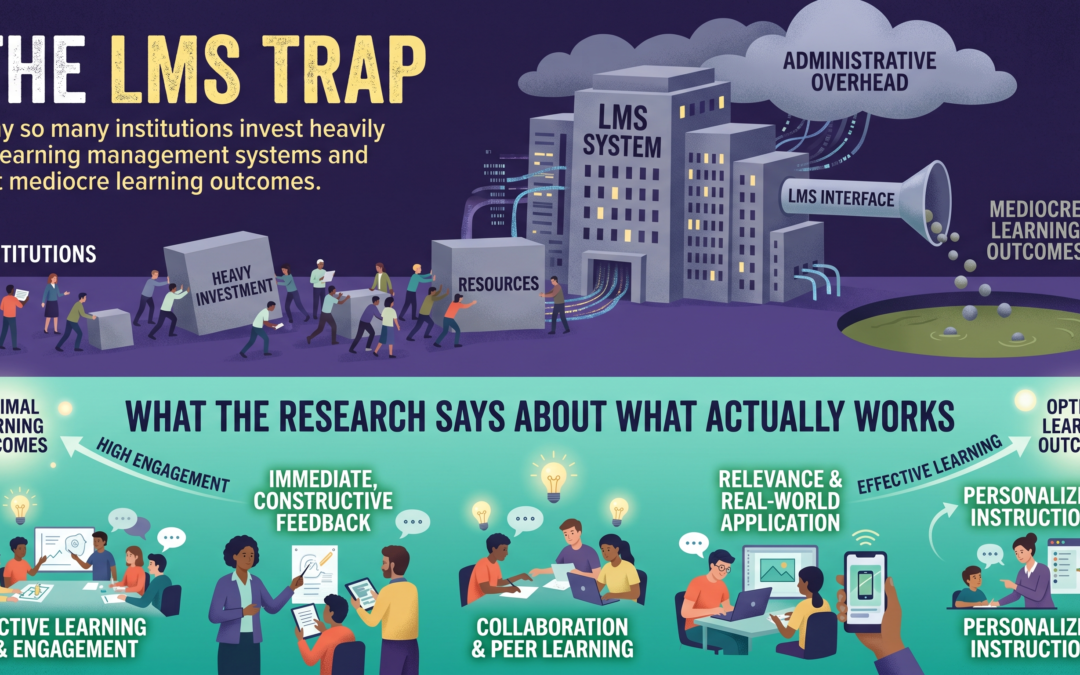
This is the LMS trap: a pattern in which institutions invest heavily in learning management systems and receive mediocre outcomes in return. It is widespread, well-documented, and poorly understood — even by the institutions caught in it.
The Numbers Behind the Problem
The LMS market is one of the fastest-growing segments in educational technology. Global revenues exceeded $23 billion in 2024, with projections pointing to $70 billion or more by the end of the decade. These are not niche figures — they represent the accumulated purchasing decisions of thousands of institutions across higher education, corporate training, and K–12 schooling.
Higher education leads adoption, with approximately 85% of universities and colleges globally using some form of LMS. Corporate training follows at around 70%, and K–12 adoption sits near 48% — a figure that accelerated significantly during the COVID-19 pandemic.
Yet adoption tells us nothing about effectiveness. And this is precisely where the picture gets complicated. Across sector after sector, research finds the same pattern: widespread deployment of LMS platforms paired with underwhelming learning outcomes, low feature utilization, and persistent teacher frustration.
The Feature Utilization Gap
Modern LMS platforms are remarkable in their ambition. Platforms like Canvas, Moodle, Blackboard, and D2L Brightspace offer dozens of tools: adaptive learning paths, sophisticated analytics dashboards, peer collaboration spaces, video integration, competency tracking, gamification layers, and rubric-based assessment engines.
Most of these features go unused.
Research consistently finds that institutions actively use between 20% and 30% of their LMS’s available functionality. Content delivery — uploading slides, PDFs, and recorded lectures — is near-universal. Basic assessments like quizzes and assignment submission are moderately used. But the features designed to improve learning outcomes — adaptive content, learning analytics, collaborative tools — are barely touched.
The analytics gap is particularly revealing. Nearly every major LMS includes dashboards that can identify at-risk students, flag engagement drops, and surface early warning signals. These tools exist precisely because the data is there — every login, click, submission, and forum post is logged. Yet studies find that fewer than one in four instructors regularly consult these dashboards, and fewer still use them to adjust instruction in real time.
“Most faculty use the LMS the same way they used email — as a delivery mechanism. The pedagogical transformation vendors promise is not happening at scale.” — EDUCAUSE Review, 2023
Why the Trap Closes Around Institutions
The LMS trap is not primarily a technology problem. The platforms themselves are often technically sophisticated and genuinely capable. The trap is a procurement and implementation problem — a mismatch between what institutions buy and why they buy it.
Procurement is driven by compliance and administration, not learning.
Most LMS selection processes are committee-driven, with representation from IT, compliance, finance, and academic administration. Pedagogy is often underrepresented, and the faculty who will actually use the system frequently have little influence over the final decision.
This produces purchasing criteria weighted toward administrative efficiency — grade book integration, SIS compatibility, FERPA compliance, uptime guarantees — rather than pedagogical capability. The result is a system selected for the wrong reasons, then handed to educators without the support needed to use it well.
Implementation ends where learning begins.
The typical LMS implementation follows a predictable arc: technical setup, data migration, a round of training sessions, a go-live date. After that, support thins out. The institution has “deployed” the system and considers the job done.
But the actual challenge — changing how teachers design and deliver learning — is not a technical event. It is a slow, ongoing professional development process. That process almost never gets the sustained investment it requires. What institutions call implementation is really just installation.
The path of least resistance points away from transformation.
Teachers are busy. Adding a sophisticated new tool to an already demanding workload requires time and incentive. Without both, faculty default to using the LMS the way they used whatever came before: as a document repository and gradebook. The system is technically present, pedagogically absent.
This is not a failure of motivation. It is a rational response to institutional structures that do not reward pedagogical innovation, do not protect time for experimentation, and do not provide ongoing support for faculty learning.
What the Research Says Actually Works
The contrast between tool-first and pedagogy-first approaches is stark when measured against actual learning outcomes. When researchers compare institutions that invested primarily in LMS capability with those that prioritized instructional design, faculty development, and blended approaches, the outcomes tell a clear story.
Knowledge retention is 20+ percentage points higher in pedagogy-first environments. Student engagement — measured through participation rates, voluntary activity, and self-reported motivation — is sharply higher. Completion rates improve. And skill transfer, the hardest outcome to achieve and the one most employers actually care about, shows the widest gap of all.
These differences are not marginal. They are the difference between a system that works and one that looks like it should.
What pedagogy-first looks like in practice:
Pedagogy-first institutions share several characteristics that distinguish them from their tool-first counterparts. They invest in instructional design staff who work alongside faculty as partners, not just technical support. They treat LMS adoption as an ongoing professional development challenge, not a one-time training event. They give faculty protected time to redesign courses, experiment with tools, and reflect on what works.
Critically, they also resist the pressure to use every feature a platform offers. The best-performing courses tend to use a small number of tools very well — not the full feature set used superficially.
The Vendor Relationship Problem
There is a structural asymmetry in the LMS market that makes this problem harder to solve. Vendors profit from initial sales and annual contracts, not from learning outcomes. Their incentives are aligned with feature development, market expansion, and contract renewal — not with whether students in Amman or Atlanta actually learned something.
This produces a market where platforms compete on feature count, integration breadth, and UI modernity rather than on evidence of learning impact. Institutions buy the shiniest platform, not the most effective one. And because measuring learning outcomes is genuinely difficult — more difficult than counting features — institutions often cannot tell the difference until years of mediocre results force the question.
The honest answer is that no LMS vendor can fully deliver on the transformation they imply in their sales material. The transformation has to come from within the institution, from the humans who design and deliver learning. The platform is infrastructure, not intervention.
A More Honest Framework for LMS Investment
Institutions that want to escape the LMS trap need to reframe how they think about the investment entirely. The platform budget is not the education budget. Licensing fees are the smallest part of what it actually costs to change how learning happens.
A more honest accounting would treat the LMS as infrastructure — like classroom furniture or network connectivity — and invest the bulk of the education budget in the things that research shows actually move outcomes: instructional design capacity, faculty professional development, learning analytics literacy, and evidence-based course design.
This is a harder sell internally. “We need more instructional designers” is less compelling in a budget meeting than “We’re migrating to a platform with AI-powered adaptive learning.” But it is what the evidence supports.
The Question Worth Asking Before the Next Contract
Most institutions will renew their LMS contracts. The switching costs are high, the migration is painful, and the new platform usually promises the same things the old one did. That is fine. The platform is not the problem.
The question worth asking before the next renewal is not “which LMS should we buy?” It is “what would it take to actually use what we already have well?” And then: “are we willing to invest in that?”
Because the data is clear. The tools are capable. What is missing is not technology. It is the sustained, patient, unfashionable work of helping educators become better designers of learning — with or without a new platform.
That work does not generate press releases. But it is the only thing that has ever actually worked.
AI, cyber security, Education, GCC
There was a time when a school’s efficiency was measured by the thickness of its filing cabinet and the neatness of its ledgers. Attendance was called by name, fees were collected in cash, and report cards were typed or handwritten. For decades, this system worked — slowly, imperfectly, but it worked.
That time is over.
Today’s schools operate in an environment of accelerating complexity. Student populations are growing. Regulatory requirements are multiplying. Parents expect instant communication. Teachers are stretched thin. Administrators are drowning in data that tells them nothing because it lives in disconnected silos. The old ways are not just inefficient — they are actively holding schools back.
The schools that will thrive in the next decade are not necessarily the ones with the best teachers or the most resources. They are the ones that have the intelligence to build smarter operational foundations. And that foundation is digital.
This article explores how modern school management systems are reshaping the way educational institutions operate, what features matter most, what obstacles schools face in adoption, and where the industry is heading.
The Hidden Cost of Running a School the Old Way
Before talking about solutions, it is worth understanding the depth of the problem.
A typical school with 500 students handles thousands of daily data points — attendance records, homework submissions, fee payments, staff schedules, exam results, parent communications, maintenance requests, procurement approvals, and more. In a manually operated school, each of these is handled independently, often by different people using different tools, and rarely in real time.
The consequences are predictable:
Data errors accumulate quietly. A student marked absent on the wrong day. A fee recorded under the wrong account. A grade entered incorrectly and never caught. Each mistake is small. Collectively, they erode trust, drain time, and occasionally trigger compliance problems.
Information moves too slowly. When a parent calls to ask why their child’s grade dropped, the administrator has to pull a file. When a teacher wants to know how many students failed last month’s test across all sections, they have to manually compile results. Speed matters in education, and slow information costs decisions.
Communication is reactive, not proactive. Parents find out about problems after they have escalated. Schools send newsletters that go unread. Parent-teacher meetings happen twice a year instead of being a continuous conversation.
Financial tracking is opaque. Schools lose revenue to uncollected fees, underbilled services, and poor financial visibility. In countries like Saudi Arabia where ZATCA-compliant e-invoicing is now mandatory, manual financial systems are not just inefficient — they are a legal risk.
Teachers burn out on administration. A teacher who spends two hours a week on attendance, gradebooks, and progress reports loses over 80 hours a year on tasks that contribute nothing to actual teaching. Multiply that across a staff of 60 and the loss is staggering.
These are not minor inconveniences. They are structural weaknesses that limit a school’s ability to grow, compete, and deliver quality education.
What Is a School Management System and Why Does It Matter?
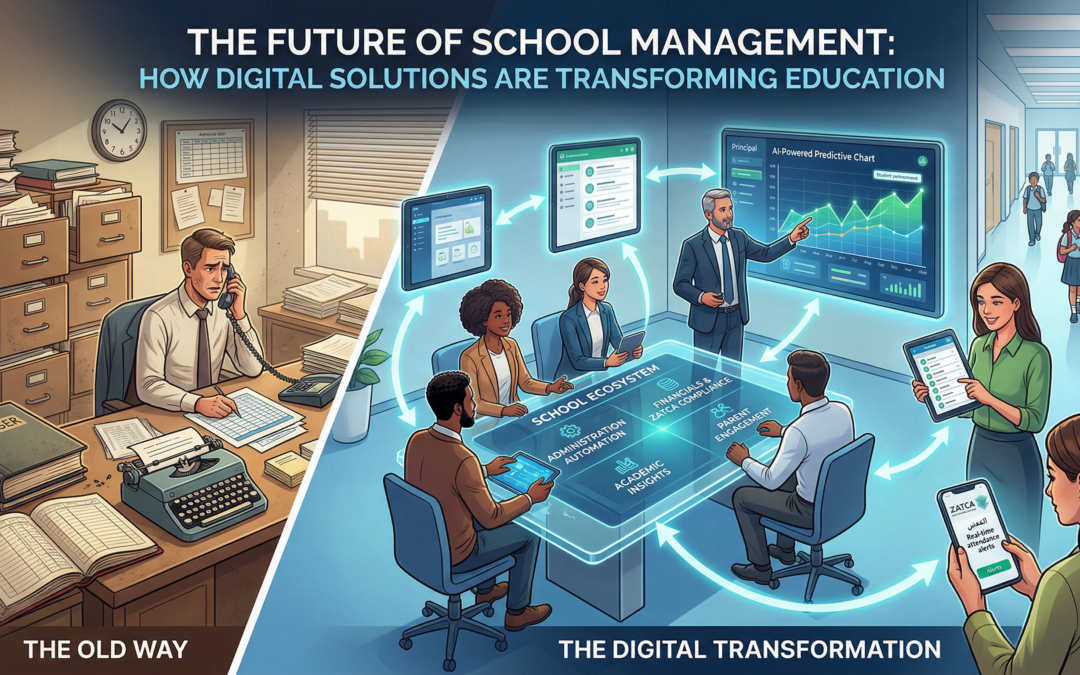
A School Management System (SMS) — also called a School ERP or School Information System — is a unified digital platform that connects every operational layer of a school into a single ecosystem.
Think of it this way: a hospital has a patient management system that connects admissions, doctors, pharmacy, billing, and records. A bank has a core banking system that connects accounts, transactions, compliance, and customer service. A school needs exactly the same kind of backbone — a central nervous system that makes every part work together.
A modern SMS connects:
Administration — admissions, enrollment, timetabling, staff management Academics — gradebooks, assessments, report cards, curriculum planning Finance — fee collection, invoicing, payroll, budgeting, compliance Communication — parent portals, teacher messaging, announcements, alerts Analytics — dashboards, performance tracking, predictive insights Compliance — attendance reporting, regulatory filings, audit trails
When these are unified under one platform, the school stops being a collection of departments and starts functioning as an intelligent organization.
Core Features That Define a High-Quality School Management System
Not all systems are equal. The quality of a school management platform can be judged by how deeply it solves real operational problems, not just how many features it lists on a brochure. Here is what truly matters:
- Smart Administration Automation
The administrative backbone of any school — admissions, student records, staff onboarding, timetable generation, classroom assignments — should be largely automated. Schools waste enormous amounts of time on tasks that a properly designed system can handle in seconds.
Automated timetable generation, for example, is a genuinely hard problem when done manually. Balancing teacher availability, room capacity, subject requirements, and student group allocations is a combinatorial challenge that can take days by hand. A smart system resolves it in minutes.
Admissions workflows — from application intake to document verification to enrollment confirmation — can be fully digitized, reducing processing time and eliminating lost paperwork. Student records become a single, always-accurate source of truth rather than a patchwork of spreadsheets and physical files.
- Financial Management and Regulatory Compliance
Money is where operational weakness most visibly hurts a school. Poor financial management leads to revenue leakage, compliance risk, and ultimately, unsustainable operations.
A capable SMS handles the full financial lifecycle: fee structure setup, invoice generation, payment collection, receipt issuance, arrears tracking, and financial reporting. Crucially, in Saudi Arabia, this must include ZATCA-compliant e-invoicing. Schools operating in the Kingdom that are not issuing tax-compliant digital invoices are already in violation of Phase 2 requirements that have been rolling out across sectors. A modern school system must have this built in, not bolted on.
Beyond compliance, good financial modules provide real-time dashboards showing outstanding balances, collection rates, revenue forecasts, and expense tracking. This kind of visibility is what separates schools that are financially in control from those that discover problems only at year-end.
- Parent Engagement and Communication
Parent engagement is one of the most underestimated drivers of student success and school reputation. Research consistently shows that students whose parents are actively involved perform better academically and behaviorally. Yet most schools communicate with parents through methods that were designed for a pre-smartphone world.
A modern SMS provides parents with a dedicated portal or mobile app where they can see their child’s attendance in real time, review grades as they are entered, receive instant push notifications for important events, pay fees online, and message teachers directly without going through the front office.
This is not a convenience feature. It is a trust-building infrastructure. Parents who feel informed and connected to their child’s school become advocates rather than complainants. Schools that invest in parent communication tools see measurably better satisfaction scores and retention rates.
- AI-Powered Academic Insights
This is where school management platforms are moving from being operational tools to genuine strategic assets.
Advanced systems now apply machine learning to the data they collect — attendance patterns, grade trajectories, assessment performance, behavioral incidents — to generate predictive insights. A student who was an A performer in the first term but has been declining steadily for eight weeks is not just having a bad week. They are at risk, and an AI-powered system can flag that for a counselor before the parent even notices.
These systems can identify which teaching interventions correlate most strongly with improvement in specific subject areas, which students are likely to require additional support in upcoming assessments, and which classrooms are consistently underperforming relative to comparable groups. This shifts school leadership from reacting to problems after the fact to anticipating and preventing them.
For schools that want to genuinely differentiate their educational quality — not just their marketing — AI-powered academic analytics is one of the highest-leverage investments they can make.
- Multi-School and SaaS Architecture
School groups, educational investment companies, and franchise school models have needs that single-school systems simply cannot meet. Managing 5, 10, or 30 campuses from a single operational center requires a fundamentally different architecture.
Modern platforms built on multi-tenant SaaS infrastructure allow a central administration team to oversee all campuses simultaneously — comparing performance, standardizing policies, consolidating financials, and enforcing compliance — while each campus retains enough autonomy to manage its own day-to-day operations.
Cloud-based delivery means the system scales without expensive on-premise infrastructure. It also means updates, security patches, and new features are rolled out centrally, without requiring IT intervention at each campus. For growing school groups in the GCC region, this is not a nice-to-have — it is a prerequisite for scalable operations.
- Bilingual and Localization Support
In Saudi Arabia and across the GCC, a school management system that does not fully support Arabic — including right-to-left text rendering, Arabic numerals, Hijri calendar options, and localized reporting formats — is not a serious solution. It is a product designed for somewhere else and awkwardly fitted to the region.
Bilingual support matters not just for the user interface but for all outputs: report cards, invoices, parent notifications, official compliance documents. Staff who are more comfortable in Arabic should not have to navigate an English-only system, and vice versa.
Localization also means compliance with local regulatory frameworks. Saudi Arabia’s Ministry of Education has specific reporting requirements. ZATCA has specific invoicing standards. VAT calculations must follow the Kingdom’s rules. A system that ignores these is not a school management system for Saudi Arabia — it is a generic product that happens to be available there.
The Real Benefits: Beyond the Feature List
Features are means, not ends. What schools actually care about are outcomes. Here is what a properly implemented digital school management system delivers in practice:
Time recovered for education. When teachers are freed from administrative burden, they teach. When administrators are not chasing paper, they lead. The hours saved by automation are not trivial — they are the margin between a school that is merely surviving and one that is thriving.
Data-driven leadership. School principals and boards who have access to real-time operational and academic dashboards make faster and better decisions. They see problems early, allocate resources accurately, and can present clear evidence of school performance to stakeholders, parents, and regulatory bodies.
Revenue protection. Digitized fee collection with automated reminders and online payment options consistently improves collection rates. Schools that have moved to digital financial management typically see a measurable reduction in arrears and revenue leakage within the first year.
Competitive differentiation. In markets where parents have choices, the experience a school provides — including how it communicates, how transparent it is, how accessible its information is — is a real competitive factor. A school that sends parents a real-time notification when their child’s fever is detected at the clinic is a school that is harder to leave.
Regulatory resilience. As governments in the GCC continue to expand digital compliance requirements, schools with modern digital infrastructure are ready. Schools that are still on paper will face increasing costs and risks as enforcement tightens.
The Obstacles Schools Must Prepare For
Digital transformation in education is not without friction. Schools that underestimate the implementation challenges often end up with expensive systems that are poorly adopted and do not deliver on their promise.
Cost and budget constraints are real, particularly for smaller private schools or government-funded institutions operating on tight budgets. The key framing, however, is return on investment rather than upfront cost. A system that reduces administrative headcount needs by one full-time position, improves fee collection by 5%, and eliminates a compliance fine more than pays for itself in year one.
Change resistance from staff is perhaps the most underestimated obstacle. Teachers and administrative staff who have worked a certain way for years do not automatically embrace new systems. Implementation without adequate training, internal champions, and a managed transition period routinely fails. The technology is rarely the problem. The human adoption process is.
Data security and privacy concerns deserve serious attention. Schools hold sensitive personal data on minors, which carries significant legal and ethical responsibilities. Any school management platform must demonstrate serious security practices: encrypted data storage, role-based access controls, audit logs, GDPR or applicable local data protection compliance, and clear data retention policies.
Integration with legacy systems is another practical challenge. Schools often have existing systems for payroll, library management, transport, or canteen operations that cannot simply be discarded overnight. A good school management platform should be able to integrate with existing tools via APIs or provide a clear and supported migration path.
Vendor selection is critical and deserves more due diligence than most schools give it. A system that looks impressive in a demo but has poor local support, an unresponsive development team, or a history of data breaches is worse than no system at all. Schools should demand references from comparable institutions, verify the vendor’s compliance credentials, and insist on data ownership guarantees in the contract.
Where the Industry Is Heading
The school management space is evolving rapidly, and the systems that exist today will look primitive compared to what is coming within the next five years.
AI will move from insights to action. Today’s AI features are largely advisory — they flag risks and surface patterns. Tomorrow’s systems will take action: automatically adjusting a struggling student’s learning pathway, reassigning teachers based on predicted workload peaks, or filing a compliance report without human intervention.
Personalized learning at scale will become a reality. The integration of school management systems with adaptive learning engines will allow schools to deliver genuinely personalized educational experiences — where each student’s curriculum, pacing, and support are continuously adjusted based on their performance data — without requiring superhuman effort from teachers.
Mobile will become the primary interface. The next generation of administrators, teachers, and parents will expect to do everything from a phone. Systems designed around desktop-first experiences will become obsolete.
Interoperability standards will define winners and losers. As governments and accreditation bodies begin requiring data sharing and reporting in standardized formats, the systems that are built on open, interoperable architectures will become the default choice. Proprietary, walled-garden platforms will face increasing resistance.
Full compliance automation will arrive. What today requires a human to review and submit will be handled entirely by the platform — from VAT filings to Ministry of Education reports to accreditation documentation. Schools will move from compliance management to compliance certainty.
Choosing the Right System for Your School
Given all of the above, the selection of a school management platform is one of the most consequential technology decisions a school leadership team will make. A few principles to guide it:
Start with the pain points, not the feature list. Every vendor will show you a feature matrix. What matters is whether the system solves the specific operational problems that are actually costing your school time, money, and quality. Build your evaluation criteria from your problems, not the vendor’s brochure.
Prioritize local compliance readiness. In Saudi Arabia, this means confirmed ZATCA compliance, Arabic language support, and alignment with Ministry of Education reporting requirements. Do not accept assurances — ask for documented evidence and live demonstrations.
Evaluate the vendor, not just the product. Software is only as good as the company behind it. Ask about response times for critical issues, the product roadmap, pricing model changes, and what happens to your data if the vendor closes. The relationship matters as much as the technology.
Plan for adoption, not just deployment. Budget for training, transition support, and an internal change management process. Assign internal champions who will advocate for the system and help colleagues through the learning curve. Measure adoption metrics alongside operational metrics.
Think long-term. A system that works well for 500 students should also work for 1,500. A system that meets today’s compliance requirements should be actively maintained to meet tomorrow’s. Build scalability and vendor commitment into your criteria from the start.
Final Thoughts
The question of whether schools should embrace digital management platforms was settled years ago. The evidence is unambiguous. Schools that have made this transition report measurable improvements in operational efficiency, financial performance, parent satisfaction, and educational outcomes. Schools that have not are working harder for worse results.
What remains is the question of how — how to choose the right platform, how to implement it effectively, how to bring staff along, and how to get the full return on the investment.
In a world where education is simultaneously becoming more competitive, more regulated, and more data-driven, the schools that thrive will be those that treat operational excellence not as an overhead cost to minimize, but as a strategic foundation to invest in.
Digital transformation in education is not about replacing the human heart of a school. It is about freeing that heart to do what it was always meant to do — educate, inspire, and build the next generation. The systems and spreadsheets were never the point. The students always were.
The technology exists today to run a school with a fraction of the administrative burden that existed a decade ago. The only remaining question is whether school leaders have the vision and courage to use it.

AI, cyber security, Education
The future of education doesn’t belong to the student with the highest GPA — it belongs to the student with the most verifiable, portable, and future-proof skills. The question is whether schools are ready to help them earn those credentials.
For generations, the transcript ruled. A grade point average, a class rank, a diploma — these were the currency of academic achievement and the primary language of hiring. But the world of work has shifted dramatically, and that language is becoming obsolete faster than most institutions realize.
The most forward-thinking schools are responding with a new model: structured, AI-powered student skill certification pathways that align education with globally recognized standards and the actual demands of future employers. This is not an incremental update to the curriculum. It is a fundamental rethinking of what a school delivers to its graduates.
Why Credentials Are Replacing Grades
The evidence is unambiguous. By 2040, leading employers across technology, finance, healthcare, and creative industries will prioritize verified competencies over traditional academic credentials. A diploma proves a student sat through twelve years of schooling. A skill certification proves they can actually do something with that time.
The competencies employers will seek are no longer confined to domain expertise. Communication, critical thinking, entrepreneurial mindset, and technological fluency are the new baseline. Employers want evidence — not inference — that candidates possess them.
The most in-demand competency areas already emerging include: AI and machine learning basics, coding and computational thinking, data analysis and literacy, communication and collaboration, critical problem-solving, entrepreneurship and innovation, digital ethics and cyber literacy, and financial and global fluency.
How AI Powers Personalized Certification Pathways
The traditional one-size-fits-all curriculum cannot generate individualized results at scale. But AI can. Modern assessment tools don’t just measure what students know — they map where they are, identify gaps, and dynamically recommend the most efficient path to globally recognized certifications.
Imagine a student in Grade 9 whose AI-powered learning profile reveals a natural aptitude for pattern recognition. The system routes them toward data analytics modules, recommends relevant certification tracks, and adjusts the pace based on demonstrated mastery — not time in seat. By the time they graduate, they hold industry-recognized credentials that speak directly to employers, regardless of their local school ranking.
“Students should graduate not just with diplomas, but with portfolios of portable, industry-recognized credentials that travel with them across borders and industries.”
AI-driven platforms are already mapping learner trajectories, flagging readiness for external certifications, and personalizing intervention — all in real time. Schools that integrate these tools into their core academic journey — rather than treating certifications as optional add-ons — will produce graduates who are measurably ahead.
Building the Pathway: A Four-Stage Model
Implementing a skill certification pathway doesn’t require scrapping the curriculum — it requires restructuring how outcomes are recognized and recorded. Here is a practical four-stage model:
Stage 1 — Map and Align Audit your curriculum against global certification standards. Identify where existing subjects already build certifiable competencies — and where the gaps are. Align course outcomes with frameworks from industry bodies, not just national exam boards.
Stage 2 — Embed, Not Add Certifications must be woven into the academic journey, not offered as optional extracurriculars. Treat each relevant certification milestone as a formal academic outcome with the same weight as a term grade or exam.
Stage 3 — Personalize with AI Deploy AI assessment tools to build individual learner profiles. Track competency development in real time, recommend certification readiness windows, and adapt learning paths based on each student’s demonstrated trajectory.
Stage 4 — Credential the Graduate Graduate students with a dual portfolio: the traditional academic transcript alongside a verified skill credential record — portable, digitally verified, and internationally legible. Credentials that work in Nairobi, Singapore, Berlin, and Boston alike.
Closing the Employment Gap
The persistent mismatch between what schools produce and what economies need is not a mystery — it is a design failure. Schools were designed for a world that no longer exists, optimized for sorting students by academic rank rather than equipping them with transferable, in-demand capabilities.
Student skill certification pathways are the structural correction. They bridge the gap between the classroom and the workplace not by lowering academic standards, but by expanding what counts as achievement. A student who can analyze datasets, communicate findings clearly, and deploy basic AI tools is an asset to any organization on earth — and a certification pathway makes that capacity legible, verifiable, and exportable.
The schools that build these pathways now are not just preparing students for employment. They are building the infrastructure of a generation that is competitive — locally, nationally, and globally — before they ever receive their first paycheck.
Key Takeaway: The diploma of the future is a portfolio of skills the world can verify. AI-ready schools don’t wait for the job market to tell them what graduates need. They build the certifications in — and let the results speak for themselves.