
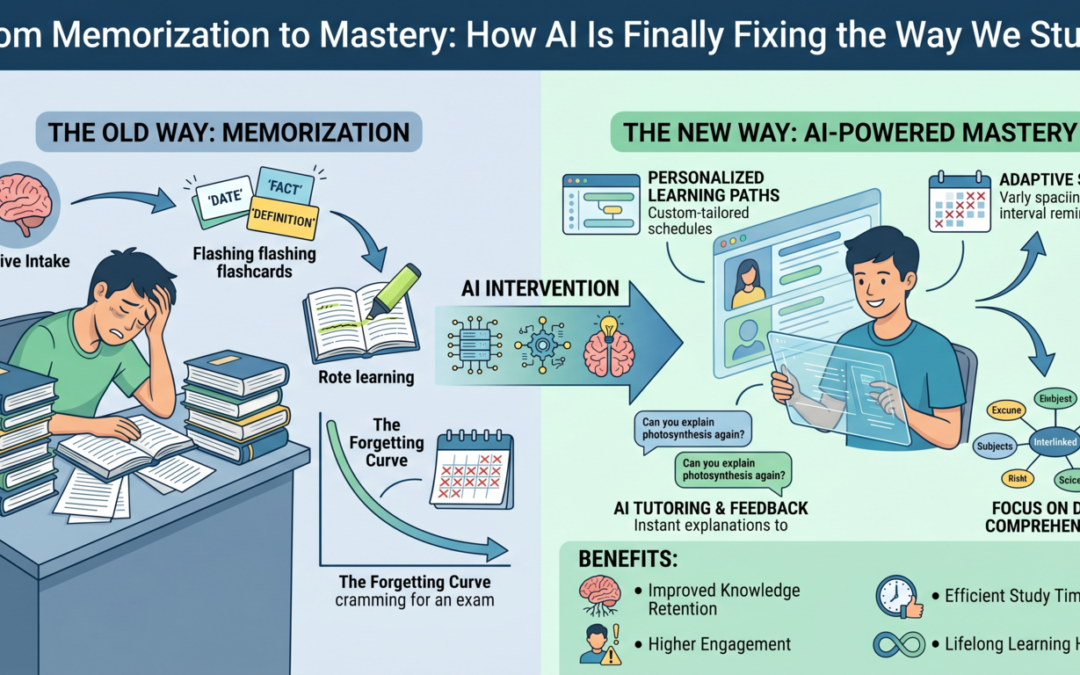
From Memorization to Mastery: How AI Is Finally Fixing the Way We Study

From Memorization to Mastery: How AI Is Finally Fixing the Way We Study

Educational Technology · May 2026

From Memorization to Mastery:
How AI Is Finally Fixing
the Way We Study

We’ve been studying wrong for decades. Highlighting, re-reading, cramming — science proved these don’t work. Now AI is making the right methods effortless.

Here’s an uncomfortable truth about how most of us were taught to study: it doesn’t work.

Highlight the textbook. Re-read your notes. Stare at flashcards the night before the exam. Make a summary. Read the summary. Repeat until your brain feels full.

Decades of cognitive science research have shown that these techniques — the ones most students use, the ones most teachers implicitly endorse — are among the least effective ways to actually learn something and retain it long-term.

We’ve known this for years. The problem was never the research. The problem was that the better methods — spaced repetition, active recall, interleaving, elaborative interrogation — were harder to do alone. They required structure, consistency, and ideally, someone to quiz you and push back when you got something wrong.

Most students don’t have that. Until now.

AI is changing the equation. Not by replacing teachers or making studying “easier” in a shallow sense — but by making the right kind of hard effortlessly accessible to any student, anywhere, at any time.

This is the story of how that’s happening.


? First: Why Our Traditional Study Methods Fail

To understand why AI matters here, you need to understand the science of how memory actually works.

The brain doesn’t store information the way a hard drive does. You can’t just “save” something by reading it repeatedly. Memory is reconstructive — every time you retrieve a memory, you strengthen the neural pathway that leads to it. The act of retrieval is the learning.

This is why two of the most well-researched study techniques — active recall and spaced repetition — are so powerful:

  • Active recall means testing yourself on material rather than passively reviewing it. Closing the book and trying to remember — even imperfectly — strengthens memory far more than re-reading.
  • Spaced repetition means reviewing material at increasing intervals over time. Instead of cramming everything in one session, you revisit information just as you’re about to forget it — which is precisely when retrieval strengthens the memory most.

Studies going back to the early 20th century, and confirmed repeatedly since, show that students using these methods retain information significantly longer and with less total study time than students who use passive review methods.

So why doesn’t everyone study this way?

Because it’s hard to do alone. Active recall means you need someone — or something — to generate questions. Spaced repetition means you need a system that tracks what you know, what you don’t, and when to review each thing. For decades, the tools available (physical flashcard boxes, basic apps like early Anki) worked but required enormous self-discipline to use consistently.

AI removes that barrier entirely.


? How AI Is Implementing Learning Science at Scale

Modern AI tools are doing something remarkable: they’re taking what cognitive scientists have known for decades and making it the default experience for students. Here’s how:

1. AI-Generated Active Recall — On Demand

Instead of re-reading your notes, you can now paste any study material into an AI and ask: “Quiz me on this. Don’t give me multiple choice — ask me open-ended questions and tell me when I’m wrong.”

The AI becomes a tireless examiner. It can generate dozens of questions from a single chapter, vary the difficulty, ask follow-up questions when you give a shallow answer, and explain why you got something wrong — not just tell you the right answer.

This is active recall at scale, available at 2am before an exam, with no study partner required.

2. Adaptive Spaced Repetition

Tools like Anki have offered spaced repetition for years — but they required the student to create every flashcard manually, which most people didn’t sustain. AI changes this in two ways:

  • Automatic card generation: Upload your notes, get a complete flashcard deck in seconds. No manual entry.
  • Adaptive scheduling: AI systems that track your responses can identify which concepts you’re weakest on and prioritize them — rather than treating all material equally.

3. Socratic Questioning — The Most Underrated Study Method

One of the most powerful learning techniques is elaborative interrogation: asking why something is true, not just what is true. This forces the brain to connect new information to existing knowledge — which is what creates deep understanding rather than surface-level recall.

AI tutors can do this naturally. Instead of just answering your question, a well-prompted AI will ask: “Before I explain, what do you think might be happening here?” or “That’s right — but can you explain why?”

Khan Academy’s Khanmigo is explicitly designed around this Socratic model. Rather than giving students answers, it guides them toward figuring out answers themselves — which is dramatically more effective for long-term retention.

4. Interleaving — The Uncomfortable Method That Works

Most students study one topic completely before moving to the next (called “blocking”). Research consistently shows that mixing topics — called interleaving — produces better long-term retention, even though it feels harder and less productive in the moment.

AI can create interleaved study sessions automatically: mixing questions from Chapter 3, Chapter 7, and last week’s material in a single session, forcing the brain to constantly retrieve and differentiate between concepts — which is exactly how exam conditions work.


?? The AI Study Stack: Tools That Actually Work

Here are the specific tools leading this shift, and how to use them effectively:

Tool Best For Learning Technique
Claude / ChatGPT Socratic Q&A, concept explanation, essay feedback Active recall, elaborative interrogation
Khanmigo Math, science tutoring without giving answers Socratic method, guided discovery
Anki + AI Automatic flashcard generation from notes/PDFs Spaced repetition, active recall
Perplexity AI Research with cited sources, concept deep-dives Elaborative interrogation, source evaluation
NotebookLM Uploading course materials and querying them Active recall from personal notes

? A Real Study Session: What This Looks Like in Practice

Let’s make this concrete. Here’s what a science-backed AI study session looks like for a university student preparing for a biology exam:

Example Prompt to Claude

“I have a biology exam on cellular respiration in 3 days. Here are my notes: [paste notes]. Please do the following: First, identify the 5 concepts I most likely need to understand deeply. Then quiz me on them one at a time using open-ended questions. After each answer I give, tell me what I got right, what I missed, and ask a follow-up that pushes me deeper. Don’t give me the answer until I’ve tried at least twice.”

This single prompt creates a study session that incorporates active recall, elaborative interrogation, immediate feedback, and Socratic follow-up — all the high-impact techniques at once.

After 30 minutes of this kind of session, students report understanding the material in a way that hours of passive review never achieved. The reason is simple: the brain was working, not coasting.


?? The Risks: When AI Study Tools Go Wrong

This wouldn’t be an honest article without addressing the shadow side. AI study tools can actually harm learning when used incorrectly.

The Shortcut Trap

Asking AI to summarize a chapter for you and then reading the summary is still passive learning. It feels efficient — you covered the material in 3 minutes instead of 30 — but you haven’t done the retrieval work that creates memory. The summary is the AI’s understanding, not yours.

Over-Reliance Without Verification

AI tools can be wrong, especially on technical or niche topics. Students who accept AI explanations without cross-referencing authoritative sources risk learning incorrect information confidently — which is worse than not knowing at all.

The Fluency Illusion

When an AI explains something clearly and you think “I understand that,” you may be experiencing the fluency illusion — mistaking the ease of reading a good explanation for actual knowledge. The test is always: can you explain it back without looking? If not, you don’t know it yet.

The rule of thumb: AI should be the thing that tests you, not just the thing that tells you. Use it to generate questions more than answers.


? What This Means for Students, Teachers & Institutions

For Students

You now have access to a personalized tutor available 24/7 that can adapt to your pace, your weaknesses, and your schedule. The students who figure out how to use this well will have a significant advantage — not because AI does their work, but because they’ll develop genuine mastery faster than ever before.

For Teachers

The role of a teacher is shifting from information-deliverer to learning architect. If AI can handle explanations, practice problems, and basic feedback — teachers are freed to focus on what AI can’t do: building relationships, developing critical thinking, facilitating discussion, and inspiring students to care about learning at all.

For Institutions

Schools and universities that ban AI rather than teach students to use it wisely are preparing students for a world that no longer exists. The institutions leading the future are the ones designing curricula that treat AI as a tool to be mastered — like a calculator, like the internet — not a threat to be feared.


The Bottom Line

We have spent generations teaching students what to think about without adequately teaching them how to think — or how to learn. Traditional study methods optimized for the appearance of effort: filled notebooks, highlighted pages, long library sessions.

AI is finally making the science of learning accessible to everyone. Spaced repetition, active recall, Socratic questioning, interleaving — these aren’t new ideas. They’re just now, for the first time, available without friction.

The students who will thrive in the next decade won’t be the ones who memorized the most. They’ll be the ones who learned how to learn — and used every tool available to do it better.

AI is the most powerful learning tool ever put in a student’s hands. The question isn’t whether to use it. The question is whether you’ll use it wisely.


? Quick-Start: 5 AI Study Habits to Build This Week

  1. After reading any topic, ask Claude: “Quiz me on what I just read — open-ended questions only.”
  2. Paste your lecture notes into NotebookLM and ask: “What are the 5 things I most need to understand deeply here?”
  3. Use ChatGPT or Claude in Socratic mode: “Don’t give me the answer — guide me to it.”
  4. Generate a spaced repetition deck from your notes using AI — then actually review it daily.
  5. End every study session by asking AI: “Give me 3 questions I should be able to answer after this session. Test me.”

Written by

Saifullah Khalid

Writing about the future of education, AI, and human potential at saifullahkhalid.com

? Know a student who still highlights and re-reads? Share this with them — it might change how they study forever.
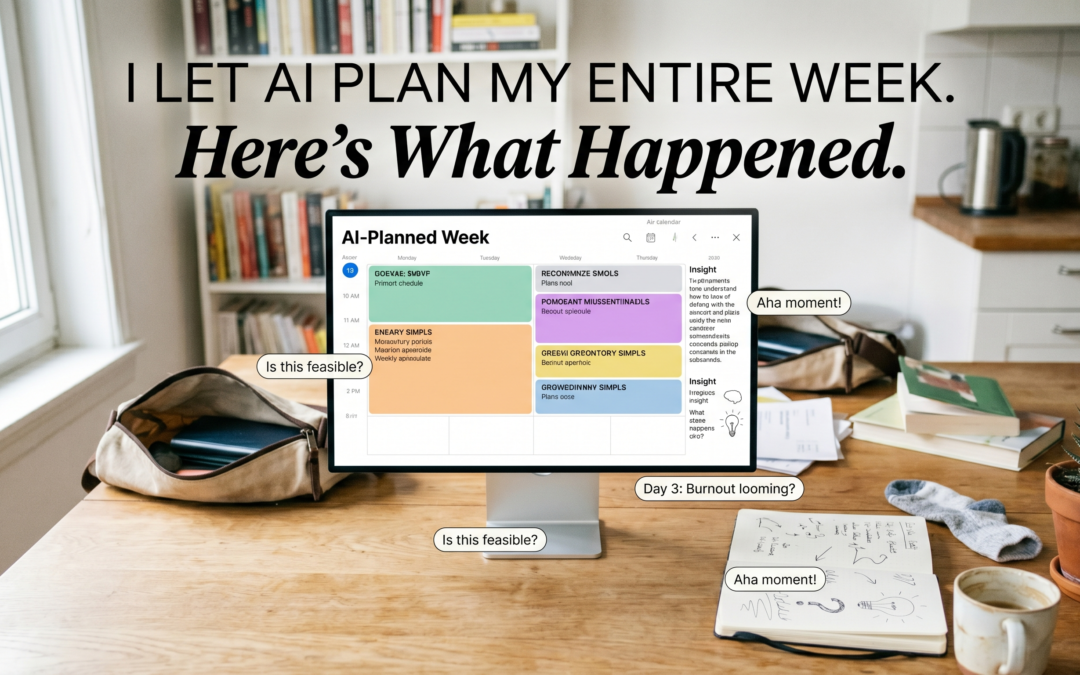
I Let AI Plan My Entire Week. Here’s What Happened.

I Let AI Plan My Entire Week. Here’s What Happened.

Personal Experiment · May 2026

I Let AI Plan My Entire Week.
Here’s What Happened.

One week. Zero manual planning. Every task, session, meal, and break — decided by AI. This is the honest, unfiltered account.

I’m someone who makes plans and then ignores them. Sound familiar?

Every Sunday night I sit down with good intentions — I open a notebook, maybe a Google Sheet — and I map out the week. Monday looks productive on paper. By Tuesday afternoon, it’s already fallen apart.

So when I started thinking seriously about AI productivity tools, a question hit me: What if I didn’t plan the week at all — and just let the AI do it?

Not just ask it for suggestions. I mean fully hand over the controls. Give it my goals, my deadlines, my energy levels, and let it build the entire week’s structure — hour by hour.

I ran this experiment for one full week. Here’s everything that happened.

? The Setup: Rules of the Experiment

Before I started, I set some ground rules to keep this honest:

  1. I would describe my week’s goals and constraints to the AI — deadlines, commitments, energy patterns, and personal priorities.
  2. The AI would generate a full daily schedule — including work blocks, study time, breaks, meals, exercise, and wind-down routines.
  3. I had to follow it for at least 80% of each day. No cherry-picking the easy parts.
  4. I could ask the AI to adjust mid-week, but only by telling it what changed — not by overriding it based on mood.
  5. At the end of each day, I would rate how it felt: productivity, stress, and satisfaction out of 10.

The AI I used was Claude (by Anthropic), with some cross-checking on ChatGPT for meal and exercise suggestions. I fed it a detailed prompt each morning with my current state, upcoming tasks, and any updates from the day before.

? What I Told the AI About Me

To generate a useful schedule, I had to be surprisingly honest. I gave Claude the following information at the start of the week:

“I have three work deliverables due this week, two online meetings, a blog post to write, and I want to start a consistent reading habit. I’m sharpest between 9am–12pm. I crash after lunch. I usually get a second wind around 4pm. I haven’t been exercising. I want to sleep by 11pm.”

That’s it. The AI took this and built a full Monday–Friday schedule, with time blocks, task labels, suggested break types (walking vs. screen-off rest), and even a note about which tasks to batch together for cognitive efficiency.

I was genuinely impressed before the week even started.

? Day-by-Day: What Actually Happened

Monday — The Honeymoon Day ? 8.5/10

Monday was surprisingly great. The AI had placed my deepest work (writing) in the 9–11am block, followed by emails and admin from 11–12. A proper lunch break at 12:30 — no screens. An afternoon meeting at 3pm, then light reading from 5–6pm. I followed it almost perfectly and ended the day feeling like I’d actually accomplished something. The key insight: the AI protected my peak hours. No meetings before noon.

Tuesday — The First Resistance ? 6/10

Tuesday had a 30-minute exercise block at 7:30am. I skipped it. Immediately felt guilty about breaking the plan. The AI had also scheduled a “focused reading” block at 8pm — which I attempted but found hard to sustain. What the AI couldn’t account for: I was more tired Tuesday than I predicted. When I updated it with that feedback, it adjusted Wednesday’s schedule to be lighter in the evening. That adaptive ability was genuinely useful.

Wednesday — The Sweet Spot ? 9/10

Wednesday was my best day of the week — and honestly, one of my most productive days in months. The AI had responded to my Tuesday fatigue by front-loading creative tasks in the morning and leaving afternoons for lighter admin. It also suggested a “theme” for the day: finish loose ends. Having a single daily theme was something I’d never tried before. It worked incredibly well. I cleared three things that had been sitting on my to-do list for two weeks.

Thursday — Where It Got Real ? 6.5/10

An unexpected personal obligation came up Thursday morning and knocked out two hours of my schedule. The AI couldn’t have predicted this. When I told it what happened, it helped me reprioritize in real-time — but the day felt choppy. This revealed an important limitation: AI planning assumes a predictable environment. Life often isn’t. The plan survived, but it required more manual intervention than any other day.

Friday — Reflection & Wrap-Up ? 8/10

The AI had scheduled Friday afternoon as a “review and reset” block — looking back at the week, noting what worked, and journaling. I hadn’t done a weekly review in years. It took 25 minutes and was genuinely clarifying. Friday felt intentional rather than like I was just surviving until the weekend. I ended the week having written my blog post, completed all three deliverables, and started a reading habit (3 out of 5 evenings — not perfect, but real progress).

? The Numbers: End-of-Week Scorecard

Metric Before AI Planning This Week
Tasks completed ~60% 85%
Average end-of-day stress (1–10, lower = better) 7 4.5
Deep work hours per day ~1.5 hrs ~3.2 hrs
Reading sessions completed 0 3
Evening wind-down routine followed 1/5 nights 4/5 nights

? What the AI Got Right

Let me give credit where it’s due. Here’s what impressed me most:

1. It Protected My Peak Hours

Without being asked, Claude scheduled all creative and high-cognitive tasks in the morning window I’d described as my “sharpest” time. No meetings before noon. No admin in the morning. This alone doubled my meaningful output.

2. It Batched Similar Tasks

The AI grouped emails, messages, and administrative work into one block rather than spreading them across the day. This reduced context-switching significantly. I hadn’t realized how much that fragmentation was costing me.

3. It Built In Recovery Time

Every day had an intentional “buffer” of 30–45 minutes — not assigned to any task. Just space. On most days, I used that buffer for something unexpected that came up. Without it, I would have fallen behind and stressed out.

4. It Gave Each Day an Identity

The “daily theme” concept was a revelation. Monday = start strong. Wednesday = clear the backlog. Friday = review and rest. This gave each day a personality beyond just a list of tasks.

?? Where the AI Fell Short

This wouldn’t be an honest review without acknowledging the gaps.

1. It Couldn’t Read My Emotional State

On Tuesday when I was more depleted than expected, the AI’s schedule still felt demanding. It adapted after I told it how I was feeling — but it couldn’t proactively sense that. A human mentor or coach might have noticed the signals before I did.

2. Unexpected Life Events Break the System

Thursday’s disruption showed that rigid AI planning can become a source of stress when reality diverges from the schedule. The AI needs human input to adapt, and that feedback loop takes time and effort.

3. It Optimized for Output, Not Always for Joy

The schedule was very efficient. But there were moments where it felt like I was executing a machine’s instructions rather than living my life. The AI didn’t know that sometimes I just want to go for an unscheduled walk without it being a “productivity tool.”

4. No Social or Relational Intelligence

The AI couldn’t account for the fact that a conversation with a friend might be more important than checking off a task. Human productivity isn’t purely output-based — relationships matter, and no AI planner currently weights that well.

? What This Taught Me About AI (And About Myself)

This experiment changed how I think about AI tools — not as replacements for thinking, but as mirrors that reflect back your own stated priorities.

When I told the AI what mattered to me, it held me to it. That accountability was the real value. The AI didn’t motivate me — but it did make it harder to lie to myself about how I was spending my time.

I also learned that the quality of what you get from AI planning is directly proportional to the quality of your self-knowledge. If I gave vague or dishonest inputs (“I have some tasks to do”), the outputs were generic. When I was specific and honest, the outputs were genuinely useful.

Most importantly: I was the one who decided to follow the plan or not. The AI didn’t make me more disciplined. It just removed the friction of figuring out what to do next — which, it turns out, was a bigger problem for me than I’d realized.

? Should You Try This?

Yes — with these caveats:

  • Start with a single day, not a full week. Ask the AI to plan just tomorrow and see how it feels before committing to more.
  • Be specific in your inputs. Tell it your energy patterns, non-negotiables, and what “a good day” means to you.
  • Give it feedback daily. The AI improves dramatically when you tell it what worked and what didn’t.
  • Don’t outsource your priorities — clarify them first. AI planning amplifies your values; if your values are unclear, the schedule will feel hollow.
  • Keep 20% of your day unscheduled. Buffer time is not wasted time — it’s the shock absorber for real life.

Final Verdict

Would I do it again? Absolutely. But I’d use AI planning as a starting point, not a rigid script. The best version of this experiment would be using AI to generate a 70% structure and leaving 30% to instinct, spontaneity, and the human things that no algorithm can fully understand.

We’re at an interesting moment in history where AI can genuinely help us become better versions of ourselves — more organized, more intentional, more productive. But it can’t want things for you. It can’t make you care. It can’t replace the deep human work of figuring out what actually matters.

That part? Still entirely on us.


Verification: 1544cdbd1105873e