AI, cyber security, Education, encryption, GCC
Opinion · May 2026
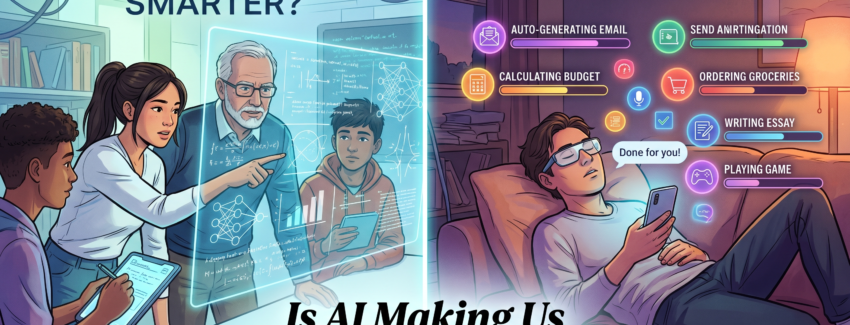
Is AI Making Us Smarter
or Lazier?
The Honest Answer
Let me tell you about two students.
The first one uses AI constantly. Every essay starts with a ChatGPT outline. Every tricky concept gets explained by Claude. Every homework problem gets at least a hint from an AI before real effort is applied. Their grades are good. Their output looks polished. Their teachers are impressed.
The second student uses AI sparingly — as a last resort after genuinely struggling with a problem. The work is messier. The process takes longer. Some of the outputs are rougher around the edges.
Here’s the question: which student is learning more?
The uncomfortable answer — backed by a growing body of research — is almost certainly the second one. And understanding why that’s the case is the most important thing any student, teacher, or parent can understand about AI right now.
The Case That AI Is Making Us Smarter
Let’s start with the argument in favor, because it’s real and it matters.
AI tools genuinely expand what people can do. A student who previously couldn’t get feedback on a draft until their teacher reviewed it on Friday can now get detailed, thoughtful feedback in seconds. A learner who was too shy to ask “basic” questions in class can ask an AI as many times as needed without embarrassment. A non-native speaker can get explanations in their own language with a single prompt.
These are not trivial gains. Access to personalized, on-demand educational support was once a privilege available only to students whose families could afford tutors. AI has democratized that access — imperfectly, but meaningfully.
The research reflects this too. Studies consistently show that students using AI-assisted learning tools produce higher-quality outputs than peers who don’t. Comprehension improves. Efficiency increases. Learning feels more accessible, more motivating, less intimidating.
For people who already have deep expertise in a domain, AI acts as a powerful force multiplier. An experienced doctor using AI diagnostics makes better decisions. A senior engineer using AI coding tools ships more reliable software. A veteran teacher using AI to generate lesson variations reaches more learning styles. When you bring existing knowledge and judgment to the table, AI amplifies both.
So yes — in the right hands, used the right way, AI absolutely makes people more capable.
The Case That AI Is Making Us Lazier
Now for the part that’s harder to admit — and more urgent.
The OECD’s Digital Education Outlook 2026 found that while students with access to general-purpose AI tools produce higher-quality outputs than their peers, this advantage disappears — and sometimes reverses — in exams when AI access is removed.
Read that again. Students who relied on AI to produce better work couldn’t reproduce that quality without it. The tool was doing the work. The student was operating the tool. Those are not the same thing.
The same report warned that offloading cognitive tasks to general-purpose chatbots creates risks of “metacognitive laziness and disengagement” — a sophisticated way of saying: if AI does your thinking for you often enough, you stop getting better at thinking.
A 2025 study by researcher Gerlich found a direct negative correlation between frequent AI tool usage and critical thinking abilities — and the effect was strongest in younger users. Not the students who used AI occasionally or strategically. The ones who used it heavily and habitually.
Meanwhile, a 2026 research paper on software developers found something striking: developers who fully delegated coding tasks to AI produced working code — but failed conceptual understanding tests afterward. They couldn’t debug what the AI had written. They had the output without the understanding. The output looked smart. The person hadn’t become smarter.
This is the core danger, and it has a name: cognitive offloading.
The Real Problem: Cognitive Offloading
Cognitive offloading is what happens when you transfer mental work to an external tool. Writing things down instead of memorizing them. Using GPS instead of building a mental map. Asking a calculator instead of doing mental arithmetic.
Some cognitive offloading is completely fine — even beneficial. Using GPS to navigate a new city frees up mental space to notice where you’re going. Using a calculator for complex arithmetic frees you to think about what the numbers mean.
The problem is when offloading replaces the development of a skill you haven’t built yet.
There’s a critical distinction that Psychology Today researcher Timothy Cook articulated clearly in early 2026:
“What AI does to a 45-year-old is likely categorically different than what it does to a 14-year-old. If I use AI to summarize a research paper, I’ve read hundreds of papers. I know what a good argument looks like — I’m offloading a task I already know how to do. A student who uses AI to summarize every paper may never develop that judgment at all.”
This is the crux. When an expert uses AI to skip a task they’ve already mastered, efficiency goes up and little is lost. When a learner uses AI to skip a task they haven’t mastered yet, they never master it.
Adults lose skills to AI. Children never build them. Those are two different problems — and the second one is the more serious one.
The Illusion of Understanding
There’s another phenomenon making this harder to see clearly: the fluency illusion.
When AI explains something clearly and engagingly, reading that explanation feels effortless. The ideas flow smoothly. You follow along without confusion. You finish and think: Yes, I understand that now.
Except — do you?
Cognitive science research consistently shows that ease of processing is a poor indicator of depth of understanding. Reading a brilliant explanation of how photosynthesis works is not the same as being able to explain photosynthesis yourself, apply it to a new context, or troubleshoot a plant biology problem. The smooth reading experience creates an illusion of competence that evaporates under any real test of knowledge.
When students use AI to get explanations — rather than to be questioned and challenged — they frequently experience this illusion. The material feels understood. The quiz or exam reveals it wasn’t.
The World Bank’s education blog framed this pointedly: “AI can make students produce smart answers without making them smarter thinkers.” That distinction is everything.
The Honest Answer: It Depends on How You Use It
Here’s where we arrive at the truth that neither AI optimists nor AI skeptics want to sit with: it’s not a binary.
AI is not inherently making us smarter. It is not inherently making us lazier. It is making us more of whatever we already are — and doing so faster and more efficiently than any tool that came before it.
| If you use AI to… |
You are likely… |
| Quiz yourself and get challenging follow-up questions |
Getting smarter ? |
| Get answers to questions you haven’t attempted yourself |
Getting dependent ? |
| Get feedback on work you’ve genuinely attempted |
Getting smarter ? |
| Generate first drafts you lightly edit |
Skipping the learning ? |
| Ask “why” and “how” to deepen understanding |
Getting smarter ? |
| Read AI explanations passively without testing yourself |
Experiencing the fluency illusion ? |
The research is fairly consistent: AI tools that are used with intentional pedagogical purpose — to challenge, question, and push the learner — produce real and sustained learning gains. AI tools used as shortcuts — to retrieve answers, summarize content passively, or generate outputs — produce the appearance of learning without the substance.
What This Means for Students
The uncomfortable truth for students is that the most valuable thing AI can do for your learning is make it harder — not easier.
An AI that asks you follow-up questions when you give a shallow answer is more valuable than an AI that just gives you the answer. An AI that pushes back on your argument is more valuable than one that agrees with everything you say. An AI that refuses to write your first draft but offers to critique one you wrote is more valuable than one that writes it for you.
The students who will thrive in a world saturated with AI won’t be the ones who learned to operate AI tools most efficiently. They’ll be the ones who used those tools to develop genuine understanding, independent judgment, and the ability to think when AI isn’t available — or when AI is wrong.
Because here’s the thing: AI is sometimes wrong. And if you’ve never built the underlying knowledge to catch it, you’ll pass along its mistakes with complete confidence. That’s not smarter. That’s a new and more dangerous kind of ignorance.
What This Means for Teachers and Schools
For educators, this research points to a clear design principle: the goal should never be to remove AI from students’ hands — it should be to design learning experiences that remain valuable even when AI is present.
That means shifting the emphasis from outputs (essays, answers, solutions) to processes (reasoning, argumentation, iteration, reflection). It means creating assessments that test understanding — not just the ability to produce polished text. It means teaching students the difference between using AI to produce and using AI to learn.
Schools that ban AI entirely are preparing students for a world that no longer exists. Schools that allow unrestricted AI access without pedagogical guidance are setting students up for the illusion of competence. The narrow, difficult path between those two failure modes is the one worth building.
The Verdict
So: is AI making us smarter or lazier?
The honest answer is: both, simultaneously, for different people, in different proportions — determined almost entirely by how they choose to engage with it.
AI is a cognitive mirror. It reflects and amplifies what you bring to it. Bring intellectual laziness, and it will help you produce lazy work faster than ever before. Bring genuine curiosity and a willingness to be challenged, and it will accelerate your growth in ways that weren’t previously possible.
The tool is not the story. The intention behind the tool is the story.
And right now, in classrooms and offices and bedrooms around the world, millions of people are making that choice — often without realizing they’re making it at all.
The Question Worth Asking
“Am I using this AI to produce something — or to understand something?”
Your answer to that question, repeated every day, will determine which kind of AI user you become.
Written by
Saifullah Khalid
Exploring AI, education, and human intelligence at saifullahkhalid.com
? Know someone who uses AI for everything? Or someone who refuses to touch it? Share this with both of them.
AI, cyber security, Education, encryption, GCC, help
Personal Experiment · May 2026
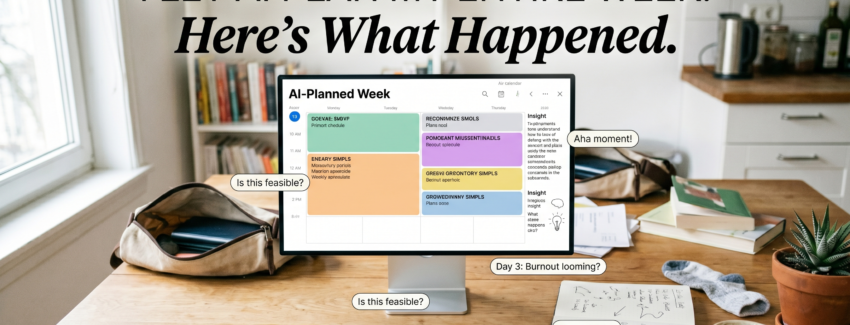
I Let AI Plan My Entire Week.
Here’s What Happened.
One week. Zero manual planning. Every task, session, meal, and break — decided by AI. This is the honest, unfiltered account.
I’m someone who makes plans and then ignores them. Sound familiar?
Every Sunday night I sit down with good intentions — I open a notebook, maybe a Google Sheet — and I map out the week. Monday looks productive on paper. By Tuesday afternoon, it’s already fallen apart.
So when I started thinking seriously about AI productivity tools, a question hit me: What if I didn’t plan the week at all — and just let the AI do it?
Not just ask it for suggestions. I mean fully hand over the controls. Give it my goals, my deadlines, my energy levels, and let it build the entire week’s structure — hour by hour.
I ran this experiment for one full week. Here’s everything that happened.
? The Setup: Rules of the Experiment
Before I started, I set some ground rules to keep this honest:
- I would describe my week’s goals and constraints to the AI — deadlines, commitments, energy patterns, and personal priorities.
- The AI would generate a full daily schedule — including work blocks, study time, breaks, meals, exercise, and wind-down routines.
- I had to follow it for at least 80% of each day. No cherry-picking the easy parts.
- I could ask the AI to adjust mid-week, but only by telling it what changed — not by overriding it based on mood.
- At the end of each day, I would rate how it felt: productivity, stress, and satisfaction out of 10.
The AI I used was Claude (by Anthropic), with some cross-checking on ChatGPT for meal and exercise suggestions. I fed it a detailed prompt each morning with my current state, upcoming tasks, and any updates from the day before.
? What I Told the AI About Me
To generate a useful schedule, I had to be surprisingly honest. I gave Claude the following information at the start of the week:
“I have three work deliverables due this week, two online meetings, a blog post to write, and I want to start a consistent reading habit. I’m sharpest between 9am–12pm. I crash after lunch. I usually get a second wind around 4pm. I haven’t been exercising. I want to sleep by 11pm.”
That’s it. The AI took this and built a full Monday–Friday schedule, with time blocks, task labels, suggested break types (walking vs. screen-off rest), and even a note about which tasks to batch together for cognitive efficiency.
I was genuinely impressed before the week even started.
? Day-by-Day: What Actually Happened
Monday — The Honeymoon Day ? 8.5/10
Monday was surprisingly great. The AI had placed my deepest work (writing) in the 9–11am block, followed by emails and admin from 11–12. A proper lunch break at 12:30 — no screens. An afternoon meeting at 3pm, then light reading from 5–6pm. I followed it almost perfectly and ended the day feeling like I’d actually accomplished something. The key insight: the AI protected my peak hours. No meetings before noon.
Tuesday — The First Resistance ? 6/10
Tuesday had a 30-minute exercise block at 7:30am. I skipped it. Immediately felt guilty about breaking the plan. The AI had also scheduled a “focused reading” block at 8pm — which I attempted but found hard to sustain. What the AI couldn’t account for: I was more tired Tuesday than I predicted. When I updated it with that feedback, it adjusted Wednesday’s schedule to be lighter in the evening. That adaptive ability was genuinely useful.
Wednesday — The Sweet Spot ? 9/10
Wednesday was my best day of the week — and honestly, one of my most productive days in months. The AI had responded to my Tuesday fatigue by front-loading creative tasks in the morning and leaving afternoons for lighter admin. It also suggested a “theme” for the day: finish loose ends. Having a single daily theme was something I’d never tried before. It worked incredibly well. I cleared three things that had been sitting on my to-do list for two weeks.
Thursday — Where It Got Real ? 6.5/10
An unexpected personal obligation came up Thursday morning and knocked out two hours of my schedule. The AI couldn’t have predicted this. When I told it what happened, it helped me reprioritize in real-time — but the day felt choppy. This revealed an important limitation: AI planning assumes a predictable environment. Life often isn’t. The plan survived, but it required more manual intervention than any other day.
Friday — Reflection & Wrap-Up ? 8/10
The AI had scheduled Friday afternoon as a “review and reset” block — looking back at the week, noting what worked, and journaling. I hadn’t done a weekly review in years. It took 25 minutes and was genuinely clarifying. Friday felt intentional rather than like I was just surviving until the weekend. I ended the week having written my blog post, completed all three deliverables, and started a reading habit (3 out of 5 evenings — not perfect, but real progress).
? The Numbers: End-of-Week Scorecard
| Metric |
Before AI Planning |
This Week |
| Tasks completed |
~60% |
85% |
| Average end-of-day stress (1–10, lower = better) |
7 |
4.5 |
| Deep work hours per day |
~1.5 hrs |
~3.2 hrs |
| Reading sessions completed |
0 |
3 |
| Evening wind-down routine followed |
1/5 nights |
4/5 nights |
? What the AI Got Right
Let me give credit where it’s due. Here’s what impressed me most:
1. It Protected My Peak Hours
Without being asked, Claude scheduled all creative and high-cognitive tasks in the morning window I’d described as my “sharpest” time. No meetings before noon. No admin in the morning. This alone doubled my meaningful output.
2. It Batched Similar Tasks
The AI grouped emails, messages, and administrative work into one block rather than spreading them across the day. This reduced context-switching significantly. I hadn’t realized how much that fragmentation was costing me.
3. It Built In Recovery Time
Every day had an intentional “buffer” of 30–45 minutes — not assigned to any task. Just space. On most days, I used that buffer for something unexpected that came up. Without it, I would have fallen behind and stressed out.
4. It Gave Each Day an Identity
The “daily theme” concept was a revelation. Monday = start strong. Wednesday = clear the backlog. Friday = review and rest. This gave each day a personality beyond just a list of tasks.
?? Where the AI Fell Short
This wouldn’t be an honest review without acknowledging the gaps.
1. It Couldn’t Read My Emotional State
On Tuesday when I was more depleted than expected, the AI’s schedule still felt demanding. It adapted after I told it how I was feeling — but it couldn’t proactively sense that. A human mentor or coach might have noticed the signals before I did.
2. Unexpected Life Events Break the System
Thursday’s disruption showed that rigid AI planning can become a source of stress when reality diverges from the schedule. The AI needs human input to adapt, and that feedback loop takes time and effort.
3. It Optimized for Output, Not Always for Joy
The schedule was very efficient. But there were moments where it felt like I was executing a machine’s instructions rather than living my life. The AI didn’t know that sometimes I just want to go for an unscheduled walk without it being a “productivity tool.”
4. No Social or Relational Intelligence
The AI couldn’t account for the fact that a conversation with a friend might be more important than checking off a task. Human productivity isn’t purely output-based — relationships matter, and no AI planner currently weights that well.
? What This Taught Me About AI (And About Myself)
This experiment changed how I think about AI tools — not as replacements for thinking, but as mirrors that reflect back your own stated priorities.
When I told the AI what mattered to me, it held me to it. That accountability was the real value. The AI didn’t motivate me — but it did make it harder to lie to myself about how I was spending my time.
I also learned that the quality of what you get from AI planning is directly proportional to the quality of your self-knowledge. If I gave vague or dishonest inputs (“I have some tasks to do”), the outputs were generic. When I was specific and honest, the outputs were genuinely useful.
Most importantly: I was the one who decided to follow the plan or not. The AI didn’t make me more disciplined. It just removed the friction of figuring out what to do next — which, it turns out, was a bigger problem for me than I’d realized.
? Should You Try This?
Yes — with these caveats:
- Start with a single day, not a full week. Ask the AI to plan just tomorrow and see how it feels before committing to more.
- Be specific in your inputs. Tell it your energy patterns, non-negotiables, and what “a good day” means to you.
- Give it feedback daily. The AI improves dramatically when you tell it what worked and what didn’t.
- Don’t outsource your priorities — clarify them first. AI planning amplifies your values; if your values are unclear, the schedule will feel hollow.
- Keep 20% of your day unscheduled. Buffer time is not wasted time — it’s the shock absorber for real life.
Final Verdict
Would I do it again? Absolutely. But I’d use AI planning as a starting point, not a rigid script. The best version of this experiment would be using AI to generate a 70% structure and leaving 30% to instinct, spontaneity, and the human things that no algorithm can fully understand.
We’re at an interesting moment in history where AI can genuinely help us become better versions of ourselves — more organized, more intentional, more productive. But it can’t want things for you. It can’t make you care. It can’t replace the deep human work of figuring out what actually matters.
That part? Still entirely on us.