|
Getting your Trinity Audio player ready...
|
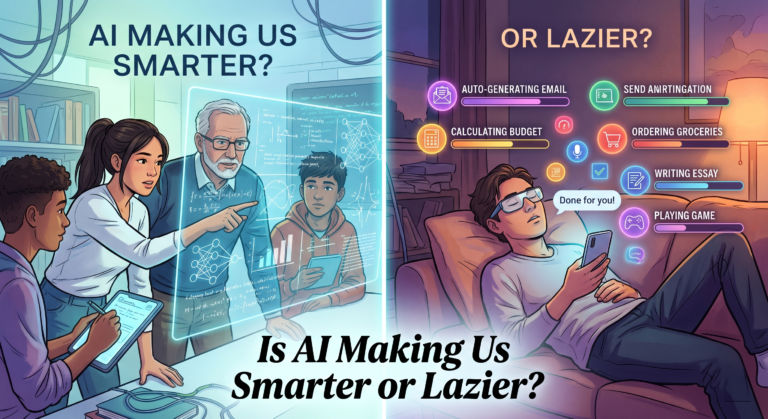
Humans have always offloaded thinking. We write shopping lists, use calculators and save phone numbers instead of memorising them. Cognitive offloading, using external tools to reduce mental effort, is not new and not inherently harmful. What is new is the scale. Generative AI can now offload not just memory or arithmetic, but reasoning, structuring, summarising and judging. For students, that changes the question from “Should we let them use tools?” to “Which thinking must stay in their heads?”
Two Kinds of Offloading
Not all offloading is equal. It helps to separate two types:
- Enabling offloading removes low-value effort so the learner can focus on the target skill. A chemistry student using a calculator for long division is offloading enabling work; the target skill is stoichiometry.
- Substituting offloading removes the target skill itself. A student who asks AI to “structure my argument” in an essay unit designed to teach argument structure has offloaded the learning.
The same AI action can be enabling in one lesson and substituting in another. That is why blanket rules, whether bans or open permission, fail. The decision has to be made at the level of the learning objective.
Why It Feels Like Learning
The mechanism that makes AI offloading risky is fluency. When a student reads a clear AI explanation, the material feels easy, and ease is mistaken for understanding. Research on learning has long shown that effortful retrieval and generation build durable memory, while passive re-reading creates an illusion of competence. AI makes the illusion cheaper and more convincing than ever.
Students are not being lazy when they offload; they are being efficient by the standards the system rewards. If grades reward finished products, offloading the process is rational. The design problem belongs to institutions, not students.
The Equity Dimension
Strong students tend to use AI as a sparring partner because they already have the background knowledge to evaluate its output. Weaker students are more likely to accept outputs wholesale, because they lack the knowledge to spot errors. The result is a widening gap: AI accelerates those who already know and quietly hollows out those who do not. Schools serving students with weaker foundations, or learning in a second language, carry the highest risk.
Designing for Productive Thinking
School leaders and teachers can reduce substituting offloading without banning tools:
- Name the protected skill. For every unit, write one line: “In this unit, students must do X themselves.” Everything else can be AI-assisted.
- Grade the process. Use planning notes, drafts, oral check-ins and in-class reasoning so the thinking is visible.
- Generate before you consult. Require students to attempt an answer before asking AI, then compare and explain differences.
- Use AI as critic, not author. Ask AI to find flaws in student work rather than produce it.
- Retrieve without tools. Short, low-stakes, tool-free quizzes reveal whether knowledge is in the head or only in the chat history.
A Simple Classroom Test
Ask: “If the AI disappeared tomorrow, could this student still do the thing this unit was meant to teach?” If the answer is no, the offloading was substitution. If the answer is yes, the AI likely helped.
Frequently Asked Questions
What is cognitive offloading in education?
Cognitive offloading is the use of external tools, such as notes, calculators or AI, to reduce mental effort. In education, it becomes a problem when the tool performs the skill the lesson is meant to develop.
Does AI make students worse at thinking?
Not automatically. AI weakens thinking when it substitutes for the target skill and strengthens it when it removes distractions or acts as a critic of student work.
How can teachers reduce harmful AI offloading?
Define which skills students must perform unaided, assess the learning process as well as the product, and include regular tool-free retrieval practice.