
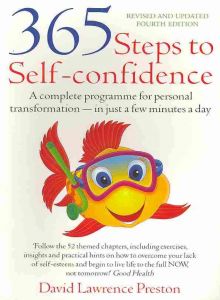
365.Steps.to.Self.Confidence {www.saifullahkhalid.com}

365.Steps.to.Self.Confidence {www.saifullahkhalid.com}


I have written this book for everyone – young and old, men, women, students, educators, business people, administrators, parents, homemakers, sports enthusiasts, entertainers – yes, and you!

It has been carefully structured into 52 sections, covering the following areas:

  • Deciding to be confident
  • Self-awareness
  • Thinking confidently
  • Using your imagination to improve self-image
  • Acting with confidence
  • Confident communication.

Each section contains information, insights and words of inspiration, plus seven exercises, practical hints or points to ponder. That’s one a day – not too taxing. Is it?

I guarantee that if you read the material carefully and apply what you learn, you’ll notice big changes taking place within two or three months, and a year from now you’ll look back amazed at how much more confident you’ve become.

Overview – Sections

  • How to build confidence: an introduction to the life-changing formula that will transform your life.
  • How confident are you? Defining your starting point
  • Sow the seeds of confidence and watch them grow: why you are the way you are and how you can become what you want to be.
  • Whose responsibility is your confidence? Why, yours, of course!
  • Getting motivated: setting goals which give you the impetus to change and to grow Determination: identifying the reasons to change, and reinforcing your commitment to be confident.
  • Thinking like a confident person: you start transforming your life by changing the way you think.
  • The Four Step Method: a cast iron way to become a positive thinker.
  • Silencing the Inner Critic: challenging the little voice in your head that loves to criticize you
  • Affirmations: how to use them to build confidence and the difference they make.
  • Who do you imagine yourself to be? Self-image and the subconscious
  • Getting the most from creative imagery: life-transforming techniques which change your self-image permanently
  • The ‘As If ’Principle: acting as if you’re confident to become more confident.
  • Eat an elephant: the importance of taking it one step at a time.
  • Self-awareness 1 – the past: examining how the past has affected you and what’s been holding you back.
  • Self-awareness 2 – what are you like? Understanding yourself – the more self-aware you are, the more control you have over your life.
  • Childhood: how you’re conditioning and your relationship with your parents as a child continue to affect you.
  • Control dramas: how you learned to get what you wanted from others, and how it still governs your behavior.
  • Take care of your Inner Child: learning to accept the child you once were as an important part of the adult you.
  • Forgive, forget and be free: how to forgive those who have hurt you, take charge of your life and move on.
  • Let go of the past: how to get rid of unwanted baggage from the past so it no longer affects you.
  • Self-acceptance: accepting yourself as you are, especially those things you cannot change.
  • Body image: love your body, warts and all!
  • Get in shape: a health and fitness guide to give you more energy and more confidence.
  • Calmness and confidence: deep relaxation and instant calmness for instant confidence.
  • Anchoring: how to produce confident feelings any time you wish
  • So far, so good: an opportunity to pause, take stock, reflect and review your progress to date.
  • Find a purpose: one that inspires and motivates you, and gives your life meaning and direction.
  • Goals revisited: consider what you wish to achieve in life, and get started right away.
  • The Thinker thinks and the Proverb proves: how to draw on the power of the subconscious mind to build confidence.
  • Confident self-talk: changing negative, restrictive thinking patterns to thoughts of confidence and self-worth.
  • Beliefs: what they are, why they’re important, how to change them and create self-belief.
  • Confident attitudes: seven attitudes of confidence for you to make your own.
  • Self-love: self-worth, the key to happiness and fulfilling relationships.
  • Concentrating on what you do well: identifying your strengths: acquiring new personal qualities.
  • Overcoming weaknesses: building on your strengths. The importance of concentrating on what you do well, and cultivating patience and persistence
  • Take a risk: how to get out of your comfort zone.
  • Just do it: sure-fire confidence building activities. Go on – have a go!
  • Confident body-language: adopt a confident posture and you feel more confident. You project confidence too.
  • Conditions of worth: how others assess you. And how to deal with rejection
  • Give up approval-seeking behavior: there’s only one person whose approval you really need – guess who?
  • First impressions: conversational skills that make others want to talk to you, and allow you to be confident.
  • Be a good listener: good listening is one of the secrets of confident communication and popularity.
  • Stand up for yourself: introduction to assertiveness.
  • How to be assertive: effective tools and techniques for standing your ground and getting your point across.
  • Saying no when you mean no: one of the hardest things to do when you lack confidence.
  • Compliments and criticism: how to handle criticism and give and receive compliments.
  • How to ask for what you want: and what to say when you don’t get it.
  • Lighten up: stop taking yourself too seriously and have a laugh.
  • Emotional intelligence: understanding and managing your emotions; and relating to other people’s in an appropriate manner.
  • Take an interest in others: helping others does wonders for your own confidence.
  • Choose peace: becoming aware of your spiritual dimension and enjoying continual peace of mind.

CLICK HERE TO DOWNLOAD SELF CONFIDENCE EBOOK

Hand Pakistan drones: Musharraf tells US

Hand Pakistan drones: Musharraf tells US


Hand Pakistan drones: Musharraf tells USWASHINGTON: Former President Gen. Pervez Musharraf believes his country should be given drone aircraft so it can take out top terror suspects without the help of the West, he told foreign news channel in an exclusive interview.Musharraf became a key U.S. ally after the Sept. 11 terror attacks and joined the United States in fighting the Taliban and Al Qaeda. He became the target of repeated assassination attempts — but he says he acted for the good of his country — not for U.S. benefit.

“It was not for United States alone … it was for Pakistan,” he said during a wide-ranging interview with foreign news’ Amy Kellogg in London.

“We are a progressive, moderate people, so it was very clear that we cannot accept” the Talibanization of his country, he said, calling it an easy decision to turn his military’s sights on the militants.

“They were roaming around our cities and causing terrorist attacks in our cities and all over, and we had to eliminate that.”

Musharraf said that Al Qaeda has been significantly diminished in Pakistan, but the Taliban is thriving. Yet he believes that the unmanned aircraft the U.S. uses to target key militants in Pakistan should be handed over to his country.

They have been very controversial always,” he said. “I personally believe that drones should be given to Pakistan because the sensitivity is American troops or any foreign troops coming into Pakistan.”

The question on so many minds — where is Usama bin Laden? — remains unanswered. Musharraf has doubts whether bin Laden has survived the eight harsh years since 9/11.

“There is even a doubt whether he is alive,” he told media. “Because right in the beginning he was a dialysis patient, he was a kidney patient; therefore I wonder if he is alive. “

The past few years have been a tumultuous time for Pakistan, with the assassination of former Prime Minister Benazir Bhutto in late 2007, followed by Musharraf’s stepping down in 2008.

He believes a combination of military might and political solutions will ultimately destroy the Taliban, a disparate band of militants with no front line. He says they are digging their own grave by making Pakistanis turn away from them.

He cited Swat Valley, where the Taliban had a stronghold but were recently defeated by the Pakistani army. The Taliban’s “very cruel behaviour in Swat” — including the harsh imposition of religious law and the slaughter of innocents — appalled the entire nation of 172 million people and bound it together behind the army, he told media.

“Now all the people of Pakistan and also the media is combined, is united, asking the army to defeat them.”

Pakistan is united and remains an American ally, but a growing divide is emerging because Pakistanis generally don’t like the U.S., Musharraf said.

“For 42 years, until ’89, we were the strategic partners of the West,” he told media, noting the “lead role” of Pakistan in the Afghanistan War that lasted from 1979 until 1989.

“We defeated the Soviet Union together,” he said, attributing the end of the Cold War in large part to the victory over the U.S.S.R. in Afghanistan.

“Then what happened after 1989 is the question,” he said. “We were left high and dry” as tribal warfare raged in Afghanistan and 30,000 mujahideen holed up there, forming the central cells of Al Qaeda.

The U.S. also turned away from Pakistan in the intervening years, he said.

“There was a strategic shift in the United States where they shifted towards India, which was always with the East, and never with the West.”

Sanctions were also imposed on both nations for developing nuclear weapons, further aggravating Pakistan, though those sanctions were lifted after 9/11.

Despite the internal tension, Musharraf says he developed a strong friendship with former President George W. Bush, whom he called “a very good man” and “a good friend.”

“I think President Bush was a very sincere person, he was a very straight-talking, upright man,” he said. “I like that in a man. A man who can look into your eyes and talk straight.

“In the military, my experience shows if you look into the eyes of a person … you can see from the glint in their eyes whether they like the man or not. I think everyone (who worked for him) loved him.”

Musharraf says the Muslim world is now waiting with bated breath to see what President Obama can deliver.

“President Obama has said that he will develop better, closer relations with Muslims, and I think he has been welcomed in the Muslim world,” he said.

“The Muslim world was very upbeat about his election. Having said that, he must deliver … (and) I think it is a tough job that he faces to deliver on all that he has been talking.

“Muslims expect the United States to play a very fair role, an impartial role to deliver justice to the Islamic world,” he said.

Choosing a Positive Attitude!

Times have changed. At least this is what everyone says. It is fashionable to use the famous management phrase: The only thing constant is change. We are not denying that. However, not everything changes. Laws of nature don’t! For example time – it marches on. We all have 24 hours in a day and how we use this time is what makes for the difference in what we each achieve.

Similarly there are certain attributes and facts that do not change. For example organizations need people who not only have the aptitude for their respective work but also the attitude.

To be where we are today, most of us would have gone through the following routine:

· To become an engineer, I joined an engineering university
· To become a doctor I joined medical university
· To become an accountant, I joined a professional accounting body
· To become an artist, I joined arts school
· To become an individual with positive attitude, I joined ???? … well…

See what I mean ? !

No single institute teaches us how to have a positive attitude. Yet most companies hire and fire people on their attitude.

Success requires one to motivate oneself to have a positive attitude. Is it easy? No! Can it be done? Can people really change their attitudes? YES!

To change our attitudes we need to take a step back and revisit our own lives. It requires us to reboot our thinking and/or maybe even upload the latest upgrade.

We were born and this is our life. At the end of the day no one is responsible for my happiness more than I myself. People often say they want appreciation and recognition (non-financial) at the workplace to feel motivated and have a positive attitude towards work. But why? Since when did non-recognition amount to de-motivation?. Years ago, officials rejected a candidate for news broadcasters post since his voice was not fit for the job. He was also told that with his obnoxiously long name, he would have trouble being recognized. This person is Amitabh Bachchan! Another example is of a student who was scolded by a school teacher for not paying attention to his mathematics and for not being able to solve simple problems. She told him that he would not become anybody in life. This boy was Albert Einstein!

I am personally fascinated by a quotation by Louisa May Alcott (1832-1888) an American writer. She says, “Far away in the sunshine are my highest aspirations. I may not reach
them, but I can look up and see the beauty, believe in them and try to follow where they lead.”

What are you looking at? Where are you going? What do you believe in? and how hard are you trying?

Remember that we are not a victim of our present but creators of our future. This requires challenging what we do – now!

Here are 4 things you can do to develop a positive attitude

1) Give one hour/day to become an expert:

Read & enhance yourself. Find a meaning to your life and drive yourself in that direction. This may be work related or otherwise. This gives you the confidence to speak and share your thoughts on a particular subject.

2) Stay away from misery lovers’ company:

These are individuals who are drowning and will take you down as well. It is like receiving an attachment from a virus infected computer. Information coming from people who are negative needs to be cleaned.

3) Spend (some) money with family:

Most of us work to support our families and provide our dear ones with a better standard of living. This is why money is so critical. Spend this money with the people you love. It may give you a sense of achievement. This is also a way of rewarding yourself. Spend money sometimes – it feels good

4) Keep your faith.

Faith gives hope for the future and allows us to dream and visualize an abundant future. “He who loses wealth loses much; he who loses a friend loses more; but he who loses courage and faith loses all”. – Miguel de Cervantes, 1547-1616, Spanish Novelist, Dramatist, Poet

Don’t wait – Choose to have positive attitude – Just do it !

Verification: 1544cdbd1105873e