|
Getting your Trinity Audio player ready...
|
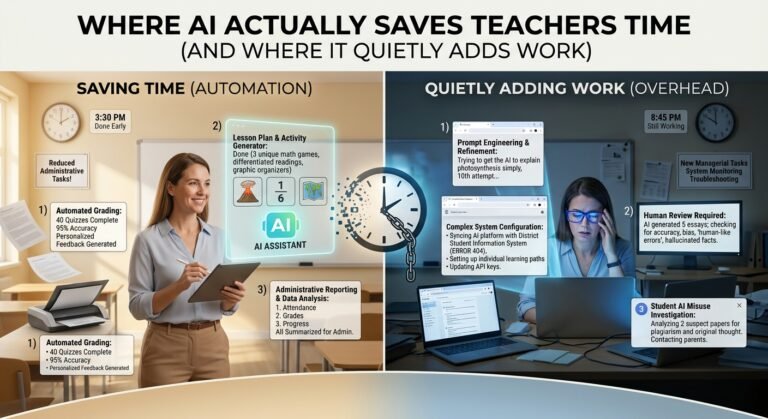
Teachers can now produce a full unit plan, differentiated worksheets and a quiz in the time it once took to photocopy them. AI-generated lesson plans have become one of the most widely adopted uses of generative AI in schools, and one of the least scrutinised. The emerging professional norm in 2026 is “human in the loop”: AI drafts, an expert reviews. The problem is that most schools have adopted the phrase without defining what the human is supposed to check.
Why AI Lesson Plans Look Better Than They Are
AI-generated materials are formatted, confident and complete. That polish hides four common weaknesses:
- Factual drift. Small inaccuracies, wrong dates, oversimplified science, invented examples, appear in otherwise correct content.
- Curriculum misalignment. Plans match a generic standard, often American, rather than your national framework or accreditation requirements.
- Shallow cognitive demand. Activities default to recall and comprehension, with few tasks requiring analysis or creation.
- Cultural mismatch. Examples, names and contexts may be irrelevant or inappropriate for your students and community.
Because the output looks professional, review becomes a skim. “Human in the loop” turns into “human glanced at it.”
The Mechanism: Review Without Criteria
Vetting fails when reviewers have no explicit criteria and no time. A teacher who saved two hours generating a unit will not spend two hours checking it. Without a short, structured checklist, review defaults to spotting typos rather than evaluating pedagogy.
A Five-Point Vetting Checklist
- Accuracy: Verify every fact, formula, date and definition you would be embarrassed to get wrong in front of students.
- Alignment: Map each objective to your actual curriculum standard. Delete anything that does not map.
- Rigour: Check that at least one activity requires students to analyse, evaluate or create.
- Context: Replace generic examples with local, culturally relevant ones.
- Accessibility: Confirm reading levels and supports suit learners with additional needs and language learners.
This takes fifteen to twenty minutes per lesson, still far less than writing from scratch, and it converts AI from a shortcut into a genuine draft partner.
The Equity Dimension
Experienced teachers catch AI errors quickly because they know the subject deeply. Early-career teachers and teachers working outside their specialism, often placed in under-resourced schools, are least equipped to spot problems. Without support, AI may widen quality gaps between schools rather than close them.
What School Leaders Should Put in Place
- Adopt the vetting checklist as department policy and keep it to one page.
- Create a shared, reviewed bank of AI-assisted lessons so vetting work is done once and reused.
- Pair early-career teachers with subject leads for review of AI materials.
- Write prompts that include your curriculum code, grade level and local context to reduce misalignment at the source.
Frequently Asked Questions
Are AI-generated lesson plans accurate?
They are often mostly accurate but can contain subtle factual errors and curriculum misalignment, so every plan should be reviewed by a subject expert before use.
What does human in the loop mean in teaching?
It means AI produces a draft and a qualified teacher reviews, edits and approves it against clear criteria before it reaches students.
How long should it take to vet an AI lesson plan?
With a structured checklist, about fifteen to twenty minutes per lesson is realistic.