|
Getting your Trinity Audio player ready...
|
English teachers are among the most concerned educators about AI, and with good reason. Writing is the subject AI most directly replicates. But the conclusion that “the essay is dead” is wrong. What has died is the take-home essay as proof of independent work. Writing as a way of thinking matters more than ever, because a person who cannot structure an argument cannot evaluate one written by a machine. Teaching writing with AI means separating the two.
Why Writing Still Matters
Writing is not just a way to show what you think; it is how you find out what you think. Drafting forces decisions about claims, evidence and order. A student who skips that process skips the thinking. Employers, universities and citizens still need people who can reason clearly in text, and who can tell when AI-generated text is persuasive but empty.
What Changes in Practice
- More writing happens in class. Drafting under observation, by hand or on locked-down devices, becomes routine.
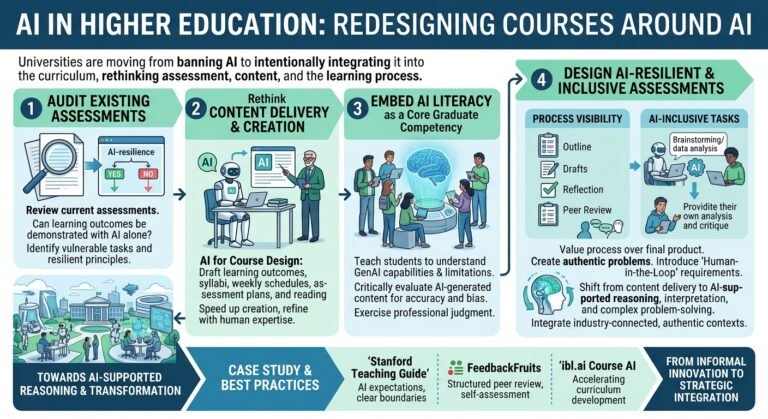
- Process becomes visible. Outlines, draft histories, annotations and reflections are assessed alongside the final piece.
- Writing gets personal and local. Prompts tied to class discussions, local issues and personal experience are harder to outsource and more meaningful.
- Conferences return. Short one-to-one conversations about a draft reveal ownership quickly.
Using AI as a Writing Teacher’s Assistant
AI can strengthen writing instruction when it plays specific roles:
- Counter-argument generator: students write a claim; AI produces objections; students respond.
- Critic: AI identifies weak evidence or unclear sentences in student drafts, and the student decides what to change.
- Model for analysis: students critique an AI-written essay, identifying generic claims and missing evidence.
- Revision partner: after a human-written draft exists, AI suggests improvements that students accept or reject with reasons.
The principle: AI comes in after the student has done the thinking, never before.
The Equity Dimension
Students writing in a second language face a strong temptation to use AI for fluency, and a strong case for some support. Teachers should distinguish between language polishing, which can be acceptable with disclosure, and idea generation, which undermines the learning. Clear rules reduce unfair suspicion of multilingual students whose improved writing is genuine.
A Policy Line Students Understand
“The ideas and structure must be yours. AI may help you check and polish, and you must say how you used it.” Simple, explainable rules earn more compliance than detection software.
Frequently Asked Questions
Is the essay still relevant in the age of AI?
Yes. Writing remains a core thinking skill. What has changed is that take-home essays alone can no longer verify independent work.
How can teachers use AI in writing lessons?
As a critic, counter-argument generator, revision partner or text to analyse, always after students have produced their own ideas.
Should students disclose AI use in writing?
Yes. A short statement describing how AI was used encourages honesty and helps teachers give accurate feedback.