AI, cyber security, Education, GCC, help
The Prepared Mind: Why Your Gear Matters Less Than You Think
Walk into any preparedness forum, any survival subreddit, any emergency planning conversation, and you will find no shortage of lists. Water storage quantities. Recommended caloric density per person per day. The merits of particular flashlight brands. The debate between freeze-dried and canned. The gear conversations are endless, detailed, and genuinely useful in their place.
But the research on who actually survives crises — and more importantly, who functions effectively during them — keeps pointing somewhere else. It points to the space between the ears.
What the Survivors Said
Researchers who study disaster survival have interviewed hundreds of people who made it through serious emergencies: shipwrecks, plane crashes, building collapses, prolonged civil conflict, extended displacement. One of the consistent findings is that physical resources, while important, are rarely the decisive factor. What separates people who keep functioning from those who freeze or collapse is a cluster of mental habits and thinking patterns that can be described, studied, and to a meaningful extent, practiced.
Laurence Gonzales, who spent years studying survival psychology, found that survivors tend to share a specific cognitive profile. They are able to accept the reality of their situation quickly, without denial. They can make decisions under uncertainty without waiting for complete information. They break overwhelming situations into small, manageable actions. And they maintain what he calls “the will to keep going” — not through bravado or denial, but through a kind of flexible, grounded determination.
None of these are personality traits you are born with. They are mental habits that develop through practice and deliberate thinking.
The Problem With Gear Dependency
There is a particular failure mode in preparedness culture worth naming honestly. It is the belief that sufficient equipment equals sufficient preparation. If you have the right bag, the right tools, the right stores, you will be ready.
The problem is that crises are characterized by exactly the conditions that make predetermined plans unreliable. Things break. Circumstances are not what you expected. The situation evolves faster than your equipment can accommodate. The person who has trained their mind to adapt is almost always better positioned than the person who has trained only for a specific scenario.
This is not a theoretical concern. After major disasters, emergency responders consistently report encountering people with substantial supplies who were effectively paralyzed — unable to make decisions because the situation did not match the scenario they had prepared for. Meanwhile, people with fewer resources but sharper mental flexibility were already solving problems and helping others.
Gear is the hardware. The prepared mind is the operating system. Without the software, the hardware sits idle.
Mental Models That Actually Help
So what does a prepared mind actually look like in practice? The research and practitioner literature point to a few specific cognitive patterns.
The first is what the military calls “situational awareness” and what psychologists describe more broadly as accurate, ongoing environmental reading. It is the habit of paying attention to your surroundings in a non-anxious but deliberate way — noticing exits, resources, potential problems, and the behavior of people around you before anything goes wrong. This is not paranoia. It is the difference between someone who is already oriented when a situation deteriorates and someone who is starting from zero.
The second is what stress researchers call “cognitive reappraisal” — the ability to reframe a frightening or overwhelming situation into one that is challenging but navigable. People who do this naturally tend to experience the physiological symptoms of stress — elevated heart rate, heightened alertness — as useful signals rather than disabling ones. They are still afraid, but fear becomes fuel rather than fog.
The third is decision-making under incomplete information. Most people, when facing a decision without full data, either freeze and wait or become reckless. The prepared mind does something different — it makes the best available decision with what is currently known, acts on it, observes the outcome, and adjusts. This iterative approach, sometimes called a “OODA loop” in tactical contexts, is not complicated. But it requires practice to execute under pressure, because pressure naturally pushes people toward either paralysis or impulsivity.
The fourth is what might be called “resource inventory thinking” — the habit of looking at whatever is available, however limited, and asking what it makes possible. Rather than cataloging what is absent, the prepared mind starts with what is present. This cognitive shift sounds minor but produces dramatically different behavior. It is the difference between a person who says “I don’t have my emergency kit” and shuts down, and a person who says “I have a car, a phone with partial battery, and twenty minutes — what can I do with that?”
Stress Inoculation and Why It Matters
One of the most well-supported findings in performance psychology is that mild to moderate stress exposure, in a controlled setting, substantially improves functioning under real stress later. This is the principle behind military training, surgical simulation, and high-stakes athletic preparation. You do not perform well under pressure by avoiding pressure. You perform well under pressure by having experienced pressure before, in progressively more demanding forms.
For civilians, this does not mean putting yourself in danger. It means occasionally practicing the kinds of decisions and actions that would matter in an emergency. Navigating somewhere unfamiliar without digital assistance. Spending a night without power by choice, not by accident. Walking through a realistic mental scenario of a local emergency and thinking through your actual, specific responses rather than a comfortable abstraction.
These exercises feel slightly awkward and unnecessary right up until they are not. What they are building is not skill in the narrow sense — they are building familiarity with discomfort, tolerance for uncertainty, and the confidence that comes from having demonstrated to yourself that you can function when things are not normal.
The Emotional Dimension
It would be incomplete to discuss the prepared mind without discussing the emotional foundations that make it possible. Research on resilience consistently identifies a few emotional capacities that matter most in crisis: the ability to self-regulate under acute stress, a stable sense of purpose or meaning that persists through adversity, and the capacity to maintain connection with others even when circumstances are difficult.
The last point is underrated in most preparedness thinking. Human beings under extreme stress need social contact. They need to feel that they are part of something — a family, a group, a community — that extends beyond their individual survival. People who have those connections intact tend to make better decisions, maintain their functioning longer, and recover faster after the crisis resolves.
This means that one of the most genuinely preparatory things a person can do has nothing to do with gear or supplies. It is to invest in relationships with people around them — not instrumentally, not transactionally, but as a genuine human priority. When something happens, that network is not just emotionally sustaining. It is practically essential.
Starting Where You Are
The prepared mind is not a state you arrive at permanently. It is a set of habits you practice continuously, imperfectly, in ordinary life. The situational awareness you build by paying attention during a routine commute. The decision-making flexibility you develop by working through hypotheticals. The stress tolerance you accumulate through small, voluntary exposures to discomfort.
None of this requires a dramatic lifestyle change or a large investment. It requires the recognition that the most reliable piece of equipment you will ever have in a crisis is the mind you bring to it — and that minds, unlike flashlights, improve with use.
AI, cyber security, Education, encryption, GCC, help
The Psychology of the “It Won’t Happen Here” Trap
There is a particular kind of confidence that lives in people who have never experienced a serious disaster. It is not arrogance, exactly. It is something quieter and more stubborn — a background assumption that the bad things happening elsewhere will continue to happen elsewhere. Researchers have a name for it: optimism bias. And it is one of the most reliably dangerous mental habits a person can have.
The Brain’s Comfort Math
When we hear about a flood in another country, a wildfire destroying a town three states over, or a grid failure paralyzing a city we’ve never visited, our brains perform a quiet calculation. We note the distance. We note the differences between there and here. We conclude, without much conscious effort, that the gap between their situation and ours is protective.
This is not irrational on its face. Distance and context do matter. But the brain doesn’t stop at reasonable inference — it goes further. It inflates the differences and deflates the similarities. It treats the gap as a guarantee rather than a variable. The result is a person who is genuinely, sincerely convinced that their city, their neighborhood, their household is sitting in a kind of permanent exception.
Psychologists studying this pattern have found it across cultures and income levels. It is not a failure of intelligence. Some of the most analytically sharp people hold this belief most firmly, because they are better at constructing arguments for why the exception applies to them.
Normalcy Bias: The Freeze Beneath the Surface
Closely related to optimism bias is what researchers call normalcy bias — the tendency to underestimate both the likelihood and the severity of a disaster because nothing like it has happened before in your experience.
Normalcy bias is why people in the path of a Category 5 hurricane stay home. It is why workers in the World Trade Center went back to their desks after the first plane hit, waiting for an announcement telling them what to do. It is why entire towns have watched floodwaters rise slowly and chosen not to move, because the water had never come this far before.
The brain uses the past as a map for the future. When the future contains something that has no precedent in your personal history, the brain struggles to model it accurately. It defaults to the nearest familiar pattern and treats the situation as less severe than the evidence suggests. This is not a bug in human cognition — it was adaptive for most of human history, when genuine novelty was rare. But in a world with cascading infrastructure, extreme weather, and complex supply chains, it quietly gets people killed.
Why Intelligent People Are Not Immune
There is a common assumption that education and critical thinking inoculate a person against these biases. The research consistently says otherwise. In some cases, higher analytical ability actually increases a person’s capacity to rationalize away warning signs, because they can build more sophisticated justifications for staying put.
This phenomenon — sometimes called “smart person’s paralysis” in disaster psychology literature — shows up repeatedly in post-disaster interviews. Survivors frequently describe their pre-event reasoning as airtight. They had thought through the scenarios. They had weighed the probabilities. They had concluded that the risk was being overstated, that authorities were being overcautious, that the historical record did not support the alarm.
The problem was not that they lacked information. The problem was that they applied their intelligence to confirming a conclusion they had already emotionally committed to — that this was not their crisis to manage.
The Role of Social Proof
Human beings are profoundly social in their risk assessment. We do not evaluate danger purely on objective information. We evaluate it in part by watching what people around us are doing.
When a warning is issued and most of your neighbors stay home, that behavior registers as data. If the people who live here, who know this place, are not leaving — then maybe it is not as serious as the alert suggests. This is not foolishness. In ordinary life, reading social cues is a highly reliable shortcut. The problem is that in a genuine emergency, social cues are often wrong, because everyone is looking at everyone else and making the same calculation simultaneously.
This dynamic helps explain how communities can be almost unanimously wrong in the face of a real threat. Nobody panicked, so nobody moved, so nobody survived to correct the assumption.
What Actually Shifts the Pattern
The research on what changes these patterns is humbling. Information campaigns, on their own, do not work particularly well. Telling people that disasters happen, that they could happen here, that the statistics support concern — this moves the needle less than anyone would hope.
What does work, to a meaningful degree, is prior personal experience. People who have lived through a serious emergency — even a relatively minor one — carry that experience as a reference point that overrides abstract reasoning. They do not need to imagine what it feels like because they already know.
The second thing that works is what researchers call “protective action” framing — giving people something specific and manageable to do. Vague threat awareness tends to produce anxiety and inaction. Specific, achievable preparation tends to produce engagement. The brain resists helplessness. When preparation is framed as a series of small, doable steps rather than a confrontation with terrifying possibilities, people are significantly more likely to act.
The third is community. When preparation is normalized in a social group — when neighbors talk about it, when it is not treated as paranoia or eccentricity — individuals within that group are far more likely to take it seriously. Social proof cuts both ways.
What This Means Practically
None of this requires believing that catastrophe is imminent. The point is not to live in a state of elevated fear. The point is to notice when your confidence that “it won’t happen here” is not actually based on evidence — when it is a feeling dressed up as analysis.
The question worth sitting with is simple: if a serious disruption did happen in your area — extended power failure, supply chain collapse, civil unrest, extreme weather — what would your first 48 hours actually look like? Not theoretically. Practically. What do you have, what do you lack, and who would you call?
Most people find that question uncomfortable not because the answer is hopeless, but because they have never thought it through. That discomfort is information. It is the optimism bias noticing that it has been caught.
AI, cyber security, Education
The Future of AI in Education: How Schools Will Change by 2030
There is a version of this story that sounds like science fiction: personalized robot tutors, classrooms without teachers, exams graded by algorithm. That version makes for good headlines but misses what is actually happening. The real story is quieter, more complicated, and in many ways more interesting. AI is not about to replace schools. It is going to change what happens inside them — slowly in some places, rapidly in others — and by 2030, the classroom most of us grew up in will look noticeably different.
The numbers alone signal how serious the shift already is. The global AI in education market was valued at roughly $7 billion in 2025 and is projected to reach $136 billion by 2035. Student AI tool usage stands at 86%, with nearly a quarter of students using these tools every single day. These are not niche adoption figures. This is a technology that has already entered the classroom whether schools invited it or not.
The Personalization Problem — Finally Getting Solved
For most of the history of formal education, teachers have faced an impossible task: deliver one lesson to thirty students who learn at different speeds, have different gaps in their knowledge, and respond to completely different teaching styles. The best educators have always known this. They’ve just never had the tools to do much about it at scale.
AI changes that equation. Generative AI tools can instantly create learning content tailored to different academic backgrounds and levels, while also helping students address specific gaps in their knowledge. An AI tutoring system can identify, in real time, that a student understands the concept but struggles with its application — and adjust accordingly. No waiting for a test. No waiting for a parent-teacher meeting.
The results from early research are striking. A 2025 Harvard University physics study found that students using AI tutors learned more than twice as much in less time compared to those in traditional active-learning classrooms. Students using an enhanced AI tutor achieved a 127% improvement in outcomes, compared to 48% with a standard AI chatbot. These are not marginal gains.
By 2030, personalized learning pathways will be standard in well-resourced schools. A student who masters fractions quickly will move on without waiting for the rest of the class. A student who keeps stumbling on the same concept will get a different explanation — maybe a visual one, maybe a simpler analogy — instead of hearing the same lesson repeated louder.
The Teacher’s Job Is Changing, Not Disappearing
Every conversation about AI in education eventually arrives at the same anxious question: are teachers going to lose their jobs? The honest answer is no — but their jobs are going to change, and significantly.
The more useful framing is not replacement but redistribution. Teachers spend enormous amounts of time on tasks that do not require a human being: generating lesson plans, writing routine feedback, managing administrative paperwork, designing quizzes. AI handles all of this. Teachers who use AI tools at least weekly save an average of 5.9 hours per week — roughly six extra weeks of reclaimed time over a school year.
What do teachers do with that time? Ideally, they do the things AI cannot: build relationships, notice when a student is struggling emotionally, inspire curiosity, make judgment calls about when a child needs encouragement versus challenge. Human tutors can interpret student emotional states with 92% accuracy, while even the most advanced AI tutoring systems currently manage only 68% accuracy. That gap matters enormously, and it is unlikely to close by 2030.
Between 80% and 90% of universities are planning to introduce AI-enabled teaching assistants in the near future, which points toward a model that will filter down to secondary education as well: human teachers supported by AI assistants, not replaced by them. The teacher becomes a mentor, a guide, a coach. The AI handles the drills.
A 2025 EdWeek survey found that 59% of teachers said AI had enabled more personalized instruction. That is a signal worth taking seriously. When teachers themselves report that a tool is making them better at their core job, adoption tends to stick.
Assessment Is About to Look Very Different
The traditional exam — a high-pressure, timed, closed-book test — was always a compromise. It measured something, but not necessarily what we cared about most. In a world where students have instant access to AI tools, the question “can you recall this information?” becomes almost beside the point.
By 2030, AI is expected to automatically score half of all college essays and nearly all multiple-choice exams. That will free up time for a different kind of assessment: project-based work, oral examinations, portfolio reviews, demonstrations of understanding that are much harder to outsource to an AI. Schools that figure this out early will have a genuine advantage. Schools that keep administering the same tests and simply try harder to detect AI use are likely to lose that arms race.
59% of students already agree that the way they are assessed is changing due to generative AI. Students have noticed what many administrators have not yet officially acknowledged.
Accessibility: The Underreported Upside
Lost in debates about academic integrity and job displacement is one of the most straightforward benefits AI brings to education: it dramatically expands access for students who have historically been left behind.
For students with learning disabilities, AI-powered speech-to-text, text-to-speech, and adaptive pacing tools remove barriers that previously made school an exercise in frustration. Students with physical and learning disabilities are achieving better results through AI tools, with speech-to-text and text-to-speech platforms among the most impactful.
For students in under-resourced schools — in rural areas, in low-income districts, in countries where qualified teachers are scarce — AI tutoring can provide consistent, patient, knowledgeable support that simply was not available before. A student in a small town with no advanced math teachers can access the same quality of instruction as a student at an elite private school. That promise is not yet fully delivered, but it is real.
The Problems Nobody Wants to Talk About
An honest account of where this is heading has to include the parts that are genuinely concerning.
First, training. Nearly 60% of educators and students say they have received no AI training, despite rising adoption. A major perception gap exists: 76% of leaders believe users are trained, but 45% of educators and 52% of students report zero training. A tool without training is not a tool — it is a liability. Schools are deploying AI faster than they are preparing the people who are supposed to use it.
Second, policy. According to a UNESCO survey covering more than 450 schools and universities, only 10% have established guidelines for using AI. Just 7% of schools worldwide have AI guidance, and of those, 40% have only informal guidance. This is not a sustainable situation. Without clear frameworks, students are left to guess what is acceptable, teachers are left to make inconsistent judgment calls, and the potential for AI to undermine learning rather than support it grows.
Third, equity. AI carries a real risk of widening existing gaps rather than closing them. The most pressing challenge ahead is ensuring that the benefits of AI in education reach students in low-income, rural, and under-resourced communities at the same rate as those in well-funded institutions. Without deliberate policy intervention, schools that are already well-resourced will adopt AI faster, train their teachers better, and pull further ahead. The technology is neutral. Its distribution is not.
Fourth, critical thinking. A January 2026 survey found that 95% of college faculty fear student overreliance on AI and diminished critical thinking. 60% of educators express concern that AI could negatively affect students’ independent thinking, writing, and research skills. These fears are not irrational. If students use AI to skip the hard, uncomfortable work of forming their own arguments and working through difficult problems, they may arrive at graduation with impressive grades and underdeveloped minds.
What 2030 Actually Looks Like
By 2030, the school that has handled this transition well will look something like this: students arrive with a baseline of AI literacy built into the curriculum from early grades. Teachers spend less time on administrative tasks and more time on mentorship, discussion, and the kinds of high-order thinking that cannot be delegated to an algorithm. Assessments are designed around what humans can do that AI cannot. Students with disabilities have access to tools that would have transformed their educational experience a decade earlier. And clear policies govern how AI is used — with enough flexibility to evolve as the technology does.
The school that has handled it poorly will look like an arms race: students using AI to complete assignments, teachers using AI detectors that produce false positives and erode trust, administrators issuing bans that nobody enforces, and the fundamental questions about what education is actually for going completely unanswered.
By 2030, approximately 70% of job skills are expected to change, primarily due to the impact of AI. Schools do not have the option of sitting this out. The question is not whether AI will change education. It already has. The question is whether schools will shape that change — or simply react to it.
The institutions that will serve students well are the ones asking hard questions now: What do we want students to be able to do that AI cannot do for them? What does genuine understanding look like in a world of instant answers? What is a teacher for, and what is a test for, when both can be bypassed by a phone?
Those are not technology questions. They are education questions. And answering them well — before 2030, not after — is the real work ahead.
GCC
Part III of the Series: Prophets, Empires & the Modern World
From Karbala to the Khilafat: How the Tragedy of 680 CE Planted the Seeds of the Modern Israel-Iran Confrontation
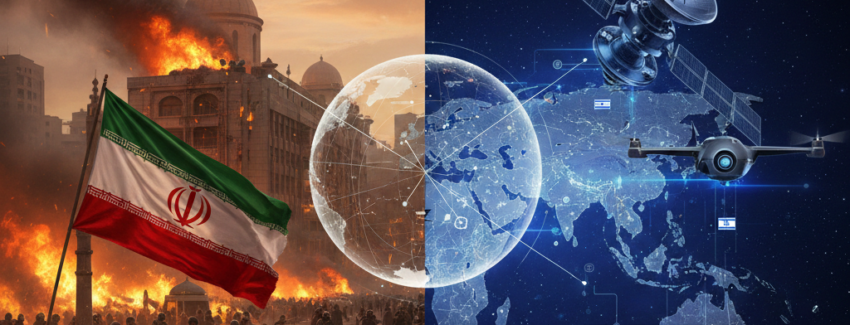
At the end of Part II, we arrived at a question that most historians and analysts have failed to ask seriously: if Jews and Muslims lived largely in peace for over a thousand years, when did the modern conflict between them actually begin? And more specifically — why is Iran, of all nations, the most implacable enemy of the Israeli state today?
The conventional answer points to 1948, the founding of Israel, or to 1979, the Iranian Revolution. Both answers are wrong — or rather, they are correct only at the surface level. The true roots of this confrontation stretch back thirteen centuries, to a desert plain in Iraq, on a single day in October of the year 680 CE.
That day was the Battle of Karbala. And to understand it is to understand nearly everything about the modern Middle East that our newspapers fail to explain.
The Background: Who Was Husayn ibn Ali?
To understand Karbala, we must first understand who Husayn was and why his death mattered so profoundly.
Husayn ibn Ali was born in January of 626 CE. His father was Ali ibn Abi Talib — the cousin and son-in-law of the Prophet Muhammad (?), and the fourth Caliph of Islam. His mother was Fatimah al-Zahra — the beloved daughter of the Prophet, described in hadith as the leader of all women of paradise. Husayn was therefore the grandson of the Prophet Muhammad (?) through the Prophet’s own daughter. The Prophet himself is recorded in multiple hadith as expressing extraordinary love for Husayn and his brother Hasan. In one famous hadith, he said: “Husayn is from me, and I am from Husayn. Allah loves whoever loves Husayn.”
This is not a minor genealogical detail. In Islamic culture — and in the broader Semitic cultural world — the family of a prophet carries a sanctity that is almost without parallel. Husayn was not a distant relative. He was the flesh and blood of the Prophet of Islam, raised in his household, loved by him personally. His death, and the manner of it, would shake the Muslim world to its foundations.
The Rise of the Umayyads and the Breaking of the Covenant
To understand why Husayn died, we must go back further — to the question of succession after the Prophet’s death.
The Prophet Muhammad (?) passed away in 632 CE. The question of who would lead the Muslim community — the Ummah — after him became the central political fault line of early Islamic history. The first three caliphs — Abu Bakr al-Siddiq, Umar ibn al-Khattab, and Uthman ibn Affan — were chosen through consultation and community consensus. Ali ibn Abi Talib became the fourth Caliph in 656 CE, but his tenure was marked by civil conflict. He was assassinated in 661 CE by a member of the Kharijite faction.
After Ali’s assassination, his son Hasan ibn Ali briefly assumed leadership but concluded a peace treaty with Muawiyah ibn Abi Sufyan — the powerful Governor of Syria and founder of the Umayyad dynasty. The treaty had one crucial condition: Muawiyah would not appoint a hereditary successor. The Caliphate would revert to the family of the Prophet after Muawiyah’s death. This was a solemn covenant.
Muawiyah violated it completely. Before his death in April 680 CE, he appointed his own son Yazid as his heir — transforming the caliphate from an institution of religious leadership into a hereditary monarchy. This was not merely a political act. It was, in the eyes of the Muslim community, a profound corruption of the entire structure of Islamic governance. Yazid, by all contemporary accounts, was a man known for drinking wine, keeping hunting dogs, and conducting himself in ways incompatible with the gravity of the caliphate.
Husayn ibn Ali refused to pledge allegiance to Yazid. His refusal was not merely political ambition — it was a principled moral stand. As he said himself: “Anyone like me will never accept anyone like Yazid as a ruler.” He was choosing principle over safety, and he knew what it would cost him.
The Journey to Karbala
Husayn left Medina in late 679 CE, eventually making his way to Mecca. There, he received hundreds of letters from the people of Kufa — a city in what is now southern Iraq, which had been a stronghold of Ali’s caliphate and remained deeply loyal to the family of the Prophet. The Kufans begged Husayn to come to them. They pledged their allegiance, their swords, their lives. They promised that tens of thousands would rally to him when he arrived.
Husayn sent his cousin, Muslim ibn Aqeel, to Kufa in advance to assess the situation. The initial report was encouraging — Muslim found the city brimming with support, and wrote to Husayn that conditions were favorable. But then Yazid’s new governor, the ruthless Ubaydullah ibn Ziyad, arrived in Kufa. Within days, he had arrested Muslim ibn Aqeel and had him executed. The promised supporters melted away under the threat of violence. Kufa went silent.
The news of Muslim’s execution reached Husayn while he was already on the road, deep in the desert. His companions urged him to turn back. Some left. But his closest followers — family members, lifelong companions, and a small number of devoted men who refused to abandon him — stayed. By the time the caravan arrived at the plain of Karbala on October 2, 680 CE, Husayn’s force numbered approximately 72 fighting men, accompanied by women and children of the Prophet’s family.
Facing them was a Umayyad army of thousands — some accounts say four thousand, others far more.
The Tenth of Muharram: The Day the World Changed
For eight days, Husayn’s small camp sat in the open desert. Yazid’s forces cut off their access to the Euphrates River. The children of the Prophet’s family — including an infant — went without water in the scorching Iraqi sun.
On the night before the battle, Husayn gathered his companions. He told them plainly: the enemy wants only me. Whoever wishes to leave in the darkness of night has my blessing and my thanks. Every one of them refused to leave.
On the morning of October 10, 680 CE — the 10th of Muharram in the Islamic calendar, known as Ashura — the battle began. One by one, Husayn’s companions and family members were killed. His brothers. His nephews. His sons. Including, according to various accounts, his infant son Ali al-Asghar, who was killed while Husayn held him in his arms pleading for water for the child.
Husayn fought until he was too wounded to continue. He was surrounded, struck repeatedly, and beheaded. His severed head and the heads of his companions were placed on spears and carried to Damascus, to Yazid’s court. The women and children of the Prophet’s family — including Husayn’s sister Zaynab bint Ali, a woman of extraordinary courage who would bear witness to the world about what had happened — were taken as prisoners.
The Umayyad forces won the battle. They lost the war for history.
The Earthquake That Created Shia Islam
Before Karbala, “Shia” — from “Shiat Ali,” meaning “the party of Ali” — was largely a political faction, not a distinct religious sect. It was a group of Muslims who believed that leadership of the Ummah rightfully belonged to the family of the Prophet. There were no separate theological doctrines, no distinct rituals, no separate religious identity.
Karbala changed everything.
The German scholar Heinz Halm, one of the foremost Western authorities on Shia Islam, wrote that there was no religious aspect to Shi’ism prior to 680 CE. The death of Husayn and his followers was, in his words, the “big bang” that created the rapidly expanding cosmos of Shi’ism and brought it into motion.
Karbala gave the followers of Ali’s family something they had not had before: a theology of martyrdom, a sacred narrative of sacrifice, and a burning sense of collective grief and injustice that has never been extinguished in fourteen centuries. The story of a small band of righteous people — the family of the Prophet — being abandoned by the masses, surrounded by an army of power, and slaughtered in the desert while standing on principle became the founding myth and the living wound of an entire civilization.
The Shia commemorated Ashura — the 10th of Muharram — not as a distant historical event but as a wound that was re-opened and re-lived every year. The phrase that became the defining cry of Shia consciousness across generations captures it perfectly: “Every land is Karbala. Every day is Ashura. Every month is Muharram.”
Iran: The Nation That Made Karbala Its Identity
Here the story turns to Persia — and this is where the bridge to the modern world becomes visible.
When the Muslim armies conquered Persia in the 7th century CE, they ended the ancient Sasanian Empire. Persia had been a great civilization for over a thousand years. Its people had their own language, their own culture, their own imperial identity. The Arab conquest was, from a Persian cultural perspective, a humiliation — however much many Persians eventually embraced Islam with genuine devotion.
For centuries, Persia remained largely Sunni — it was home to some of the greatest Sunni scholars in Islamic history, including Imam al-Bukhari, Imam al-Tirmidhi, and Imam al-Ghazali, all of whom were from the Persian cultural world. But underneath the surface, there was always a current of sentiment — both religious and cultural — that looked toward Ali’s family, toward the oppressed, toward resistance against Arab political dominance.
Then came the Safavids.
In 1501 CE, a young military leader named Shah Ismail I of the Safavid dynasty conquered Tabriz and declared himself Shah of Iran. His first act — before consolidating military control, before establishing administration — was to declare Twelver Shia Islam the official state religion of Iran. This was a political as much as a religious decision. Iran was surrounded by Sunni powers: the Ottoman Empire to the west, the Uzbek khanates to the east. By making Shia Islam the state religion, Ismail gave Iran a distinct religious identity that would permanently differentiate it from its rivals and unify its diverse population around a single, emotionally powerful narrative — the narrative of Karbala.
For the next two centuries, the Safavids pursued this conversion with enormous force. Sunni scholars who refused to convert were executed. Shia scholars were imported from Lebanon and Iraq to staff religious institutions. Public rituals of mourning for Husayn — weeping, lamentation, the dramatic re-enactment of Karbala — were institutionalized across the country. Within roughly a century, Iran was transformed from a predominantly Sunni nation into the world’s most Shia state. Today, approximately 90–95% of Iran’s population is Shia Muslim.
What the Safavids understood — and what has remained true ever since — is that for Iranian Shia Muslims, Karbala is not merely a historical event. It is the central organizing story of their civilization. Husayn is not merely a historical martyr. He is the supreme symbol of justice against tyranny, of standing alone against overwhelming power, of refusing to submit to illegitimate authority even at the cost of one’s life. Every Iranian ruler who has invoked Husayn’s memory has tapped into something deep and inexhaustible.
The Thread That Connects Karbala to Israel
Now we arrive at the connection that most analysts miss entirely.
The Umayyad dynasty — the force that killed Husayn, that cut off the water supply from the Prophet’s grandchildren, that carried his head on a spear to Damascus — was headquartered in Damascus, in Syria. The Umayyads were Arab in identity, Syrian in base, and their political culture was shaped in significant part by the Levantine region — which included the Jewish communities of Palestine and the broader Fertile Crescent.
From the Shia Iranian perspective — formed over fourteen centuries of commemorating Karbala — the Umayyad tradition represents something specific: the tradition of illegitimate power, of worldly authority dressed in religious clothing, of those who killed the family of the Prophet in the name of political control. This is not merely a medieval grievance. It is a living theological framework through which Iranian political culture understands power, justice, and resistance.
When the modern State of Israel was founded in 1948 — backed by Western powers, built on Palestinian land, governed by Ashkenazi political leadership — what Iranian Shia religious culture saw was a pattern it recognized completely: a powerful, externally-backed political project, claiming religious legitimacy, dispossessing and oppressing the weaker party, with the full support of the dominant world powers. The parallel to the Umayyad caliphate — powerful, politically backed, claiming Islamic credentials while oppressing the righteous — was not lost on Shia scholars and clerics.
When Ayatollah Ruhollah Khomeini framed the Israeli state in the language of Karbala — as a Yazidian power, as a force of oppression that the heirs of Husayn were bound to oppose — he was not inventing a new ideology. He was plugging the Palestinian cause into the oldest and deepest story in Iranian religious consciousness. He was telling Iranian Shia Muslims: this is your Karbala. These are your people. This is the moment you stand up, as Husayn stood, and refuse to submit.
That is why the slogan of the Iranian Revolution — “Every day is Ashura, every land is Karbala” — was applied directly to Palestine. And that is why, unlike most Arab states which have made peace with or accommodation toward Israel, Iran’s opposition is not transactional or political. It is theological. It is civilizational. It is rooted in a grief and a sense of justice that is fourteen centuries old.
What This Means for the Modern Conflict
Several conclusions flow from understanding this history properly.
First, the Iran-Israel conflict is not a conflict between Judaism and Islam. It is a conflict between, on one side, an Ashkenazi-led political state founded on European Zionist ideology with Western military backing, and on the other side, a Shia Iranian civilization that has for five centuries defined itself through the prism of Karbala — through resistance to unjust power, through solidarity with the oppressed, through refusal to acknowledge illegitimate authority regardless of the cost.
Second, Iran’s support for Hamas, Hezbollah, and Palestinian resistance movements is not primarily an expression of Arab solidarity — Iran is not Arab. It is an expression of Shia theological conviction. The Quds Force is named after Jerusalem — al-Quds in Arabic. The annual Al-Quds Day rally, established by Khomeini in 1979 on the last Friday of Ramadan, frames Jerusalem not as a foreign policy interest but as an Islamic obligation. This framing is Karbala in modern dress.
Third, the conflict will not be resolved by the methods being applied to it. No military campaign, no diplomatic agreement between Arab states and Israel, no American-brokered deal will address the roots of Iranian opposition to the Israeli state — because those roots are not in policy. They are in theology and civilizational identity. Iran does not oppose Israel because of this or that military action. Iran opposes the Israeli state because, from a Shia Iranian perspective, its very existence represents an act of Yazid — an act of worldly power crushing the righteous, backed by the dominant empire of the age.
Fourth — and this is perhaps the most important insight — the Palestinian people themselves occupy a particular place in this framework. They are the Husayns of the modern age: the small band, the family, the people abandoned by much of the world, surrounded by overwhelming force, denied water and bread, dying in the desert of history while the powerful look on. Whether one agrees with this framing or not, understanding that this is how Iran genuinely understands the situation — not as a calculation but as a sacred obligation — is essential to understanding why the conflict looks the way it does.
A Note on Perspective and Responsibility
This analysis does not endorse violence, nor does it assign collective guilt to any people or faith. It is the responsibility of an honest historian and analyst to trace causes accurately, even when those causes are uncomfortable or when they challenge simplified narratives on all sides.
The tragedy of Karbala was a genuine human catastrophe — the killing of the Prophet’s grandson and family by a political power that had usurped legitimate authority. Its grief is real. Its lessons about justice and standing against tyranny are genuinely profound, recognized even by Sunni Muslims and by non-Muslims who have studied it seriously.
At the same time, the people of Gaza and Palestine are real people suffering real dispossession and violence in the present. The Iranian revolutionary state has its own complexities, contradictions, and abuses of power that exist alongside its invocation of Karbala’s memory. And the Jewish people — all three branches of them — carry their own centuries of suffering and legitimate fears.
What the history tells us — from the Babylonian exile, through the ministry of Jesus, through Karbala, through the Safavid transformation of Iran, to the founding of modern Israel — is that the Middle East is not a region of simple conflicts between simple enemies. It is a region where the wounds of the past are very much alive in the present, where the words “justice” and “martyrdom” and “promised land” carry the weight of millennia, and where no solution that ignores history will last.
What Comes Next
In Part IV, we will trace the thread from the Abbasid revolution — which overthrew the Umayyads with the help of Persian and Shia forces in 750 CE — through the fragmentation of the Caliphate, the Crusades, the Mongol invasions, and the Ottoman Empire, to ask a question that ties all of these threads together: what does the collapse of the Khilafat in 1924 have to do with the birth of Israel in 1948 — and why are these two events, separated by just twenty-four years, not a coincidence?
(To be continued)