|
Getting your Trinity Audio player ready... |
A quiet shift is happening in academic integrity cases. Students accused of AI misuse are pushing back, challenging unreliable detection scores, pointing to contradictory rules between courses, and in some cases bringing in parents or lawyers. Many are right. Most integrity frameworks were written for a world of copy-paste plagiarism and have been patched rather than rebuilt. An academic integrity policy for the AI era needs to be clear, consistent and fair enough that students accept it.
Why Old Policies Are Failing
- Vague definitions: “unauthorised assistance” means little when AI is built into word processors and search engines.
- Inconsistent rules: one teacher bans AI, another requires it, a third never says.
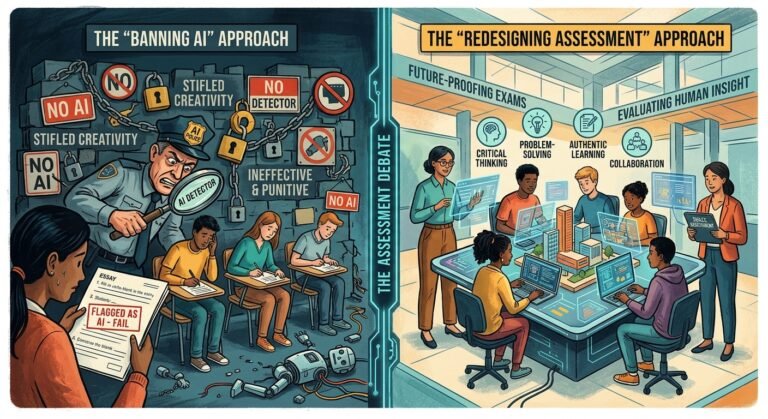
- Detector dependence: AI detection tools produce false positives, and some groups, including students writing in a second language, are more likely to be wrongly flagged.
- Burden of proof: students are asked to prove they did not use AI, which is often impossible.
The Mechanism: Rules Students Cannot Follow
When rules are unclear, honest students cannot comply with confidence, and dishonest students exploit ambiguity. Enforcement then depends on teacher suspicion, which is inconsistent and can be biased. The result is a system students experience as arbitrary, which undermines the very culture of integrity it is meant to protect.
Principles for a Modern Policy
- Use a clear scale. For every task, state the AI level: none, planning only, editing allowed, fully integrated with disclosure.
- Require disclosure. A short statement of how AI was used, normalised rather than stigmatised.
- Never rely on detectors alone. A detector score can start a conversation; it cannot be the evidence.
- Use conversation as verification. Ask the student to explain their work; understanding is the best evidence.
- Proportionate responses. Distinguish confusion, minor misuse and deliberate deception.
- Include student voice. Involve students in drafting the policy; they will spot ambiguities staff miss.
The Equity Dimension
Second-language writers, neurodivergent students and students whose writing improved rapidly are disproportionately suspected. Families with resources can contest accusations; others cannot. A fair process, with clear evidence standards and the right to explain, protects students who are most likely to be wrongly accused.
Frequently Asked Questions
Are AI detectors reliable for academic integrity?
No. They produce false positives and should never be the sole evidence in an integrity case.
What should an AI academic integrity policy include?
Task-level AI rules, a disclosure requirement, evidence standards, verification through conversation and proportionate consequences.
Should students help write integrity policies?
Yes. Student input makes policies clearer and increases acceptance and compliance.