|
Getting your Trinity Audio player ready... |
Schools have long been attractive targets for cybercriminals: valuable personal data, limited IT staff and many users with varying security awareness. AI adds a new layer. Chatbots connected to school data, AI agents that can send emails or change records, and AI-generated phishing all expand the attack surface. AI cybersecurity for schools is no longer a future concern; it belongs in this year’s IT plan.
The New Risks
- AI-powered phishing: fluent, personalised emails and voice messages impersonating principals, finance staff or parents.
- Prompt injection: hidden instructions in documents, emails or web pages that manipulate an AI assistant into revealing data or taking actions.
- Over-permissioned agents: AI agents granted broad access to email, drives or the SIS that can be misused if compromised or misdirected.
- Data leakage: staff and students pasting sensitive information into unapproved tools.
- Shadow AI: unapproved browser extensions and apps with access to school accounts.
Why Agents Change the Picture
A chatbot that only answers questions can leak information. An agent that can act can cause damage: sending messages, sharing files, modifying records. If an agent reads an email containing hidden malicious instructions, it may follow them. The security principle is simple and old: least privilege. Give agents only the access they need for one task, and require human approval for sensitive actions.
Controls School IT Teams Should Prioritise
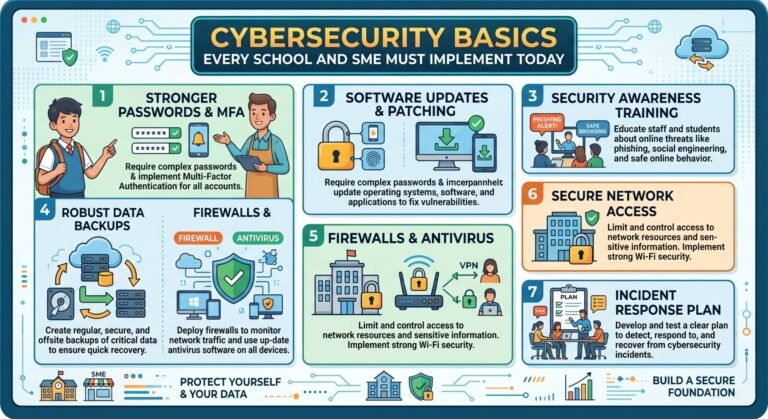
- Inventory AI: list every AI tool, extension and integration with access to school systems.
- Review OAuth grants: revoke unneeded third-party app permissions on school accounts.
- Restrict agent permissions: read-only by default; approval required for sending, sharing or deleting.
- Strengthen identity: enforce multi-factor authentication, especially for finance and admin staff.
- Verify payment requests: require call-back verification for any change to bank details, regardless of how convincing the request is.
- Update training: show staff examples of AI-generated phishing and deepfake voice calls.
- Log and monitor: keep audit logs of AI tool activity where platforms allow.
The Equity Dimension
Large school groups can afford security teams and enterprise tools. Small schools often rely on one overstretched IT person. Shared services, regional frameworks and national cybersecurity guidance can help smaller institutions reach a baseline of protection.
Frequently Asked Questions
What is prompt injection?
Prompt injection is an attack where hidden instructions in content such as an email or document manipulate an AI system into doing something unintended, like revealing data.
Are AI agents a security risk for schools?
They can be if given broad permissions. Least-privilege access and human approval for sensitive actions reduce the risk.
How can schools defend against AI phishing?
With multi-factor authentication, verification procedures for payments and sensitive requests, and updated staff training.