
The Psychology of Staying Put: Why People Don’t Run When They Should

The Psychology of Staying Put: Why People Don’t Run When They Should

The Psychology of Staying Put: Why People Don’t Run When They Should

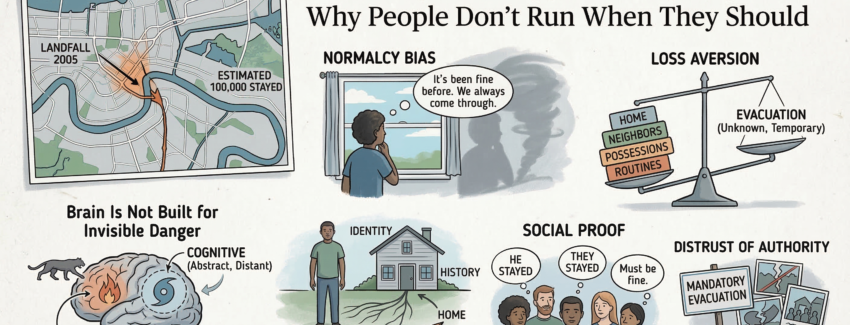
When Hurricane Katrina made landfall in August 2005, officials had issued a mandatory evacuation order for New Orleans more than 24 hours in advance. The storm’s path was well-documented. The warnings were loud and clear. And yet, an estimated 100,000 people stayed behind.

They weren’t all uninformed. They weren’t all unable to leave. Many of them simply didn’t go.

This pattern repeats itself with uncomfortable regularity across disasters of every kind — wildfires, floods, wars, chemical spills. The evacuation order goes out, and a significant portion of the affected population makes the quiet, often fatal decision to stay. Understanding why isn’t just an academic exercise. It’s one of the most important things a person can know about how human beings actually behave under threat.

The Brain Is Not Built for Invisible Danger

The human threat-detection system was shaped over hundreds of thousands of years to respond to immediate, visible danger. A predator. A fire in front of you. A flood already at your door. It is exquisitely calibrated for the present tense.

Abstract danger — a storm system still two hundred miles offshore, a front line advancing slowly through a region, a chemical plume that hasn’t reached your street yet — doesn’t trigger the same visceral alarm. The brain registers the information intellectually, but the gut doesn’t follow. There’s no spike of adrenaline, no overwhelming urge to move. Just a kind of uneasy uncertainty that’s easy to rationalize away.

This is part of why official warnings are less effective than they should be. The information is there, but it arrives in the wrong format for the part of the brain that actually drives behavior.

Normalcy Bias: The World Will Probably Be Fine

One of the most well-documented phenomena in disaster psychology is normalcy bias — the tendency to underestimate both the likelihood and the severity of a crisis because nothing this bad has happened before.

The logic, when made explicit, sounds almost reasonable: I’ve lived in this city my whole life. There have been storms before. The power’s gone out a few times, maybe some flooding in the low-lying areas, but we’ve always come through. Why would this time be any different?

The brain defaults to its archive of past experience. And if that archive doesn’t contain a true catastrophe, it has nothing to calibrate against. The worst-case scenario remains genuinely unimaginable, not in the poetic sense but in a literal, neurological one.

This is also why so many accounts from disaster survivors include some version of the same statement: “I didn’t think it would actually be that bad.” The warning had to compete with a lifetime of evidence that things usually weren’t that bad. And the warning lost.

Loss Aversion: What You Stand to Leave Behind

Leaving feels like losing. That’s not irrational — it’s deeply human, and it’s backed by decades of behavioral economics research.

The psychologists Daniel Kahneman and Amos Tversky demonstrated that losses feel roughly twice as powerful as equivalent gains. In practical terms, this means that the prospect of abandoning your home, your possessions, your neighborhood — even temporarily — carries an emotional weight that’s genuinely difficult to overcome, even when the rational case for leaving is airtight.

Think about what evacuation actually asks of someone. Leave your home, possibly forever. Leave your belongings, most of which you can’t take. Leave your neighbors, your routines, your sense of place. Accept that you may return to rubble, or may not be allowed to return at all. Go somewhere unfamiliar, probably at your own expense, with no guarantee of when this ends.

Against all that loss, the threat has to feel not just real but immediate and overwhelming. For a lot of people, it never quite crosses that threshold — until it’s too late.

The Anchoring Effect of Home

Beyond the fear of losing things, there’s something harder to quantify: the gravitational pull of place itself.

For many people, especially older residents and those who have lived in the same community for decades, home is not simply a building. It’s an identity. It’s the place where their history lives — the house they raised their children in, the street where their parents are buried nearby, the neighborhood where everyone knows their name. Evacuating doesn’t just mean leaving a structure. It means leaving the physical architecture of a life.

This is particularly pronounced in communities with strong cultural or ethnic ties to a place. Leaving isn’t just uncomfortable. It can feel like a form of erasure, a severing from something essential about who you are. Some people would genuinely rather risk death than accept that.

This isn’t weakness. It’s a measure of how much a place can mean. But it is, under crisis conditions, a potentially lethal attachment.

Social Proof and the Wait-and-See Effect

Human beings are deeply social animals, and in moments of uncertainty, we look to each other for cues about how to behave. If my neighbors are staying, that’s data. If my family thinks the warnings are overblown, that carries weight. If the most respected person on the block says they’ve seen worse and they’re not going anywhere, that shapes my decision more than any official broadcast.

This is social proof operating in the worst possible context. When the people around you collectively underestimate a threat, their collective behavior becomes its own form of evidence. Everyone is watching everyone else, and everyone else is staying, so staying must be reasonable.

The effect is compounded by something called pluralistic ignorance — the phenomenon where most individuals privately harbor doubts or fears, but assume they’re alone in feeling that way because no one around them is visibly alarmed. In the absence of anyone expressing panic, everyone concludes there’s no cause for panic, even when almost everyone is quietly uneasy.

Distrust of Authority

There’s another factor that doesn’t get discussed enough in mainstream accounts of why people fail to evacuate: many of them don’t trust the people telling them to leave.

This is not irrational. In communities that have historically been failed by government institutions — through neglect, displacement, broken promises, or outright harm — an official warning carries a different weight than it does for someone with a baseline of institutional trust. When the government says “leave for your safety,” people who have spent their lives watching government action harm rather than protect them are entitled to ask: safe for whom? And what happens to our neighborhood while we’re gone?

After Katrina, predominantly Black neighborhoods in New Orleans were among the last to receive aid and among the first to be bulldozed for redevelopment. The distrust that led some residents to stay wasn’t purely psychological failure. It was informed by a rational reading of history.

Disaster preparedness communication that ignores this dynamic will always fall short in the communities that need it most.

What This Means for Anyone Trying to Survive

Understanding why people stay isn’t just intellectually interesting — it has practical implications for how you think about your own behavior under threat.

The first implication is this: do not trust your instincts about whether something is dangerous enough to act on. The part of your brain that generates urgency is not calibrated for slow-moving or distant threats. You need to make decisions based on information, not on whether you feel scared enough yet.

The second is to make your decisions in advance. The research on decision-making under stress is unambiguous: people who have predetermined thresholds — if the wind speed reaches X, I leave; if the front advances to Y, I go — are far more likely to act in time than people who are deciding in the moment. When the crisis arrives, your cognitive load is already at maximum. You don’t want to be running cost-benefit analyses while the situation deteriorates.

The third is to be honest about your attachments. Knowing that you have strong ties to a place, to possessions, to community, doesn’t make those ties disappear — but it does allow you to account for their distorting effect. Naming the bias doesn’t eliminate it, but it creates a fighting chance.

And the fourth is to talk to the people around you before a crisis, not during one. The social proof effect works both ways. If the people in your household, your family, your immediate community have already discussed what the trigger for leaving looks like, you’re far less likely to be paralyzed by collective inertia when the moment arrives.

The instinct to stay is not stupidity. It’s human. It’s ancient. It’s built from love of place, distrust of uncertainty, and a brain that was never designed for the kind of abstract, slow-rolling danger that modern disasters often present.

But understanding it — naming the mechanisms clearly and without condescension — is the beginning of being able to act differently when it matters most. The people who make it out are not always the strongest or the best-prepared in any material sense. They’re often simply the ones who understood, in advance, how easy it is to stay too long.

From Shepherds to Rulers: The Story of Prophet Dawud (David) and the Rise of the Jewish People

From Shepherds to Rulers: The Story of Prophet Dawud (David) and the Rise of the Jewish People

From Shepherds to Rulers:

The Story of Prophet Dawud (David) and the Rise of the Jewish People

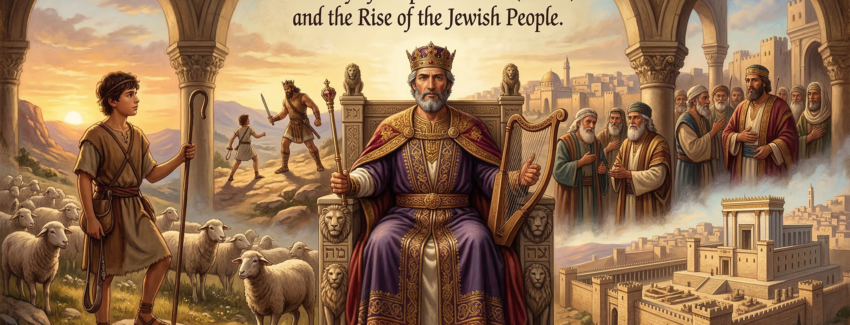
After the return of the Israelites to Palestine, the tribe of Judah (Banu Yahuda) found itself expelled from Jerusalem by the other ten tribes of Israel. The reason, according to biblical tradition, was economic — the Judahites had become notorious moneylenders who, within a few generations, had brought the entire economic system under their control, making the other ten tribes financially dependent on them. Eventually, the ten tribes united and drove Banu Yahuda out of Jerusalem. The exiled tribe settled on the western bank of the Jordan River, barred from trade and left with only two occupations: herding sheep and goats, and working as laborers in Jerusalem’s ironworks — though they were not permitted to remain in the city after sunset. In their hardship, they prayed fervently to God for relief. God answered their prayers by sending Prophet Dawud (David) among them.
Even in childhood, God had blessed Dawud with two remarkable gifts. The first was his voice — extraordinarily beautiful and deeply moving. When he sang, people stopped in their tracks, as though their hearts had momentarily ceased beating. This gift would soon carry him to the royal court. At the time, Palestine was under the rule of the tribe of Benjamin — the tribe of Benjamin, the youngest son of Prophet Jacob. The king was Saul (known in the Quran as Talut). When the king heard the young Dawud sing and play music, he was captivated and brought him into his court as a musician. Dawud was an expert in two instruments of the era — the harp and the lyre. The Quran mentions his magnificent recitation (Lahn Dawudi), while the biblical details about his early career as a court musician come from the Book of Samuel in the Bible.
Dawud was between ten and fifteen years old at the time. His second gift was marksmanship. From childhood, he had practiced with a sling — a length of rope or leather used to hurl stones — and had become the most accurate marksman of the tribe of Judah. He could identify a single fruit on a tree laden with hundreds, swing the sling, and bring down only that fruit. The Prophet Samuel, who belonged to the tribe of Levi and was the spiritual authority of the time, recognized something extraordinary in the boy and prophesied that Dawud would be Israel’s next king and prophet. (The full account of Dawud’s life is recorded in the Book of Samuel in the Bible.)
The defining moment came around 1012 BCE, when the Philistines — a powerful people from the coastal plain of Canaan — launched an assault on the Israelites. Their champion was Goliath (called Jalut in the Quran), a giant warrior from the Philistine city of Gath, standing approximately nine feet tall. The two armies faced each other in the Valley of Elah. Goliath stood in the middle of the field, his body covered in iron and bronze armor from head to toe — with only his forehead left bare. He taunted the Israelites day after day, challenging them to send out a single champion to face him, but no one dared step forward.
Dawud had come to the battlefield merely to bring food to his brother, who was serving in the Israelite army. He arrived to find Goliath mid-taunt. In his bag, Dawud carried his sling and five smooth stones. Without hesitation, he loaded a stone into the sling and ran forward to face the giant. Dawud barely reached Goliath’s knees. Goliath initially refused to fight what he saw as a shepherd boy, mocking both him and the Israelites. But as Goliath turned to address the crowd, Dawud released the sling. The stone flew straight and struck Goliath on the bare forehead — the one unprotected spot. The giant collapsed like a felled tree. Dawud then took Goliath’s own sword and beheaded him. It was over in seconds. The watching armies stood stunned. The Philistines fled in panic, and the Israelites won the battle.
King Saul rewarded Dawud by giving him his daughter Michal in marriage and bringing him into a position of power. This marked the beginning of the restoration of the tribe of Judah’s honor and standing. By 1010 BCE, after Saul’s death, Dawud became king, and the kingdom passed into the hands of Banu Yahuda.
God then bestowed upon Dawud three extraordinary gifts simultaneously: prophethood, kingship, and a revealed scripture. The Psalms (Zabur in Arabic) — the second divinely revealed book after the Torah — were sent down to him. God also gave him a miraculous mastery over iron: in his hands, iron became as pliable as wax. This was particularly significant because the tribe of Judah, during their years of hardship, had worked as ironworkers and metalworkers. Dawud’s family had also made armor as a side trade alongside herding. With iron made soft in his hands, Dawud could bend and shape it with his fingers alone, without tools, crafting chainmail and armor until the end of his life. This tradition of metalworking would become one of the lasting legacies of the Jewish people — to this day, global trade in metals and precious materials is substantially dominated by Jewish business networks.
Under Dawud’s rule, the Judahites transformed from shepherds and laborers into rulers. His kingdom stretched from the Nile to the Euphrates, encompassing present-day Saudi Arabia, the Gulf states, much of Iraq, and all of Jordan and Syria — with Jerusalem as its capital. He reigned from 1010 to 970 BCE, a period of forty years.
A brief but fascinating linguistic digression: the Judahites were also skilled goldsmiths and silversmiths. In the Moroccan city of Fez, there was a Jewish quarter where they crafted and sold jewelry. The word “Yahudi” (Jew) traveled through Arabic and Persian into Old English, eventually becoming “Jew” and “Jewish.” The Jewish craftsmen of Fez were also called “Jew” by traders, and their wares became known as “Jewels” — and so the English word “jewelry” traces its roots, through a long linguistic journey, back to these Jewish artisans of North Africa.
After Dawud, God granted both prophethood and kingship to his son, Prophet Sulaiman (Solomon). Sulaiman’s kingdom was vast and his reign legendary. Among his many wives was the Queen of Sheba — known in Islamic tradition as Bilqis, and believed by Ethiopian tradition to have been an ancestor of the Beta Israel (Ethiopian Jews). Their descendants settled in what is today Ethiopia, Zimbabwe, South Africa, and Uganda. Ethiopia still has a synagogue said to be over 2,700 years old, belonging to this community.
In 957 BCE, Sulaiman built the First Temple in Jerusalem, constructed around the ancient mosque (place of worship) that Prophet Ibrahim had established there. This Temple became the holiest site in Judaism. Beneath it, Sulaiman entombed the Ark of the Covenant — a wooden chest containing the stone tablets that Prophet Musa brought down from Mount Sinai, along with other sacred relics. The Temple, built over this ark, became the axis of Jewish religious identity and remains so to this day.
This age of glory, however, eventually came to an end. In 586 BCE — roughly 2,600 years ago — the Babylonian King Nebuchadnezzar II (whom the Jews call Nebuchadnezzar, and who is sometimes referred to in Islamic oral history as Bukht Nasr) attacked Jerusalem. He destroyed the First Temple, leaving only its outer western wall standing. He then razed the city, enslaved the Jewish population, and marched them back to Babylon — the capital of the Neo-Babylonian Empire, located in what is now Iraq. There, they were put to work as laborers and builders, in conditions reminiscent of their ancestors’ bondage in Egypt under Pharaoh. This was the most difficult period in Jewish history. Many of the later prophets were sent during this era of captivity, including Prophet Daniel (Daniyel), whose tomb stands to this day in the Iranian city of Susa (Shush).
The Jews remained in Babylonian captivity for approximately fifty years. Then came Cyrus the Great — founder of the Achaemenid Persian Empire — who conquered Babylon in 539 BCE and issued what is known as the Edict of Cyrus, freeing all captive peoples and allowing them to return to their homelands. He permitted the Jews to return to Jerusalem and even financed the rebuilding of their Temple. Cyrus is so revered in Jewish tradition that the Hebrew Bible calls him “anointed” (Messiah) — the only non-Jewish figure in all of Jewish scripture to receive that title.
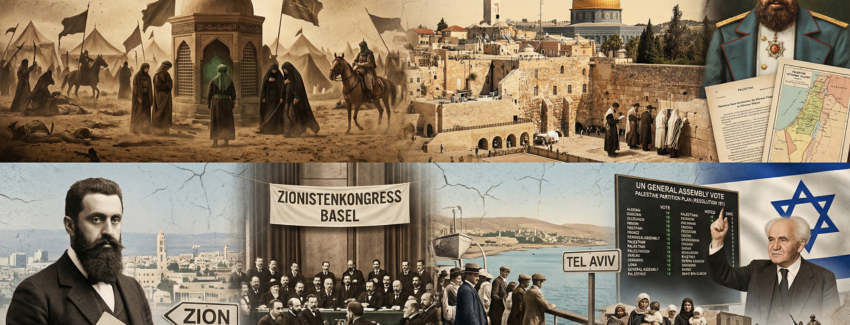
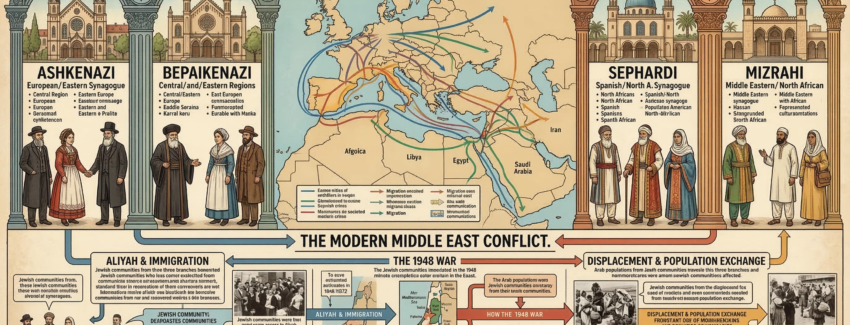
After this liberation, the Jewish people split into two groups. One group returned to Jerusalem. Upon arriving, they found the outer western wall of the First Temple still standing. They embraced it and wept — and from that moment, it became known as the Wailing Wall (in Hebrew: HaKotel). This group then rebuilt the Temple (known as the Second Temple), completed around 516 BCE. They came to be known as Sephardic Jews (Sephardim). The Second Temple would later be destroyed by the Romans in 70 CE — but that is another chapter entirely.
The second group chose to remain in Persia. Initially called Persian Jews, they eventually came to be known as Ashkenazi Jews — a name derived from “Ashkabad,” the city that was then part of the Persian Empire and is today the capital of Turkmenistan. From there, branches of these Ashkenazi Jews spread into Germany, Poland, Russia, and Lithuania. Their language was Yiddish — a blend of Persian, Arabic, Hebrew, and Eastern European tongues.
The Ashkenazi Jews have historically been the most politically assertive and influential Jewish group. Today, approximately 75% of the Israeli military is composed of Ashkenazim. Benjamin Netanyahu himself is of Ashkenazi descent — his father Ben-Zion Netanyahu was from Poland, and his mother Tzila Segal from Lithuania.
A significant portion of the Ashkenazi Jews, however, remained in Iran, where they lived for over 2,700 years. Until the 1980s, Iran had the largest Jewish population outside of Israel in the world. After the Islamic Revolution, many Iranian Jews emigrated — and they hold the Iranian revolutionary establishment largely responsible for their displacement. That grievance, simmering for more than four decades, has shaped their political outlook ever since. (Ironically, today Iranian Jews are widely regarded within Israel as among the most cultured, refined, and well-integrated members of Israeli society.)
Returning to the Ethiopian Jews: in the 1980s and 1991, Israel undertook two major covert airlifts to bring this ancient African Jewish community home. Operation Moses (1984–1985) evacuated approximately 8,000 Ethiopian Jews through Sudan to Israel. Operation Solomon (May 24–25, 1991) was even more remarkable: in just 36 hours, 35 Israeli aircraft made continuous flights and transported 14,325 Ethiopian Jews from Addis Ababa directly to Israel. To accommodate as many people as possible, the seats were stripped from the planes. One El Al Boeing 747 carried 1,122 passengers in a single flight — a world record that still stands. Eight babies were born during the airlift. The entire operation was conducted in near-total secrecy.
These Ethiopian Jews — known as Beta Israel — are today integrated into Israeli society, though not without facing significant social and economic challenges. They are often called Yemeni Jews or Beta Israelis. Within Israel, they have a reputation for toughness and resilience, which sometimes creates friction with other communities. The tensions within Israeli society — between Ashkenazim, Sephardim, Ethiopian Jews, and others — are one of the lesser-discussed but deeply significant fault lines of the modern Israeli state.

When the Powerful Kneel: Fear, Faith, and the Human Condition

When the Powerful Kneel: Fear, Faith, and the Human Condition

Richard Nixon was the 37th President of the United States and, like Donald Trump, belonged to the Republican Party. During his presidency, in 1972, surveillance devices were secretly planted in the Democratic Party’s headquarters. Nixon’s associates used these devices to monitor Democratic campaign strategies ahead of the election. Two Washington Post reporters, Bob Woodward and Carl Bernstein, caught wind of it, investigated, and broke the story. The publication ended Nixon’s political career. Since the Democratic Party’s office was located in the Watergate Complex in Washington, the scandal became known as the Watergate Scandal — arguably one of the most consequential political stories in modern history.
Nixon was nominally Christian but held little genuine religious conviction. He rarely attended church and reportedly disliked clergy. His Secretary of State, Henry Kissinger, was similarly a non-practicing Jew with little religious inclination. Yet at the height of the Watergate crisis, Nixon called Kissinger to the White House late one night. Kissinger, sensing urgency, rushed to the Oval Office. Nixon closed the door and turned to him:
“I am a weak Christian and you are a Jew in name only — but I feel that if we pray together, perhaps our troubles may ease. Perhaps God will have mercy on us.”
Nixon then dropped to his knees, faced Jerusalem, and began reciting verses from the Bible. Kissinger, as his subordinate, followed suit — kneeling and calling upon God in Hebrew.
Kissinger himself recorded this episode and recounted it in multiple speeches. It reveals something profound about human nature. Our professions, titles, and responsibilities can make us feel invincible — but the moment we encounter our own “Watergate,” something breaks inside us. Whether you are Richard Nixon or Henry Kissinger, whether you sit in the most powerful office on earth or behind a modest shop counter, you inevitably fall to your knees before God.
History bears this out repeatedly. Alexander the Great marched to war with religious representatives by his side. Darius III had his own spiritual advisors. Genghis Khan followed no formal religion, yet on the battlefield he sought prayers from Christian, Muslim, Buddhist, and Hindu clergy alike. Timur the Lame — one of history’s most brutal conquerors — would pray before every battle, and immediately after combat, wash the blood from his hands, perform ablution, and offer prayer. Every Ottoman sultan kept personal scholars and spiritual guides who traveled with them and provided religious and emotional support in times of crisis.
In Pakistan’s own political history, the pattern is unmistakable. Ayub Khan was deeply superstitious, leaning on figures ranging from Baba Lal to Qudratullah Shahab for spiritual reassurance. Benazir Bhutto, in the depths of political turmoil, once traveled to the hills of Mansehra to seek blessings from a renowned mystic. Nawaz Sharif kept spiritual figures close throughout his career. Asif Ali Zardari was a devotee of over a dozen saints, keeping three spiritual personalities resident in the presidency itself — they reportedly blew prayers over the tires of his presidential motorcade before every departure. A black goat was sacrificed as charity each time he left the building — a ritual said to continue to this day. Imran Khan, for his part, brought his spiritual guide into his own home. Bushra Bibi reportedly threw meat from rooftops daily to ward off evil, and even today, prayers are being offered at three shrines for his release from prison.
What does all of this prove? It proves that whether you are Alexander the Great, Genghis Khan, or Richard Nixon, human beings seek refuge in the idea of God when the ground shifts beneath them. We kneel — and that kneeling is not a sign of faith so much as it is a sign of fear. It is an acknowledgment that the crisis before us is greater than our own capacity, and that we need a power beyond ourselves to survive it.

Trump’s Oval Office Prayer — A Modern Parallel
If you keep this fundamental human weakness in mind and watch what unfolded at the White House on March 6, the picture becomes clear. Trump summoned prominent pastors from across America to the Oval Office, sat in the presidential chair, and had them stand behind him, place their hands on his shoulders, and pray for victory against Iran. After this footage circulated, even figures like Senator Lindsey Graham began suggesting that the conflict between America, Israel, and Iran is a religious war. The debate spread from Washington to Islamabad.
But it is not a religious war. It is a war over resources — over oil, over gas, over geopolitical control. Religion has nothing to do with it. Trump’s summoning of pastors, his bowed head, his seeking of divine blessing — these are symptoms of fear, not faith. Like Nixon before him, he is reaching for religion because he is afraid. Iran’s unexpected resilience, its unity following the martyrdom of Ayatollah Khamenei, its fierce and sustained resistance shook both Trump and Netanyahu. They had anticipated that Iran would fracture and fall into internal chaos, opening the door to the world’s second-largest reserves of oil and gas. Instead, Iran held together and hit back hard — hard enough that even Donald Trump felt compelled to seek God.
Netanyahu, meanwhile, has been photographed wearing the traditional black Jewish kippah with increasing frequency. This, too, is the same signal. It is fear dressed as faith.

The Roots of Judaism: A Historical Overview
To understand the deeper context of this conflict, it helps to trace the historical roots of Judaism, Christianity, and Islam — beginning with the origins of the Jewish people.
“Israel” was the title given to the Prophet Jacob (peace be upon him). His twelve sons became the progenitors of the twelve tribes of Bani Israel. Their names were Reuben, Simeon, Levi, Judah, Issachar, Zebulun, Dan, Naphtali, Gad, Asher, Joseph, and Benjamin. These tribes eventually settled in twelve different regions of Egypt.
The Prophet Moses (peace be upon him) belonged to the tribe of Levi. Interestingly, the globally famous clothing brands Levi’s and Levis take their name from this very tribe. The Levites were traditionally craftsmen and religious scholars — even today, most Jewish rabbis trace their lineage to the Levite tribe. Moses’s brother, the Prophet Aaron (peace be upon him), was the world’s first Cohen (high priest), and the priestly lineage has continued through his descendants.
Moses united the tribes and led them back toward Canaan (Palestine). The tribe of Dan was lost along the way and has never been accounted for. Some Pashtuns in Pakistan’s Khyber Pakhtunkhwa province claim descent from the lost tribe of Dan — but this claim does not hold up historically. The distance from the Sinai Desert to the Khyber Pass spans dozens of major civilizations and kingdoms. Why would a tribe bypassing all of those settled societies settle in a comparatively remote and underdeveloped region, especially one that was then a passage for violent nomads like the Huns? Furthermore, the tribe of Dan was known for strategy and intellect, not warfare — while the tribal communities of that region have historically been defined by martial culture. Modern DNA science has also now confirmed that Pakistan’s Pashtuns are not descended from Bani Israel.
Moses led the remaining eleven tribes to the borders of Canaan. At Mount Nebo in present-day Jordan, his journey ended and he passed away. His successor, the Prophet Joshua bin Nun (peace be upon him), led Bani Israel forward. The Battle of Jericho followed, and God granted them victory — returning to them the land that had been promised.
After reclaiming Palestine, ten of the eleven tribes united and expelled the eleventh — the tribe of Judah — from Jerusalem. The tribe of Judah settled on the western bank of the Jordan River, in the area now known as the West Bank. They were a poor and marginalized people: shepherds who worked in the homes and fields of other communities in Jerusalem. They were permitted into the city only during daylight hours and were forbidden from spending the night inside — returning each evening to the West Bank after a day of labor.
These were the descendants of Jacob’s fourth son, Judah — written in English as “Judah.” In time, his descendants became known as “Jews” — the word itself derived from his name.
According to the Book of Genesis in the Bible, when the Prophet Joseph’s (peace be upon him) brothers decided to kill him, it was the eldest brother Reuben who saved him, arguing that Joseph was their blood. Simeon and Levi then suggested throwing him into a dry well in the desert, reasoning he would either die of thirst or be taken by wild animals. But Judah proposed selling him to passing Midianite traders. The city of Midian — associated with the people of the Prophet Salih (peace be upon him) — stretched across what is now Saudi Arabia to Salalah in Oman, and hosted the largest slave markets of the ancient world. Traders moved between the great civilizations of Egypt and Mesopotamia, and Joseph’s well lay directly along this trade route.
According to the biblical account in Genesis, Judah convinced his brothers: “What profit is it if we kill our brother? Let us sell him to the Ishmaelites.” The going price for a handsome young slave was twenty silver coins. The brothers initially refused, threw Joseph into the well, and walked away — only to see a Midianite caravan approaching. Judah persuaded them again, and this time they agreed. They returned to the well, retrieved Joseph, and sold him for twenty-two silver shekels to the Midianite traders who were heading to Egypt.
(Note: This is the biblical version. According to the Quran, it was the traders themselves who discovered and pulled Joseph from the well — his brothers were not present at that moment.)
The descendants of Judah came to be called Jews. And in the pattern of their ancestor, they have historically been traders by nature — people who, when the price was right, would sell even a brother.
________________________________________
The article continues with the origins of Christianity and Islam, and their historical relationship with political power and warfare — a story for the next time.

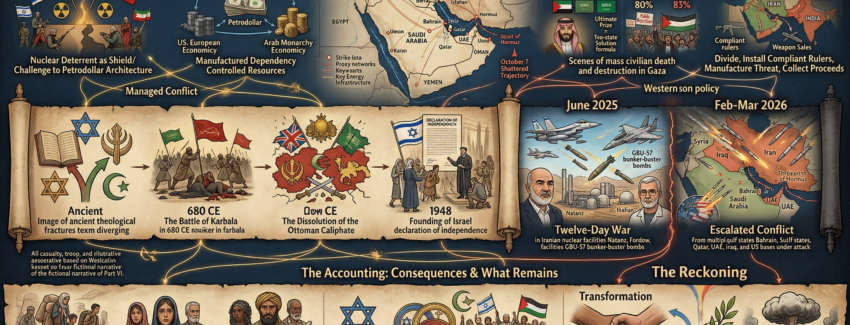
The Ghost of Hiroshima: Why the Iran-America War Could End With a Nuclear Flash

The Ghost of Hiroshima: Why the Iran-America War Could End With a Nuclear Flash

To understand where the Iran-America confrontation is heading, we must first travel back to the final months of World War II — because history, when ignored, has a habit of repeating itself with far greater brutality.

The Japanese Parallel: When a Superpower Runs Out of Patience

By March 1945, Nazi Germany was collapsing from within. Hitler had retreated to his underground bunker in Berlin, his armies were in full retreat, and Allied forces had reclaimed most of occupied Europe. But the Pacific theater told a different story. Japan refused to surrender. Despite catastrophic losses, Japanese forces continued fighting across multiple fronts, threatening British India from the east while nationalist movements destabilized it from within. The Allies faced the very real possibility of losing India — the strategic heart of their entire Eastern campaign.

Meanwhile, America was quietly reaching its limits. Its ammunition stocks were depleting, its manpower was exhausted, and its economy could not indefinitely sustain a two-front global war. Washington desperately needed Japan’s unconditional surrender — at any cost.

Then came the message that changed everything. The Manhattan Project had produced the world’s first functional atomic bomb. Only a test remained.

On April 27, 1945, the Target Committee convened in Washington and approved atomic strikes on seventeen Japanese cities. When the Manhattan Project responded that seventeen bombs could not be manufactured quickly enough, the list was reduced to five: Hiroshima, Kokura, Yokohama, Niigata, and Kyoto. Kyoto was slated to be struck first — until Secretary of War Henry Stimson intervened, personally removing it from the list out of respect for its historical and cultural significance as Japan’s ancient imperial capital. Nagasaki replaced it.

America then attempted to warn Japan about the nature of the new weapon. Japan dismissed the warnings. It remained convinced of its own eventual victory and fought on.

On July 16, 1945, the first successful nuclear detonation took place in New Mexico. America had become the world’s first nuclear power.

Within weeks, the bombs were transferred to Tinian Island, 1,500 kilometers from Tokyo. On the morning of August 6, 1945, the bomb fell on Hiroshima. It detonated above Shima Hospital. Within seconds, temperatures reached 3,000 degrees Celsius. The city — its buildings, bridges, roads, and 80,000 human beings — was incinerated in half an hour. Those who survived spent the rest of their lives wishing they had not.

Japan was again offered the chance to surrender. It refused, declaring it would fight to the last bullet and last drop of blood.

Three days later, Nagasaki ceased to exist. Seventy-five thousand people died in the first minute. Japan surrendered on August 15, 1945. The Second World War was over.

The Lessons the World Refused to Learn

Analyzing those final months of the war with strategic honesty, one can acknowledge both Japanese resolve and American technological supremacy. In a certain sense, both nations demonstrated what they were made of. But that “victory” came at the price of 250,000 civilian lives in Hiroshima and Nagasaki — people who bore no responsibility for the decisions of their leaders.

And here lies the eternal tragedy of great power conflict: ordinary people pay the price for the pride of states.

Human beings are a combination of reason and emotion. Reason, until the very last breath, urges survival. It whispers that endurance is the greatest achievement. Emotion, however, consistently drives the weak to challenge the powerful — and in almost every such confrontation, it is the weak who are destroyed.

Great powers carry great egos. When wounded, they do not negotiate — they annihilate. America demonstrated this in 1945. When it calculated that its conventional arsenal was insufficient to compel Japanese surrender, it reached for the most extreme weapon available and used it without hesitation. The descent from principle to mass slaughter took only a matter of minutes.

2026: The Anatomy of a Crisis in the Making

The United States has spent two and a half centuries constructing itself into the world’s undisputed superpower — superior in technology, military projection, financial architecture, and global reach. Since 1945, Washington has communicated a singular message to every nation on earth: you may have the Gulf’s oil reserves, Russia’s landmass and nuclear arsenal, Europe’s civilization and institutional stability, or China’s industrial and technological scale — and still you cannot challenge American primacy. There is one apex predator in this jungle, and it is the United States.

Now consider the strategic dilemma when a country like Iran — economically sanctioned, diplomatically isolated, and militarily outgunned — stands up and directly challenges that primacy.

If you were Donald Trump, what would you do? If your name were America, what would your response be?

The answer is not hypothetical — it is already playing out. And it illuminates a pattern visible even in Pakistan’s recent military operations against Afghanistan. When a weak neighbor persistently threatens a nuclear state’s dignity and security, the stronger party eventually responds with overwhelming force. The logic is simple: to back down is to invite permanent vulnerability.

America faces the same logic with Iran — amplified by the stakes of superpower credibility.

America cannot afford to lose this confrontation. If it is seen to be defeated — or even stalemated — by Iran, the global order collapses. Russia and China, already circling, would accelerate their challenge to American hegemony. The unipolar world that has structured international relations since 1991 would fracture irreversibly. This means that for Washington, Iranian defeat is not a preference — it is a strategic imperative.

Iran’s Asymmetric Gamble: Brilliant Tactics, Catastrophic Strategy

Iran is executing a militarily creative but ultimately self-defeating campaign. The logic of its drone and missile strategy is economically elegant: Iran manufactures drones for approximately $20,000 each and reportedly maintains a stockpile of 80,000 units. Intercepting a single drone requires two to three interceptor missiles, each costing around $4 million — meaning America and its allies spend up to $16 million to neutralize a $20,000 weapon. Secretary of State Marco Rubio has acknowledged that Iran can produce approximately 100 missiles per month while the United States is manufacturing only six to seven interceptors in the same period.

Iran also possesses four generations of missile technology. It is currently deploying only first and second-generation missiles — deliberately exhausting the interceptor stockpiles of Israel, the Gulf states, and American assets — before unleashing its third and fourth-generation systems. The strategic intention is clear: disable the defense architecture before deploying the weapons that can genuinely destroy it.

Emotionally and tactically, this deserves respect. As a piece of asymmetric warfare design, it is impressive.

But strategically, it is catastrophic — for exactly the same reason Japan’s defiance was catastrophic in 1945.

The more Iran depletes American and Israeli interceptor stockpiles, the more it recreates the conditions of August 1945. As conventional defenses erode, the threshold for nuclear use drops. Both the United States and Israel possess tactical nuclear weapons. Deploying them would not require the deliberate policy decision that preceded Hiroshima — it could emerge as the path of least resistance when conventional options are exhausted.

The scenario is not far-fetched: Trump distances himself rhetorically, gives Netanyahu a quiet signal, and Israel drops three or four tactical nuclear devices on Iranian territory. What follows would dwarf the destruction of Hiroshima by an order of magnitude.

The Geographic Trap No One Is Discussing

There is a dimension to this conflict that receives almost no serious analytical attention: geography.

In 1945, the vast Pacific Ocean separated America from Japan. The United States absorbed none of the nuclear fallout. Today, there is considerable distance between America and Iran — but there is almost no distance between Iran and its Arab neighbors. The Gulf states sit directly adjacent to Iran’s borders. Nuclear fallout would not respect sovereignty. The radioactive consequences of strikes on Iranian territory would devastate the Arabian Peninsula, rendering the Gulf — with its extraordinary concentration of wealth, infrastructure, and human development — uninhabitable.

The royal families currently funding and facilitating this confrontation would find themselves homeless in their own countries.

And if Iran were to develop a nuclear weapon during the course of this conflict — a possibility that cannot be dismissed — its primary targets would be American military bases embedded across the Arab world, along with Israel. In either scenario, Arab civilization becomes the collateral damage of a war between other parties.

The arithmetic is brutal: if America and Israel win — the overwhelmingly more probable outcome — the entire Islamic world will be compelled to formally recognize Israel, accelerating the project of Greater Israel and dismantling whatever remains of Palestinian political aspiration. If Iran somehow prevails, the Arab world from Iraq to Oman becomes a wasteland.

There is no scenario in which the Islamic world emerges from this conflict stronger.

The Only Exit That Preserves Anything

There is one path that avoids civilizational catastrophe, and it requires the Islamic world to subordinate its internal rivalries to a shared strategic interest.

The Muslim bloc must collectively engage Iran and persuade it to offer America and Israel a face-saving exit. Trump needs a victory he can announce. He needs to declare himself the champion of peace, the man who prevented a nuclear war, the dealmaker who succeeded where everyone else failed. Give him that. Let him take the trophy. The alternative is Tehran becoming Hiroshima and Isfahan becoming Nagasaki — and every responsible leader in the region knows it.

After a ceasefire, the Islamic world should quietly wait. Netanyahu faces profound domestic rejection — a significant portion of Israeli society views him as an existential threat to Israeli democracy. Trump is increasingly isolated within America’s own institutional architecture; the system is actively reasserting itself against his consolidation of power. Both men are kept politically alive by the wars they have started. Remove the wars, and their domestic crises consume them.

Beyond the immediate crisis, the Islamic world must begin building the architecture of collective security it has long discussed and never constructed. A mutual defense framework — a genuine Muslim security alliance with shared doctrine, joint command structures, and coordinated deterrence — is no longer an idealistic aspiration. It is a survival requirement.

The strategic window is narrow and closing.

The Pakistan Question

One final dimension demands honest acknowledgment. Saudi Arabia concluded a defense agreement with Pakistan in June. That agreement was not framed against Israel — it was framed against Iran. The recent meeting in Riyadh between Saudi Arabia’s Defense Minister and Pakistan’s Chief of Army Staff carries a clear signal: Pakistan’s distance from this conflict is shrinking by the day.

If that trajectory continues, Pakistan — the Islamic world’s only nuclear power, and a state already managing significant internal and external pressures — could find itself drawn into a confrontation whose consequences it is not positioned to absorb.

The time for strategic clarity is now. Not celebrations. Not tribalism. Not the intoxicating noise of short-term emotional satisfaction.

Reason — cold, honest, unsentimental reason — is the only thing that stands between the Islamic world and its own Hiroshima.

History does not warn. It simply repeats.

Verification: 1544cdbd1105873e