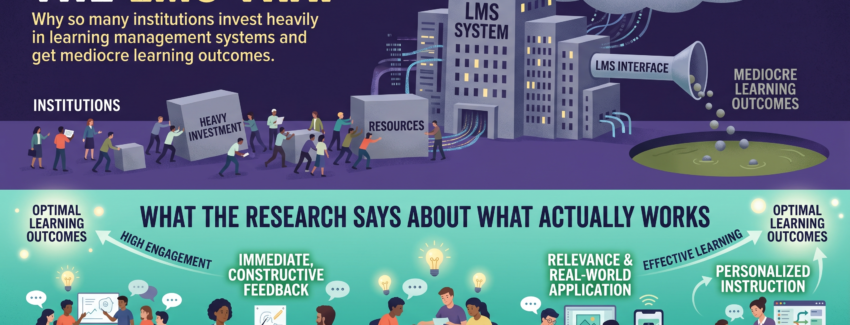
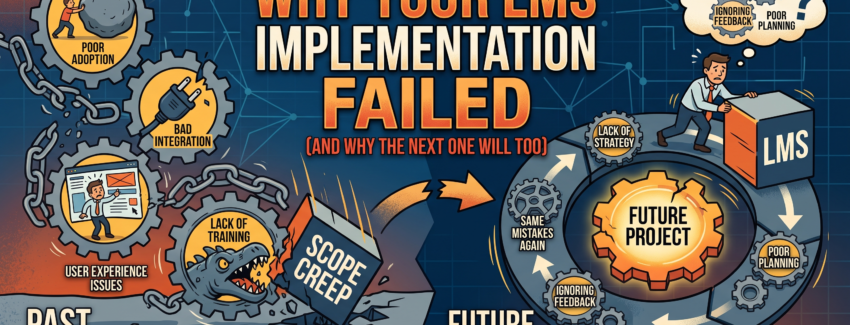
There is a peculiar dynamic at the center of most LMS adoption stories. Institutions evaluate platforms extensively — feature checklists, vendor demonstrations, pilot programs, procurement committees. They negotiate contracts, configure systems, train administrators. And then, somewhere in the gap between what the platform promised and what teachers actually do in the classroom, the investment begins to quietly underperform.

This gap has been examined from several directions: the procurement failure angle, the utilization data problem, the vendor incentive misalignment. What is examined less often is the teacher’s-eye view — what educators who use these systems daily actually need from them, what they consistently do not get, and why that mismatch persists across platform generations and institutional contexts.

The answer, when you ask teachers directly rather than surveying administrators, reveals something important: the features that matter most to effective teaching are not the ones that feature most prominently in vendor demonstrations. And the friction that matters most is not in the headline capabilities but in the daily workflow.

The Feedback Problem

Ask teachers what takes the most time in their LMS workflow and the answer is almost always the same: assessment and feedback. Creating assignments, receiving submissions, providing meaningful responses, tracking completion and revision cycles. This is the core instructional loop, and it is where most LMS platforms create the most friction.

The feedback interface in most platforms was designed for administrative completeness, not instructional efficiency. Teachers navigate multiple clicks to open a submission, switch to a different view to enter a grade, open another panel to enter comments, and repeat this process for every student in a class that may have thirty, sixty, or a hundred members.

Most LMS platforms treat each assignment as a discrete transaction. Good teaching treats feedback as a running conversation.

What teachers describe needing — and rarely have — is a feedback workflow that is fast enough to use consistently, rich enough to communicate meaningfully, and integrated enough that the feedback given on one assignment is visible and buildable-upon in the next.

Analytics That Answer the Right Questions

Learning analytics has been one of the most heavily marketed capabilities in LMS development over the past decade. Dashboards, engagement metrics, predictive risk scoring — platforms have invested significantly in generating data about student behavior and presenting it to instructors.

The problem is that most of the data generated answers questions that teachers are not asking, while failing to answer the questions they are.

Knowing that a student logged into the course three times last week is not actionable information for a teacher trying to support that student’s learning. Engagement proxies — clicks, time-on-page, login frequency — are plentiful in LMS analytics. Evidence of actual learning is scarce.

What teachers consistently describe wanting to know is simpler and harder: which students are struggling with specific concepts, not just which ones are disengaged? Where in the learning sequence are students getting lost? What patterns of misconception appear across the class that should inform how the next lesson is taught?

The gap between available analytics and useful analytics is not primarily a technical problem. It is a design priority problem. Engagement data satisfies institutional reporting requirements. So that is what gets built and marketed. Teachers, who could use learning data, are given engagement data and told it is insight.

Communication That Reflects How Teaching Works

Communication tools in most LMS platforms were built for a synchronous, course-bounded model of teaching: announcements go to all students, discussion boards contain threaded conversation, messaging happens within the platform’s inbox. This architecture made sense for a world where the course was the primary context for teacher-student interaction.

It maps poorly onto how teaching actually works in blended and online environments, where students have questions outside of course sessions, where the relevant group for a conversation is sometimes a subset of the class, where follow-up communications about assessment need to happen quickly and in contexts students actually monitor.

Teachers frequently report maintaining parallel communication infrastructure outside their LMS — email, messaging apps, video conferencing tools — because the LMS communication tools are too slow, too rigid, or too poorly integrated with how students actually check for messages. When teachers build shadow infrastructure around a system, the system is not serving their needs.

Flexibility Without Fragmentation

One of the persistent tensions in LMS design is between standardization and flexibility. Institutions want consistency: a common platform that all courses run on, with standardized navigation that students can rely on. Teachers want flexibility: the ability to organize their course according to their pedagogical logic rather than a platform template.

Most LMS platforms resolve this tension in favor of standardization — the institutionally rational choice. Platform templates tend to favor chronological or topic-based organization. Teachers whose courses are organized around inquiry cycles, project phases, or conceptual progressions find themselves mapping their instructional logic onto a structural container it was not designed for. The content gets in, but the coherence is lost.

Course organization is not just an administrative convenience — it is a pedagogical communication. The way a course is structured tells students what the teacher thinks the learning journey is. When that structure is flattened into a generic module format, something real is lost.

The Integration Problem

Modern teaching increasingly involves a range of tools beyond the LMS: video platforms, collaborative editors, polling tools, AI writing assistants, simulation software. The LMS is supposed to be the hub that connects these tools and gives students a coherent experience.

In practice, LMS integrations are one of the most consistent sources of teacher frustration. LTI connections break or behave inconsistently. Grade passback from third-party tools fails silently. Institutional IT policies restrict which external tools can be integrated. The “ecosystem” that vendors demonstrate in sales presentations looks considerably different from the fragile patchwork that teachers actually manage.

What the Gap Reveals

The distance between what teachers need from their LMS and what they are getting is not primarily a product quality problem. The major platforms are sophisticated pieces of software. The gap is a design philosophy problem: these systems were built around administrative requirements and the concerns of procurement committees — not around the daily workflow of teaching.

The Verdict

A system with slightly fewer features that teachers actually use is more valuable than a system with every possible capability that teachers route around.

Closing this gap requires institutions to involve teachers substantively in LMS evaluation and selection — not as a consultation checkbox but as a genuine design constraint. It requires asking not just “can this platform do X?” but “can teachers actually do X efficiently in this platform’s daily workflow?”

The LMS that teachers need is not technically beyond reach. It is a system that makes feedback fast and meaningful, that delivers analytics teachers can actually act on, that communicates the way teaching communicates, and that stays out of the way when it is not needed. Whether the market will build it depends on whether institutions start demanding it.

EdTech
LMS
Learning Management Systems
Instructional Design
Higher Education
Pedagogy