AI, Education, GCC
Part 2 of the AI-Ready Schools Series
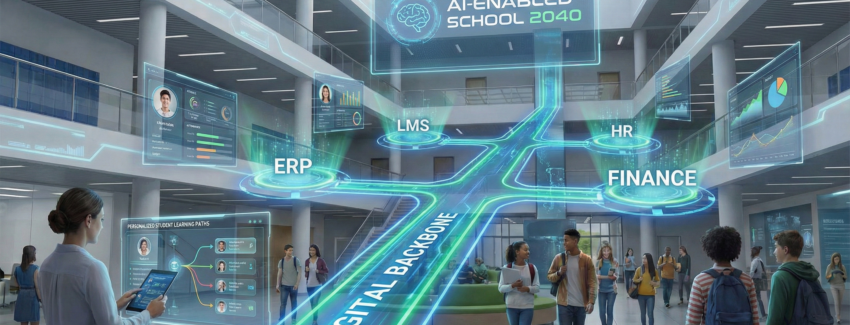
Artificial intelligence is only as powerful as the foundation it sits upon. In education, that foundation is a unified digital ecosystem—one where Enterprise Resource Planning (ERP), Learning Management Systems (LMS), Human Resources, and Finance modules don’t just coexist, but communicate seamlessly.
Why Fragmentation Fails AI
Many schools today operate with disconnected systems: one platform for student records, another for finance, a third for learning content, and spreadsheets filling the gaps. This fragmentation creates data silos that render AI implementation impossible. AI algorithms require comprehensive, real-time data to identify patterns, predict outcomes, and generate insights. When information is trapped in isolated systems, even the most sophisticated AI tools become ineffective.
The Power of Integration
A truly unified digital platform transforms how schools operate:
- Attendance data automatically feeds into learning analytics, helping identify students at risk of falling behind before grades drop
- Student performance metrics inform staffing decisions, revealing where additional teaching support is needed or which educators excel with specific learning challenges
- Financial insights directly support strategic planning, showing the real cost per student outcome and enabling evidence-based budget allocation
- HR systems connect with professional development needs identified through classroom data, creating targeted teacher training programs
This isn’t just about efficiency—it’s about creating an intelligent nervous system for your institution where every data point strengthens every decision.
The 2040 Reality Check
Schools clinging to fragmented systems face a stark future. By 2040, the gap between digitally unified institutions and traditional ones will be insurmountable. Schools without integrated platforms will struggle with chronic inefficiency, spending countless hours on manual data reconciliation, battling delayed decision-making that leaves problems unaddressed, and watching talented educators waste time on administrative tasks that should be automated.
Meanwhile, AI-enabled schools with unified backbones will offer personalized learning pathways that adapt in real-time, predictive interventions that support students before they struggle, automated administrative workflows that free educators to teach, and transparent reporting that builds trust with parents and oversight bodies.
Beyond Efficiency: Building Trust and Scale
The benefits of unified digital systems extend far beyond operational improvements. These platforms create the transparency modern education demands—parents can track their child’s progress in real-time, administrators can demonstrate accountability with data-driven reporting, and policymakers can measure educational impact with unprecedented clarity.
This transparency builds trust, while the scalability of unified systems allows successful practices to spread rapidly across classrooms, schools, and entire districts. As national transformation agendas increasingly emphasize educational excellence and digital readiness, unified digital infrastructure becomes not just an advantage but a requirement.
Taking the First Step
Building your digital backbone begins with honest assessment: What systems do you currently use? Where does data get trapped? What decisions are delayed by lack of information? The answers to these questions reveal your path forward—whether that’s integrating existing systems, migrating to comprehensive platforms, or building custom solutions that fit your institution’s unique needs.
The AI revolution in education won’t wait for schools to catch up. The digital backbone you build today determines whether your institution leads that revolution or struggles to survive it.
Next in series: Part 3 – Smart & Hybrid Classrooms
AI, Education, GCC, work
AI is no longer optional. Schools that fail to integrate AI risk becoming irrelevant in 3–5 years. Here’s a step-by-step plan for safe, effective AI integration.
- Teach AI as a Foundational Skill
AI should be treated like:
- Mathematics
- Reading
- Digital literacy
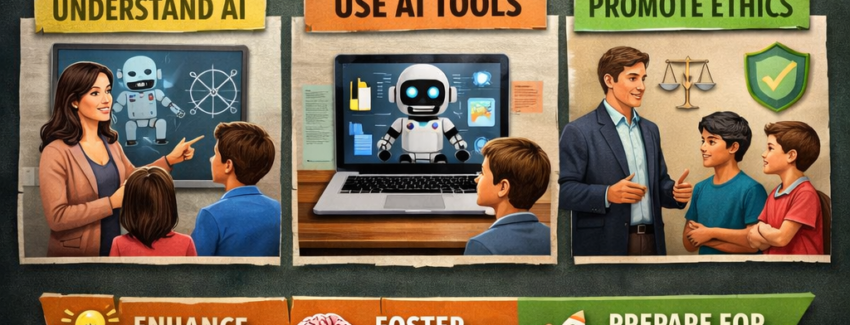
Students must understand:
- Basic AI concepts
- How AI tools work
- Ethical use
- Data privacy
- Use AI to Personalize Learning
AI can:
- Adjust lesson difficulty
- Identify learning gaps
- Provide summaries and explanations
- Support inclusive education
This shifts the teacher role from “lecturer” to learning coach.
- Create AI Labs & Hands-On Activities
Schools should establish:
- AI playgrounds
- Robotics labs
- No-code tools (Scratch, Machine Learning for Kids)
- AI project exhibitions
Practical experience is essential.
- Add AI Modules to Every Subject
Examples:
- English: AI writing & analysis
- Math: AI-driven problem generators
- Science: data modelling & simulations
- Social Studies: AI ethics, digital citizenship
- Train Teachers Intensively
Teachers need:
- AI safety training
- Classroom use-case training
- Awareness of AI risks
- Certification pathways
(Google, Microsoft, UNESCO, PISA-Aligned AI programs)
- Establish AI Use Policies
Schools must define:
- What AI students may use
- What AI teachers may use
- Academic honesty policies
- Data protection practices (aligned with PDPL or national laws)
Finally, I think, AI is not replacing teachers—it is empowering them. Early adopters will lead the future of education.
Uncategorized
Artificial Intelligence (AI) is transforming the world faster than any previous technology. From customer service and transportation to healthcare and education, automation and AI are taking over many tasks that once required human effort. While this shift creates fear about job losses, it also opens massive new opportunities for those who adapt wisely.
In this article, we’ll explore what you can do to stay relevant, secure your income, and even grow in the era of AI.
? The Reality: AI Is Replacing Repetitive Jobs
AI excels at doing repetitive, predictable, and data-driven tasks faster and cheaper than humans. Jobs in areas such as data entry, telemarketing, basic accounting, manufacturing, and even content writing are being automated.
According to a recent study by McKinsey, nearly 30% of current work activities could be automated by 2030. That means millions of workers will need to reskill or switch professions.
But the key point is this: AI is not replacing people — it’s replacing tasks. Humans who learn to work with AI will remain in demand.
? Step 1: Learn to Work With AI, Not Against It
The best survival strategy is collaboration, not competition. Learn how to use AI tools that boost productivity and decision-making in your field.
? Examples:
- Marketers should master AI tools like ChatGPT, Jasper, and Copy.ai to write faster and smarter.
- Designers should explore Midjourney, Leonardo.ai, or Canva’s AI features.
- Programmers can leverage GitHub Copilot or Replit Ghostwriter to speed up development.
By mastering these tools, you don’t just survive — you increase your value as a professional who can do more in less time.
? Step 2: Focus on Human Skills AI Can’t Replace
AI can analyze data, but it lacks empathy, creativity, and emotional intelligence. The future belongs to those who strengthen their uniquely human abilities.
? Skills AI cannot easily replace include:
- Critical thinking & problem-solving
- Leadership & emotional intelligence
- Creative storytelling & design thinking
- Negotiation & communication skills
- Ethical decision-making
Jobs in fields like healthcare, education, leadership, entrepreneurship, and counseling will always need the human touch.
? Step 3: Build a Personal Brand and Go Independent
As traditional employment structures shift, freelancing, consulting, and entrepreneurship are growing rapidly. People who can build a personal brand online can turn their expertise into income.
Start by:
- Creating a LinkedIn profile that showcases your expertise and achievements
- Launching a personal website or blog (like this one!)
- Offering online courses, digital products, or consulting services
- Building an audience through YouTube, Substack, or social media
Your brand will act as your career insurance. Even if your job disappears, your reputation, audience, and skills will stay.
? Step 4: Learn Digital & AI-Related Skills
No matter your background, you need digital literacy. The most in-demand skills in the AI era include:
? Top Future Skills to Learn:
- Prompt engineering
- Data analysis and visualization
- Machine learning fundamentals
- Cybersecurity
- Automation tools (Zapier, Make, etc.)
- Cloud computing
- Digital marketing and SEO
Start small — take short online courses on Coursera, Udemy, or Google Skillshop. Learn one tool or concept per week and apply it practically.
? Step 5: Create Multiple Streams of Income
Relying on one job is risky in an AI-driven world. Build multiple income sources to stay financially stable.
? Examples:
- Freelance on platforms like Upwork or Fiverr
- Start a YouTube channel or podcast
- Invest in stocks, ETFs, or digital assets wisely
- Sell online courses or eBooks
- Build affiliate marketing websites
Automation may reduce job availability, but it also reduces costs and opens up new earning opportunities online.
? Step 6: Adopt a Lifelong Learning Mindset
The future belongs to the curious. Every new AI innovation brings change — so make learning a daily habit.
Tips:
- Read technology and business news regularly
- Follow AI influencers on LinkedIn and X (Twitter)
- Experiment with new tools monthly
- Take online micro-certifications
- Join online communities or mastermind groups
When you stay updated, change won’t scare you — it will empower you.
?? Final Thoughts: AI Is a Tool, Not an Enemy
AI will continue to reshape industries, but it doesn’t have to destroy careers. Think of it as a powerful tool that enhances what you can do. The real danger lies not in AI itself — but in refusing to adapt.
Those who embrace learning, creativity, and innovation will not just survive but lead the AI revolution.